Japan Earthquake | Page 2322
 Swiss Artist Catalogs Mutant Insects Around Nuke Plants
On The Simpsons, the effects of nuclear contamination are conspicuous and comedic. In nature, though, they're often subtle — and sometimes strangely beautiful. Scientific illustrator Cornelia Hesse-Honegger details these minute mutations in the so-called true bugs she collects near nuclear facilities and areas of chemical contamination. True bugs don't travel far, and they "suck the liquid from the plants they live on," she says. "So if the plant is contaminated, they take a lot of radioactivity into their bodies."
Conventional wisdom holds that nuclear power stations don't leak enough radiation to create malformed organisms. But in some locations, Hesse-Honegger discovered mutations — curtailed feelers, misshapen legs, asymmetrical wings — in as many as 30 percent of the bugs she gathered. That's 10 times the overall rate of about 3 percent for insects found in the wild. "For me, the mutated bugs were like prototypes of a future nature," she says. A selection of Hesse-Honegger's work will be shown this fall in Berlin.
Watercolor Photos: www.wired.comby joniver 9/9/2011 7:19:03 PM possible, that`s not Fuku I-131?by Puc 9/9/2011 7:26:05 PM
 @Puc I don't know if medical waste could make up that big of an amount? What else could cause it?by lillymunster 9/9/2011 7:28:10 PM
- TEPCO released some huge report nobody asked for that claims unit 3 didn't melt through on the 20th of March. Around the same time the unit lost pressure and there was loads of black smoke belching out of the reactor well.
ex-skf.blogspot.comby lillymunster 9/9/2011 8:23:48 PM  @lilly and @RadioGuy Thx. It's so confusing. I guess until there are enough detectors and enough transparency (around the world) we can only see patterns.by Cryptococcus 9/9/2011 8:39:04 PM
- @Cryptococcus the iodine levels seem odd. I want to ask others as they show up. They might have better idea what it means.by lillymunster 9/9/2011 8:47:36 PM
 Kyoto U. expert: Melted fuel may have sunk into ground — “We are now head to head with a situation that mankind has never faced before”
[...] At the No. 1 reactor, there’s a chance that melted fuel has burned through the bottom of the pressure vessel, the containment vessel and the floor of the reactor building, and has sunk into the ground. [...]
It’s doubtful that there’s even a need to keep pouring water into the No.1 reactor, where nuclear fuel is suspected to have burned through the pressure vessel. [...]
Recovering the melted nuclear fuel is another huge challenge. I can’t even imagine how that could be done. When the Three Mile Island accident took place in 1972, the melted nuclear fuel had stayed within the pressure vessel, making defueling possible. With Fukushima, however, there is a possibility that nuclear fuel has fallen into the ground, in which case it will take 10 or 20 years to recover it. We are now head to head with a situation that mankind has never faced before. [...]
enenews.comby Majj 9/9/2011 9:01:17 PM- @Majj wow. That's a powerful articleby Cryptococcus 9/9/2011 9:06:31 PM
- @lilly @all Telling the story of Fukushima after 6 months. Here's an example. I don't know how to use these tools, but there is one that you can make a timeline on. I like this one better. Not just a line. www.voanews.comby Cryptococcus 9/9/2011 10:43:32 PM
- All the factors coming together: unexpected size of earthquake, unexpected size of tsunami, poor design, corrupted oversight, poor policies in place, disconnect between experts, company, and policy makers/direction makers... Lots of factors playing in same sandbox.by Cryptococcus 9/9/2011 10:47:26 PM
- Flood-zone nuclear reactors maintain output as rivers crest and fall Washington (Platts)--9Sep2011/400 pm EDT/2000 GMT
Nuclear power plants in the flood zone in Pennsylvania have maintained normal power generation as water levels in adjacent rivers peaked, US Nuclear Regulatory Commission spokesman Neil Sheehan said Friday. www.platts.comby Cryptococcus 9/9/2011 10:49:30 PM - NRC Commissioners Deny Groups’ Petition to Suspend New Reactor Licensing Industry/Regulatory/Political Issues Commissioners at the Nuclear Regulatory Commission today denied a request by several groups to suspend licensing and standardized design certification decisions pending completion of the NRC Fukushima Task Force evaluation of the implications of the Fukushima accident. The commissioners also denied a petition to suspend hearings and opportunities for public comment on reactor or used fuel pool issues identified for investigation by the task force. The commissioners granted the groups’ request for a safety analysis of regulatory implications of the events in Japan, incorporating stakeholder input into the process. nuclearstreet.comby Cryptococcus 9/9/2011 10:51:07 PM
- Rebalancing the nuclear debate through education Better physics teaching with a particular emphasis on radioactivity and radiation science could improve public awareness through education of the environmental benefits and relative safety of nuclear power generation, according to leading Brazilian scientist Heldio Villar. He suggests that it might then be possible to have a less emotional debate about the future of the industry that will ultimately reduce our reliance on fossil fuels. www.eurekalert.orgby Cryptococcus 9/9/2011 10:54:25 PM
- Nuclear industry infiltrates ABC to push for an atomic Australia The nuclear industry is using increasingly subtle methods to promote the development of a nuclear power and radioactive waste disposal industry in Australia. Noel Wauchope reports. In the ABC radio program Ockham’s Razor, first broadcast on Sunday 4th August, Terry Krieg enthusiastically promotes the nuclear industry.
This program was remarkable for two reasons.
First, Mr Krieg appeared to be not your usual expert connected with the nuclear industry. Mr Krieg, we were told, is “a retired geography and geology teacher”. Good, I thought, as it seemed that the ABC was giving an ordinary mortal a go on national radio. But was that all he was? No, alas. There was, as there always seems to be, some “astroturfing” going on. A bit of research on the Net and we soon discover that Mr Krieg is a spokesperson for the Australian Nuclear Forum. ... www.independentaustralia.netby Cryptococcus 9/9/2011 11:00:40 PM - NRC allows closure of Yucca Mountain nuclear dump
By MATTHEW DALY , 09.09.11, 06:21 PM EDT WASHINGTON -- A divided Nuclear Regulatory Commission on Friday allowed the Obama administration to continue plans to close the controversial Yucca Mountain nuclear waste dump in Nevada. www.forbes.comby Cryptococcus 9/9/2011 11:06:30 PM - Japanese translation needed. kaleido11.blog111.fc2.comby Cryptococcus 9/9/2011 11:07:34 PM
- @Cryptococcus just got back in. Will see if I can get someone to translate that post.by lillymunster 9/9/2011 11:17:40 PM
- @Cryptococcus Reading through the google trans of that it mentions a new METI report that supposedly quietly mentions plutonium findings. The blogger says it was released with a benign title to not call attention to it. I will see if I can get an English version of the METI document.
This would explain why they suddenly released that big document claiming unit 3 didn't remelt or melt through on the 21st of March. Trying to CYA for the METI report coming out. METI report www.meti.go.jpby lillymunster 9/9/2011 11:23:53 PM - Here is the document METI put out on Aug 26 that the blogger is talking about
www.meti.go.jpby lillymunster 9/9/2011 11:27:09 PM - In the METI document, first table is released isotopes based on June IAEA meeting/report time. Second page table is estimated releases from Hiroshima and Nagasaki.by lillymunster 9/9/2011 11:30:02 PM
- Synopsis of the article, METI produced that isotope chart for IAEA in June but sat on it til Aug 26. TEPCO has been not or under reporting plutonium claiming they don't have equipment to test for it. Media has not been aggressive on the issue due to ties to nuclear industry.
Is there anything we can determine from the isotope chart?by lillymunster 9/9/2011 11:49:05 PM 
enenews.com
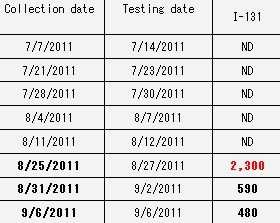
i found another reference for high i131 readings enenews.com
"Iodine-131 now being detected in large amounts almost 200 km from Fukushima meltdowns
Oshu City is located 187 kilometers north of Fukushima I Nuclear Power Plant.
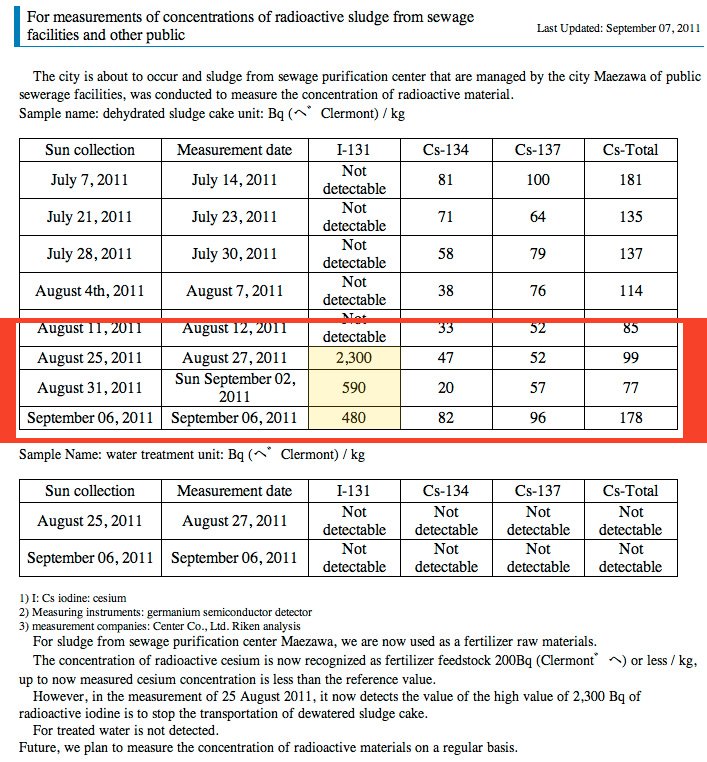
The city announced the latest survey of radioactive materials in sewer sludge in a sewage treatment center in the city, and it shows iodine-131 being detected in the sludge cake since August 25. [...]
The city says it has stopped the shipment of sludge cakes from this plant because of the high radioactive iodine concentration detected from the August 25 sample [...]
Here is what nuclear engineer Arnie Gundersen said about the presence of iodine-131 back in April:
Iodine-131 can only come from nuclear fission, and because it has a short life, it disappears after about 80 days.
In other words, the presence of iodine-131 suggests that the [nuclear] fuel has started its own chain reaction without any human intervention."by Edano via Enenews 9/10/2011 12:10:46 AM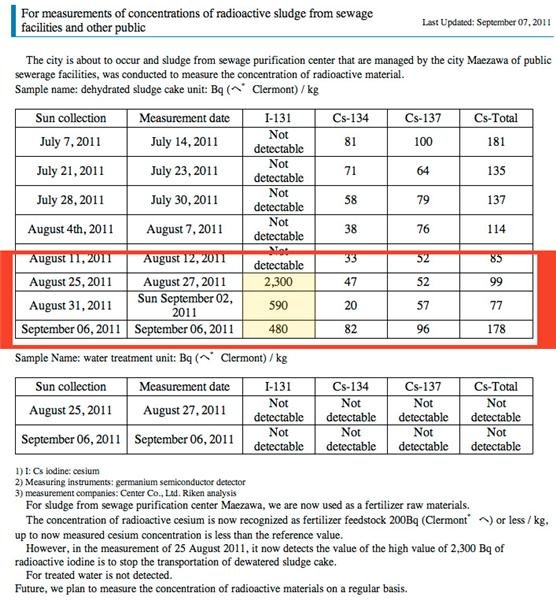 by Edano via Fukushima-diary 9/10/2011 12:14:48 AM
- What is your take on those numbers?by lillymunster 9/10/2011 12:16:41 AM
- it's been found in sludge. what does it mean ? is it from the sea or the rain ?by Edano 9/10/2011 12:19:27 AM
- i assume it is radiation from the air washed out by rain into the sludge.by Edano 9/10/2011 12:24:54 AM
- @Edano it sounds like city sewage so rain would be likely. How long is the total life of Iodine 131. If the half life is 8 days when it that completely gone?by lillymunster 9/10/2011 12:25:24 AM
- @lillymunster 80 days should be untedectable again, but with a higher initial concentration, it can last longer.by Edano 9/10/2011 12:26:59 AM
- august 25 corresponds with the steam out of the soil around #1. and the high rad readings in drywell. it may stem from #1 corium which is already outside the containment in the soil or groundwater. i don't think the sfps are so hot anymore.by Edano 9/10/2011 12:29:33 AM
- @Edano so small amounts still left, concentrated creates a detectible amount? Do you think the recriticality thing is unlikely?by lillymunster 9/10/2011 12:29:48 AM
- Radiation expert says outcome of nuke crisis hard to predict, warns of further dangers : The nuclear disaster is ongoing. Immediately after the crisis first began to unfold, I thought that we'd see a definitive outcome within a week. However, with radioactive materials yet to be contained, we've remained in the unsettling state of not knowing how things are going to turn out.
Without accurate information about what's happening inside the reactors, there's a need to consider various scenarios. At present, I believe that there is a possibility that massive amounts of radioactive materials will be released into the environment again.
At the No. 1 reactor, there's a chance that melted fuel has burned through the bottom of the pressure vessel, the containment vessel and the floor of the reactor building, and has sunk into the ground. From there, radioactive materials may be seeping into the ocean and groundwater. mdn.mainichi.jpby Majj 9/10/2011 12:30:21 AM - BRB, need to run down to the storeby lillymunster 9/10/2011 12:31:24 AM
- @lillymunster the corium in #1 shows recriticality from time to time, you can see that in the rad spikes.by Edano 9/10/2011 12:31:29 AM
- @Majj i agree to that, plus radioactive steam seems to find its way thru the soil into the air.by Edano 9/10/2011 12:33:21 AM
 The amount of radiation released during the Fukushima nuclear disaster was so great that the level of atmospheric radioactive aerosols in Washington state was 10,000 to 100,000 times greater than normal levels in the week following the March 11 earthquake and tsunami that triggered the disaster. www.eurekalert.orgby Ian 9/10/2011 12:34:18 AM
- assumed corium state imo:
#1 showing recriticality, in groundwater since beginning of august, steaming thru the soil into the air.
#2 possibly broken thru containment and basement on august 11.
#3 outside the rpv since march 20-24, now inside concrete basement.by Edano 9/10/2011 12:41:31 AM  good evening, edano, as to the increased iodine-131 radioactivity detected in Oshu City sludge would be whether there is a nuclear facility near the city that could be the source.
by Peter 9/10/2011 12:49:48 AM- @Peter fukushima-diary.com same in Tokyo, Niigata City and Nagano City.by Edano 9/10/2011 12:51:50 AM
- all 4 cities are far away (~300 km) from fuku, arranged on a circle, reaching until the west coast. it's a bit strange.by Edano 9/10/2011 12:57:51 AM
- @edano, was there a wind and rain pattern that could explain this distribution?by Peter 9/10/2011 1:03:26 AM
- @Peter i dont know.by Edano 9/10/2011 1:04:18 AM
- @Edano, what's the basis for #1, steaming soil?by Ian 9/10/2011 1:24:44 AM
- Noda ducks radioactive soil issue in visit to Fukushima Prime Minister Yoshihiko Noda sidestepped the controversial issue of a temporary storage facility for radioactive soil and waste when he visited Fukushima Prefecture on Sept. 8.
Noda met with Fukushima Governor Yuhei Sato, as well as mayors of 14 municipalities, at the Fukushima prefectural government office after inspecting the damaged Fukushima No. 1 nuclear power plant.
The focus of the meetings was whether Noda would discuss details of the government plan to set up a temporary storage facility for contaminated soil and waste within Fukushima Prefecture, which is fiercely opposed by Sato.
But Noda, who took office on Sept. 2, avoided any in-depth discussion of the issue so as not to antagonize local government leaders, who had deep distrust in Naoto Kan, Noda's predecessor as prime minister, over his handling of the nuclear crisis. www.asahi.comby Majj 9/10/2011 1:26:54 AM - Oshu City is north of Sendai in the far north of the main island, looking for nearby nuclear plantsby lillymunster 9/10/2011 1:28:45 AM
- EU to extend restrictions on Japanese food
The European Union will continue testing food imports from Japan for radioactive contamination through the end of the year.
The EU announced the decision on Friday.
Following the accident at the Fukushima Daiichi nuclear plant, the EU tightened import conditions on farm and marine products from 12 Japanese prefectures, including Tokyo.
All products from these prefectures must be accompanied by documents issued by Japanese authorities confirming that they contain radiation below EU-permitted levels.
The EU says it will review its controls each month from next year.
The EU is also asking the Japanese government to ensure that all food products from other areas correctly display their place of origin.
Saturday, September 10, 2011 08:58 +0900 (JST)
www3.nhk.or.jpby Edano 9/10/2011 1:29:02 AM

Japan Earthquake | Page 2322
- Who's Blogging
-
 hudebnik
 alblee
 UKVal
UKVal Oliver (ScribbleLive)
 Jonathan Keebler
 kaykodh
 PKelley
 Markfm
 Angie
Angie Deb
Deb Mid Valley
- Pedro Jesus
 Matt (ScribbleLive)
 George Gibb
 elainekirk
- lillymunster
 dean
dean bo
bo- Edano
 IanGoddard