Japan Earthquake | Page 2745

 by Edano via Www3.nhk.or.jp 12/5/2011 6:28:11 PM
- Guides seek TEPCO compensation for fallen revenue
A group of Japanese tour guides is demanding compensation from the Tokyo Electric Power Company. They say the Fukushima nuclear accident caused a sharp drop in the number of foreign tourists.
The fifteen tour guides from Tokyo and elsewhere have taken their case to the state-run dispute settlement center to ask for arbitration with the TEPCO. All of guides have an official license to offer tours in foreign languages.
The power company says it will compensate for cancellation of tours made by the end of May. This is based on guidelines provided by the state supervisory panel.
The licensed guides on Monday demanded over 360 thousand dollars in damages.
They are claiming the number of their foreign clients has not returned to usual levels even after June.
One claimant offering guided tours in French says his income has shrunk to nearly zero and he has used up all his savings. He's asking the utility to understand the difficulties the guides are facing.
TEPCO says it will examine the demand and consider how to solve their predicament.
Monday, December 05, 2011 19:33 +0900 (JST)
www3.nhk.or.jpby Edano 12/5/2011 6:28:41 PM - Strontium-tainted water leak suspected
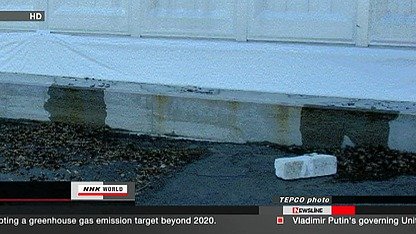
The operator of the Fukushima Daiichi nuclear power plant says about 45 tons of strontium-tainted water may have leaked out of a water treatment device, with a portion of it spilling out of the facility.
Tokyo Electric Power Company says the water may contain high levels of radioactive strontium. Strontium causes internal radiation exposure.
The company is trying to determine whether the water reached the sea.
The utility said at about 11:30 am on Sunday a water leak was spotted in a device to remove salt from contaminated water from which radioactive material had already been removed.
It said the leak was stopped after the device was turned off, but at least 45 tons of water containing radioactive materials may have leaked out, with some portion possibly reaching a ditch outside the facility.
The level of radioactive cesium had been reduced to 45 becquerels per cubic centimeter after the treatment. But the water is believed to have contained 130,000 becquerels per cubic centimeter of radioactive strontium.
The ditch connects to the sea about 600 meters away. The power company is piling up sand bags in the ditch to prevent the water from flowing to the sea.
The water is used to cool down the reactors in the power plant and the utility says the leak does not pose any problems for the process.
Monday, December 05, 2011 06:09 +0900 (JST)
www3.nhk.or.jpby Edano 12/5/2011 6:29:53 PM - Solar power fair begins near Tokyo
A trade show exhibiting cutting-edge solar cells and other eco-friendly technologies has begun at a major convention center in Chiba city, near Tokyo.
Some 250 companies and groups from 6 countries, including China and Germany, are taking part in the 3-day event starting Monday.
Interest in renewable energy has soared in Japan following the power shortages that hit much of the country after the Fukushima Daiichi nuclear power plant accident in March.
A new law that comes into effect next July also obligates Japanese power utilities to purchase solar, wind and other forms of renewable energy, with prices set by the government.
Many exhibitors are showing solar panels for use in large-scale power plants and factories.
The panels come in various shapes to accommodate the different needs of users.
Varieties range from solar panels that generate power by amassing light inside tightly arranged lenses, to lightweight panels that can be bent to fit.
With production of solar batteries by Chinese and Taiwanese makers growing rapidly, international competition is on the rise.
Japanese makers are increasing their production and distribution systems, saying that they expect growth on a global scale.
Monday, December 05, 2011 18:38 +0900 (JST)
www3.nhk.or.jpby Edano 12/5/2011 6:32:26 PM - TEPCO checking on radioactive water leakage into sea from nuke plant
TOKYO, Dec. 5, Kyodo
Tokyo Electric Power Co. said Monday it is checking whether water containing radioactive substances, including strontium, has flowed into the Pacific Ocean from its crisis-hit Fukushima Daiichi nuclear power plant, after finding leakage from a water processing facility inside the plant.
The government's nuclear safety agency ordered the utility known as TEPCO the same day to take preventive measures and to enhance patrolling activities. It also told the utility to confirm the amount of leakage and assess the impact of the incident on the environment.
Still, the Nuclear and Industrial Safety Agency said the latest finding is unlikely to have immediate impact on progress toward achieving a stable state of cold shutdown at the plant, expected later this month.
The water has leaked after undergoing a process for removing radioactive cesium, but not strontium, which tends to accumulate in bones and is feared to cause bone cancer and leukemia.
At around 11:30 a.m. Sunday, the plant operator found about 45 tons of water accumulating inside a building housing the desalination installation, which is part of the water processing facility.
The utility suspended operation of the desalination installation, but found that some water has leaked from a concrete crack of the building to a nearby gutter, which leads to the sea about 500 meters away.
''At this moment, we're conducting an investigation because there's a possibility that water (containing strontium) has flowed into the sea,'' TEPCO spokesman Junichi Matsumoto told a press conference jointly attended by nuclear safety agency and other government officials.
The water processing facility is essential to create water for injection into the crippled Nos. 1 to 3 reactors, as they have lost their key cooling functions in the wake of the devastating March 11 earthquake and tsunami.
The water, once used to cool the reactors, contains massive radioactive substances and it is put into the water treatment facility so it can be recycled as a coolant.
==Kyodo english.kyodonews.jpby Edano 12/5/2011 6:34:16 PM - Lessons from Fukushima crisis should be applied in Turkey: Edano
TOKYO, Dec. 5, Kyodo
Japanese industry minister Yukio Edano expressed hope Monday for the deepening of bilateral cooperation with Turkey in the area of nuclear power generation, including exports of related Japanese technology, saying the lessons learned from the Fukushima nuclear crisis should be utilized in quake-prone Turkey.
Speaking at the Turkey-Japan Economic Forum in Tokyo attended by visiting Turkish Deputy Prime Minister Ali Babacan, Economy, Trade and Industry Minister Edano said that nuclear power generation is an ''important area of cooperation'' with Turkey.
''We intend to advance cooperation in a way that Turkey can apply the lessons of the accident (at the Fukushima Daiichi plant),'' Edano said.
''The nuclear accident is steadily moving toward a situation where it is brought under control,'' Edano said, adding that Japan intends to realize a cold shutdown of the plant reactors by the end of this year.
In October, Edano requested in a meeting with Turkish energy minister Taner Yildiz that Ankara continue talks with Tokyo over a nuclear power plant deal in Turkey.
==Kyodo english.kyodonews.jpby Edano 12/5/2011 6:34:50 PM - Tour guides seek gov't mediation for compensation after atomic crisis
TOKYO, Dec. 5, Kyodo
A group of 15 licensed guides for foreign tourists filed for government mediation to seek compensation payments from Tokyo Electric Power Co. totaling 27.5 million yen due to a plunge in the number of visitors from abroad following the nuclear crisis at the utility's Fukushima Daiichi nuclear power plant.
''Radiation concern has discouraged foreign tourists from visiting (Japan) and we see no hope for the future,'' said 57-year-old Tomoyuki Nagano, one of the 15 guides residing in the Kanto region with Tokyo at the center.
Nagano said that since the nuclear disaster at the Fukushima Daiichi power plant caused by the March 11 earthquake and tsunami, he has been living on savings and part-time jobs in the absence of revenue from his principal job.
The tour guides are seeing mediation from a government organ set up to settle nuclear accident-related disputes.
According to the Japan National Tourism Organization, the number of foreign tourists visiting Japan plunged 60.6 percent in March from a year before, 81.9 percent in April and 65.8 percent in May.
==Kyodo english.kyodonews.jpby Edano 12/5/2011 6:35:46 PM  So if the radioactive water had the cesium removed, but not the stronium. So is the stronium removed in a later process?by lillymunster 12/5/2011 6:39:47 PM
 @Edano Thank you for posting the you tube video.by MaryW 12/5/2011 6:40:52 PM
- is leaking strontium compatible with cold shutdown ?by Edano 12/5/2011 6:45:05 PM

english.kyodonews.jp
Paris launches electric car-sharing program
Program assistants are shown standing in front of electric vehicles during a ceremony in Paris on Dec. 5, 2011 to launch an electric car-sharing program called Autolib. In the program, users can rent an electric vehicle at one location and drop it off at another. (Kyodo) english.kyodonews.jpby Edano via English.kyodonews.jp 12/5/2011 6:48:56 PM- @All Urgent inquiry: Does anyone know/have links to newspaper or tech articles on the changes to rad levels the USA and Europe did, pos-fuku?by M.I.A. 12/5/2011 6:49:44 PM

english.kyodonews.jp
Survey in Fukushima rice field
Prof. Yasuyuki Muramatsu (L) of Gakushuin University, an expert on radiochemistry, holds a rice plant stump he collected in a rice field in the city of Fukushima, northeastern Japan, on Dec. 5, 2011. Excessive levels of radioactive cesium have been found in rice harvested in the area in the aftermath of the nuclear disaster at the Fukushima Daiichi power plant. (Photo taken with fish-eye lens)(Kyodo) english.kyodonews.jpby Edano via English.kyodonews.jp 12/5/2011 6:50:03 PM- @M.I.A. you mean like the EPA saying they were going to up acceptable levels?by lillymunster 12/5/2011 6:55:04 PM
- @lillymunster Yes- daughter doing a college paper. TY!by M.I.A. 12/5/2011 6:56:28 PM
- by Edano 12/5/2011 6:59:21 PM
- @M.I.A. nothing archived on the website since we started that a bit later on. Have you looked at the Fukushima FAQ yet? If there isn't anything there let me know and I will use my google Fu to see what I can find. We did put the current/old radiation levels for US and other places in the FAQ when we heard the EPA was going to raise levelsby lillymunster 12/5/2011 6:59:23 PM
- @M.I.A. You looking for examples like this one? Uranium-234 detected in Hawaii, Southern California, Seattle.... enenews.comby MaryW 12/5/2011 7:00:09 PM
- The old FAQ page fukushimafaq.wikispaces.com
Allowable levels page we grabbed before changes could be made by agencies fukushimafaq.wikispaces.comby lillymunster 12/5/2011 7:02:16 PM - I looks like Japan may have changed their food levels at least vs. what we found early onby lillymunster 12/5/2011 7:04:17 PM
- Enviroment Pollution in Japan on Monday, 05 December, 2011 at 03:54 (03:54 AM) UTC.
Description
As much as 45 tons of radioactive water leaked from Japan's crippled Fukushima nuclear station over the weekend and some may have reached the sea, Tokyo Electric Power Co. said. The leakage shows the company known as Tepco is still struggling to control the disaster nine months after an earthquake and tsunami wrecked the plant. The water contained 1.8 millisieverts per hour of gamma radiation and 110 millisieverts of beta radiation, Tepco said in an e-mailed statement Saturday. "The source of the beta radiation in the water is likely to include strontium 90, which if absorbed in the body through eating tainted seaweed or fish, accumulates in bone and can cause cancer," said Tetsuo Ito, the head of Kinki University's Atomic Energy Research Institute. Since the March 11 disaster, the utility has reported several leaks of radiated water into the sea, though its estimates of their size has been disputed. In October, a French nuclear research institute said the Fukushima plant was responsible for the biggest discharge of radioactive material into the ocean in history. Tepco is still checking whether the water reached the sea, spokeswoman Chie Hosoda said by phone today. The water leaked from a desalination unit and through a cracked concrete wall into a gutter that drains into the Pacific Ocean, she said. Radiated water has now been pumped out of the building where it was leaking from. The study by the French government-funded Institute for Radiological Protection and Nuclear Safety said radioactive cesium that flowed into the sea from the Fukushima Dai-Ichi nuclear plant was 20 times the amount estimated by Tepco. Prolonged exposure to high levels of radiation can cause leukemia and other forms of cancer, according to the World Nuclear Association. hisz.rsoe.huby Edano 12/5/2011 7:07:05 PM - @M.I.A. EPA to raise radiation exposure while Canada turns off fallout detectors. www.naturalnews.comby MaryW 12/5/2011 7:07:43 PM
- Press release from PEER on EPA raising levels www.peer.org
EU govt document on fukushima and raising levels
translate.google.comby lillymunster 12/5/2011 7:09:54 PM - Enviroment Pollution in Japan on Monday, 05 December, 2011 at 03:54 (03:54 AM) UTC.
Updated: Monday, 05 December, 2011 at 12:57 UTC
Description
More environmental damage has likely occurred at Japan’s stricken nuclear reactor after more than 45 tons of highly radioactive water leaked from the Fukushima Daiichi atomic power station this weekend, with some of the water possibly reaching the nearby Pacific Ocean, the utility that operates the plants says. The leak counteracts assurances that Tokyo Electric Power Co. (Tepco) has largely controlled damage at the coastal plant, located about 220 miles northeast of Tokyo, which it plans to bring to a total shutdown by year's end. On March 11, the 1970s-era plant was hit by a massive earthquake-triggered tsunami that knocked out its cooling system, eventually leading to several reactor core meltdowns. The catastrophe, which experts have called the largest single release of radioactivity into the ocean, has threatened fisheries in the region and caused the evacuation of 80,000 residents near the facility.
Since March, utility engineers have attempted to cool the ailing plant's reactors by flooding them with water, which becomes contaminated with radioactivity in the process. Tepco installed a new circulatory cooling system in September with filters that decontaminate and recycle the cooling water. But the company acknowledges that some water has already leaked into the ocean, and thousands of tons of water remain in the flooded basements of the plant's reactor buildings. According to a statement on the utility’s website, workers discovered Sunday morning that radioactive water was pooling in a runoff container near one of those purification devices. The system was shut down and the leak apparently ceased, but workers later found highly radioactive water leaking from cracks in the container’s concrete wall into a gutter that leads to the ocean.
Employees stemmed the leak with sandbags. The newspaper Asahi Shimbun quoted Tepco officials saying that as much as 220 tons of water may now have leaked from the damaged facility since the disaster struck nearly nine months ago. The water from Sunday’s leak was measured at 16,000 becquerels per liter of cesium-134, and 29,000 becquerels per liter of cesium-137, the utility acknowledged. Those numbers are 270 times and 322 times higher, respectively, than government safety limits, experts say. Both substances are readily absorbed by living tissue and can greatly increase the risk of developing cancer.
In another development, Japanese press quoted an interim report released by Tepco last week to capture the desperation workers faced when the Fukushima Daiichi plant was struck by the tsunami in March. "I felt I could do nothing. Other operators appeared anxious, and said, 'When we cannot control (the reactors) and are helpless, is there any point in us staying here?' " the chief of the reactors' central control room is quoted as saying in the utility’s internal investigation report released Friday. "So, I bowed my head and asked them to stay." Another worker interviewed by officials was part of an effort to vent the containment vessels around the nuclear cores to prevent explosion. "I heard some big weird popping sounds . . . and when I tried to start working . . . my black rubber boots melted (because of the heat)," he said. hisz.rsoe.huby Edano 12/5/2011 7:11:21 PM - PEER seems to be the source for all the blog posts about EPA raising levelsby lillymunster 12/5/2011 7:12:34 PM
- @lillymunster I could kiss you! TY TY TYby M.I.A. 12/5/2011 7:29:12 PM
- @M.I.A. Your welcome :-) I don't know if EPA actually changed the levels but we have the old ones on the FAQ for comparisonby lillymunster 12/5/2011 7:36:52 PM
- aaaaand the Greenpeace activists in France that invaded a nuke plant just got arrested. online.wsj.comby lillymunster 12/5/2011 8:27:23 PM
- Japan Times - TEPCO water system doesn't really remove stronium www.japantimes.co.jpby lillymunster 12/5/2011 8:28:19 PM
- Yet they are spraying it on the trees etc?by lillymunster 12/5/2011 8:28:30 PM
 @lillymunster I'm back for a few seconds. Regarding your question, yes, both power companies in Portugal are obliged, by law, to buy energy from micro-producers and it is the Government who fixes the prices, not the power companies. But like I wrote, it's a win win situation. If the power companies buy more from costumers who are also micro-producers, they get energy cheaper than what they buy from Spain. We are around 2-3% short of being self-sufficient energy wise so any local input to the grid is welcome. Also, the power companies can have more profit if they don't have to import because they can buy cheaper [from micro-producers] and sell cheaper. Tax reductions make the profit better the less energy they need to import from Spain. It's a very good system. That's how we came to this situation, here in the south, where 80% plus energy comes from renewable sources.by Pedro Jesus 12/5/2011 8:52:48 PM
- A few years ago the power companies here were whining that they will have to build new plants and raise rates - rates are locked down by law. Need state approval to raise rates.
But they are who is blockading grid tied solar where they buy from consumers.by lillymunster 12/5/2011 8:55:35 PM - Okuma mayor planning reconstruction.
After releasing caution zone "in southern hub city life," Mayor Okuma in Fukushima
Related Topics
Nuclear power plantTEPCO
Watanabe, mayor of the town rope available in the caution zone Okuma, Fukushima Prefecture 20 kilometers radius from TEPCO's Fukushima Daiichi nuclear power five days after the release of the caution zone for support "is a set of size 10 to 15 years 3,000 to spend build a house, office and medical institutions want to improve, "he said. Create a base for the time being living in the south of the town is relatively low radiation dose, but intends to expand the habitable area promoting decontamination.
Watanabe visited the town during the same answers to the questions, who accompanied reporters. Of candidate sites was Mr. Watanabe is a district located 7.5 km from the town Okawara, primary estimate of the annual radiation dose of about 22 mSv (Source: Ministry of Education). In a relatively short time, it is expected that areas less than 20 mSv per year and set standards for evacuation zone.
Okuma is a town near intention to conduct a survey for all residents were evacuated around, we summarize the reconstruction plan of the city it plans next spring. The initiative will expand to gradually create habitable area offices is also the country "but a very powerful concept" (from phase Hosono 志原 Go) and are supportive. (Shinichi Sekine)
www.asahi.comby lillymunster 12/5/2011 9:27:41 PM - Does anyone remember what company bought up a huge stockpile of frozen fish right after the disaster? Was it Toshiba or Toyota? I can't find a news storyby lillymunster 12/5/2011 10:06:03 PM
- Conventional nuclear power uses just 0.6% of the energy contained in the uranium that fuels it. Integral fast reactors can use almost all the rest. There is already enough nuclear waste on earth to meet the world's energy needs for several hundred years, with scarcely any carbon emissions. IFRs need be loaded with fissile material just once. From then on they can keep recycling it, extracting ever more of its energy, until a small fraction of the waste remains. www.guardian.co.ukby M.I.A. 12/5/2011 10:13:44 PM
- Confusion clouds Education Ministry notices on radiation levels in school lunches
A radiation contamination guideline of 40 becquerels per kilogram that the government introduced in connection with school lunches was actually meant for selecting radiation measuring equipment, the ministry has announced. mdn.mainichi.jpby M.I.A. 12/5/2011 10:14:16 PM - @lillymunster I don't remember it, but I'll certainly help look :-)by M.I.A. 12/5/2011 10:15:33 PM
- I think maybe it was Mitsubuishi but now can't find the news story on it.by lillymunster 12/5/2011 10:16:43 PM
- @lillymunster mitsubishi: www.fastcoexist.comby Edano 12/5/2011 10:19:31 PM
- but it seems mitsubishi stockpiled bluefin tuna long before fukushima, in speculation of its soon extinction. www.abovetopsecret.comby Edano 12/5/2011 10:27:04 PM
- @Edano Isn't that lovely. :-(by lillymunster 12/5/2011 10:32:13 PM
- @lillymunster capitalism.by Edano 12/5/2011 10:33:07 PM
- Wouldn't stronium 90 be removed by reverse osmosis or distillation? I thought both were part of the decontamination process?by lillymunster 12/5/2011 10:41:46 PM
- @lillymunster i asked that before when they installed their magic. they only spoke of cesium all the time.by Edano 12/5/2011 10:57:25 PM
- RO seems to remove stronium but they have made so many alterations to the system I don't know what they have in placeby lillymunster 12/5/2011 10:58:32 PM


Japan Earthquake | Page 2745
- Who's Blogging
-
 hudebnik
 alblee
 UKVal
UKVal Oliver (ScribbleLive)
 Jonathan Keebler
 kaykodh
 PKelley
 Markfm
 Angie
Angie Deb
Deb Mid Valley
- Pedro Jesus
 Matt (ScribbleLive)
 George Gibb
 elainekirk
- lillymunster
 dean
dean bo
bo- Edano
 IanGoddard