Japan Earthquake | Page 1301
 @elainekirk you dont teach me news, lets start it!by skibboy 5/22/2011 1:30:04 AM
 @skibboy yeah freedom !!by elainekirk 5/22/2011 1:32:16 AM
 YEP... a fissionby dean 5/22/2011 1:32:25 AM
 @dean I edited your page... formatting only. Check to see it's OK.by radioguy 5/22/2011 1:32:59 AM
- @Nancy you never know whats happening in the other plants until the shite is boiling....by skibboy 5/22/2011 1:33:09 AM
 @skibboy other plants at hamaoka or fukuby Nancy 5/22/2011 1:33:53 AM
- @Nancy all around the world!by skibboy 5/22/2011 1:34:40 AM
- ty radioguyby dean 5/22/2011 1:36:13 AM

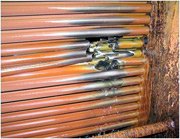
Broken pipes discovered at Hamaoka's No. 5 nuclear reactor
2011/05/22
...Damage was found to small pipes running inside the condenser of the boiling water reactor, which turns steam into water after it has been used to power the turbine. At least 20 of the approximately 21,000 titanium pipes, which are 0.5 millimeters thick and have a diameter of 3 centimeters, had cracks or holes in them...
www.asahicom.jp
www.asahi.comby estacion via Asahicom.jp 5/22/2011 1:37:24 AM- @estacion tx!by skibboy 5/22/2011 1:38:47 AM
- Anybody else notice that chubu are actually voluntarily putting information into the public domain? what a contrast to tepcoby elainekirk 5/22/2011 1:40:09 AM
- It now seems that the physical integrity of RPV penetrations larger than instrumentation lines were compromised for a time on each Unit, and TEPCO had more than enough evidence to tell us upon discovery of the turbine basement waters. For Unit #3, this may have included one or more of the CRDMs through the bottom of the RPV. Speculation now exists that some of the fully melted core (corium) from Unit #3 fuel cell may have broken through the CRDM housing (or housings) and fell to the concrete floor beneath. The base mat below the RPV is ~ 10 feet thick, made of high-density steel-reinforced concrete. Even a full corium breach to the floor wouldn't get more than a few inches into the base mat before cooling and solidifying. Regardless, the leaked corium would have cooled and solidified almost immediately upon contact with the floor.by dean 5/22/2011 1:40:33 AM
- haven't seen that elaine
I think we are being pretty well informed of hamaoka's problemsby dean edited by elainekirk 5/22/2011 1:40:55 AM - JAIF reports operators of Unit #1 manually shut off the automatically-initiated flow of cooling water to the core 10 minutes after the earthquake, because of an unexpected pressure drop inside the RPV. Cooling water flow remained shut off for three hours. No wonder Unit #1 melted first. Decay heat production is massive for the first hour after reactor fissioning ceases (SCRAM), and remains high for several hours after that. This is a gross example of operator error. Never, ever should emergency cooling water flow be stopped...not for any reason!by dean 5/22/2011 1:42:17 AM

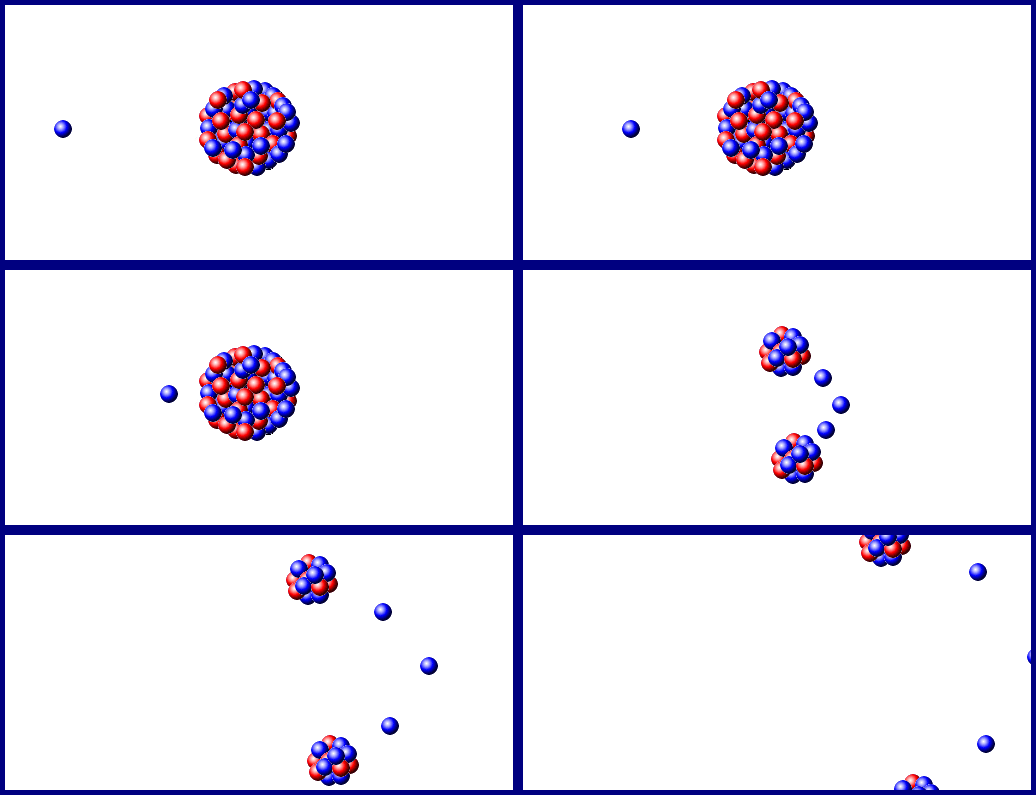 by Rob in SF via Boluodusmyportfolio 5/22/2011 1:45:30 AM
- @dean why did the pressure likely drop fast? Broken pipes due to the quake?by Nancy 5/22/2011 1:47:27 AM
- @elainekirk From what I saw previously looking on chubu's website they seemed to have leaned more toward honesty. They had been under pressure for years over the safety of the plant.by Nancy 5/22/2011 1:49:40 AM
- @dean According to the AREVA report, cooling in the isolation condenser in unit 1 stopped at 16:36 on March 11, less than an hour after the backup diesel generators had failed. By contrast, the RCIC pump in unit 3 continued until 02:44 on March 13, about 35 hours after loss of backup power. In unit 2 the RCIC survived until 13:25 on March 14, some 46 hours after the accident.by elainekirk 5/22/2011 1:49:57 AM
- I would say that and RV'sby dean 5/22/2011 1:50:12 AM
- @dean If they hadn't shut the IC valve it might have had enough circulating water to keep the cooling loop going.by Nancy 5/22/2011 1:53:38 AM
- I believe there were a series of things happened as a result of the EQ and subsequent loss of off site power as well as operator intervention to shut off the emergency core cooling that resulted in inability to maintain proper make up to the RVP. reports are that the electrical grid changes in voltage surges, frequency etc can have affects on the power for the control valves and systems in the reactor.by dean 5/22/2011 1:55:31 AM
- @deanby skibboy 5/22/2011 1:57:42 AM
- operation of the RCIC on steam requires the reactor to be continued to produce enough steam to drive the RCIC system to provide adequate cooling.. the pressure increase from right after scram I think was stopped but automatic action of the safety relieve valves which took the pressure down and subequently the RPV levelby dean 5/22/2011 1:58:05 AM
- yes skibboyby dean 5/22/2011 1:58:16 AM
- More on the saga.
Kan halted seawater injection / Operations stopped for 55 minutes over fears of 're-criticality'
The Yomiuri Shimbun
The injection of seawater into the No. 1 reactor at the Fukushima No. 1 nuclear power plant was stopped for nearly an hour soon after the Great East Japan Earthquake, at Prime Minister Naoto Kan's request, government sources have revealed.
The prime minister feared that injecting seawater might cause re-criticality to occur inside the reactor, the sources said.
Criticality refers to a self-sustaining chain reaction of nuclear fission in uranium atoms. Re-criticality is when a system achieves criticality despite mechanisms being in place to prevent it.
In the case of the Fukushima plant, control rods were inserted into the No. 1 reactor just after the March 11 temblor, with the aim of preventing criticality from occurring.
According to data released by Tokyo Electric Power Co. on May 16, injection of seawater into the No. 1 reactor began at 7:04 p.m. on March 12. TEPCO decided to use seawater because its freshwater supply was running short.
According to the sources, TEPCO informed Kan in advance about the plan to switch from freshwater to seawater.
Kan asked Haruki Madarame, chairman of the Cabinet Office's Nuclear Safety Commission whether injecting seawater would pose a risk of re-criticality, and Madarame said it was possible.
Therefore at 6 p.m. March 12, Kan instructed the commission and the Nuclear and Industrial Safety Agency of the Economy, Trade and Industry Ministry to examine the possibility that injecting seawater would lead to re-criticality.
Kan called for the evacuation of residents within a 20-kilometer radius of the nuclear plant.
Because the prime minister expressed concern, TEPCO stopped injecting seawater at 7:25 p.m., about 20 minutes after it had begun. At 7:40 p.m., the commission reported to Kan that injecting seawater would not trigger re-criticality.
At 7:55 p.m., Kan ordered Economy, Trade and Industry Minister Banri Kaieda to instruct TEPCO to resume injecting seawater. TEPCO did so at 8:20 p.m.
Ultimately, the injection of seawater was stopped for about 55 minutes.
Former Prime Minister Shinzo Abe, a Liberal Democratic Party lawmaker, told reporters Friday evening in Kyoto: "The prime minister's mistaken judgment stopped [the injection of seawater]. It was an unforgivable mistake. He should step down as prime minister immediately."
Prof. Hisashi Ninokata of Tokyo Institute of Technology, an expert in nuclear reactor engineering, said: "It's certain the nuclear fuel rods inside the No. 1 reactor were damaged. It's highly likely that suspending the injection of seawater made the situation worse."
"As it was the second day of the crisis, there was almost no information about conditions inside the reactor, and thus it was necessary to cool the fuel at any cost," Ninokata said. "Even if the seawater caused re-criticality, it wouldn't discharge extremely high levels of energy. If the prime minister was more afraid of re-criticality [than of the nuclear fuel continuing to overheat], he was completely wrong."
(May. 22, 2011)
www.yomiuri.co.jpby estacion 5/22/2011 1:59:14 AM - think so too and thats wat I wanted to say..by skibboy 5/22/2011 2:00:21 AM
- More calls to rescue pets in the evac zone and more die mdn.mainichi.jpby Nancy 5/22/2011 2:01:28 AM
- @Nancy ..and who resuques the rest of the world?by skibboy 5/22/2011 2:03:07 AM
- I have heard some reports where they questioned if all the control rods made it down in unit 1..by dean 5/22/2011 2:03:32 AM
- well.. it's my rest time.. ty all ..PEACE to allby dean 5/22/2011 2:03:46 AM
- My bedtime too g'night all:)by elainekirk 5/22/2011 2:04:56 AM
- @dean sleep in peace, bro..by skibboy 5/22/2011 2:05:21 AM
- @elainekirk ..and sis..by skibboy 5/22/2011 2:06:03 AM
- nite, allby skibboy 5/22/2011 2:07:52 AM
- More highly radioactive debris found outside #3by Nancy 5/22/2011 2:45:25 AM
- by Nancy 5/22/2011 2:45:28 AM
- @Nancy Doh!: "found debris releasing 1,000 millisieverts per hour in an area south of the Number 3"by Rob in SF 5/22/2011 2:46:22 AM
 Is that 10 Seiverts?by Panserbjorne9 5/22/2011 2:50:14 AM
- @Panserbjorne9 1000 mSv = 1 Svby Rob in SF 5/22/2011 2:51:19 AM
- Yeah, I suck at math. So 1 sievert, still prettttyy bad. Outside of the reactor. Greatby Panserbjorne9 5/22/2011 2:52:45 AM
- Fuel rod bundle?by Panserbjorne9 5/22/2011 2:53:14 AM
- 100.0000 rem = 100000.0 mrem = 1 Sv = 1.000000 Sv = 1000.000 mSv = 1000000 µSv
en.wikipedia.orgby Rob in SF 5/22/2011 2:53:20 AM - @Panserbjorne9 That would be much hotter.by Rob in SF 5/22/2011 2:53:40 AM
- My eyes just melted, stop that with the digitsby Panserbjorne9 5/22/2011 2:54:34 AM
- @Panserbjorne9 LOL. Really really radioactive. Possibly something spewed from the containment concrete or full of reactor water.by Nancy 5/22/2011 2:55:30 AM

Japan Earthquake | Page 1301
- Who's Blogging
-
 hudebnik
 alblee
 UKVal
UKVal Jonathan Keebler
 Oliver (ScribbleLive)
 kaykodh
 Markfm
 Angie
Angie Mid Valley
 Matt (ScribbleLive)
 George Gibb
- elainekirk
 PKelley
 lillymunster
- dean
 bo
bo Edano
Edano Deb
Deb- Pedro Jesus
 IanGoddard