Japan Earthquake | Page 2749
 '...the world's largest nuclear disaster'. TEPCO releases results of investigation of Fukushima accident causes. Dec 06.2011. www.shimbun.denki.or.jpby MaryW 12/6/2011 3:46:47 PM
 They wonder why US education is slipping "Ann Day Becker, who manages Entergy’s outreach to schools, estimates that the materials are now being used in at least 400 Mississippi classrooms."by lillymunster 12/6/2011 3:49:12 PM
- ANS has a teacher's CD with lesson materials. Most of it from industry resources. local.ans.org
This looks like the DOE school program. I can't find the neutropolis website mentioned www.osti.govby lillymunster 12/6/2011 3:55:35 PM - @all - is this kind of thing going on in schools in other countries?by lillymunster 12/6/2011 3:56:24 PM
 @lillymunster damn no - here not !by Edano 12/6/2011 3:59:01 PM
- @Edano good. The infiltration of industry propaganda into the schools annoys me. The cuts in school budgets make it worse as these companies provide free teacher materials.by lillymunster 12/6/2011 4:27:43 PM
- post from Happy about the water system at Fuku via Fukushima diary
The contaminated water leaks a lot recently. This time ,it went out of the “building” so it was reported but actually it happens frequently.
I called it “a building” ,but it’s actually a temporary tent on a temporary concrete basement. It leaked from the first operation ,so they made a tiny dam in it. Maybe it’s only 20cm high.
I don’t get into the tent recently because it’s too radioactive,but I used to pump up leaked contaminated water. The contaminated water emits a lot of beta ray ,so you need to be careful. This time ,Tepco’s spokes man said it was 110mSv/h ,but it is higher at some points.
The concrete basement was constructed really urgently. They built the tent even before the concrete dried. so it got cracked already. Other tent may have the same problems too.
Unlike our ordinary contract ,makers only set the facility ,they don’t take responsibility of handing or maintenance.
As I tweeted before,this water purifying system is not a long-lasting system. It is a temporary system without proper planning process. In order to release cooling water to the sea ,we must install more proper facility.
Now the gutter is straightly connected to the sea. They must be shut down or a dam must be made. Currently every time it rains, radiation on the ground and radiation stuck to the plants flow into the sea straightly.
Makers and workers are already withdrawing from Fukushima plants ,but Tepco has no long term plan. They need to predict the future risk and prevent it from happening in advance. fukushima-diary.comby lillymunster 12/6/2011 4:34:43 PM - PM Noda Looks To Promote Nuclear Exports. Dec 06.2011. www.yomiuri.co.jpby MaryW 12/6/2011 4:45:14 PM
- The Death of the Pacific Ocean. Fukushima Debris Soon to Hit American Shores. www.rense.comby MaryW 12/6/2011 5:13:08 PM
- "We again sincerely apologize for causing worries and troubles to the area residents as well as the society at large for releasing water containing radioactive materials", TEPCO said in a statement. Dec 06,2011by MaryW 12/6/2011 5:15:48 PM
 @MaryW Japan is 'nuclear exporting' via sea, air& food contamination already!by UKVal 12/6/2011 5:18:13 PM
- @lillymunster this is shocking!by Edano 12/6/2011 5:18:47 PM
- @UKVal :) Very goodby MaryW 12/6/2011 5:18:56 PM
- The radiation concentrations have already been detected in Russian 1 month after and over half way across the Pacific by September.by lillymunster 12/6/2011 5:22:54 PM
- OB_Li said one of the govt. ministers said the radioactive contaminated baby formula is safe because you dilute it with water. ::headdesk::by lillymunster 12/6/2011 5:26:19 PM
- TEPCO: Radioactive strontium leaked into the sea
The operator of the Fukushima Daiichi nuclear power plant says about 150 liters of radioactive contaminated water, containing radioactive strontium, has leaked into the sea.
The Tokyo Electric Power Company found on Sunday that massive amounts of radioactive water had leaked from a desalination device. It said that up to 300 liters of radioactive water leaked out from cracks in the foundation of the building which contains the device.
The company detected beta-ray emitting radioactive substances, including strontium, from a gutter near the building. The gutter drains into the Pacific Ocean.
TEPCO announced on Tuesday that it estimates about 150 liters of radioactive water reached the sea.
Radioactive strontium accumulates in the bones once inside a body due to its similar properties to calcium and releases radiation for a long time. One type of strontium -- strontium 90 -- has a half-life of 29 years.
TEPCO apologized for the leak. However the power company said that, judging from the amount released, it is likely to have almost no effect on the environment.
Tuesday, December 06, 2011 21:07 +0900 (JST)
www3.nhk.or.jpby Edano 12/6/2011 5:27:54 PM - Test to see safety of mountainside nuclear plants
Japanese engineers have carried out an experiment to check the safety of nuclear power plants located near mountain slopes.
The government-backed Japan Nuclear Energy Safety Organization has been testing the safety of the country's nuclear power plants, which are often built on narrow parts of coastal land carved from surrounding mountains.
In Tuesday's experiment at a research facility in Miki city, Hyogo Prefecture, engineers created a 3.8-meter-high slope using about 200 tons of rock and soil.
They then artificially made the slope shake on the same wave length as the 2007 earthquake off Niigata Prefecture, central Japan.
The organization says 9 nuclear plants, or more than half of all nuclear plants across Japan, are located near such mountain slopes.
It plans to draw up safety assessment guidelines for such slopes based on data from the experiment.
Organization official Katsumi Ebisawa says the experiment was a success in that they were able to obtain data needed to calculate possible damage and to analyze how much shaking triggers a landslide.
Tuesday, December 06, 2011 19:49 +0900 (JST)
www3.nhk.or.jpby Edano 12/6/2011 5:30:02 PM - Video shows tsunami gushing from manhole + video
New video footage illustrating the force of Japan's March tsunami shows seawater spewing from a manhole in a coastal area.
The scene was shot in Kesennuma, Miyagi Prefecture, one of the worst-hit areas. A local resident took the footage from the rooftop of a building when the first tsunami wave struck the city center on March 11th.
The video shows water spouting from a flooded intersection, reaching as high as the second floor of a house.
City officials say they believe tsunami waves gushed into a sewer system, blowing off a manhole cover. They say a similar phenomenon likely affected at least 10 manholes in coastal areas of the city.
Torrential downpours are also known to blow off manhole covers as water floods sewage pipes and pressure rises. Two people died in the past after falling into flooded manholes that had lost their covers.
A new type of manhole designed to withstand high pressure has already been introduced in some places.
Tuesday, December 06, 2011 10:29 +0900 (JST)
www3.nhk.or.jpby Edano 12/6/2011 5:32:15 PM - @Edano The worker who tweeted about the water leak said they have to date done nothing about sewer grates in the complex that run straight to the sea.... For months TEPCO scrambled and couldn't figure out how water was leaking out to the sea.....by lillymunster 12/6/2011 5:34:20 PM
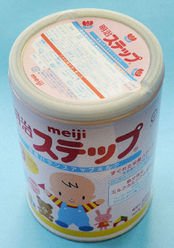
UPDATE2: Radioactive cesium found in Meiji baby formula
TOKYO, Dec. 6, Kyodo
Radioactive cesium of up to 30.8 becquerels per kilogram has been found in infant formula produced and sold by Meiji Co., the major food company said Tuesday, citing an internal examination.
The company suspects a link with the radioactive leaks from the Fukushima Daiichi nuclear power plant damaged by the 11 March earthquake and tsunami, saying ingredients for its Meiji Step milk powder may have come into contact with airborne radioactive cesium when they were being dried at a plant in Kasukabe, Saitama Prefecture, between March 14 and 20.
Radioactive cesium has been found in baby formula for the first time since the March disaster, prompting the Health, Labor and Welfare Ministry to begin looking into the matter.
The levels of cesium-134 and cesium-137 contained in the product remain below the government-set allowable limit of 200 becquerels per kilogram. A radiation expert said the reading was not at levels that would have an immediate impact on human health.
The company nonetheless plans to offer customers free replacements, affecting around 400,000 850-gram cans of the Meiji Step formula.
Amid concern that babies are more susceptible to the harmful effects of radioactive materials than adults, the ministry has planned to set a new limit for food products for babies.
The company will offer replacement products for batches with recommended consumption dates of Oct. 3, 4, 5, 6, 21, 22, 23 and 24 next year, according to the manufacturer. The dates are printed on the bottom of the cans.
Of the 23 samples with recommended consumption dates ranging from September to November 2012, four contained radioactive cesium of between 21.5 and 30.8 becquerels per kg.
The formula in question came from milk produced before the March disaster, according to the company.
''Because the cesium is diluted to 3 to 4 becquerels (per kg) when the powders are added to hot water, we don't think it will have an impact on health. But we still want to address the anxieties of those who bought the product by providing replacements,'' a public relations official of the company said.
The examination was conducted after a civic group in Nihonmatsu, Fukushima Prefecture, found radioactive cesium in the company's infant formula in a test late last month and asked Meiji to conduct a similar test.
When the health ministry examined 25 infant formula samples from multiple manufacturers, including Meiji, between July and August, the cesium level in each sample was below the minimum detectable limit of 5 becquerels per kg.
Meiji commands a leading share of roughly 40 percent in domestic baby formula sales. The same product has been exported to Vietnam under a different name.
Meanwhile, Meiji's Chinese unit said Tuesday infant formula sold in China does not pose a safety risk as it has been produced in Australia.
==Kyodo english.kyodonews.jpby Edano via English.kyodonews.jp 12/6/2011 5:36:15 PM- Water containing strontium leaked into sea from Fukushima plant
TOKYO, Dec. 6, Kyodo
Tokyo Electric Power Co. said Tuesday that around 150 liters of water containing strontium and other radioactive substances has flowed into the Pacific Ocean from its crippled Fukushima Daiichi nuclear power plant.
The utility known as TEPCO said the amount of radioactive substances is estimated at around 26 billion becquerels, adding that the impact would be ''negligible'' even if people continue to eat marine products from the area.
The water leaked from a water processing facility after undergoing a process to remove radioactive cesium. But the facility is not capable of removing strontium, which tends to accumulate in bones and is feared to cause bone cancer and leukemia.
The seawater near the plant has already been contaminated not only by massive radioactive fallout since the March 11 earthquake and tsunami triggered the nuclear crisis, but also by accidental releases of polluted water.
In the latest case, TEPCO found on Sunday that around 45 tons of water had accumulated inside a building housing part of the water processing facility and some of it was seeping through a concrete crack in the building to a nearby gutter, which leads to the sea about 500 meters away.
According to TEPCO's press release, the water contained radioactive materials including about 11 billion becquerels of strontium-89, 15 billion becquerels of strontium-90 and 4.4 million becquerels of cesium-137.
The water processing facility is essential to create water for injection into the crippled Nos. 1 to 3 reactors, as they have lost their key cooling functions since the March disaster.
The water used to cool the reactors contains massive amounts of radioactive substances and is channeled to the water treatment facility so it can be recycled as a coolant.
TEPCO said the latest incident has not affected the injection of water into the reactors.
==Kyodo english.kyodonews.jpby Edano 12/6/2011 5:39:31 PM 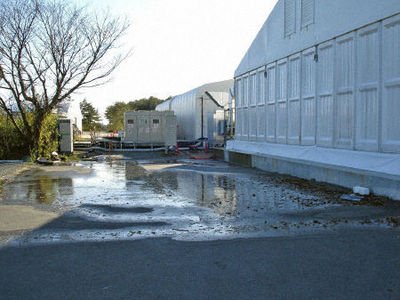
english.kyodonews.jp
Contaminated water leaked into sea from Fukushima plant
Supplied photo taken Dec. 4, 2011, shows water containing strontium and other radioactive substances that has leaked from a water processing facility at the Fukushima Daiichi nuclear power plant in Fukushima Prefecture, northeastern Japan. The plant's operator, Tokyo Electric Power Co., said Dec. 6 that around 150 liters of the water had leaked from the facility and flowed into the Pacific Ocean. (Photo provided by Tokyo Electric Power Co.)(Kyodo) english.kyodonews.jpby Edano via English.kyodonews.jp 12/6/2011 5:39:58 PM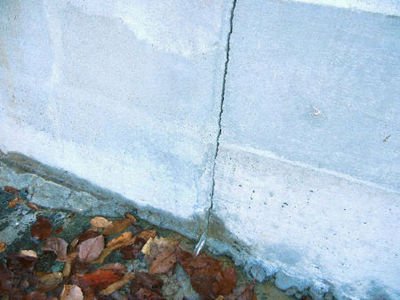
english.kyodonews.jp
Contaminated water leaked into sea from Fukushima plant
Supplied photo taken Dec. 4, 2011, shows a concrete crack at the bottom of a water processing facility at the Fukushima Daiichi nuclear power plant in Fukushima Prefecture, northeastern Japan. The plant's operator, Tokyo Electric Power Co., said Dec. 6 that around 150 liters of water containing strontium and other radioactive substances had leaked from the facility and flowed into the Pacific Ocean. (Photo provided by Tokyo Electric Power Co.)(Kyodo) english.kyodonews.jpby Edano via English.kyodonews.jp 12/6/2011 5:41:05 PM- Damages recommended for voluntary evacuation zones in Fukushima
TOKYO, Dec. 6, Kyodo
A government panel Tuesday recommended that 400,000 yen in damages be paid to pregnant women and minors aged 18 or younger who evacuated or remained in the voluntary evacuation zone since the March 11 earthquake and tsunami triggered the Fukushima nuclear crisis.
The Dispute Reconciliation Committee for Nuclear Damage Compensation also advised that 80,000 yen in damages be paid to everyone else in the 23 municipalities outside the compulsory evacuation zones close to the Fukushima Daiichi nuclear plant.
Subject to the recommendations are about 1.5 million people, with the damage payments estimated to total 200 billion yen.
The damage payments to pregnant women and children, who are believed far more vulnerable to radiation than others, cover a period to this month, the recommendation said, adding damages for later periods will be considered separately.
==Kyodo english.kyodonews.jpby Edano 12/6/2011 5:42:58 PM - by Majj 12/6/2011 5:43:04 PM
- Noda to declare achievement of 'cold shutdown': Fujimura
TOKYO, Dec. 6, Kyodo
Prime Minister Yoshihiko Noda will be the one to declare the achievement of a ''cold shutdown'' at the disaster-struck Fukushima Daiichi nuclear power plant, Japan's top government spokesman said Tuesday.
The prime minister will make the announcement because the nuclear crisis has been drawing ''a high degree of attention from all over the world,'' Chief Cabinet Secretary Osamu Fujimura said at a press conference. But he declined to comment on when Noda will announce the accomplishment.
Realizing a cold shutdown is the key goal of the ''step 2'' phase of the road map for the resolution to the emergency.
The cold shutdown is defined as a situation in which the bottom part of a reactor pressure vessel at the station is kept below around 100 C and radiation exposure from the release of radioactive substances is significantly held down.
Noda has pledged that the government will achieve the goal by the end of this month, around nine months after the devastating March 11 earthquake and tsunami severely damaged the nuclear power plant in Fukushima Prefecture.
==Kyodo english.kyodonews.jpby Edano 12/6/2011 5:44:59 PM - Part of the rush to declare cold shutdown, the govt. disaster panel gives their first report Dec 26thby lillymunster 12/6/2011 5:45:58 PM
- Wow the nuke industry shills claiming no risk exists from nuclear power are busy this week. www.nytimes.com Cause it is all just in your head....by lillymunster 12/6/2011 5:48:35 PM
- Link below is for a very instrutive video. Sorry .Im using the mobile phoneby Majj 12/6/2011 5:49:39 PM
- The NYTimes article fails to mention the guy that wrote that is one of the chief people at TerraPower, Gates nuclear venture www.xconomy.comby lillymunster 12/6/2011 5:50:32 PM
- Gov't panel report states both pro- and anti-nuclear power opinions
TOKYO, Dec. 6, Kyodo
A government panel tasked with compiling a basic framework for Japan's thoroughly revised energy policy released a draft report Tuesday which incorporates opinions both supporting and opposing nuclear power generation, while agreeing on the need to save electricity and develop renewables.
The panel chaired by Nippon Steel Corp. Chairman Akio Mimura is tasked with mapping out by the end of this month interim guidelines for compiling Japan's new basic energy plan by next summer.
The report which compiled key issues of the panel's discussions said, ''There was an opinion that (Japan) should maintain (nuclear power) at a certain proportion as a strategic decision.'' It also said, ''A question was also raised over whether resource-poor Japan should easily abandon a choice of energy.''
The paper also showed opposing views. ''There were not a few opinions that call for the withdrawal from (nuclear power) as soon as possible,'' it said, citing concern over huge costs and the suffering that would follow if a nuclear accident occurs, as well as the burdens related to radioactive waste.
The paper basically agreed on the policy of reducing dependence on nuclear power generation as much as possible, while underscoring a gap remains between panel members over their views toward nuclear power policy.
The basic energy plan that Japan endorsed in 2010 sought to increase the country's reliance on nuclear energy to 53 percent by 2030, from about 30 percent just before the quake.
But in the wake of the nuclear crisis at the Fukushima Daiichi plan following the March earthquake and tsunami, the government decided to reconsider it from scratch.
The paper also showed the panel members basically agreed to strengthen measures to save electricity, accelerate the development and use of renewable energy, and to promote the effective use of fossil fuels.
The panel said discussion on Japan's future energy portfolio should be deepened, with attention paid to its effects on the economy, employment, national energy security, the environment and international developments.
==Kyodo english.kyodonews.jpby Edano 12/6/2011 5:50:55 PM - @Majj link does not workby Edano 12/6/2011 5:52:09 PM
- @Edano @Majj The link that is not working due to 'site maintenance.\'by MaryW 12/6/2011 6:00:48 PM
- @Edano @MaryW www.google.com take time and after it open :-)by Majj 12/6/2011 6:28:43 PM
- FYI: From my notes on The International Study by the Norwegan Institute for Air Research. Oct 2011. Study was done ONLY on Caesium-137 and Xenon-133. www.atmos-chem-phys-discuss.net Plume Arrival Dates. XENON-133: Richland = March 16. Oahu = March 19. Stockholm = March 22. CAESIUM-137: Tokai-mura = March 14, 21 and 30, another peak in April. Tokyo = March 20-22, no measured data for 14-16. Japan air mass/weather-related to cyclone in the area. March 15 = Main deposition event over Japan. 1) high emissions, 2) winds transport, 3) precipitation, No rains= Tokyo and other major population centers. But still high emissions. March 19 = Major peak, likely from the spent-fuel pool in unit #4. Plume emissions (wind-related) back over Japan. Tokyo hit big on March 21. During the accidents events, Xe-133 and Cs-137 were dispersed throughout the Northern Hemisphere, and eventually reached Southern Hemisphere. *March 15 = First radionuclide cloud ahead of the main plume were transported quickly across North pacific at low altitudes in a steady westerly flow and arrived in Western North America (coast). Main part of radioactive Plume entered Western North America on 17-18 March. March 18 @ 12:00 UTC, head of plume already arrived over the North Atlantic and Hawaii, *still close to surface, rich in Cs-137. March 19 = arrives in Europe at high altitudes only. March 22 = Xe-133, All of Western North America was ENGULFED and parts of East North America and East Asia. On March 22 contaminated air in entire Northern Hemisphere and both the Tropics and Polar Regions. ( **I apologize for this format, as my return key is also the enter key)by MaryW 12/6/2011 6:42:54 PM
- 150 liters of this radioactive strontium-rich water leaked into the ocean from the evaporative condensation apparatus (part of the contaminated water treatment system), via the regular drains.
Density:
Strontium-89: 74,000 becquerels/cubic centimeter
Strontium-90: 100,000 becquerels/cubic centimeter
Total amount of radioactive materials (including cesium) that leaked into the ocean this time: 26,000,000,000 becquerels, or 26 billion becquerels.
ex-skf.blogspot.comby lillymunster 12/6/2011 7:54:24 PM - TEPCO admits strontium leaked into Pacific Ocean
The operator of the Fukushima Daiichi nuclear power plant said on Tuesday that about 150 liters of water containing radioactive strontium has been discharged into the sea. The leak occurred even though the operator took preventive measures after similar incidents in April and May.
Tokyo Electric Power Company discovered on Sunday that massive amounts of radioactive water had leaked from desalination equipment. The company detected beta-ray emitting radioactive substances, including strontium, from a gutter near the building that houses the device. The gutter drains into the Pacific Ocean.
The utility estimates that 26 billion becquerels of strontium and other radioactive substances were leaked. It added that the impact would be negligible even if marine products from the area were eaten every day as the substance will be diluted in the sea water. It has apologized to local residents and people across the country.
After the leaks in April and May, the company closed the underground tunnels near the ocean and installed sensors in the purifiers. But no measures were taken at the facility where the latest leak occurred.
TEPCO plans to find the cause of the leak and take preventive steps as soon as possible, while receiving advice from the Nuclear and Industrial Safety Agency.
Wednesday, December 07, 2011 05:07 +0900 (JST)
www3.nhk.or.jpby Edano 12/6/2011 10:29:55 PM 
My RT interview yesterday
by bo 12/6/2011 11:27:06 PM- @bo I would like to thank you for your continuing efforts in educating the world on this disaster.by MaryW 12/6/2011 11:50:47 PM
- @MaryW thanks a lot. I depend on this community for a lot of what I know and say!by bo 12/6/2011 11:54:25 PM
- Voices of Fukushima evacuees www.nytimes.com
Conditions at plant improve - decades to return home www.nytimes.comby lillymunster 12/6/2011 11:58:55 PM 
re: Ok look, another nuclear shill saying everyone in Fukushima should go home because it is just "fear" of radiation. spectator.orgby artnuke 12/7/2011 12:12:57 AM- re: American spectator, if khalili is right and we're looking at dozens of thyroid cancer cases and no cesium deaths, maybe there is more harm to forced evacuation than letting people chose to manage it the best they can? We have 50+ deaths due to medical neglect when people fled in panic.by artnuke 12/7/2011 12:12:59 AM
- @artnuke there are plenty of mainstream groups and experts and well adopted protocols that say that mentality is total BS. All it is, is corporate propaganda. One of the people writing opinion pieces and news articles is actually a part owner in Terra Power yet the NYTimes neglected to mention that in his bio. The lazy reporting in major media
lately just annoys me. :-)by lillymunster 12/7/2011 12:14:44 AM - This happened a month ago? and NOW! the US Air Force (North Dakota) decides to tell us. Reason: "...because they wanted to avoid needless alarm over nuclear weapons safeguards". ALERT MAP Non-categorized Event in USA on Tuesday,06 December 2011. hisz.rsoe.huby MaryW 12/7/2011 12:17:39 AM


Japan Earthquake | Page 2749
- Who's Blogging
-
 hudebnik
 alblee
 UKVal
UKVal Oliver (ScribbleLive)
 Jonathan Keebler
 Matt (ScribbleLive)
 kaykodh
 PKelley
 Markfm
 dean
dean Angie
Angie- Edano
 Deb
Deb Mid Valley
- Pedro Jesus
 George Gibb
 elainekirk
- lillymunster
- bo
 IanGoddard