Japan Earthquake | Page 13
 Also got a reading of 106 uSv/hour 25 km North of the plant.by Jojo 3/26/2011 7:51:22 AM
- @borrrden The 103 is the same 103 I mentioned before. It's a lot easier if you download the PDFs, they map out the Sv by distance.by Jojo 3/26/2011 7:52:29 AM
 @borrrden - No, you wouldn't receive the full dose to the body, and we also need to consider that I-131 makes up a large part of that dose. The half life of I-131 is just over a week, and it will fully dissipate in a matter of months. How that would change the uSv/hr exactly I don't know, but it would affect it significantly. The remaining C-137, however, would present problems if the soil were used to grow food.by Hank Scorpio 3/26/2011 7:53:45 AM
- They don't even give fallout #s for the entire Miyagi/Fukushima prefectures. On the PDF it says "Not be measured because of the earthquake disaster damage". I kid you not.by Jojo 3/26/2011 7:54:39 AM
- @Hank Scorpio Actually that is one of the points I wanted to touch on. It has been 15 days since the reactors shut down. That means within the next few days the amount of I-131 should be around 1/4 of the original amount, right?by borrrden 3/26/2011 7:55:16 AM
- @Jojo - The roads are damaged and its an exclusion zone. I think that's what they might mean.by Hank Scorpio 3/26/2011 7:55:34 AM
- @Jojo Yeah....because things tend to break when you throw them aroundby borrrden 3/26/2011 7:55:46 AM
- @Hank Scorpio That's why it's so problematic. They are finding 1,500,000 Bq /kg of CESIUM on spinach in Iitate Village. 40 km NW of the plant.by Jojo 3/26/2011 7:56:08 AM
- @borrrden - No. The dissipation is not a straight line. Half-life can't be doubled to indicate full removal.by Hank Scorpio 3/26/2011 7:56:22 AM
- @Hank Scorpio How are they measuring air and food samples?by Jojo 3/26/2011 7:56:38 AM
- @Jojo - I agree there are some hotspots. We won't know the full effect until it's all over. So far, the data I see suggests hotspots only, but that's because winds have been favorable.by Hank Scorpio 3/26/2011 7:57:12 AM
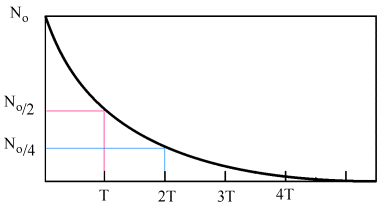
@Hank Scorpio If it were a straight line it would be 0 after 2 half lives. I am saying it is going to be 1/4 after 2 half lives (half of half). www2.slac.stanford.edu
by borrrden via Www2.slac.stanford.edu 3/26/2011 7:57:36 AM- Well, sure, there were hotspots with Chernobyl as well. The problem is that they aren't doing widespread measurements, but the ones they are doing do not bode well.by Jojo 3/26/2011 7:57:56 AM
- Thanks, @borrrden. You should be correct on that one, assuming, that is, that absolutely no new radioiodine was being produced since.
> ... It has been 15 days since the reactors shut down. That means within the next few days the amount
> of I-131 should be around 1/4 of the original amount, right? --> by borrrdenby Albert Lee in Manila 3/26/2011 7:58:22 AM - @borrrden - Sorry, brain fart. You are correct.by Hank Scorpio 3/26/2011 7:58:27 AM
- @Hank Scorpio How are the Iodine/Cesium levels on food changing up/down so rapidly? Is that rainwater sloughing off excess radiation?by Jojo 3/26/2011 7:59:04 AM
- @Jojo - They're measuring different samples. I don't believe they're hitting the exact same spot within inches for every measurement. I could be wrong though.by Hank Scorpio 3/26/2011 7:59:49 AM
- @Jojo That question's answer can only be theorized by an expert, I would imagine.by borrrden 3/26/2011 8:00:17 AM
- And yes, I would assume that rain would indeed move accumulated surface radiation to the soil from the vegetation.by Hank Scorpio 3/26/2011 8:01:04 AM
- Update on drinking water situation from the World Health Organization. www.who.intby borrrden 3/26/2011 8:03:06 AM
- Just a quick reminder, for those who wish to contribute to a list of useful links that George Gibb can build into a sidebar widget thingy. Thanks. Keep rocking. ---> www.goo.glby Albert Lee in Manila 3/26/2011 8:05:36 AM
- @borrrden Same PDF, there are sections that cover water with elevated radiation levels. Granted some of them are ponds/rain water, but how much of that is going to eventually seep into the drinking water? I don't believe they have covered their drinking water sources with tarps.by Jojo 3/26/2011 8:05:53 AM
 Couldn't sleep...can you guys help me understand the DOE's findings? blog.energy.govby Sinthia Domina 3/26/2011 8:06:16 AM
 I think the biota has got to play a large role in what we're seeing. The speed at which isotopes were taken up into plant tissue, I think, surprised many people. The other shoe will drop when it's found in animals.by Jim Carver 3/26/2011 8:06:34 AM
- @anyone Had 2 questions about the comment regarding fresh water in the reactors. 1 Why would they just be using Boric Acid in number two reactor? From the white papers someone (?Dean?) showed us the other day, it looks like you need both Boron-10 mixed with Boric Acid or a product called Polybor which only needs mixing with water? #2 Why wouldn't they use it in number 3 reactor since it's the MOX fuel core. I wonder if the Fukushima and Peachtree reactors are close in size? Would appreciate any thoughts, I've got about 10 min left before sleep wins. Thanks, Beccaby Becca 3/26/2011 8:06:40 AM
- @you For example in Ono Town, Iodine of 7400 Bq /l, Cesium of 107 Bq /L in rain water.by Jojo 3/26/2011 8:06:58 AM
- @Jojo You would have to take into account the proximities of those locations to the treatment plants, along with any countermeasures the plant itself might be taking (activated charcoal, for example). So, while it is a legitimate concern, we here cannot make any reasonable conclusions from that data alone.by borrrden 3/26/2011 8:09:08 AM
- @Sin Those are good numbers, but they directly contradict the numbers being released from the Japanese Ministry of Science. For example, 30 km NW of the plant the DOE shows low radiation, while Jpan has it at over 100 uSv/ hour (that would be in red).by Jojo 3/26/2011 8:09:39 AM
- @borrrden Plants would have active countermeasures to radiation? What I'm saying is that these high readings across the soil and rain/pond water, how can there be such a low drinking water number?by Jojo 3/26/2011 8:11:02 AM
- @Becca - The boric acid acts to stop the neutrons like the control rods. The problem isn't fission, only decay heat. The reactors need a consistent supply of water to bring the temperature down and keep them cool. Anyone feel free to correct me if I misunderstand this part.by Hank Scorpio 3/26/2011 8:11:06 AM
- Meh. I'm retarded I think. :)by Hank Scorpio 3/26/2011 8:12:18 AM
- Reuters Live Earthquake Blog Back onlineby GeorgieAussie 3/26/2011 8:12:56 AM
- For the last reading (again for Iitate Village) for soil, the Iodine reading was 1,170,000 Bq /kg of Iodine, and 163,000 Bq/Kg of Cesium. How does that number compare to Chernobyl?by Jojo 3/26/2011 8:13:08 AM
- NEWS ADVISORY: High radiation suspends work to fix Fukushima plant's No. 1 reactor - Kyodoby Hank Scorpio 3/26/2011 8:13:18 AM
- I've been thinking something like this would happen for the past 3 days. I think it will continue to get worse.by Hank Scorpio 3/26/2011 8:13:42 AM
- France and S. Korea and the US is sending large amounts of boron to japan.by Sinthia Domina 3/26/2011 8:13:48 AM
- @Jojo Radioactive particles are no different than any other particles aside from a few minor internal differences, they can be filtered. chemistry.about.comby borrrden 3/26/2011 8:13:51 AM
- @borrrden So why has the Japanese gov't told various cities (incl Tokyo at one point) to not drink the tap water?by Jojo 3/26/2011 8:15:13 AM
- apologies, Reuters still in hiatus.by GeorgieAussie 3/26/2011 8:16:31 AM
- @Jojo What I gathered was that they were not (are still not?) performing those measures at the time, for whatever reason. I am not saying that all plants do it all the time, I'm just saying it is possible to do so.by borrrden 3/26/2011 8:16:32 AM
- @borrrden Ok. Thanks.by Jojo 3/26/2011 8:17:01 AM
- Does anybody here live in Saitama like me? Until recently they were only publishing drinking water levels for one plant, but now they are providing data for all the plants in the prefecture (including mine, Gyoda city plant). Sorry, but it is in Japanese. www.pref.saitama.lg.jpby borrrden 3/26/2011 8:19:03 AM
- We're still seeing massive radiation in the soil/air/plants outside of the evacuation zone. 25 Km South it is 69,000 Bq/kg of Iodine, 2600 Bq/kg of cesium. 30 km NW it's 200,000 bq of iodine and 45000 bq of Cesium. 11000/3300, 33000/8600, 70000/12000, ...by Jojo 3/26/2011 8:20:38 AM
- Jojo I am looking at this www.mext.go.jp can you explain just the first entry so that I can figure out the conversion myself?by Sinthia Domina 3/26/2011 8:22:46 AM
- My understanding was you need both Boron-10 AND boric Acid to create the poison for the Decay heat. Unless you have the other product Polybor which only requires water. Not that 156.2 tons will get them to 700 ppm in all reactors and pools. Please let me know if I miss read the white paper. I have no knowledge of nuclear physics except what I picked up lurking in the last 2 weeks. I can ask Dean later today as well. Beccaby Becca 3/26/2011 8:23:21 AM

Japan Earthquake | Page 13
- Who's Blogging
-
 hudebnik
 alblee
 UKVal
UKVal Jonathan Keebler
 Oliver (ScribbleLive)
 kaykodh
 Markfm
 Angie
Angie Mid Valley
 Matt (ScribbleLive)
 George Gibb
 elainekirk
 PKelley
 lillymunster
 dean
dean bo
bo Edano
Edano Deb
Deb- Pedro Jesus
 IanGoddard