Japan Earthquake | Page 1866
 Nite Elaine!by LM 7/9/2011 2:34:00 AM
 Nite Elaine.by lillymunster 7/9/2011 2:37:19 AM
 @lillymunster This is where I'm stumped, because I'm seeing the French bump up the MOX content of their PWR cores through the re-loading process, until it reaches the maximum allowable (which is 1/3 MOX Core). We know that MOX looses efficiency in 18 months and has to be replaced...therefore the part that is stumping me has to do with how long the operating cycles are at these NPPs whose goal is to being running on a 1/3 MOX Core? (because they bump up the MOX content gradually) This ties into the google translation that I submitted to you earlier for Peer Review, because it does look at if TEPCO's goal for #3 was a 1/3 MOX load in the core.by smoss 7/9/2011 2:39:14 AM
 Good night Elaineby bo 7/9/2011 2:39:29 AM
- @smoss I still need to read through the translations. So every 18 months they remove part of the core. Dean might be able to fill in details. I do know that they don't pull out the entire core. They take out oldest rods and move around others to manage how things run in the reactor.by lillymunster 7/9/2011 2:47:35 AM
- So I am not 100% sure how long the first batch of MOX rods would hang out in the reactor being moved then cycled out. IIRC MOX and LEU both follow the same type of fuel cycle.by lillymunster 7/9/2011 2:48:33 AM
- Nite all! TV time with the family.by LM 7/9/2011 2:50:44 AM
- So potentially they would have needed a refueling March 2012 at Fuku 3. I found an oddity at Ikata NPP doing a refueling at 14 months instead of 18-19. They have a first mox load from 2010 in the reactor in question. They also found small amounts of plutonium outside the plant. Bobby mentioned the plutonium find and found a cached version of the results, they had been scrubbed from the web. So right now it is unsure if the plutonium leaked out of Ikata or is Fuku spread that far. en.wikipedia.orgby lillymunster 7/9/2011 2:51:22 AM
- As far as the Kashiwazaki MOX fuel. I have confirmation of location to 2007. Going through a big maintenance document from 2010 and near done. If nothing in that I have about 4 pages of METI documents left to go through. If I don't have an answer then I will start contacting the anti-MOX groups to see if they know anything.by lillymunster 7/9/2011 2:52:34 AM
- @lillymunster If you take a look at the "wonky" table, what I'm seeing indicates that the orignial 32 MOX FAs at Fukushima I-3, where to stay in the reactor core, as they then loaded 32 MOX FAs in the next operating cycle and then 80 MOX FAs in the next cycle...bringing us to a total of 144 MOX FAs in the core of reactor #3 (1/3 of total FAs). In my mind, if those first 32 assemblies were to remain viable, then the operating cycle (re-loading cycle) needed to be much shorter than 18 months.by smoss 7/9/2011 2:54:00 AM
- @lillymunster I did catcth @Bobby and that bit on the plutonium at Ikata. And actually, in my mind lately, the shorter refueling cycle at Ikata makes sense, especially if they are intentional about uping the percentage of MOX in the core.by smoss 7/9/2011 2:58:01 AM
- @smoss Double check with Dean about fuel cycle and changing out. I think the fuel cycle of 18 months means they degrade as LEU would and are not unusable but become those older rods that get moved. If this is the case it would keep the typical LEU reloading schedule but adding the mox increments you mention each 18 months and then rotate out some of it as they replenish. The percentages would be adjusted by how much new they put in. The idea of them running 1/3 MOX sounds quite typical TEPCO. GoJ was hard on the path to using lots of MOX before Fukushima.by lillymunster 7/9/2011 2:58:09 AM
- @smoss Hmm. If they are using a shorter fuel cycle something from French or German documentation might explain it. Greenpeace or Barnaby might be able to explain the fuel cycle as your describing if that is how it plays out. So some of the Barnaby papers might provide the technical details needed. There are also some US documents on MOX standards from when they thought the US was going to do this adoption. Those might explain refueling cycles and percentage loads too. I should have the US document URL somewhere. I might have a contact for Barnaby through the NGO he worked for if we hit a dead end.by lillymunster 7/9/2011 3:00:56 AM
- I wondered if Ikata did refuel early if they did so due to some sort of leaking or failed fuel thus the radiation release?by lillymunster 7/9/2011 3:02:18 AM
- @lillymunster Thanks! I began a bit of a search tonight into the protocol the French use when they run MOX in their reactors and found this: "In the core of the 900 MWe PWRs loaded with MOX fuel, there are 48 MOX fuel assemblies,
coming from three reloads of 16 assemblies each. Each MOX fuel assembly is irradiated during 3 annual
cycles. The remainder of the core consists in 109 U02 fuel assemblies " www.iaea.orgby smoss 7/9/2011 3:06:25 AM - @lillymunster Definate possibility that the refuel at Ikata was done to hid something, given the plutonium present. Thank you for the conversation and input, I must make a smart choice and go to bed, tomorrow will be a long day.by smoss 7/9/2011 3:08:51 AM
- @smoss I am headed there soon also. My brain stops working at a point. :-)by lillymunster 7/9/2011 3:09:32 AM
 hi all... @ lilly I noticed you were talking about mox fuel loadingby dean 7/9/2011 3:11:29 AM
- @dean @dean yes. trying to determine normal LEU cycle and then how MOX loading might differ, esp. trying to increase load percentageby lillymunster 7/9/2011 3:12:33 AM
- I will look for a document I had that basically explains how the LEU and MOX loadings are done in general, how they are zone loaded in the core, how the percent Pu oxide is loaded to get the right core neutronics and stay within the safety limits... it's pretty complicated how they select each fuel loading to maximize efficiencies to produce an even power accross the core with out violating any safety requirements..by dean 7/9/2011 3:14:57 AM
- and,, it's different some what for reactors in different countries.. russia versus.. usa versus japan for instanceby dean 7/9/2011 3:15:34 AM
- @dean that would help. Are they different vs. country safety laws?by lillymunster 7/9/2011 3:16:01 AM
- also.. the theory of once through process for fuel.. ie" none is reused..by dean 7/9/2011 3:16:11 AM
- @dean Is that specific to Mox or for both?by lillymunster 7/9/2011 3:16:36 AM
- @ lilly.. different countries have somewhat different approaches to fabrication and content of PU based on the type of reactor and how they want to factor that into the fuel cycleby dean 7/9/2011 3:16:51 AM
- both fuel elements can have somewhat different loadings of U235.. PU OR combination..by dean 7/9/2011 3:17:35 AM
- so then does mox only do one cycle then out?by lillymunster 7/9/2011 3:17:55 AM
- ie' not all LEU is precisely the same.. but all are low contentby dean 7/9/2011 3:17:56 AM
- usually .. but I want to refer to that document.. they mostly have 18 month cycle..by dean 7/9/2011 3:18:18 AM
- it doesn't mean all the fuel is burned up.. only a small precentage actually but they have to put replacement fuel in for the reactor physicsby dean 7/9/2011 3:18:44 AM

www3.nhk.or.jp
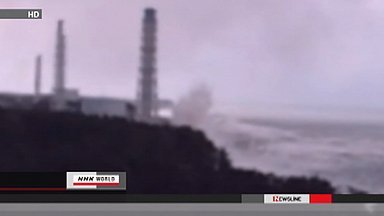
TEPCO: 13.1 meter tsunami hit Fukushima plant
The operator of the troubled Fukushima Daiichi nuclear power plant estimates that the facility was hit by a tsunami as high as 13 meters on March 11th.
Tokyo Electric Power Company released a computer simulation based on data recorded during the disaster and other information.
TEPCO estimates that a 13.1-meter-tall tsunami passed a tidal observatory near the plant 51 minutes after the earthquake struck. That figure is far higher that the company's originally estimate of 5.7 meters.
Ten kilometers away at the Fukushima Daini nuclear plant, a tsunami up to 9.1 meters high was recorded 48 minutes after the quake.
TEPCO says the differences in height of the 2 waves may have been caused by topographic features of the seafloor.
It says tsunamis were generated at 6 locations on seabed faults, resulting in the Daiichi plant being hit with a higher wave.
TEPCO also says the ground beneath the 2 plants fell by 50 to 65 centimeters after the disaster.
Saturday, July 09, 2011 09:05 +0900 (JST)
www3.nhk.or.jpby Edano via Www3.nhk.or.jp 7/9/2011 3:19:07 AM- @dean If MOX does one cycle and then out to the SFP then they would need very increasing shipments of MOX to refuel if they intended to gradually increase to 1/3 MOX loadby lillymunster 7/9/2011 3:19:22 AM
- they try to load every core @ lilly so they don't have fluctuations of power over the core,, called power peaking.. they like a nice smooth powerby dean 7/9/2011 3:19:39 AM
- indeed @ lilly.. that is the fuel cycle part.. new in.. 18 months.. then out.. then new in and so on... the need to have the supply of new MOX set up to meet the cycle of operationby dean 7/9/2011 3:20:28 AM
- no matter what position in the core any fuel goes.. it all has what's called a burnup limit.. and when that is reached the fuel element is defined as depleted and put in the canal for cooling and then off to process or storageby dean 7/9/2011 3:21:34 AM
- Survey: radioactive materials found in plankton
A scientific survey has found radioactive substances in plankton collected from the seafloor off Fukushima Prefecture.
A group of researchers from the Tokyo University of Marine Science and Technology ended its 8-day survey on Friday. The goal was to study the spread of radioactive materials into the Pacific Ocean from the Fukushima Daiichi nuclear power plant. The group collected samples from the seabed along a 120-kilometer stretch off the coast of Fukushima.
Radioactive cesium was found in animal plankton collected 35 kilometers off Iwaki City. The level was measured at 6 becquerels per kilogram.
The researchers say this level does not exceed the national safety standard. They added that the level would still be under the limit even if the cesium were to enter the bodies of larger fish that eat the contaminated plankton.
Professor Takashi Ishimaru, a member of the research group, says he and his colleagues will continue the survey to check the effects of radioactivity on the local ecosystem.
Saturday, July 09, 2011 06:14 +0900 (JST)
www3.nhk.or.jpby Edano 7/9/2011 3:21:43 AM - Dean that puts an interesting twist on things. Even if they were not doing increasing loads Japan would have needed new loads for the 5 or so reactors running MOX right now soon.by lillymunster 7/9/2011 3:21:44 AM
- good info.. Edanoby dean 7/9/2011 3:22:05 AM
- @dean hi @all !by Edano 7/9/2011 3:22:28 AM
- exactly @ lilly, and part of what you had looked at earlier were the shipments of MOX that were held up and returned.. etc.. so that whole process will have to be re-evaluated based on the end result of MOX burning reactors in JAPANby dean 7/9/2011 3:23:03 AM
- MOX suppliers meet with their customers for precise loading, then manufacture and arrange scheduled deliveries to meet the needs and demand of the MOX fuel types..by dean 7/9/2011 3:24:03 AM
- @dean They have a number of reactors coming due for a reload if they are running less than 18 month fuel cyclesby lillymunster 7/9/2011 3:24:11 AM
- But no new shipments. There were May shipments that were turned back.by lillymunster 7/9/2011 3:24:39 AM
- yes.. and that would be interesting to see which of those many facilities already have the replacement mox fuel assemblies on hand.. and which need to get some.. .and if none is available they would probably switch back to all LEU if they had enoughby dean 7/9/2011 3:25:10 AM
- the JAPAN crisis put a crunch on all fuel assembly manufacturing I'm sureby dean 7/9/2011 3:25:56 AM
Japan Earthquake | Page 1866
- Who's Blogging
-
 hudebnik
 alblee
 UKVal
UKVal Jonathan Keebler
 Oliver (ScribbleLive)
 kaykodh
 Markfm
 Angie
Angie Mid Valley
 Matt (ScribbleLive)
 George Gibb
 elainekirk
 PKelley
- lillymunster
- dean
- bo
- Edano
 Deb
Deb Pedro Jesus
 IanGoddard