Japan Earthquake | Page 2331
 We are without power so I will preserve my phone battery and bid you all goodnight @veenie @ Lilly could you tell our akatsubu friends hello from me please if @ thunder @ wwrshpr are on please keep the weather updates coming g.night alliiby elainekirk 9/12/2011 12:25:36 AM
 Here's a paper by Prof. Yury Bandazhevsky with the data Busy cites showing a sharp downward acceleration of the demographic index (measure of births vs deaths) of Belarus shortly after Chernobyl and going into negative replacement (ie, the population of Belarus is decreasing) : www.chernobyl-day.org @elainekirk Hope the lights are back when you wake!by Ian 9/12/2011 12:42:23 AM
- Sorry, this is the correct URL : www.dpi.lt I don't know how to access the PDF directly, seem you have to save it first.by Ian 9/12/2011 12:49:27 AM
 Nite Elaine, stay safe.by lillymunster 9/12/2011 12:50:46 AM
 well, we have decreasing populations in many developed countries, e.g. germany. right after the chernobyl disaster in eastern countries the change to perestroika and glasnost began, leaving a great amount of people in uncertain conditions which accounts in a negative demographic index. in germany, cardiovascular diseases are main death cause, and they increase nearly all over the world. in a word, the studies are interesting, but not conclusive enough.by Edano 9/12/2011 12:55:56 AM
- i will check cardiomyopathy from Cs‐137 incorporation tomorrow. :) good night.by Edano 9/12/2011 1:02:57 AM
- @Edano Nite.by lillymunster 9/12/2011 1:18:59 AM
- Video of some of the protesting. www.youtube.comby lillymunster 9/12/2011 1:27:54 AM
- This one explained as right wingers (pro nuke) counter protesting the anti nuclear rally www.youtube.comby lillymunster 9/12/2011 1:28:57 AM
 @lillymunster , I believe edano is correct in that the noted increase in cardiovascular disease was related rather to the unraveling of the USSR and the resulting abysmal tailspin of the standard of living than to the Chernobyl accident.by Peter 9/12/2011 1:37:29 AM
- @Peter I think Busby's claim was heart attacks in children, sounds pretty unusual. I would think something that out of the ordinary would be documented if true. I don't trust anything Busby says though. :-) Were they claiming adult cardio went up also? That could be hard to prove unless it was a culture than had a really low rate of cardiovascular problems to begin with.by lillymunster 9/12/2011 1:40:29 AM
 @all Good Morning...Good Evening...Hello!by smoss 9/12/2011 1:45:37 AM
- @smoss HI!by lillymunster 9/12/2011 1:45:52 AM
- @all Don't know if this is new/old...of course the idea of applying the term "cold shutdown" to reactors 1-4 at Fukushima I has become an oxymoron Japan Times: Nuclear fuel is escaping from holes and cracks — Years before leaking stops? enenews.com @lillymunster Hi!by smoss 9/12/2011 1:50:13 AM
- @smoss new article and new experts saying what some others said late this week. Bonus, Edano was on this before the experts went to the media. :-)
Good to see some of the real brains in Japan speaking up.by lillymunster 9/12/2011 1:55:51 AM - @all Nikkei down by 2.1% online.wsj.comby smoss 9/12/2011 1:56:13 AM
- @lillymunster Edano and so many others on this board (you included) have pegged many aspects of the Fukushima situation so accurately from the beginning...truely a valuable resource and example to others of what a crowd sourcing community can achieve and accomplish...kudos to everyone!by smoss 9/12/2011 2:02:05 AM
- @all Just saying...I loved Krugman's blog entry today The Years of Shame krugman.blogs.nytimes.comby smoss 9/12/2011 2:06:23 AM
- @lillymunster , so far, I found this info on public health of the USSR on the wiki en.wikipedia.org : "The rising reported adult mortality and infant mortality was not explained or defended by Soviet officials at the time. Instead, they simply stopped publishing all mortality statistics for ten years. Soviet demographers and health specialists remained silent about the mortality increases until the late 1980s when the publication of mortality data resumed and researchers could delve into the real and artifactual aspects of the reported mortality increases." Because of this paucity of reporting, I think it will be extremely difficult to draw conclusions.by Peter 9/12/2011 2:12:49 AM
- @Peter, are there independent data showing lowered living standards after the fall of communism? In general, communism lowers living standards. And also, are there data showing heart disease increases with lower living standards? Heart disease can be a trait of affluence, as for example from gluttony and a sedentary lifestyle. The counter thesis of blaming post-Chernobyl ill health the fall of communism is not intuitive, assumption laden and potentially rather complicated to build from a range of data sets. On the other hand, Cs-137 is already known to be cardiotoxic, whereas communism is not know to be cadio-protective.by Ian 9/12/2011 2:18:20 AM
- LOL! "communism is not know to be cadio-protective." quote of the day!by lillymunster 9/12/2011 2:20:51 AM
- @all This video seems to be making the rounds Radiation check at Hachioji station-1(25km from Central Tokyo)
australiancannonball.com enenews.comby smoss 9/12/2011 2:22:58 AM - Youtube link for it www.youtube.com
Asuperdry posted one from eastern Tokyo today got around the same reading on a road on an incline.by lillymunster 9/12/2011 2:27:07 AM - Dang Edano went to bed already. Just got this off Twitter:by lillymunster 9/12/2011 2:29:53 AM
- tokyorich Yukio Edano has taken over at METI.by lillymunster 9/12/2011 2:29:54 AM
- @Ian , if they did not publish the data on child morbidity and mortality in the decade before the accident, it will be difficult to assess any trends.by Peter 9/12/2011 2:30:26 AM
- @lillymunster , yup, it's in the news: www.reuters.comby Peter 9/12/2011 2:38:13 AM
- Just found it off twitter www3.nhk.or.jpby lillymunster 9/12/2011 2:42:20 AM
- Hachiro's Resignation May Delay Nuke Plant Restart TOKYO (Nikkei)--The resignation of Industry Minister Yoshio Hachiro after just one week in office will further cloud the outlook for resuming operations at the nation's suspended nuclear power plants.
Hachiro stepped down on Saturday to take responsibility for gaffes he made during a visit to the Fukushima Daiichi nuclear power plant on Thursday with Prime Minister Yoshihiko Noda.
However, Hachiro expressed a willingness to resume operations at the stalled nuclear plants. "I will make every effort to gain an understanding from local governments that have nuclear plants, and that is my biggest task," he said.
The nation's power companies have already started to conduct stress tests to evaluate the reliability of their nuclear reactors. But Hachiro's resignation could potentially disrupt this process.
His resignation will also probably disrupt discussions on the Trans-Pacific Partnership agreement. Hachiro, a former Japan Agricultural Cooperative employee, is particularly well-versed on agricultural issues.
Some observers viewed his appointment as a potential obstacle to Japan's participation in the TPP, while others saw him as a key player in the drive to reach a consensus between the two opposing camps in the free trade debate.
(The Nikkei Sept. 11 morning edition)by Luisa 9/12/2011 2:48:27 AM - LDP politician says people should not be allowed to use radiation monitors. gurepon.iza.ne.jp because numbers might vary and things like height taken.by lillymunster 9/12/2011 2:49:31 AM
- I must sleep - nite all!by lillymunster 9/12/2011 2:52:22 AM
- @lillymunster Good Night! @all Be Well! I'm off, as well...by smoss 9/12/2011 2:54:41 AM
 The growing nuclear backlash post Japan earthquake Since the disaster, the anti-nuclear sentiment in Japan has been growing steadily with the nation becoming increasingly vociferous in its opposition to atomic power plants. www.telegraph.co.ukby Cryptococcus 9/12/2011 3:46:57 AM
- Trial to start in bid to close US nuclear plant Print Text: A A
Topics AP
Trial to start in bid to close US nuclear plant
By AP | September 12, 2011
Chat inShare0 Email
BRATTLEBORO, Vermont (AP) — A federal judge is about to be asked to take a first crack at this question: In early 21st-century America, can a small state tell an $11.2 billion corporation to pack up its nuclear plant and go home?
On Monday morning, in a stately federal courtroom upstairs from a U.S. Post Office — in a town still recovering from the floods two weeks ago of Hurricane Irene's remnants — a high-powered Entergy Corp. legal team will square off against the Vermont attorney general's office with that question in the balance.... www.canadianbusiness.comby Cryptococcus 9/12/2011 3:54:17 AM - TABLE-Japan nuclear plant ops (Onagawa No.1, 3 undergo maintenance) Sun Sep 11, 2011 10:45pm EDT
Sept 12 (Reuters) - Tohoku Electric Power Co said it began regular
maintenance at the 524-megawatt No. 1 reactor and the 825-megawatt No. 3 reactor at
its Onagawa plant on Saturday as scheduled.
The move does not change the company's electricity generating capacity as the two
reactors have been shut since the March 11 earthquake and tsunami. (for the rest of the article and chart see...) www.reuters.comby Cryptococcus 9/12/2011 3:55:39 AM - good morningby elainekirk 9/12/2011 5:59:35 AM
- www.nrc.gov
In the mid-cycle assessment period that concluded on June 30, 99 of 104 plants were in the
two highest performance categories. Ninety-one plants were performing at the highest level and are
being inspected by NRC using the normal detailed level inspection program. Eight plants performed
at the next highest level, needing to resolve one or two items of low safety significance, and will
receive additional inspection and attention to follow up on corrective actions. These plants were:
Brunswick 1 and 2 (N.C.); Byron 2 (Ill.); Cooper (Neb.); Ginna (N.Y.); Millstone 2 (Conn.); Prairie
Island 1 (Minn.) and Turkey Point 4 (Fla.)
Three nuclear reactors were at the third level of performance with one degraded safety
cornerstone and will receive more NRC inspections, senior management attention and oversight
focused on the cause of the degraded performance. These plants were: H. B. Robinson 2 (S.C.);
Perry 1 (Ohio) and Susquehanna 1 (Pa).
Two plants, Browns Ferry Unit 1 (Ala.) and Fort Calhoun (Neb.), require the NRC’s highest
level of attention, which will include additional inspections to confirm the plant’s performance
issues are being addressed.
In addition, mid-cycle letters were also sent to both the Watts Bar Unit 2 site, (Tenn.) and
the Vogtle Unit 3 and 4 site (Ga.) reviewing activities associated with the early site permit and
limited work authorized by the NRCby elainekirk 9/12/2011 9:38:47 AM
Decision
On August 18, 2011, the TVA Board
decided to proceed with an application
to extend the operating licenses for
Sequoyah Units 1 and 2 for an
additional 20 years and other such
actions as necessary to accomplish NRC
approval of the license renewal
application. Continuing to operate SQN
would provide the Tennessee Valley
with an additional 20 years of safe,
reliable, base load power while
promoting TVA’s efforts to reduce
carbon emissions, make beneficial use
of an existing asset, and deliver power
at the lowest feasible cost.
www.gpo.govby elainekirk 9/12/2011 9:48:09 AM- Noda picks Edano as new trade minister
Japanese Prime Minister Yoshihiko Noda picked former chief cabinet secretary Yukio Edano as the country's new Economy, Trade and Industry Minister on Monday.
On Saturday, the trade minister, Yoshio Hachiro, resigned from his post for making inappropriate remarks about radiation contamination in Fukushima Prefecture. This came only 8 days after Noda launched his Cabinet.
Edano, aged 47, is currently serving his 6th term in the Lower House. The former lawyer was elected to the Diet for the first time in 1993.
After the Democratic Party came into power in 2009, Edano rigorously screened government projects to cut spending.
In February last year, then Prime Minister Yukio Hatoyama appointed Edano as Government Revitalization Minister. It was Edano's first Cabinet post.
He later became the governing Democratic Party's secretary general.
While serving as Chief Cabinet Secretary since January, Edano led the government's efforts to cope with the Fukushima nuclear accident.
Monday, September 12, 2011 12:11 +0900 (JST)
www3.nhk.or.jpby Edano 9/12/2011 10:40:18 AM - cool !!!! i told you i will return !by Edano 9/12/2011 10:40:34 AM
 @Edano happy you will be back, We miss you ;-))))))by Majj 9/12/2011 10:44:47 AM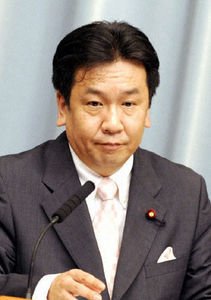
english.kyodonews.jp
Edano tapped as industry minister
Undated file photo shows Yukio Edano, who was chief Cabinet secretary in the Cabinet under former Prime Minister Naoto Kan. A government source said Sept. 12, 2011, that Prime Minister Yoshihiko Noda will appoint Edano as new industry minister to succeed Yoshio Hachiro, who resigned over remarks that displeased people affected by the Fukushima nuclear crisis. (Kyodo) english.kyodonews.jpby Edano via English.kyodonews.jp 9/12/2011 10:45:19 AM- Plugging leaks will end crisis, not cold shutdown: analysts
Evacuees' health said at risk if they return home after 'Step 2' achieved
By KAZUAKI NAGATA
Staff writer
Ever since the nuclear crisis erupted six months ago, the public has been clamoring to know when the damaged reactors at the Fu ku shi ma No. 1 power plant will be brought under control and when the nightmare will end.
The government and Tokyo Electric Power Co., which runs the crippled plant, are working to bring the three reactors into cold shutdown by mid-January.
Cold shutdown means the temperature at the bottom of the pressure vessel, which holds the core, has been lowered to less than 100 degrees.
This critical milestone, known as "Step 2" in Tepco's road map for containing the crisis, would limit the release of radioactive materials from the plant to less than 1 millisievert per year, a level that poses no health risks.
Since work at the plant is proceeding relatively smoothly, it appears likely the mid-January target will be met.
But Fukushima No. 1 will still have a long way to go before the flooded plant's reactors are stable enough to be considered safe, experts warn. The main reason is the abundance of highly radioactive water.
"There are about 110,00 tons of contaminated water (in the plant) and the situation is still not completely under control because coolant water is leaking from the containment vessels.
There is no guarantee that the irradiated water won't leak from the plant (and contaminate the environment)" if another natural disaster strikes, said Hisashi Ninokata, a professor of reactor engineering at the Tokyo Institute of Technology.
After achieving cold shutdowns of reactors 1, 2 and 3, the government may declare parts of the 20-km no-go zone around the plant safe. It may even let the evacuees return, as long as the area is decontaminated and crucial infrastructure restored.
But the longer the tainted water leaks, the more the radioactive waste will grow, leaving the Fukushima plant vulnerable to further disasters, Ninokata said.
Before the Fukushima crisis can be said contained, the holes and cracks from which the water and fuel are escaping must be located and sealed. But this extremely difficult task could take years because the radiation near the reactors is simply too high to let workers get near them.
"It'll be too early to say that the situation has reached a stable phase even after Step 2 is completed," said Chihiro Kamisawa, a researcher at Citizens' Nuclear Information Center, a nonprofit group of scientists and activists opposed to nuclear power.
When a reactor is in cold shutdown, the water cooling its fuel is still hot but no longer boiling, which significantly reduces the amount of radioactive emissions.
In late July, the temperature in reactor No. 1's pressure vessel fell below 100 degrees. On Monday, the same thing was achieved in reactor 3 after Tepco activated a system that pumps water deep into the containment vessel. But on Friday, reactor No. 2 was still boiling away with a reading of 112.6.
"Efforts seem to be making smooth progress, and I think Step 2 is likely to be achieved by mid-January," said Shinichi Morooka, a Waseda University professor and reactor expert.
Another reason for optimism is the progress being made with the water decontamination system. The cleaning rate has greatly improved in the past few weeks and exceeded 90 percent of capacity last week.
If the decontamination system ever reaches its full potential, it will allow Tepco to inject coolant at a higher rate and bring the melted cores to lower and stabler temperatures.
The government also plans to start decontaminating soil in various hot spots so the evacuees can return once the second step is completed.
But some experts are questioning whether residents should be allowed to return so soon. The cracks and holes in the leaking reactors haven't even been pinpointed yet, let alone fixed, they say.
"As an engineer, I am worried (about the plan to let residents return) when it is still unclear what is really going on inside the reactors," said Morooka.
For the time being, Tepco can only guess where the water is leaking from and which parts need repair, because radiation has prevented workers from fully exploring the buildings.
Spokesman Junichi Matsumoto said that since no extensive damage to the reactors was found during inspections of the first and second floors of the buildings, any holes or cracks are probably at the basement level.
But with the basement floors flooded, Tepco's top priority is just to get the water out. Plans to fix the reactors aren't even being discussed yet, Matsumoto said.
Asked if the containment vessels can take another quake, the Tokyo Institute of Technology's Ninokata said he believes the impact would likely be distributed evenly through the structure without widening existing cracks or holes.
But if the impact somehow focuses on parts damaged by the March 11 disasters, there could be further damage, he said.
"The containment vessel is what really ensures the safety of a nuclear reactor," Ninokata said, warning that if radioactive materials are still leaking out, allowing residents to return would risk harming their health. search.japantimes.co.jpby Luisa 9/12/2011 10:45:43 AM - and the best thing: i am anti-nuke !by Edano 9/12/2011 10:45:49 AM
- And you now can use a suit. not blue working gear. You got promote ;-)by Majj 9/12/2011 10:47:55 AM

Japan Earthquake | Page 2331
- Who's Blogging
-
 hudebnik
 alblee
 UKVal
UKVal Oliver (ScribbleLive)
 Jonathan Keebler
 kaykodh
 PKelley
 Markfm
 Angie
Angie Deb
Deb Mid Valley
- Pedro Jesus
 Matt (ScribbleLive)
 George Gibb
- elainekirk
- lillymunster
 dean
dean bo
bo- Edano
 IanGoddard