Japan Earthquake | Page 2660
 10/19/11 A 3.3-magnitude earthquake hit Armenia on Wednesday, about 7 kilometers south from Masis city.
The earthquake with 4-5 magnitude in the epicenter was felt in Yerevan, Artashat and Masis.
Armenia’s national seismic protection service says the information is being clarified. www.mamul.am Prior to the big one in Turkey on 10/23by smoss 11/14/2011 8:07:47 PM @lillymunster, is this article from Oct25? Because i see May 23 too. Is it old?http://translate.google.com/translate?sl=ja&tl=en&js=n&prev=_t&hl=en&ie=UTF-8&layout=2&eotf=1&u=http%3A%2F%2Fjapanese.irib.ir%2Findex.php%3Foption%3Dcom_content%26view%3Darticle%26id%3D22102%3A2011-10-25-11-37-35%26catid%3D17%3A2010-09-21-04-36-53%26Itemid%3D116by Liz 11/14/2011 8:09:31 PM
 @Liz It could be google botching the translation. Sometimes it misreads number sets or dates incorrectlyby lillymunster 11/14/2011 8:15:58 PM
- Oh, thanx@lillymunster.by Liz 11/14/2011 8:17:47 PM
- Have to run out of the office for about an hour. Will start working on the timeline and map when I get back.by lillymunster 11/14/2011 8:18:45 PM
- Could this place be a source of iodine-131? Would they need a medical reactor at this Institute?
Institute for Scintillation Materials of NAS of Ukraine, State Institution 60, Lenin Ave., Kharkiv, 61001, Ukraine
Part of the Kharkiv Institute for Single Crystals (ISC), ISMA/ISC is the world’s second largest producer of scintillation crystals after the French company St. Gobain and together they share nearly the entire market. In layman’s terms, scintillation crystals are materials employed in the production of CT scanners and gamma cameras used in medical diagnostics. Their properties (such as chemical composition, dimensions, quality) contribute to the effectiveness of pre-medical imaging tools and influence their cost and affordability. Beyond nuclear medicine, scintillators have security applications (like Homeland Security radiation detectors), and can be used also for environmental monitoring and the productions of space instrumentation.
www.euroindex.uaby Liz 11/14/2011 8:21:01 PM - @Liz I would guess Germanium. Peter might know for sure though.by lillymunster 11/14/2011 8:23:55 PM
- SAVE FUKUSHIMA'S CHILDREN: A petition to Japan's Prime Minister Yoshihiko Noda secure.avaaz.orgby MaryW 11/14/2011 8:35:14 PM
- 'Vacuum cleaner' caused stop in power plant. 11.14.2011. www.stockholmnews.comby MaryW 11/14/2011 9:09:18 PM
- Radioactive Dust Over Sweden. 11.12.2011. www.stockholmnews.comby MaryW 11/14/2011 9:11:37 PM
- Does anyone know the first date they started seeing iodine increases in Denmark and Sweden?by lillymunster 11/14/2011 9:46:03 PM
 @lillymunster we can track back i will go tryby elainekirk 11/14/2011 9:46:54 PM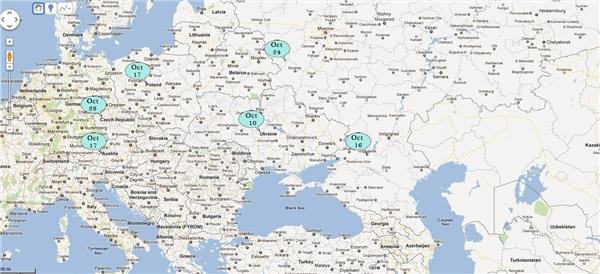
Radiation Map With Dates Spikes Started
by lillymunster 11/14/2011 10:04:57 PM- As we find more I will add them into that graphic with the dateby lillymunster 11/14/2011 10:06:37 PM
 @lillymunster excellent.by Edano 11/14/2011 10:13:16 PM
- So far Russia east of the Caspian Sea has no spikesby lillymunster 11/14/2011 10:13:24 PM
- Looking for initial spike dates for Denmark, Sweden, north Germany, Slovakia, Turkey. I can get vague increase dates from the EuDep but if we can find an actual station graph with a date it jumps would be great or a mention in a news article that a country saw a jump on that date. This is slowly starting to draw a picture for us.by lillymunster 11/14/2011 10:14:59 PM
- Shikoku electric submits reactor test results
An electric company in western Japan has submitted to the government the results of safety tests on a reactor at its nuclear power plant. The plant has been offline since a month after the accident at the Fukushima plant.
Shikoku Electric Power Company executive Susumu Tanigawa handed the Nuclear and Industrial Safety Agency the results of the so-called stress test on the No. 3 reactor at Ikata nuclear plant in Ehime Prefecture on Monday.
The utility says the test results show that the reactor can withstand seismic shaking of up to 1,000 gals, around 1.9 times the assumed maximum intensity of a quake, and it can hold out against a tsunami of up to 14.2 meters.
The nuclear watchdog agency will scrutinize the test results.
A final decision to reactivate the reactor will be made by the government.
Sikoku Electric became the 2nd utility to submit stress test results after the Fukushima accident.
But prospects for the restart of idle reactors are uncertain.
Some nuclear experts voiced criticism of the reactor safety tests on Monday at the first meeting of a government panel to discuss ways to evaluate the results.
One member said the stress test should not be the only condition for restarting reactors when the cause of the Fukushima accident has not been clarified.
Some also said it will be impossible to gain public understanding if safety evaluations are conducted solely by the government-run nuclear safety agency, and stressed the need to listen to the opinions of local residents.
Disagreements within the panel lead to it putting off specific discussions on evaluating the test results of the No. 3 reactor at Kansai Electric's Ohi plant, which were submitted earlier in October.
Tuesday, November 15, 2011 06:16 +0900 (JST)
www3.nhk.or.jpby Edano 11/14/2011 10:16:07 PM - Radioactive cesium may have reached Hokkaido
A team of researchers says radioactive cesium discharged from the damaged Fukushima Daiichi nuclear plant may have contaminated soil in Hokkaido and areas of western Japan more than 500 kilometers from the plant.
The international team, including researchers from Nagoya University, simulated the spread of radioactive materials. They combined global atmospheric patterns with nationwide radioactive measurements taken over one month from March 20th, 8 days after a hydrogen explosion at the Fukushima plant.
The researchers say the results suggested that some cesium-137 had reached the northernmost island of Hokkaido, and the Chugoku and Shikoku regions of western Japan.
They say the radioactive material may have accumulated in the soil due to rain.
Cesium-137 has a half-life of 30 years.
But the research team says the pollution is not high enough to require decontamination.
The radiation density per kilogram reached 250 becquerels in eastern Hokkaido, and 25 becquerels in mountainous areas of western Japan.
Nagoya University professor Tetsuzo Yasunari says the simulation suggested cesium had dispersed across a wide area. He called for a nationwide testing of soil, and warnings of hot spots where radiation levels are high.
Tuesday, November 15, 2011 06:16 +0900 (JST)
www3.nhk.or.jpby Edano 11/14/2011 10:19:29 PM - Counter-terror measures for nuclear plants
The Japanese government is planning to strengthen defensive measures against terror attacks on nuclear power plants.
A government anti-terror panel met on Monday to discuss ways to respond to international threats.
It proposed counter-terrorism measures for nuclear plants, including compelling plant operators to cover emergency power sources and seawater pumps, which are used to cool reactors.
Utilities will also be obliged to step up security surveillance.
The panel calls for increasing the number of police guards and stocking up on protective clothing at the plants.
It says computer systems that control nuclear plants should be cut off from outside networks to protect them from cyber attacks.
Chief Cabinet Secretary Osamu Fujimura told the panel that the nuclear crisis at the Fukushima plant could be triggered not only by natural disasters but also by terrorist attacks.
The government will ask utilities to implement urgent measures within this fiscal year.
Tuesday, November 15, 2011 06:16 +0900 (JST)
www3.nhk.or.jpby Edano 11/14/2011 10:21:32 PM - @Edano it will soon mount up over winter all that cesiumby elainekirk 11/14/2011 10:24:46 PM
- On my phone. Before I forget again. Greenpeace. Do they have anything on the eu issue?by lillymunster 11/14/2011 10:39:29 PM
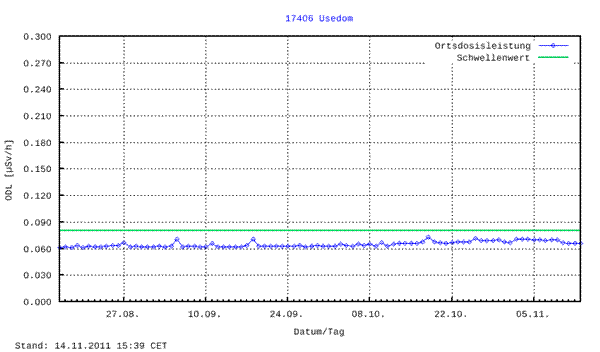
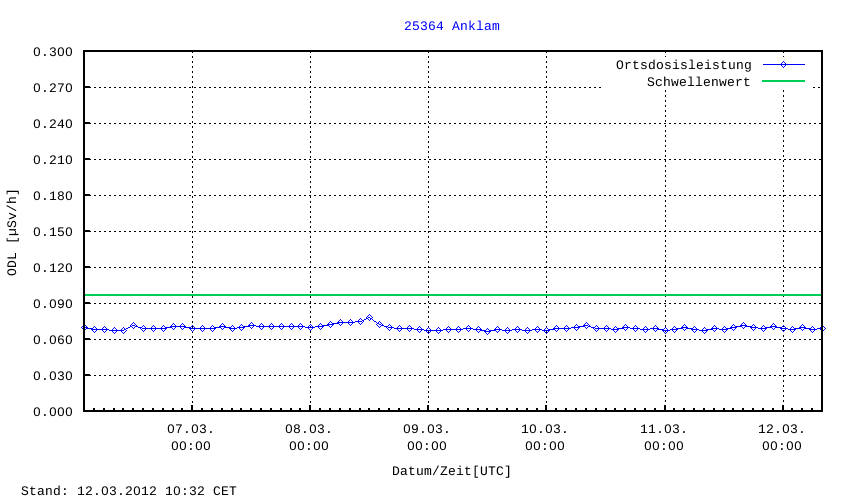
odlinfo.bfs.de
odlinfo.bfs.de
radiation in north east germany
all measuring posts: odlinfo.bfs.deby Edano via Odlinfo.bfs.de 11/14/2011 10:44:35 PM- all german federal countries: odlinfo.bfs.deby Edano 11/14/2011 10:46:51 PM
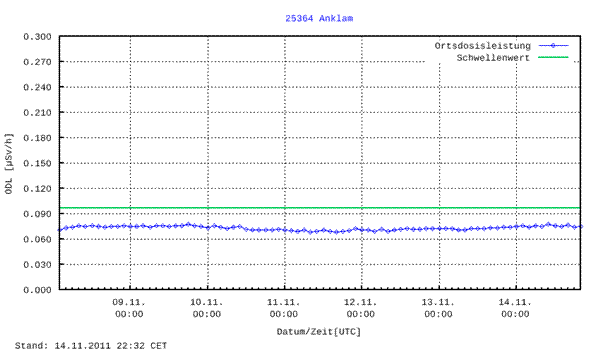 by Edano via Odlinfo.bfs.de 11/14/2011 10:48:01 PM
- @Edano what is blue / green?by elainekirk 11/14/2011 10:50:54 PM
- blue is tgamma, green is alarm threshold.by Edano 11/14/2011 10:51:49 PM
- ah thankyby elainekirk 11/14/2011 10:53:33 PM
- @lillymunster @liz, I just returned and saw your question concerning the use of sodium iodide crystals in nuclear medicine. I quote from the wiki en.wikipedia.org : "Sodium iodide activated with thallium, NaI(Tl), when subjected to ionizing radiation, emits photons (i.e., scintillate) and is used in scintillation detectors, traditionally in nuclear medicine, geophysics, nuclear physics, and environmental measurements. NaI(Tl) is the most widely used scintillation material and has the highest light yield of the commonly used scintillators. The crystals are usually coupled with a photomultiplier tube, in a hermetically sealed assembly, as sodium iodide is hygroscopic. Fine-tuning of some parameters (i.e., radiation hardness, afterglow, transparency) can be achieved by varying the conditions of the crystal growth. Crystals with a higher level of doping are used in X-ray detectors with high spectrometric quality. Sodium iodide can be used both as single crystals and as polycrystals for this purpose." In short, sodium iodide crystals are used in some radiation detectors, but do not contain radioactive isotopes of iodine.by Peter 11/14/2011 11:08:47 PM
- another 5.2 quake in eastern turkey quakes.globalincidentmap.comby Edano 11/14/2011 11:10:30 PM
- @Peter thanks! Great explanation. :-)by lillymunster 11/14/2011 11:13:38 PM
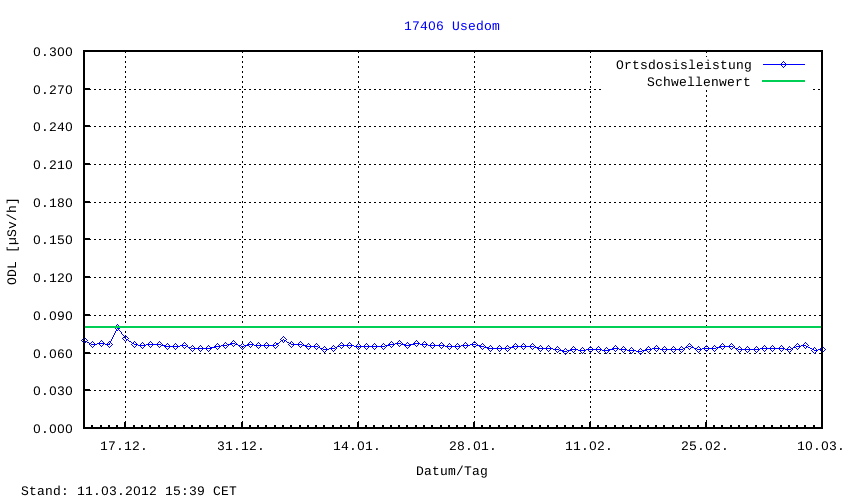
- All of the sites in NE Germany have the same little blip on Oct 17by lillymunster 11/14/2011 11:35:20 PM
- by lillymunster 11/14/2011 11:35:30 PM
- Blogger humor for the day: If the Idiots are too stupid to know where it is coming from, then perhaps, they need their toys taken away.by MaryW 11/14/2011 11:44:51 PM
- Europe Map radiationnetwork.comby MaryW 11/15/2011 12:07:22 AM
- @MaryW I like it
#by elainekirk 11/15/2011 12:22:50 AM - Group to study cattle's radiation exposure in Fukushima no-go zone
TOKYO, Nov. 15, Kyodo
A group of veterinarians and other researchers will soon begin studying cattle's radiation exposure at farms in Minamisoma, Fukushima Prefecture within a no-go zone near the crisis-hit Fukushima Daiichi nuclear power plant, participants said Tuesday.
Many of the roughly 3,500 cattle at farms within the 20-kilometers radius of the plant are believed to be living in the wild after their owners evacuated in March in the wake of the country's worst ever nuclear disaster. About 70 cows, however, have been recaptured and are now being raised on farms in parts of Minamisoma within the zone, according to the city office.
The group, including radiobiologist Nobuhiko Ito, a professor at Kitasato University, and members of the Japan Veterinary Medical Association will visit cooperating farms on a regular basis and study the extent of cattle's contamination with radioactive materials, they said. english.kyodonews.jpby Edano 11/15/2011 12:38:37 AM - Does anyone know whether there are/has been any increase readings in the US for iodine135 ?by MaryW 11/15/2011 12:42:09 AM
- @MaryW Have you looked at Radnet?by lillymunster 11/15/2011 12:44:10 AM
- Yes but....:)by MaryW 11/15/2011 12:45:03 AM
- If anyone knows a way to get historical graph data for Turkey or other EU countries that feed their data to EuDep please let me know. Other than the graphic map I can't seem to find actual numbers and graphs.by lillymunster 11/15/2011 12:45:30 AM
- @MaryW but what?by lillymunster 11/15/2011 12:45:37 AM
- Think I'm hoping for some independent readingby MaryW 11/15/2011 12:45:42 AM
- @MaryW Radiation network. There are also bunches of online meters at various universities and also a citizen network in Nevada. Berkeley has one that is live IIRC, google Tehachapi Clicky he might still have his online. Don't have the URL for the nevada citizen network but there is one. One of the universities in Washington state had monitors online when fuku was spewingby lillymunster 11/15/2011 12:47:33 AM
- I'm sure there are lots of citizens in US monitoring our levels and haven't heard of any increased findings out thereby MaryW 11/15/2011 12:48:00 AM
Japan Earthquake | Page 2660
- Who's Blogging
-
 hudebnik
 alblee
 UKVal
UKVal Oliver (ScribbleLive)
 Jonathan Keebler
 Matt (ScribbleLive)
 kaykodh
 PKelley
 Markfm
 dean
dean Angie
Angie- Edano
 Deb
Deb Mid Valley
- Pedro Jesus
 George Gibb
- elainekirk
- lillymunster
 bo
bo IanGoddard