Japan Earthquake | Page 2718
 I have to get a printer soon and print my files. I had videos in my email files that became censored after the internet videos were censored. So they have their waysby MaryW 11/29/2011 2:55:13 AM
 @Edano there were reports of explodey sounds from 2. I'm voting for water hammer destruction.by lillymunster 11/29/2011 2:55:19 AM
- YouTube has videos of reactor #2 explosionby MaryW 11/29/2011 3:25:41 AM
- Radioactive iodine and silver concentrate in squid liver and mollusks www.rist.or.jpby lillymunster 11/29/2011 3:51:26 AM

The most detailed and close-in shots I've ever seen of Unit 4. What strikes me is what I've noticed often, that the damage is a shattering, everything broken like grass, lot's a straight edges, fractures. In clear contrast, Unit 3 damage is twisted, melted, pulverized with signs of burning (little surprise then the visible fire with its explosion). Very distinct damage patterns consistent with Unit 3 being a different kind of explosion.
by Ian 11/29/2011 5:13:53 AM Ohio gozaimasuby bo 11/29/2011 5:16:37 AM
- by Ian 11/29/2011 6:50:25 AM
 bumpby Edano 11/29/2011 9:02:36 AM
- in the nightby bo 11/29/2011 9:13:36 AM
 It's early morning here. =)by Pedro Jesus 11/29/2011 9:35:11 AM
- "Nuclear waste arrives in Germany"
"Nov. 29 - Containers of radioactive material arrive safely at a storage facility in Germany. Julie Noce reports." uk.reuters.comby Pedro Jesus 11/29/2011 11:51:07 AM - Nobel Prize winner Tanaka eyed as member of nuclear crisis probe panel
TOKYO, Nov. 29, Kyodo
The ruling and opposition parties are making final arrangements to appoint Nobel chemistry laureate Koichi Tanaka as a member of a special committee in parliament to investigate the causes behind Japan's ongoing nuclear crisis at the Fukushima Daiichi power plant, sources familiar with the matter said Tuesday.
The parties also plan to make Kiyoshi Kurokawa, 75, former president of the Science Council of Japan, head of the 10-member panel, the sources said.
Ten panel members including Tanaka, 52, and Kurokawa are expected to be chosen by a joint council made up of members of the steering committees of both the lower and upper houses of parliament when the council holds a meeting on Thursday. english.kyodonews.jpby Edano 11/29/2011 11:59:11 AM - Rice shipments banned from part of Fukushima Pref. for contamination
TOKYO, Nov. 29, Kyodo english.kyodonews.jpby Edano 11/29/2011 11:59:37 AM - Japan to refuse setting new binding targets under Kyoto Protocol
TOKYO, Nov. 29, Kyodo
Japan will refuse to accept fresh binding targets for reducing developed countries' greenhouse gas emissions under the 1997 Kyoto Protocol, the world's only legally binding framework for reining in heat-trapping gases, government officials said Tuesday.
Japan will continue to seek a new framework that would require not only developed countries but all major gas-emitting nations to reduce emissions, the officials said.
The government of Prime Minister Yoshihiko Noda took the decision at Tuesday's ministerial meeting on global warming after nearly 200 countries across the globe started talks in Durban, South Africa, on Monday to discuss the fight against global warming. english.kyodonews.jpby Edano 11/29/2011 12:01:45 PM 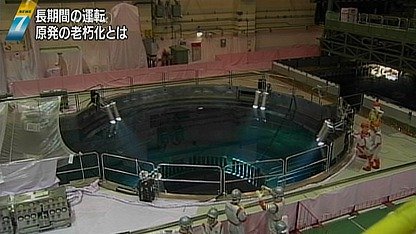
www3.nhk.or.jp
Panel studies aging effect on Fukushima accident
Japanese nuclear experts are investigating how the aging of facilities factored into the accident that struck the Fukushima Daiichi nuclear power plant in March.
The Nuclear and Industrial Safety Agency, together with a panel of experts, has begun studying regulations on aging nuclear plants. Nineteen --- or more than one-third of all reactors in Japan, including those in Fukushima --- began their operations more than 30 years ago.
In their first meeting on Tuesday, the panel's secretariat reported that the Fukushima Daiichi plant shut down automatically after the March 11th quake, and emergency power generators were working until the tsunami struck.
The staff said that facility aging did not appear to have been an issue in the accident.
The Fukushima plant lost all electricity sources on the day of the disaster, which caused meltdowns at 3 of the reactors.
But some experts said it is too early to determine causal relations of the accident at this point.
The government panel decided to study whether the age of facilities played a role in the accident before making revisions to its safety regulations for aging reactors.
In the meeting, the experts also reported that steel used for a 36-year-old reactor at the Genkai nuclear plant in southwestern Japan has become weaker than estimated.
Some members said that to win local approval to continue operating the reactor, the reason why this happened must be determined as soon as possible.
Tuesday, November 29, 2011 18:35 +0900 (JST)
www3.nhk.or.jpby Edano via Www3.nhk.or.jp 11/29/2011 12:02:39 PM- In the meeting, the experts also reported that steel used for a 36-year-old reactor at the Genkai nuclear plant in southwestern Japan has become weaker than estimated.
have to find more info on that.by Edano 11/29/2011 12:05:08 PM - by Edano 11/29/2011 12:08:06 PM
- Structures for nuclear facilities: analysis, design, construction ...
von M. Y. H. Bangash books.google.de
this book could become interesting ....by Edano 11/29/2011 12:12:21 PM - Tuesday, July 26, 2011
Nuclear Energy in Japan: Genkai pressure vessel embrittlement atomicpowerreview.blogspot.com
Today in Japan there are a number of reports in circulation concerning a report given by a Tokyo professor in the field of metal physics to a public watchdog group concerning supposed near-disastrous conditions at Genkai No. 1 in terms of the structural integrity of that plant's reactor pressure vessel.
The public watchdog group, Citizens Nuclear Information Center, is a Japanese non-profit that is WHOLLY ANTI-NUCLEAR. (This is flag number one.) The professor is an expert in what Japan Times says is the field of metal physics, but apparently so far as can be determined at this point has no real working knowledge of the history of reactor pressure vessel development or the study over many decades of neutron embrittlement. (This is flag number two.)
The presentation of data from this report, quotes from its author, and more are seen in the anti-nuclear hyperbole filled extravaganza linked below. If you can tolerate it, please read it and then return here for a sober discussion. search.japantimes.co.jp
......by Edano 11/29/2011 12:15:40 PM 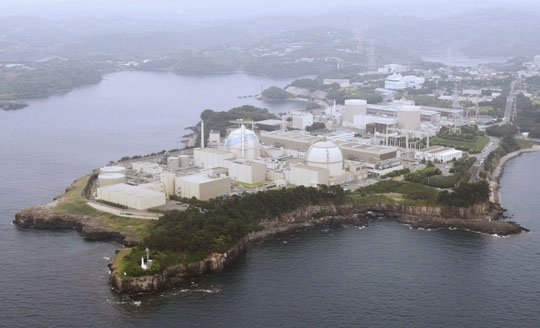
www.japantimes.co.jp
Brittleness factor of aging reactors key restart criterion
Decades of intense irradiation, heat skews cooling equation
By JUN HONGO
Staff writer
In the world of nuclear reactor science and safety, the ductile-brittle transition temperature, which is used to measure the strength of the inner wall of a reactor pressure vessel, is a critical factor.
The steel walls of a reactor vessel wear out through years of direct exposure to neutron irradiation, and when they are weakened they can become brittle with sudden temperature drops.
A high DBTT means the walls can shatter at a relatively high temperature when the vessel is going through the cooling process, similar to pouring ice-cold water into a hot glass, causing it to shatter.
Even though the government is mulling new stress-test standards and when to give the green light to reboot nuclear power plants across Japan, some experts warn that aged reactors and their high DBTTs should be considered key factors when assessing safety levels.
And when it comes to the brittleness factor, the one causing the most concern is reactor 1 at Kyushu Electric Power Co.'s Genkai nuclear plant in Saga Prefecture.
It has a DBTT of 98 degrees, the experts say.
The reactor "exceeded the ductile-brittle transition temperature of 81 degrees Celsius of the No. 1 nuclear reactor in Mihama (Fukui Prefecture)," Hiromitsu Ino, a University of Tokyo professor in metal physics, wrote in a thesis submitted in February to Citizen's Nuclear Information Center, a nonprofit organization.
In terms of age, the Mihama nuclear plant in Fukui Prefecture run by Kansai Electric Power Co. is older than unit 1 at Genkai.
The DBTT figure for reactor 1 at Genkai indicates that any attempt to cool it in an emergency would have to be conducted near at temperatures near boiling point.
"It can be considered the most dangerous reactor in Japan," Ito continued.
Genkai, with four reactors, is near the northwestern tip of Kyushu and is "surrounded by beautiful sea and grandeur of nature," as its website says. Reactor 1 is the oldest of the four, having begun producing electricity in 1975.
Reactors 1 and 4 are in operation, while 2 was shut down for routine checks in December, as was reactor 3 in January.
The plant drew recent media attention when it looked likely that reactors 2 and 3 would get the OK to restart, the first to do so since the March 11 quake and tsunami caused three reactor meltdowns at Tokyo Electric Power Co.'s Fukushima No. 1 nuclear plant.
But Prime Minister Naoto Kan abruptly stepped in and declared that all reactors nationwide would need to undergo stress tests to ensure their safety before they can be restarted.
The Genkai reboot bid fell through.
According to Kyushu Electric Power, reactor 1's DBTT has been soaring in recent years — from 35 degrees in 1976 to 56 degrees in 1993 and then to 98 degrees in 2009.
"There are so many things to do even before conducting a stress test at Genkai," Kobe University professor Katsuhiko Ishibashi said last week regarding the threat.
Ishibashi, who decades ago coined the term "genpatsu-shinsai" (nuclear-quake disaster) has been active in warning of the dangers of operating nuclear plants in earthquake-prone Japan for decades.
In a gathering in Tokyo, he said the level of metal fatigue is alarmingly high.
"No one, not even (industry minister Banri) Kaieda, can truly say the Genkai nuclear power plant is safe and ready for operation," he warned.
Regarding the extremely high DBTT of reactor 1, Kyushu Electric has acknowledged it is "above the expected level" but claims "safety is secured," based on test samples deliberately taken from a spot with high exposure to radiation and that the actual reactor vessel has an 80-degree DBTT.
Kyushu Electric also added that even if the unit continued to operate for approximately two more decades, the DBTT would only go as high as 91 degrees, 2 degrees lower than the standard required for any newly built reactors.
"At this point cooling off the vessel does not pose any threat," the utility said, adding DBTT shouldn't be taken as a definite temperature that will cause metal to fracture.
Kyushu Electric also stresses that a 4.9-meter-high tsunami induced by an 8.1-magnitude quake — considered the largest possible temblor — in the surrounding sea won't damage the nuclear plant because it is located well above sea level.
Such a temblor would hit the power plant with a level of acceleration of 120 gal, but that is still far below the 540 gal that reactor 1 is designed to withstand, the utility said.
Kobe University's Ishibashi said optimistic speculation can end up inducing grave consequences, as was the case in Fukushima.
For one, the seismology expert pointed out that Kyushu Electric's earthquake and tsunami assumptions are "too low, to the point that it should be considered criminal."
"The utility needs to calculate the possibility of a large-scale tsunami and losing all electricity power" and then figure out if having a weakened nuclear reactor that can't sustain sudden cooling is still safe under such circumstances, he insisted.
The tsunami that knocked out the Fukushima nuclear plant is believed to have been at least 14 meters, and well above Tepco's estimates. Historic records show that the region not far from Genkai was hit with major earthquakes above magnitude 7.0 in 679, 1700 and 2005, Ishibashi added.
"I wouldn't be surprised if a major earthquake hit the area around the nuclear power plant," Kobe University's Ishibashi said, reiterating that combined with the high DBTT, the consequences can exceed the damage caused in Fukushima. www.japantimes.co.jpby Edano via Japantimes.co.jp 11/29/2011 12:19:39 PM- hahaha, why do they set up a panel, if the genkai problem is only anti nuke hysteria ?by Edano 11/29/2011 12:21:58 PM
- Academic society set up to study decontamination
A group of researchers has set up an academic society in the hope of helping on-going efforts to remove radioactive materials caused by the trouble at the Fukushima Daiichi nuclear plant.
Researchers in a wide range of fields, including atomic energy and nuclear waste, jointly launched the society at a meeting in Tokyo on Monday.
Ehime University visiting professor Masatoshi Morita, an expert on environmental pollution, said progress has been slow in decontamination efforts centering on Fukushima Prefecture.
He emphasized the need for the cooperation of various types of specialists to study technologies that would be effective in cleaning up radioactive contamination.
A Japan Atomic Energy Agency official in charge of decontamination in Fukushima noted that radioactive contamination levels on houses near forests are difficult to reduce because of the radioactivity that adheres to trees.
The society hopes to come up with recommendations for municipal authorities making decontamination efforts.
Monday, November 28, 2011 21:44 +0900 (JST)
www3.nhk.or.jpby Edano 11/29/2011 12:28:59 PM - morning! (afternoon-evening).by lillymunster 11/29/2011 12:50:03 PM
- Reading the brittleness article. Makes me wonder if we have data on the same in other old reactors. I know there are a bunch of really old ones in the US. What is the oldest group still operating in the EU?by lillymunster 11/29/2011 12:52:12 PM
- The world's first commercial nuclear power station, Calder Hall in Sellafield, England was opened in 1956 with an initial capacity of 50 MW (later 200 MW).[34][40] The first commercial nuclear generator to become operational in the United States was the Shippingport Reactor (Pennsylvania, December 1957). en.wikipedia.orgby Edano 11/29/2011 12:56:30 PM
- Oyster Creek nuclear power station is a single unit 636 MWe boiling water reactor power plant located on an 800 acre (3.2 km²) site adjacent to the Oyster Creek in the Forked River section of Lacey Township in Ocean County, New Jersey. The facility is currently owned and operated by Exelon Corporation and is the oldest operating nuclear power plant in the United States. en.wikipedia.orgby Edano 11/29/2011 12:57:30 PM
- Commission date December 23, 1969
Licence expiration April 9, 2029by Edano 11/29/2011 12:58:31 PM - Oldest US nuclear reactor: a 'disaster' in waiting? www.physorg.comby Edano 11/29/2011 12:59:33 PM
- 1956: Queen switches on nuclear power
The Queen has opened the world's first full-scale nuclear power station, at Calder Hall in Cumberland. news.bbc.co.ukby Edano 11/29/2011 1:00:09 PM - What ones are still running in the EU though? The US has been discussed lots on the aging issue. Are there any of these old ones running outside US and Japan? Germany's oldest was 1975 that is still currently "running"by lillymunster 11/29/2011 1:01:18 PM
- oldest french 1977 www.euronews.netby Edano 11/29/2011 1:02:06 PM
- World's oldest nuclear plant to close down
Alan Jones
Saturday 22 October 2011
The oldest civilian nuclear reactor in the world will stop generating electricity next February after 44 years because it would not be economically viable to continue, it was announced yesterday.
The nuclear power station at Oldbury in Gloucestershire has been generating electricity since 1967. Operators Magnox and site owners the Nuclear Decommissioning Authority said Oldbury will move through a transition period before decommissioning begins. www.independent.co.ukby Edano 11/29/2011 1:03:50 PM - UK oldest Dungeness 1965, Hartlepoole 1965to1985 construction,by lillymunster 11/29/2011 1:05:29 PM
- hmmm article says oldbury ..by Edano 11/29/2011 1:07:21 PM
- Spain has a BWR started in 1971 that is still running en.wikipedia.orgby lillymunster 11/29/2011 1:10:23 PM
- NPPs in Spain date from late 60's and 70's. Spain is due to decommission all its 8 nuclear reactors as soon as renewable energy becomes viable, particularly in the neighbouring country Portugal.by Pedro Jesus 11/29/2011 1:10:34 PM
- @Edano sans Oldburyby lillymunster 11/29/2011 1:10:36 PM
- en.wikipedia.org yes, oldburyby Edano 11/29/2011 1:11:05 PM
- Sweden BWR Osckerham 1 started 1972by lillymunster 11/29/2011 1:13:04 PM
- Switzerland has a group of old reactors but IIRC they decided to phase out also?
Beznau NPP Beznau 47°33′09″N 8°13′43″E PWR 365 1969-
47°33′06″N 8°13′42″E PWR 365 1971-
Muehleberg Nuclear Power Plant Muehleberg 46°58′08″N 7°16′05″E BWR 355 1972-by lillymunster 11/29/2011 1:14:09 PM - That appears to be all in EU, skipped the former USSR countries.by lillymunster 11/29/2011 1:15:08 PM
- The metal brittlement issue, from what the one article mentions makes it almost impossible to rapidly cool down the reactor ala Unit 1. So can these things be even run safely? The US NRC refuses to address much of it. I remember seeing some metal analysis in either inspections or relicense documents but the NRC says they don't use it to decide if a plant should get a license extension.by lillymunster 11/29/2011 1:17:27 PM
- The person originally quoted on this issue was cited as being from Kobe uni. But AtomicPowerReview claims he works for CNIC? But then the article also cites this guy:
," Hiromitsu Ino, a University of Tokyo professor in metal physics, wrote in a thesis submitted in February to Citizen's Nuclear Information Center, a nonprofit organization.
So they have more than one person and more than CNIC.by lillymunster 11/29/2011 1:19:23 PM
One of the two NPP in Finland uses two BWRs. It was built during the late 70's by a Swedish firm ASEA-Atom, part of Toshiba Corporation since 2005. Both reactors are of ASEA-Atom design with some modules produced by other contractors in Sweden and Finland. This NPP is currently under expansion. The new Unit 3 is under construction, due to come online in 2013 (it's an EPR) and a 4th unit has already been licensed but it is not under construction yet.by Pedro Jesus 11/29/2011 1:34:48 PM- Quit nuclear power all together www.csmonitor.comby lillymunster 11/29/2011 1:52:54 PM

Japan Earthquake | Page 2718
- Who's Blogging
-
 hudebnik
 alblee
 UKVal
UKVal Oliver (ScribbleLive)
 Jonathan Keebler
 Matt (ScribbleLive)
 kaykodh
 PKelley
 Markfm
 dean
dean Angie
Angie- Edano
 Deb
Deb Mid Valley
- Pedro Jesus
 George Gibb
 elainekirk
- lillymunster
- bo
 IanGoddard