Japan Earthquake | Page 2719
 7 reasons to abandon nuclear power www.csmonitor.comby lillymunster 11/29/2011 1:56:14 PM
 Fukushima Daiichi nuclear power plant operator 'ignored tsunami warning'
Tokyo Electric Power rejected report warning the nuclear plant could be at risk from 10-metre high tsunami, media claim. The operator of the Fukushima Daiichi nuclear power plant ignored warnings that the complex was at risk of damage from a tsunami of the size that hit north-east Japan in March, and dismissed the need for better protection against seawater flooding, according to reports.
Tokyo Electric Power (Tepco) officials rejected "unrealistic" estimates made in a 2008 internal report that the plant could be threatened by a tsunami of up to 10.2 metres, Kyodo news agency said. www.guardian.co.ukby Majj 11/29/2011 1:59:17 PM- FLASH: Six UK embassy staff taken hostage by protesters in northern compound of Tehran embassy - Mehr news agencyby lillymunster 11/29/2011 2:10:13 PM
- power washing fruit trees ex-skf.blogspot.comby lillymunster 11/29/2011 2:11:44 PM
- TEPCO radiation levels inside/outside silt fence of units 1-4 and draft quay. Still in the high 200 bq/L www.tepco.co.jp
TEPCO claims no radiation in seawater off Ibaraki www.tepco.co.jp
TEPCO seawater sampling near the plant. Makes no mention of how deep they tested. www.tepco.co.jp
No new photos of interest unless someone needs a photo of the desalination unit.by lillymunster 11/29/2011 2:24:31 PM - Another Fukushima group. They offer "escape" service/references and have lots of info on health safety. www45.atwiki.jpby lillymunster 11/29/2011 3:36:09 PM
- Local citizen rad readings: November 30 (Wednesday) when 0 "⇒ 0.98 Fukushima" "⇒ 0.76 Koriyama City," "⇒ 0.39 Shirakawa" "⇒ 0.13 Aizuwakamatsu" "⇒ 0.41 Minamisoma" "⇒ 0.16 Iwaki" unit: μGy / h ≒ μSv / h # fukushima # botby lillymunster 11/29/2011 3:41:43 PM
 Help to relocate or "escape" options offered by Geographic Communities Listed by Country and State or Province. directory.ic.orgby MaryW 11/29/2011 4:32:30 PM
- @MaryW Interesting. Do you have any understanding of how these groups work? Might be something desired for someone who doesn't have much already and wants out of Fukushima.by lillymunster 11/29/2011 4:45:35 PM
- @lillymunster I will try to find the source for this link and post it. It was offered to Japanese residents who need to find alternative housing so they are able to leave Japan. A number of these communities list free housing in exchange of helping the community in their gardens, making meals, building repair or whatever. Stays can be temporary, others can be permanent. Each location gives a description of the site's housing, acreage and etc, along with contact phone numbers and email addresses to obtain additional information.by MaryW 11/29/2011 5:06:33 PM
- Fukushima manager says he intends to return to work after medical leave www.bloomberg.comby lillymunster 11/29/2011 5:13:51 PM
- Found something interesting while researching rpv embrittlement. Tepco contradicts itself on IC of Unit 1. Recall, a tepco official exclaiming that even had it performed, the IC was not going to make a difference in the course of events? In the NISA report to IAEA last June, page IV-46, I read: "The basic means of cooling the reactor after the MSIV is closed are cooling via the IC and water injection via the HPCI."by Peter 11/29/2011 5:18:11 PM
- @Peter So the main means TEPCO admits wouldn't work well enough.
Are the embrittlement number expressions used in the Japan Times article normal? I seem to remember NRC using more of a formula to express embrittlement.by lillymunster 11/29/2011 5:30:48 PM - Here is something important for the interpretation of rpv temps on p IV-45 of the NISA June IAEA report: "As a result of increasing the amount of water injected when the injection was changed from the feed water line on March 23 the temperature of the RPV bottom dropped from being higher than the measurable maximum (greater than 400°C),..." Hence, 400°C can be any greater temp.by Peter 11/29/2011 5:34:25 PM
- @lillymunster , perhaps it is best to paste the whole paragraph on p IV-46: "The basic means of cooling the reactor after the MSIV is closed are cooling via the IC and water injection via the HPCI. However, there were few records of the operating conditions of these systems following arrival of the tsunami. Furthermore, the radiation dose rose in the turbine building at around 23:00 on March 11 and there was an unusual rise in pressure in the PCV at around 0:49 on March 12. Therefore, these conditions suggest that the RPV had been damaged before 23:00 on March 11 to increase the pressure and temperature of the PCV significantly, which led to the leakage from the PCV. Similarly, the information, written on the whiteboard in the central control room, of the increased indication of the radiation monitor when the outer air lock was put on at 17:50 on March 11 suggest that core damage was then starting. Analysis is required from here on to confirm the degree to which IC and HPCI were functioning that includes detailed investigation and analysis of the conditions of each component."by Peter 11/29/2011 5:38:05 PM
- Based on the wiki timeline 14:46 was the quake, 15:27 tsunami so about 3 hours until they notice what they think is meltdown signs.by lillymunster 11/29/2011 5:44:08 PM
- Because of the rpv embrittlement issue, the operator was instructed to maintain the rate of change in rpv temp at or lower than 55°C/h. Let us say the rpv temp after the scram was 400°C, it would have taken at least six hours to cool the rpv down to 100°C, that is to cold shutdown. Needless to say the temp probably was several 100 degrees higher. Even if the diesel generators had worked, would they have had sufficient fuel for the time necessary to reach cold shutdown? This is the essential question that must be asked for reactors of similar design here in the US.
by Peter 11/29/2011 5:46:55 PM - @lillymunster , imagine people were sent into the building during these hours. Makes you wonder whether tepco reported their absorbed doses accurately.by Peter 11/29/2011 5:49:14 PM
- Conrad Murray, Michael Jackson's "doctor", probation denied, sentence is 4 years prison for involuntary manslaughter.by MaryW 11/29/2011 5:57:50 PM
- @Peter If they were reporting leaks at 3 hours and that meltdown was likely underway that seems really early to me? So if it was 400c at SCRAM, little or not cooling is would continue to go up rather than down from that 400c. We know they had the 55c/h instruction. Do we have any actual way of finding the temp at scram and temp 3 hours later or is that in the data hole where they didn't have info?by lillymunster 11/29/2011 6:03:21 PM
- @lillymunster , I have been looking for this data. Perhaps @edano would know.by Peter 11/29/2011 6:33:10 PM
- In an entirely different vain, I was still thinking about Fukushima Plant Director Yoshida who just left his post because of health reasons. Sometime ago, Dean posted a National Geographic video on the Chernobyl accident. We were hoping to get a glimpse on the actual explosion, but it turned out to be a re-enactment. The video contained interviews with the two operators whose actions caused the accident. Though they acted on instructions, it seemed none felt responsible for what happened. By contrast, Yoshida's first statement contained an apology for the distress (inconvenience in Japanese) that his plant had inflicted. In my mind Yoshida did not have to apologize. Without him and his crew much worse could have happened, whereas the mentality that the Soviet Union bred gives me the creeps.by Peter 11/29/2011 6:36:14 PM
- @Peter Everything Yoshida and those that stayed on have done has been beyond heroicby lillymunster 11/29/2011 6:42:54 PM
- Fukushima plant head told workers to disregard order on water injection
TOKYO, Nov. 30, Kyodo
The head of the troubled Fukushima Daiichi nuclear power plant, who will be relieved of his post effective Thursday for medical treatment, told workers to disregard the plant operator's order to stop injecting seawater into a reactor soon after the nuclear crisis erupted in March, government and other sources said Tuesday.
Masao Yoshida, who has since drawn media attention over his decision to continue the seawater injection despite Tokyo Electric Power Co.'s decision to suspend the measure, told workers not to obey his ensuing instruction before going on to order them to stop injecting the water, according to government and TEPCO sources.
While some people have criticized Yoshida's unilateral action, others have said his decision prevented the situation at the plant from deteriorating as workers scrambled to try to bring the crisis, triggered by the March 11 earthquake and tsunami, under control.
The disaster caused the plant's No. 1 reactor to lose power and thus its cooling functions. As the supply of fresh water to cool the reactor was running out, workers began injecting seawater from shortly after 7 p.m. on March 12.
But the utility's head office instructed Yoshida to stop the seawater injection after a TEPCO official, who was dispatched to then Prime Minister Naoto Kan's office, reported to the head office that there was ''a feeling that seawater injection could not be implemented without the prime minister's decision.''
Yoshida then told the workers, ''I will order you to stop the water injection..., but do not listen to it,'' before instructing them to stop the seawater injection, according to the sources.
The workers ignored the order and continued injecting seawater into the reactor, they said.
Based on a report from Yoshida, TEPCO initially announced that seawater injection had been suspended from 7:25 p.m. to 7:55 p.m. Two months later, he revealed that the injection had not actually been suspended and he was reprimanded by TEPCO.
On Monday, TEPCO said Yoshida had been hospitalized and will be relieved of his post, while declining to provide details of his illness and his accumulated radiation exposure, citing privacy, only saying that doctors have not indicated a link to radiation.
Yoshida, who became the plant's chief in June 2010, has directed onsite operations to bring the radiation-leaking plant under control since the March 11 disaster triggered Japan's worst nuclear crisis.
english.kyodonews.jpby lillymunster 11/29/2011 7:11:15 PM - Myagi prefecture port is top place for bonito catch english.kyodonews.jpby lillymunster 11/29/2011 7:35:58 PM
- Fukui municipalities call on gov't to keep nuclear power plants
TOKYO, Nov. 29, Kyodo
Fukui Prefecture municipalities that host nuclear power plants urged the central government on Tuesday to maintain the plants at a time when it is mulling the best combination of energy sources following the nuclear crisis at the Fukushima Daiichi power plant.
''The host communities hope the need for nuclear power generation will be shown and such power will be used in the search for a better mix of power sources,'' a group representing the municipalities said in a statement.
Jitaro Yamaguchi, chairman of the group and also mayor of Mihama town that hosts a Kansai Electric Power Co. nuclear power plant, handed the statement to Economy, Trade and Industry Minister Yukio Edano at the ministry.
Yamaguchi also said the request is premised on ensuring the safety of residents in areas with nuclear power stations.
Edano responded, ''Even if the nation's (nuclear power) policy changes, we intend to thoroughly fulfill our responsibility (to the municipalities).''
On the same day, Mitsuharu Kanazawa, mayor of Oma town in Aomori Prefecture, asked Tadahiro Matsushita, senior vice industry minister, to realize the early resumption of construction of Electric Power Development Co.'s Oma nuclear power plant.by lillymunster 11/29/2011 7:37:55 PM - Again the NRC does a no-notice meeting:
November 29, 2011
NRC TO DISCUSS IMPLEMENTING RECOMMENDATIONS OF
NEAR-TERM JAPAN TASK FORCE DEC. 1 IN ROCKVILLE, MD
Nuclear Regulatory Commission staff will meet with industry representatives Thursday,
Dec. 1, to discuss the NRC’s Japan Near-Term Task Force recommendations, which were
subsequently categorized as “Tier 1,” those to be implemented without unnecessary delay. The
Task Force examined issues raised by the Fukushima nuclear accident in March.
The meeting will be held from 9 a.m. – noon in Room T2B3 of the Two White Flint
North building, 11545 Rockville Pike, Rockville, Md. Discussion will focus on the general
approach to implementing the “Tier 1” recommendations. The public will have the opportunity
to ask the NRC staff questions about the process during the meeting, which will be webcast. A
teleconference will also be available by calling 888-469-1349 and using passcode 2977606.by lillymunster 11/29/2011 7:39:51 PM
Report: Huge blast heard in Iranian city of Isfahan
Iran's Fars news agency reported a large explosion in one of Iran's largest cities, located near uranium conversion plant. Report removed from website shortly afterwards; security officials deny incident Conflicting reports?
Less than two weeks after a mysterious explosion destroyed an Iranian missile base near Tehran, the Islamic Republic's official news agency Fars reported Tuesday that a loud blast was heard in the city of Isfahan at 2:40 pm local time, but later removed the report. According to the initial report, search and rescue teams called to the scene confirmed the blast, but reported no injuries. Iran's uranium conversion plant is located just outside Isfahan – one of the country's largest cities. The report also stated that a security official confirmed that the explosion had occurred, but refused to give further details. The district's security department head Muhammad Mahdi Ismaili told the news agency that he hadn't received "exact information, but the incident is being investigated." In a curious turn of events, shortly after the initial report was published, the item was removed from the news agency's website, which is affiliated with the country's Revolutionary Guard. Hours later, conflicting reports began to surface, the deputy governor of Isfahan province telling Iran's Mehr news agency that there was no report of a major explosion in the province. "So far no report of a major explosion has been heard from any government body in Isfahan," he was quoted as saying. However, the news agency also quoted another Iranian media outlet as saying that a blast took place at a petrol station in a town near Isfahan.Meanwhile, the head of Isfahan province judiciary told Isna news agency that an explosion-like sound was heard across the city. "In the afternoon, there was a noise like an explosion, but we don't have any information from security forces on the source of the noise," Gholamreza Ansari was quoted as saying.The uranium conversion plant is an integral part of Iran's nuclear program, where urania, also known as Yellowcake, is processed into uranium hexafluoride gas (UF6).From there, the gas is transferred to Iran's nuclear facilities in Natanz and Qom.
www.ynetnews.comby Liz edited by lillymunster 11/29/2011 7:40:17 PM- sorry my computer is all messed up!by Liz 11/29/2011 7:41:16 PM
- The 11 March Japan Disaster/Comprehensive Nuclear-Test-Ban-Treaty (CTBT) Preparatory Commission. The CTBTO's measuring stations help Japanese authorities issue timely tsunami warnings and traced the dispersal of radioactivity from the Fukushima power plant globally. www.ctbto.orgby MaryW 11/29/2011 7:53:20 PM
- radiation in soybeans
400 becquerel Nihonmatsu Fukushima Iwaki City, Fukushima 240 becquerel Becquerel 216 Saigo Village, Fukushima , Fukushima 190 becquerels Tenei village Tenei village in Fukushima Prefecture 190 becquerels Becquerel Sukagawa, Fukushima 184 Tome, Miyagi 240 becquerel becquerel 99 Yamamoto-cho, Miyagi , Iwate Becquerel 96 Ichinoseki , Iwate Prefecture 25 becquerel陸前高田City Morioka, Iwate Prefecture 64 becquerel becquerel 99 Hitachi City, Ibaraki , Tochigi Prefecture 78 becquerel Nasushiobara 38 Becquerel, Tochigi Shioya town 59 becquerel Nikko Nikko, Tochigi Prefecture 43 Becquerel , Tochigi Otawara 32 becquerel Becquerel Shibukawa, Gunma 111 or more,
d.hatena.ne.jpby lillymunster 11/29/2011 8:11:27 PM - I found this description pbadupws.nrc.gov on IC function. We had some posted before, but this piece gives the most detailed explanation:
"6.3.2.1 The isolation condenser
The isolation condenser, figure 6.3-1, operates by natural circulation. During system operation, steam flows from the reactor condenses in the tubes of the isolation condenser,and returns (by gravity) to the reactor. The water head, created
by condensate flow to the reactor, serves as the driving force for the system.
The isolation condenser is approximately 55 feet long, 12 feet in diameter, and holds approximately 29,000 gallons of water at normal level. Two tube bundles are immersed in Water, one bundle at each end of the condenser. The shell side of the condenser vents to atmosphere. Baffles are installed in the shell above the tube bundles to prevent the boiling action from driving shell water out through the shell vents.
The steam inlet valves are normally open so that the tube bundles are at reactor pressure even when in standby. The tube side of the isolation condenser is vented to the main steam line during normal reactor operation. A sustained high reactor pressure automatically puts the isolation condenser system in operation. An automatic initiation will signal the dc motor operated valve on the condensate return line to open and vent valves to the main steam line to close. Steam then flows, under reactor pressure, to the isolation condenser. The steam is routed to both condenser tube bundles where it is condensed by the cooler water in the shell side of the condenser. To obtain the desired flow of condensate from the isolation condenser to the reactor vessel, the normally closed condensate return valve can be throttled by the operator in the control room.
During operation, the water on the shell side of the condenser will boil off and vent steam to the atmosphere. Two radiation monitors are provided on the shell side vent so that in the event of excessive radiation levels, the control room operator will be alerted and can take necessary corrective actions.
Following a reactor isolation and scram, the energy added to the coolant will cause reactor pressure to increase and may initiate the isolation condenser. The capacity of this system is equivalent to the decay heat rate generation 5 minutes following the scram and isolation. With no makeup water, the volume of water stored in the isolation condenser will be depleted in 1 hour and 30 minutes. This allows sufficient time to initiate makeup water flow to the shell side of the condenser.
Makeup water is normally added from the demineralized water makeup system to avoid concentrating radioactive matter resulting from normal water evaporation that occurs in standby mode. Additional water is available from the condensate and fire protection systems." So the operator did not have to shut the valves entire. Rather he could have throttled the flow thereby maintaining functionality. Besides, there is quite some wishful thinking in this design.by Peter 11/29/2011 8:57:02 PM - @Peter Oh there are so many things that could go wrong with that. 1hr to 30min of water in the tanks. Do you remember how many minutes post scram til the operator shut the IC valve?by lillymunster 11/29/2011 9:24:55 PM
- Found it in the timeline:
14:46 quake
14:52: IC turns on
15:03: operator shuts off IC
Exactly 5 min from scram to IC turn on. 11 min until operator shut the IC valve
Our outline of the video of the IC inspection trip inside unit 1 www.simplyinfo.orgby lillymunster 11/29/2011 9:26:23 PM 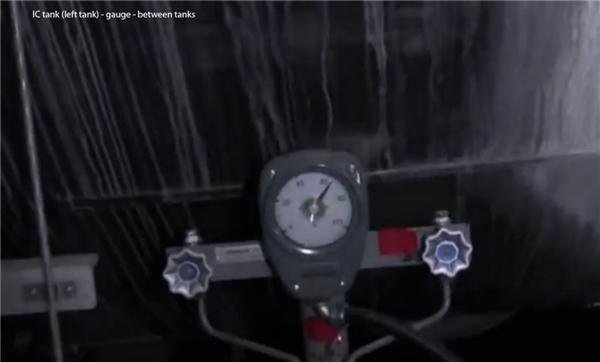
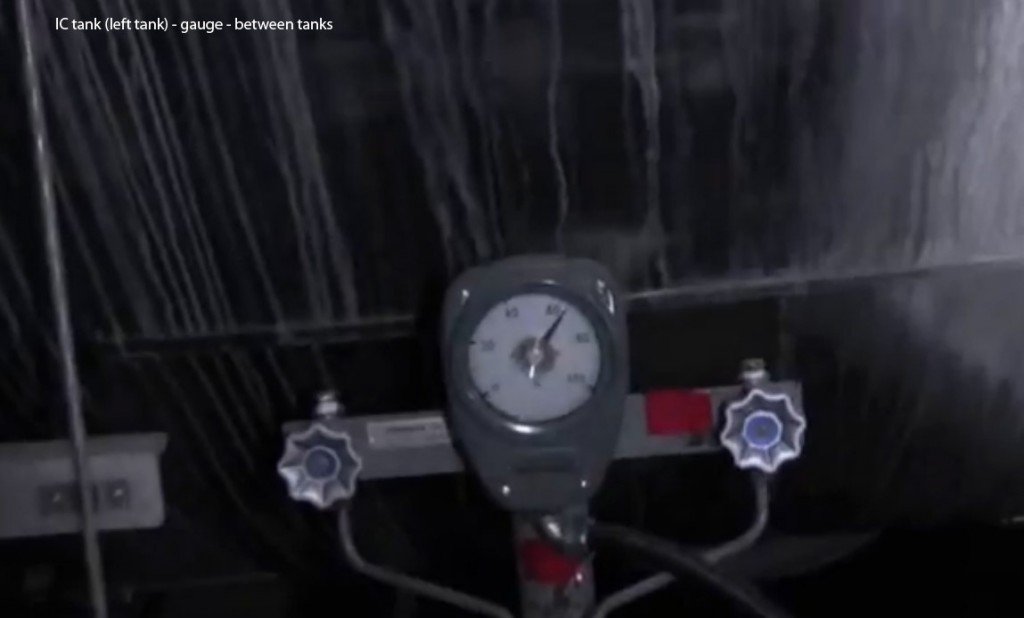
Left IC at 60 (don't know if that is PSI, percentage or what) houseoffoust.com
by lillymunster via Houseoffoust 11/29/2011 9:31:05 PM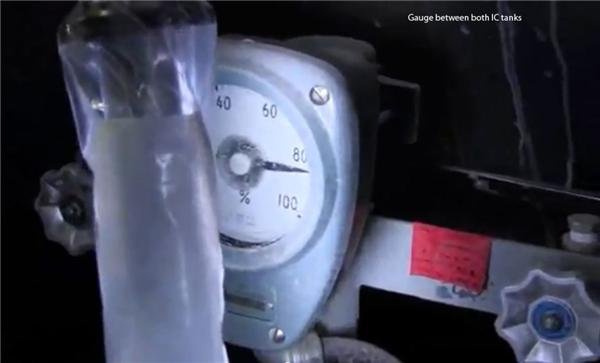
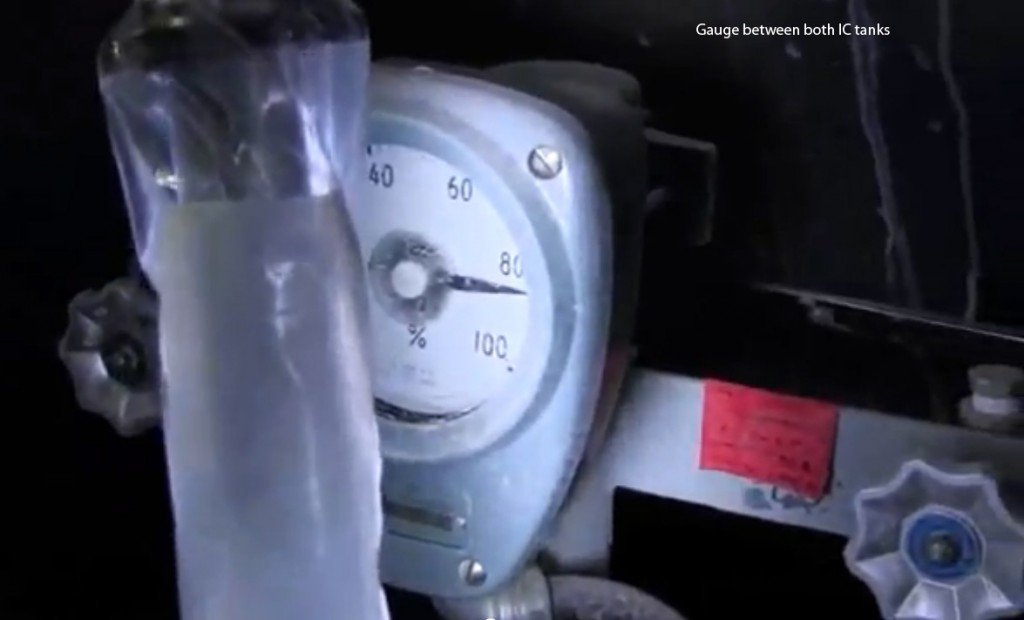
Right tank at about 85 houseoffoust.com
by lillymunster via Houseoffoust 11/29/2011 9:31:27 PM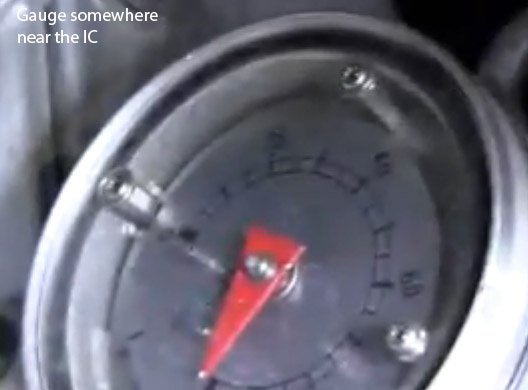
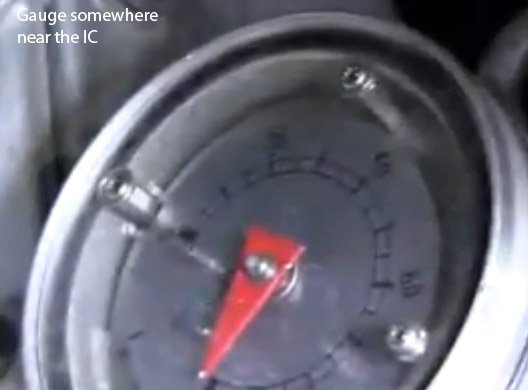
Gauge at the end of the IC tanks houseoffoust.com
by lillymunster via Houseoffoust 11/29/2011 9:32:51 PM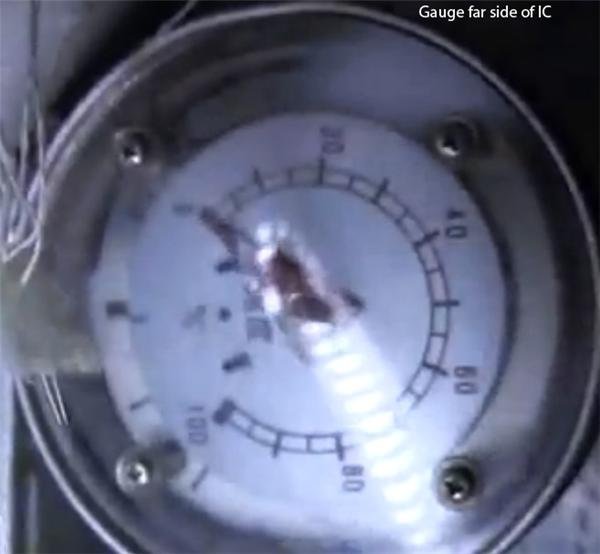
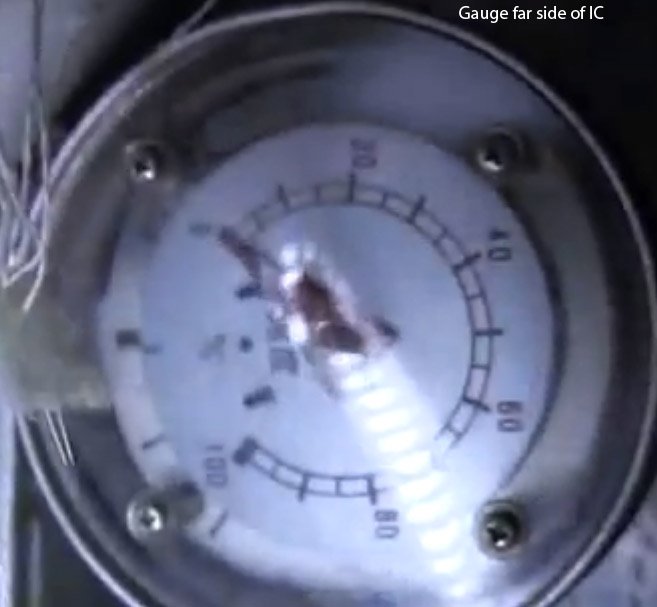
The other gauge at the far end of the IC tanks. Could not determine during the video what gauge belonged to what tanks houseoffoust.com
by lillymunster via Houseoffoust 11/29/2011 9:33:38 PM- Left tank at 60, right tank 80 then the mystery gauges at the tank ends, one is 100 and the other at 0. I think these may be percentages on the gauge face?
Also noticed this in the wiki timeline:
15:30: The emergency condenser designed to cool the steam inside the pressure vessel of the No. 1 reactor fails.
Not sure if this is "fail" because they lost DC and could not reopen?
en.wikipedia.org
This claims "emergency cooling" back on but doesn't say if it is the IC
18:18: Reactor 1's emergency cooling system is once again back on.by lillymunster 11/29/2011 9:35:29 PM - Alert Map. Event: Environment Pollution in Japan (Fukushima wide) on Tuesday, 29 November 2011. Event Description: Radioactive rice has been detected again in Japan... hisz.rsoe.huby MaryW 11/29/2011 9:48:45 PM
 Additional rice shipment ban due to radioactivity
Japan's government has banned rice shipments from 2 districts in Fukushima Prefecture after samples were found to be contaminated with radioactive cesium above the state limit.
Chief Cabinet Secretary Osamu Fujimura said on Tuesday that he instructed the prefecture's governor to suspend shipments of rice harvested this year in the districts in Date City. The areas are about 60 kilometers from the crippled Fukushima Daiichi nuclear plant.
Fujimura said 9 kilograms of contaminated rice has been sold to consumers, and that the prefectural government is trying to find out whether it has been consumed.
In October, Fukushima Prefecture said all rice harvested in the prefecture this year had been cleared for shipment, with radioactivity levels below the government standard. But this month, the prefectural government found contaminated rice in a district in Fukushima City, about 60 kilometers from the plant. Shipments of rice from the district have been suspended.
Tuesday, November 29, 2011 18:35 +0900 (JST)
www3.nhk.or.jpby Edano 11/29/2011 9:59:33 PM- NRC SEEKS PUBLIC COMMENT ON IMPLEMENTATION
OF REACTOR OVERSIGHT PROCESS
The Nuclear Regulatory Commission is seeking public comment on the implementation of
the Reactor Oversight Process (ROP), which the agency put in place 11 years ago to revamp and
improve its inspection and enforcement programs for commercial nuclear power plants. Every two
years, the NRC seeks feedback from the public to help the agency continue to improve its regulatory
approach.
In particular, the NRC would appreciate the public’s feedback on a list of questions relating
to the ROP, including the following:
Does the Inspection Program adequately cover areas important to safety?
Is the information in NRC inspection reports useful to you?
Is the ROP understandable, and are the processes, procedures and products clear and written
in plain English?
Has the public had sufficient opportunity to participate in the ROP and provide input and
comments?
All information on the survey is contained in the Federal Register notice. The 2011 ROP Survey is
available on the NRC’s website.
The comment period runs until Jan. 13, 2012. You may submit survey forms by emailing the
electronic version via the NRC website and select “submit survey” button; e-mail scanned survey
forms to ROPSurvey@nrc.gov or mail the survey forms to Cindy Bladey, Chief, Rules,
Announcements and Directives Branch, Office of Administration, Mail Stop TWV-05-B01M, U.S.
Nuclear Regulatory Commission, Washington, D.C., 20555-0001 and include Docket ID
NRC-2011-0270 in the subject line of your submission.
Information regarding the ROP and licensee performance can be found on the NRC website.
Public survey submissions and supporting materials related to this action can be found at
Regulations.gov by searching on Docket ID NRC-2011-0270 ; NRC’s Public Document Room,
One White Flint North, 11555 Rockville Pike, Rockville, Md, Room 01-F21, and in the agency’s
electronic document management system, ADAMS accession number ML112030316.
Via NRC emailby lillymunster 11/29/2011 10:01:19 PM - Just In: Asahi reports on recent plutonium detections--better translation needed. Nov 29.2011 04:38pmEDT enenews.comby MaryW 11/29/2011 10:02:33 PM
- Fukui municipalities call on gov't to keep nuclear power plants
TOKYO, Nov. 29, Kyodo english.kyodonews.jpby Edano 11/29/2011 10:02:55 PM - So the GoJ has learned nothing from the cesium beef mess. They declared fukushima rice safe after testing a couple of locations unlikely to have contamination. Then they had to backpeddle oops the rice is dangerous. What did they THINK would happenby lillymunster 11/29/2011 10:03:18 PM
Japan Earthquake | Page 2719
- Who's Blogging
-
 hudebnik
 alblee
 UKVal
UKVal Oliver (ScribbleLive)
 Jonathan Keebler
 Matt (ScribbleLive)
 kaykodh
 PKelley
 Markfm
 dean
dean Angie
Angie- Edano
 Deb
Deb Mid Valley
- Pedro Jesus
 George Gibb
 elainekirk
- lillymunster
 bo
bo IanGoddard