Japan Earthquake | Page 1273
 Hi @nancy - here are some nice pretty 5&6 temp graphs - no, I don't know what they show! www.tepco.co.jpby hudebnik 5/20/2011 12:17:37 PM
 @Ralph Unger nope, look at the corner of #2, there is a small pipe that runs up the side.by Nancy 5/20/2011 12:24:37 PM
- @hudebnik Thanks, I am a tad paranoid about #6 after TEPCO said it was at risk of flooding the cooling systems.by Nancy 5/20/2011 12:26:06 PM
- @nancy - I'm paranoid about EVERYTHING!by hudebnik 5/20/2011 12:27:17 PM
 Lisa P. Jackson needs our support! She is defending the EPA. Or what is left of it....by Ralph Unger 5/20/2011 12:29:53 PM
- I think we can infer that #5 is temperature cycling over quite a wide range, 45-70C, #6 is cooler, 25-50C. But what goes down as the temperature rises? My guess is that the first of the 2 traces for each reactor is water temp (I think I recognise the Kanji character for water in the legend) the second is some other sensor (?). Any Japanese speakers on the board?by hudebnik 5/20/2011 12:32:57 PM
 @hudebnik 原子炉水温度 reactor water temperature
使用済麟料ブール温度 SFP water temperatureby Jocke_Jensen 5/20/2011 12:33:19 PM- @Jocke - that's brilliant, thanks.by hudebnik 5/20/2011 12:34:40 PM
- So I've passed 1st grade Kanji...by hudebnik 5/20/2011 12:35:10 PM
- Google translate works wonder for the kanji you dont know :) I can only read water, temperature and the katakana for poolby Jocke_Jensen 5/20/2011 12:36:26 PM
- Unfortunately I can't get Google to tx stuff from Tepco's PDFs because they have set the permissions to deny copying.by hudebnik 5/20/2011 12:38:23 PM
- @hudebnik What I am keeping an eye out for is any temp spikes that don't routinely go back down or sudden black out of data on #6 indicating the reactor systems might have been flooded out. How they let #6 fill up with 6 feet of water is just beyond me. One would think preventing the other 2 from melting down would be a priority in water management decisions.by Nancy 5/20/2011 12:38:35 PM
- @hudebnik This little app works wonders. I used it to unlock the one I translated the other day. wwwpdfs\.pdfunlock.comby Nancy 5/20/2011 12:39:27 PM
- @hudebnik maggie.ocrgrid.org take a printscreen and run it tru that site, then use any radical lookup tool to correct if there is any errorby Jocke_Jensen 5/20/2011 12:39:48 PM
- Thanks for suggestions - pdfunlock then google worked fine!by hudebnik 5/20/2011 12:45:13 PM
- Now nothing is safe from our prying eyes...by hudebnik 5/20/2011 12:46:10 PM
 @Nancy I think it is a (highly contaminated) ground water issue. Several weeks ago the mentioned pumping out water from #6 and referred to it as "subdrains". Groundwater level ther is high, and is going to continue to be a factor. I brought up real early, that they have groundwater pumps working around the clock, in normal times.. www.asahi.comby RBeaner 5/20/2011 12:48:44 PM
- @hudebnik TEPCO will not defeat me. :-) It just annoys me that they lock down their documents to that extent. I had one I could not save and reopen because they put a password on it.by Nancy 5/20/2011 12:56:07 PM
- @nancy - they won't defeat me either. I was very pleased to spirit the historical reactor docs from them before they had realised what they had done. As we used to say at the BBC after an especially big c**k-up, "Assistant Heads will roll!"by hudebnik 5/20/2011 1:02:39 PM
- @hudebnik Elaine found tons of documents doing a bit of reasearch. We saved anything that looked of value. TEPCO was erasing documents over a month ago. So anything found of use keep a copy! We can figure out how to share and distribute later. Making copies before TEPCO deletes them is probably the biggest issue right now.by Nancy 5/20/2011 1:09:28 PM

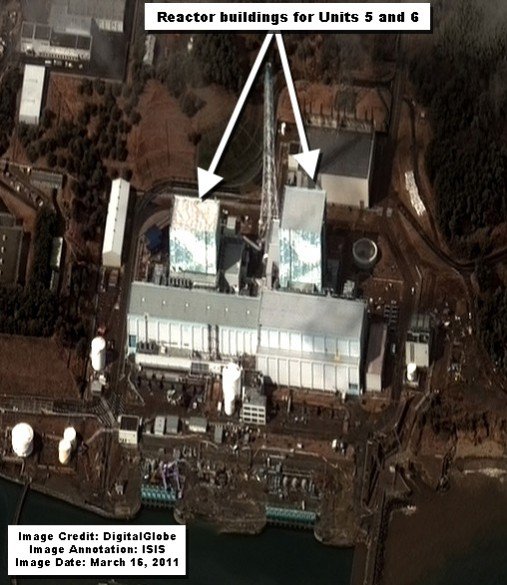
Find this photo : chong.zxq.net
by Majj via Chong.zxq.net 5/20/2011 1:15:59 PM For 20 May NISA reports, they have filenames of the form "pdfs\.pdfs\.pdf" instead of "pdfs\.pdf"by Markfm 5/20/2011 1:16:24 PM
- New news from Japan via some of the reporters I have contact with.
#3 is having heat issues, they intend to water more. Estimate is they will be out of water holding capacity in 1 week. No plan what they will do, sea release may happen again.
Worker conditions are getting worse, the upcoming summer heat is a major concern with no current plan. If we have brainstorming ideas on this we should gather and pass on.
Building 3 is having structural issues. They are warning workers about falling objects but have not rated it as fragile yet as in needing a new plan but it is a concern.by Nancy 5/20/2011 1:26:14 PM - I hate to post and fly. I have to leave, should be back in about 6 hrs and can field questions related to the post below.by Nancy 5/20/2011 1:26:37 PM
- @markfm - well found! Typical Homer-style efficiency there, then. So #1 temp falling but pressure still rising, #4SFP pretty hot...by hudebnik 5/20/2011 1:27:24 PM
- @nancy - bye, thanks for all.by hudebnik 5/20/2011 1:29:34 PM
- Katsushika Toukyou radiation dose experts remeasured five times the government announced translate.google.co.krby Majj 5/20/2011 1:31:21 PM
- The #4 SFP temp is 7 May data.by Markfm 5/20/2011 1:31:45 PM
 #3 warning about falling objects, but not yet calling it fragile -- yeah, right. ("Pieces are falling off, but don't worry")by Markfm 5/20/2011 1:36:21 PM
- @Nancy:
May be you have missed this...
@estacion and @Nancy: The TEPCO plan was for the water supply and drainage system at Daiichi NPP and the Japanese for deep well indicates it is a well that "goes down to the water table."
by dhby estacion 5/20/2011 1:44:27 PM - 19 May 5:00 vs. 20 May 11:00 plant parameters. #1 WL listed as +150 mm, but who knows -- haven't heard of anything to stop the leaks. #1 RPV pressure continues slow rise, RPV temps up 3 - 7C, at 93/109C, DW temps show +5C, at 92/95C, DW B CAMS up 11 at 47 Sv/hr. #2 temps pretty much unchanged, over 100C in RPV and DW, S/C at 64 - 65C, slow drop in CAMS radiation readings, spent fuel pool temp down 15 to 55C. #3 RPV temps down 5 - 8C, still running around 108C, DW temps shown decreasing, still near or over 100C, other values stable or slight decrease. #5 SFP 1C increase, but only 44C, while #6 SFP has dropped 7 to 30C (in other words, 5 & 6 SFP look fine). #5 and #6 RPV water temps both increased, to 50 and 43C; #6 is +16 compared to yesterday.by Markfm 5/20/2011 1:51:49 PM
 hi to allby Dean 5/20/2011 1:52:38 PM
- @markfm - it is fine. If scribble allowed paragraph entries it would make life so much simpler! Do you have a recent #4SFP temp?by hudebnik 5/20/2011 1:55:26 PM
- Hi @deanby hudebnik 5/20/2011 1:56:53 PM
 No.1 reactor has 4.2 meters of contaminated water
Workers have confirmed that more than 4 meters of highly radioactive water has flooded the basement of one of the reactors at the Fukushima Daiichi nuclear power plant.
The plant's operator, the Tokyo Electric Power Company, sent workers inside the No.1 reactor on Friday as part of preparations to install a cooling system to stabilize the reactor core.
TEPCO suspects that the reactor's fuel rods have melted down, creating holes in a pressure vessel and damaging the reactor's containment vessel.
Contaminated water is apparently leaking from the holes. Under a revised plan announced this week, the utility plans to decontaminate the water and circulate it to cool the reactor core.
Two workers who went into the building on Friday morning stayed there for about one hour, and confirmed that water in the basement was roughly 4.2 meters deep. That's slightly more than a week ago, when TEPCO first confirmed the existence of water there.
4 other workers later took over and spent about 90 minutes on the ground floor using a gamma camera to measure the spread and densities of radiation.
TEPCO plans to use the findings to decide how to install the cooling system and set procedures for workers to follow.
Friday, May 20, 2011 19:46 +0900 (JST)
www3.nhk.or.jpby Edano 5/20/2011 1:58:24 PM- Actually, you can insert line breaks, I'm just too lazy. Not sure where #4 stands -- I thought they were supposed to have put in permanent temp and water level sensors several weeks ago, but don't seem to be providing that info in the summary reports.by Markfm 5/20/2011 2:00:00 PM
www3.nhk.or.jp
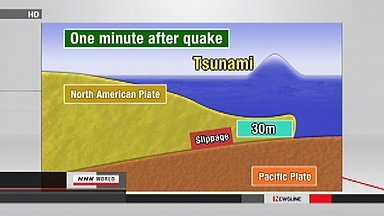
March quake mechanism
A Japanese scientist says the March 11th earthquake and tsunami were caused by distinctive movements of nearby tectonic plates.
Associate Professor Satoshi Ide of the University of Tokyo's Graduate School analyzed data from seismometers around the world. He studied the movements of the descending Pacific plate, or the ocean plate, and the overlying North American plate carrying eastern Japan, at the time of the quake.
Ide found the quake began with the North American plate sliding relatively slowly along its boundary with the Pacific plate, off the coast of Japan at a depth of about 20 kilometers.
The sliding movement spread in the direction of the coast for about 40 seconds, sending strong tremors across northeastern Japan.
Then, about one minute after the quake began, the displacement accelerated near the Japan Trench, causing the North American plate to slip as far as 30 meters. Ide says this resulted in lifting vast amounts of seawater, triggering the massive tsunami.
About 90 seconds after the start of the quake, the plate slid again deep beneath the seabed near the coast, triggering another wave of strong jolts.
Ide says the findings show that the movement of the North American plate was greater than the stress accumulated around its boundary with the Pacific plate. He says he will next explore whether similar events could happen in other areas.
Friday, May 20, 2011 12:15 +0900 (JST)
www3.nhk.or.jp + videoby Edano via Www3.nhk.or.jp 5/20/2011 2:00:57 PM- NHK stories carried in today’s JAIF Earthquake Report: (Fukushima NPP site) ● Humidity, heat, radiation in reactor buildings ● Workers find pools of water at No.2 ● TEPCO studying ways to start nitrogen injection ● A special new forklift for Fukushima ● Health office to monitor nuclear plant workers (Environment) ● Trace of radioactive materials detected in Osaka ● Experiments to decontaminate soil to start (Business) ● Foreign travelers to Japan down 62% in April ● TEPCO to record historic financial loss ● Moody's says TEPCO could be downgraded further (Other news) ● Radiation limits activities in school fields ● No outdoor swimming classes for Fukushima schoolsby Markfm 5/20/2011 2:07:27 PM
- @dean if you're around - to confirm - are the timings in your table pinned above in minutes?by hudebnik 5/20/2011 2:17:10 PM
- @hudebnik hours !by Edano 5/20/2011 2:17:23 PM
- 'Tepco hours' maybe - I can't really make them fit either way.by hudebnik 5/20/2011 2:21:28 PM
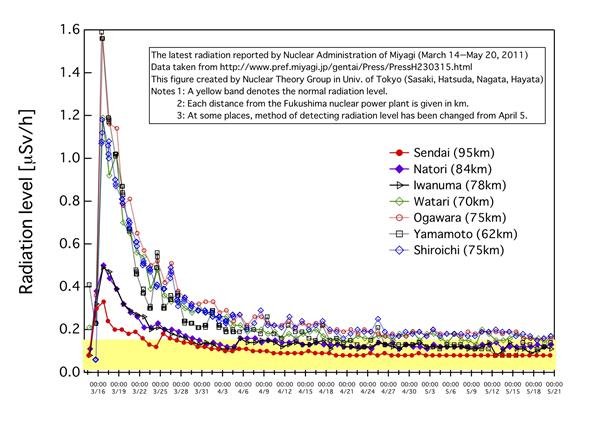
Graph update: Radiation level in Japan] May 20 twitpic.com
by Majj via Twitpic 5/20/2011 3:00:10 PM- “A Massive Cover-up”: Texas officials directed staff to change test results that showed drinking water exceeded EPA radiation limits
May 20th, 2011 at 11:18 AM www.khou.comby Majj 5/20/2011 3:32:15 PM  Experts detect 5 times higher radiation levels in Tokyo than announced by government enenews.comby Bobby1 5/20/2011 3:37:50 PM
- Proprietary Gradi simulation of radiation diffusion in Japan www.youtube.comby Bobby1 5/20/2011 3:47:13 PM


Japan Earthquake | Page 1273
- Who's Blogging
-
 hudebnik
 alblee
 UKVal
UKVal Jonathan Keebler
 Oliver (ScribbleLive)
 kaykodh
- Markfm
 Angie
Angie Mid Valley
 Matt (ScribbleLive)
 George Gibb
 elainekirk
 PKelley
 lillymunster
 dean
dean bo
bo Edano
Edano Deb
Deb- Pedro Jesus
 IanGoddard