Japan Earthquake | Page 1596
 Welcome back Deanby bo 6/12/2011 11:39:08 AM
 ty boby dean 6/12/2011 11:39:21 AM
 @es tyby elainekirk 6/12/2011 11:46:50 AM
- @dean greetings:)by elainekirk 6/12/2011 11:47:21 AM
- greetings to you as well elaine, glad your here as I made fresh coffee and have fruit snacksby dean 6/12/2011 11:50:21 AM
- elaine are we still unsure of what crashed through the roof of the #3 turbine building?by dean 6/12/2011 11:52:44 AM
 On phone virus xp internet secuity 2012 killed comp. Thought it was licked. Then came back with vengence.by RBeaner 6/12/2011 11:55:40 AM
- @Dean have you ever seen such a liquid processing system as that provided by areva/US ZIRCONby RBeaner 6/12/2011 11:55:42 AM
- @dean I think so best check with nancyby elainekirk 6/12/2011 11:56:08 AM
- hi RBeaner, I haven't seen the details of the system yet but what little I've seen it's quite impressive.. there will certainly be barrels and barrels of waste to deal with,,, weren't they going to go up to 50 milliSv in each container and then switch to another one... and they said something about 400 containers over the course of 1 yearby dean 6/12/2011 12:01:38 PM
- www.bloomberg.com
reading this article on it RBeanerby dean 6/12/2011 12:03:37 PM - @Dean. I'M used to resin beds and filters, BUT Never this zeolite stuff. I propose 55gal drums or 4 x 8's with mix of sand and ionic resin for the innitial pass. They are being to conventional for an unconventional problem.by RBeaner 6/12/2011 12:04:12 PM
 Sludge from contaminated water would be packed with radioactive substances: TEPCO (10 June, 2011): mdn.mainichi.jpby es 6/12/2011 12:05:43 PM
 ooh, just got up - the magical zeolithe ding dang does not work ? what a surprise. and now ?by Edano 6/12/2011 12:06:08 PM
- non techi asking
how much will zeolite absorb if they are talking having 50milliserve in filtered how long can zeolite keep absorbing the rest and whet happens to the radioactive zeolite?by elainekirk 6/12/2011 12:06:57 PM - we use zeolite as a base medium on which we put spent resin but not as intented to reduce the rad isotopes, only to act as an absorbant so I'm wondering and questioning the zeolite as wellby dean 6/12/2011 12:08:39 PM
- too bad i have no areva shares. tepco seem to buy everything they offer. reminds me of the tamiflu affair, when mr rumsfeld became trillionaire in short time.by Edano 6/12/2011 12:11:46 PM
- www.stcloudmining.com a few words on zeoliteby dean 6/12/2011 12:12:38 PM
- RBeaner I'm used to pretty much the same thing.. a side stream of water going through a filter which can be flushed and then on through cation and anion bets to remove the rad isotopes and then back to the system.... after the beds are depleted they are sluiced out into a holding cask which has zeolite on the bottom of the casks and then the holding casks are shipped to storageby dean 6/12/2011 12:14:38 PM
- @edano yes I think areva and toshiba have been very quick to move into the accident/decommissioning market and what we are seeing is fukushima being used as a test bed for their prototypes . We don't have time for it !by elainekirk 6/12/2011 12:16:04 PM
- your right Edano... in Japan the chief financial economist will probably have the last say .... starte the reactors or suffer economical crisisby dean 6/12/2011 12:16:13 PM
- classic example of SCHEDULE over SAFETY...by dean 6/12/2011 12:16:50 PM
- slowly we get a glimpse on the economical impact of this disaster.by Edano edited by Edano 6/12/2011 12:18:52 PM
- @elaine.. could you call TEPCO and tell then to straighten up that dang light pole on the webby... I keep looking at it and trying to line things up with it.. WHEWWWWby dean 6/12/2011 12:19:07 PM
- The cause of the problem "may not fit the valve opening and closing" has said.
they are shiftin not 12tons per hour but half a ton translate.google.comby elainekirk 6/12/2011 12:20:18 PM - @Edano, from what I've seen in my experience, if you have an accident that goes outside of your analyzed envelope for operation you either modify the system so that the margins of safety return to where they should be,, "or" if you can't, then you reduce the reactor full power level until the analyses with current conditions return your safety margins to normal. If that were the case several reactors in Japan would already be running at reduced power ,,, and reactors most vulnerable in the USA for that matter,,, then I would tell the public why it was done.by dean 6/12/2011 12:22:10 PM
- @dean : very good point. i don't see any power reduce besides in germany.by Edano 6/12/2011 12:25:03 PM
 by Edano via 30.media.tumblr 6/12/2011 12:25:36 PM
- the main use of zeolithe is in aquarium filters ....by Edano 6/12/2011 12:27:07 PM
- and there are some people eating it and they say they feel better now.by Edano 6/12/2011 12:28:17 PM
- translate.google.com getting closer to some of my estimates on meltby dean 6/12/2011 12:29:19 PM
- @dean : wrong link ?by Edano 6/12/2011 12:31:03 PM
- Fukushima deep in hot water: www.nature.com
"The decontamination system is being built by Paris-based nuclear manufacturer Areva and nuclear-remediation company Kurion, headquartered in Irvine, California. The water will pass through Kurion's filters, which contain a zeolite mineral — an extremely porous aluminosilicate that loosely binds metal ions. Through a combination of adsorption and ion exchange, the filters will trap the radioactive elements strontium-90, caesium-134 and caesium-137, reducing their concentration in the water by a thousand times.
Areva's process will then take over. The water will pass into a series of tanks, where it will mix with reagents such as nickel ferrocyanide and barium sulphate, along with polymers and sand. The dissolved radioactive metals will form precipitates and colloids, which can be trapped as a radioactive sludge, allowing the water to be desalinated and fed back into the reactors. The two processes should reduce the concentration of caesium — the major element of concern from the reactors — in the water by up to a million times. TEPCO estimates that the process will cost ¥53.1 billion (US$660 million). Areva says it has successfully tested its system with sea water containing radioisotopes and borates — a simulation of the chemical brew in the reactors, where boric acid was added to halt nuclear reactions."by es 6/12/2011 12:32:29 PM - checking Edanoby dean 6/12/2011 12:33:06 PM
 by Salu 6/12/2011 12:33:47 PM
- @All, this video of Daiichi is replayed often yet this one has been modified in pics and narration.by Salu 6/12/2011 12:34:16 PM
- Here:
asahi.com
News
Featured
East earthquake
Articles.....by dean 6/12/2011 12:36:14 PM
those are the links I clicked to get to the article.. but can't get the web page to copyby dean 6/12/2011 12:36:39 PM- Unit 1, 5 hours after the tsunami revealed by analysis of fuel melting TEPCOby dean 6/12/2011 12:37:50 PM
- @dean is that when they knew?by elainekirk 6/12/2011 12:40:43 PM
- TEPCO 15, the No. 1 TEPCO Fukushima Daiichi Nuclear Power Station, five hours after the Tsunami in the east by the earthquake, all from exposure to the cooling water in nuclear reactor fuel, and reached the preliminary fuel melting announced the results. The molten fuel so far it has been March 12. Will be significantly off the current status was a prerequisite for accident protection. Likely have an impact on future measures to verify.
Fukushima Daiichi nuclear power plant, the reactor automatically shut down after 46 minutes of the earthquake occurred at 2:00 pm March 11. The power outage also affected by the earthquake equipment powered from an external. Wearing a tidal wave around 2:30 up 3 more, as well as damaged emergency generators, lost all power necessary to cool the reactor core.
For this reason the heat in the core of nuclear fuel (decay heat), fell into a situation that we are gradually lost by the cooling water.
According to the TEPCO, the water level down to the crown of nuclear fuel at about 6:00 pm "exposed some of the fuel" has begun. At the same time the core temperature rises rapidly.
After about half an hour, completely eliminate that flooded parts of fuel rod length about 4 m "full exposure" was the state. Metal cylinder surrounding the nuclear fuel (cladding) is starting to melt above the melting point of 1800 degrees from the bottom center of the reactor core melts and top center core collapse in 20 minutes. Seems to have reached 2800 degrees to melt the fuel pellets begin at nine o'clock in the afternoon. The next 12 days at the bottom of the reactor pressure vessel broke down all the nuclear fuel.
TEPCO has so far confirmed the declining water level of the Unit 1 reactor at around 9:30 pm July 11 at 9 am before the core is 12 "from all of the exposed coolant temp" came as a.
However, in this analysis, the core is completely melted in the morning after 12 days 15 hours 20 minutes after reaching the tsunami (meltdown) will be had. In the analysis, nearly one day, more rapid progression of the situation.
TEPCO about the state core of Unit 1 of the current "fuel is believed to be in the water by water injection is broken, that is cool and stable. That could lead to the release of radioactive material a large future should "be emphasized.
In contrast, a significant difference between the results of the evaluation so far, Director of Quality and Safety of Nuclear Shin Kawamata TEPCO head office "time of the accident, unsure of the correct value of the instrument was not different. Obtained all the necessary information again Not that there is no. is the result of preliminary analysis, "in which Todometa.
TEPCO, and endeavor to understand the condition of the Unit 1 reactor core will continue to promote research, conduct analysis and also the No. 3 No. 2, trying to. (Yoshida Susumu, T. Sugimotby dean 6/12/2011 12:41:00 PM - sorry all for the length of that.. I just cut and pasted itby dean 6/12/2011 12:41:13 PM

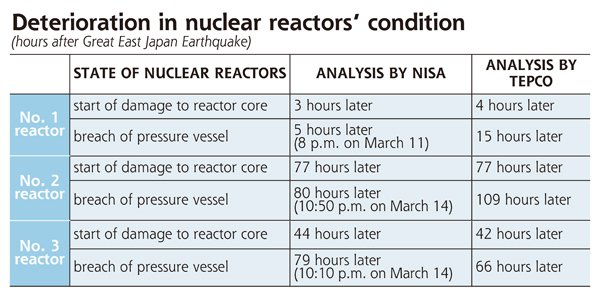
@Dean
by Edano 6/12/2011 12:46:28 PM @Edano Could be interesting to lookup video of those estimated times of pressure vessel failure on the different units, might just show something interesting.by WolfDK 6/12/2011 12:49:19 PM
- that's what I was thinking of Edano.. I have that one and compared my databy dean 6/12/2011 12:49:40 PM

Japan Earthquake | Page 1596
- Who's Blogging
-
 hudebnik
 alblee
 UKVal
UKVal Jonathan Keebler
 Oliver (ScribbleLive)
 kaykodh
 Markfm
 Angie
Angie Mid Valley
 Matt (ScribbleLive)
 George Gibb
- elainekirk
 PKelley
 lillymunster
- dean
- bo
- Edano
 Deb
Deb- Pedro Jesus
 IanGoddard