Japan Earthquake | Page 2284
 bumpby Edano 8/31/2011 6:14:48 AM
 good morning :)by elainekirk 8/31/2011 7:58:27 AM
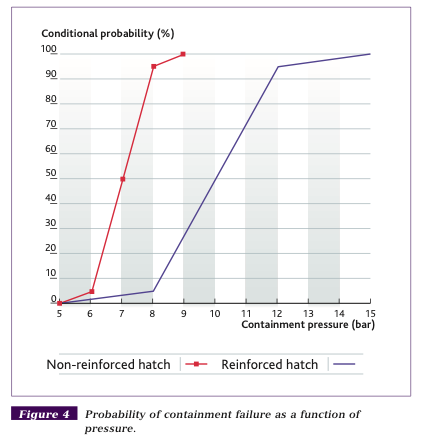
iangoddard.com Interesting graph to consider, from a nuclear-engineering textbook well-worth perusing : www.irsn.fr
by Ian via Iangoddard 8/31/2011 8:09:47 AM- Hay Elaine, rise n shine! :)
@Edano, notice my second comment below your last, we may need to rethink Ott, or better understand the Reactor Core Isolation Cooling System.by Ian 8/31/2011 8:17:52 AM - @Ian hi having boiler and shower put in so in and out all dayby elainekirk 8/31/2011 8:45:02 AM
 @hi all “We got to stop these reports from coming out” ?? HOW? Then they have to close down the internet.When I read things like this, I think maybe it is even worse than I imagine. Because WE KNOW the leak is not small- WE KNOW they should evacuate more people.
A blogger comments:
According to some Propaganda appearing inNew Scientist, the problem is not the Fukushima Radiation but the reporting on the radiation.
This is so silly as to be laughable. But unfortunately there are millions of lives at stake. So it is not funny.
The piece quotes Gary Thomas of the Imperial College of London as saying, "There's very little leakage now." He says, "We've got to stop these reports from coming out"
So attendees at an international conference on radiation research in Warsaw, Poland heard that all is well at Fukushima. The only bad thing is the negative reporting.
But this is nonsense.
As of early August, TEPCO was reporting the highest release of radiation ever at the nuke plant.
....Tokyo Electric Power Co. (TEPCO) said Monday it had monitored record high radiation at the Fukushima Daiichi nuclear power plant crippled by the March 11 quake and tsunami
grantlawrence.blogspot.com
New from Greenpeace:
Fukushima City kids should not have to choose between radiation and education
www.greenpeace.orgby Mona 8/31/2011 8:50:57 AM @Ian G'morning I agree that all wasn't well with the RCIC, or that it's effectiveness in this situation is badly lacking. I haven't looked into all the details but I understood the sequence of events as this: At 15:05 on March 11 the Reactor Core Isolation Cooling System (RCIC) at Reactor 3 was manually started - note it didn't automatically start. It did however stop automatically "at 15:25 on the same day due to the rise of the reactor water level". 38 minutes later the RCIC was again started manually but according to the records water levels continued to drop and "the RCIC stopped at 11:36 on March 12", after some 20 hours of operation. I think this final stoppage was automatic, I've read about an 'RCIC trip'. An hour later the HCPI automatically kicks in as the water levels have dropped below a certain level. I read this as meaning that the RCIC either cannot effectively cool a hot core, or there was a leak somewhere.by es 8/31/2011 8:53:19 AM
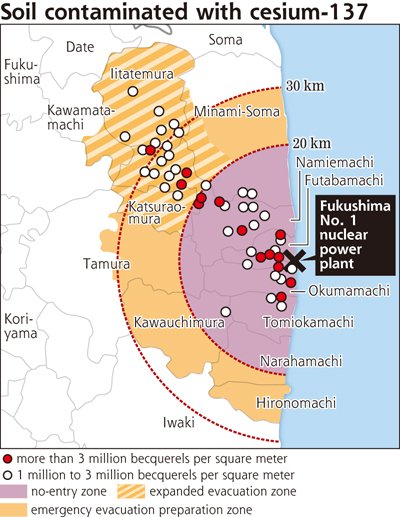
Japan Finds Radiation Spread Over a Wide Area
TOKYO—The first comprehensive soil survey from areas around the Fukushima Daiichi nuclear plant showed extensive ground contamination and another report warned of the continued threat to Japan's food chain, underscoring the major challenges the country still faces in its radioactive cleanup efforts.
online.wsj.comby Mona 8/31/2011 8:58:33 AM- @Ian Without the RCIC playing its part everything would simply have happened earlier - it managed to delay rather than prevent the meltdown and subsequent explosion.by es 8/31/2011 9:02:06 AM
- 34 spots top Chernobyl evacuation standard
The Yomiuri Shimbun
Soil at 34 spots in six Fukushima Prefecture municipalities has been contaminated with levels of radioactive cesium higher than the standard used for forcible evacuations after the Chernobyl disaster, it has been learned.
According to a soil contamination map submitted at a study meeting of the Education, Culture, Sports, Science and Technology Ministry, six municipalities recorded more than 1.48 million becquerels of cesium 137 per square meter--the standard used for forced resettlement after the 1986 Chernobyl accident.
www.yomiuri.co.jpby Mona 8/31/2011 9:05:58 AM 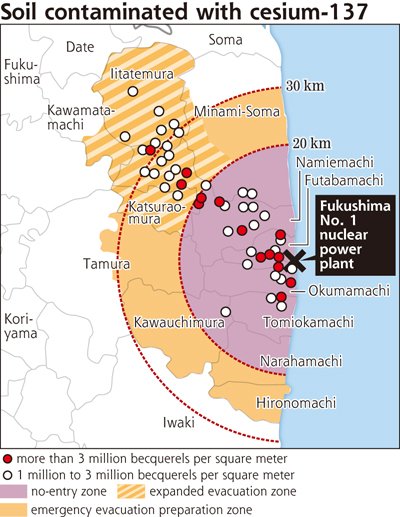 by Mona via Yomiuri.co.jp 8/31/2011 9:06:17 AM
- @es, thanks for those details. I wonder if there's a coherent comprehensive write up of such details, versus assembling them from the blizzard of press release. I've spent most of my time studying the visible dynamics of the explosions and ruins, but not so much on the measures and circumstances of the containments.by Ian 8/31/2011 9:34:30 AM
- @Ian Yes, it's confusing. Naturally people will pick out the bits they favour from the press notices to support their analyses, so we rarely see such full and comprehensive details as the original PN's provide. I'm sure Peter could point out which is the most complete published timeline for the early events - he actually seems to understand the functions and failures of these systems!by es 8/31/2011 9:48:09 AM
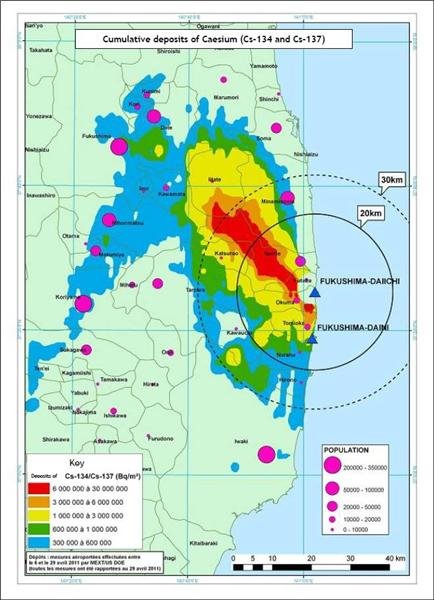
i52.tinypic.com
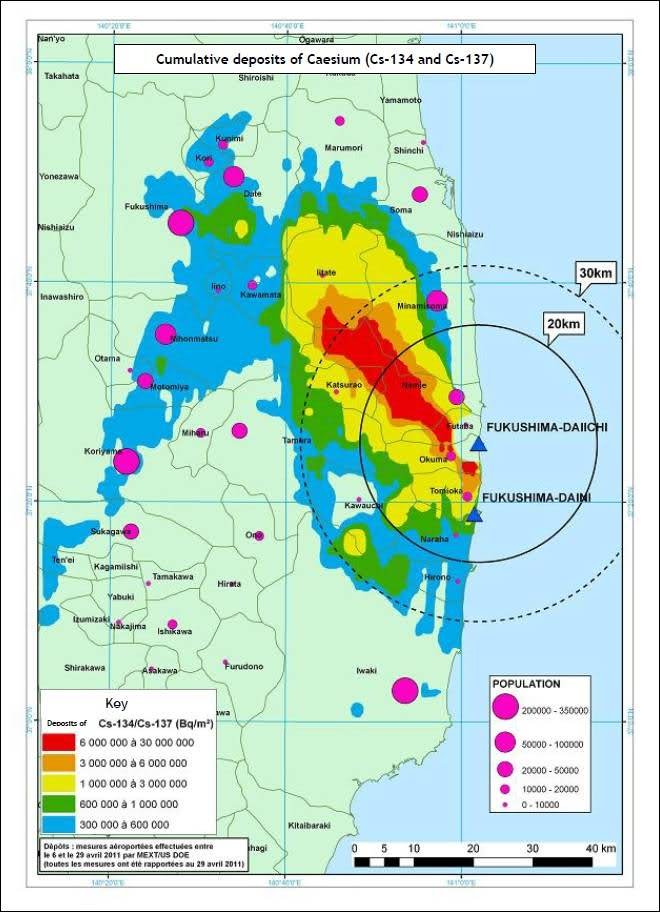
@Mona Hi. I was surprised to see from the new MEXT maps that the levels of cesium had diminished so much. Perhaps I've misunderstood, but it's curious that this MEXT map from April shows cu-mulative cesium deposits of up to 30MBq/m2 (we were told the ratio btw 131 and 137 was approx 1:1, so for comparative purposes it's approx half this figure for the amount of each). Already in June MEXT were telling us the levels were falling - see this: eq.wide.ad.jpby es via I52.tinypic 8/31/2011 9:50:44 AM- @Ian Just to add, if you're not referring to it already, I've found this comprehensive report useful for getting a handle on the sequence of events - it's the 'Report of Japanese Government to the IAEA Ministerial Conference on Nuclear Safety - The Accident at TEPCO's Fukushima Nuclear Power Stations' published in June: www.kantei.go.jpby es 8/31/2011 10:18:45 AM
 good morning, a while ago, I attempted to find the weakest standby coolant system and happened upon the RCIC: brainmindinst.blogspot.com .by Peter Melzer 8/31/2011 10:26:53 AM
- g'morningby elainekirk 8/31/2011 10:54:25 AM
- @Peter Melzer G'morning. That's excellent work, thanks. I'd read it earlier, but it made less sense to me then :) The part I'm still chewing over is in your final paragraph - why would they vent the wetwell using the hardened vents at 5:20? Ugh. Note this is just after the LOCA is declared.by es 8/31/2011 10:58:00 AM
- @es , the was not the only venting. Foremost, the operators wanted to vent hydrogen, I suppose, and reduce pressure in the wet well. Recall the valves for hardened venting would not stay open for the period of time intended. They had to go in repeatedly to open them manually.by Peter Melzer 8/31/2011 11:20:24 AM
- @Es - I am no expert.Only thing I am sure of is they downplay the consecuenses – Kan have said so himself, afrid people panic. Half life of cesium 137 is 30 years and for 134 is 2 years.So there it is. If the statistics are right and done in the same way – maybe the rain season took more of the cs down on the ground? Greenpeace last rapport shows the variation in radiation in height for ex. on stairs from playground to street: 1.5 uSv/h at 1m abow ground, 2 uSv/h at 0,5m, and 7.9 uSv/h at 0,10m. All the big numbers are hard to relate to for most people. I am so greatful to people like Arnie Gundersen, like Greenpeace, who I think is more trustworthy than the Japanese authorities. And all the wise people at scribble maybe find out of your question.
Greenpeace: “Last week, the Japanese government announced a new clean up plan for the greater Fukushima area – but like many of its initiatives so far, this is too little and too late. Prime Minister Noda must delay the opening of schools, immediately relocate people who are in high-risk areas, and mobilise the huge workforce needed to get radiation dose rates as far below safety limits as possible.
This is the challenge for incoming Prime Minister Yoshihiko Noda. He must move quickly to secure people’s health, homes and livelihoods. Then he must secure his country’s future by abandoning nuclear technology, and moving towards a future powered by renewable energy.”
www.greenpeace.org
Letter from Greenpeace to Kan: www.greenpeace.orgby Mona 8/31/2011 11:35:50 AM - @Peter Melzer Yes, and I noted the other venting events too. I can kind of see why they might have wanted to try to disperse some of the hydrogen, but I don't see the high pressure readings/concern. Am I missing something? The venting btw 8.41-9.20 on the 13th looked super-stinky - I'm assuming that by 8:41 vessel melt-through was known to be imminent.by es 8/31/2011 11:39:40 AM
 Morning! (afternoon-evening)by lillymunster 8/31/2011 11:51:20 AM
- ikrockhopper
Report at press conf today: This morning, a worker got hit and covered by contaminated water of 100,000cpm. No details yet.by elainekirk 8/31/2011 11:53:24 AM - es, I guess you are right. The hydrogen must have been the overarching concern. I recommend to watch this NHK documentary on the beginning of the crisis: www.nippon-sekai.com . It teaches a lot about the venting at Fukushima.
Tepco had also hardened vents installed on the dry wells. I wonder why they never used them. As to the HPCI system, this system also uses a pump driven with a turbine that is fed by decay steam. It might have failed for reasons similar to the RCIC.by Peter Melzer 8/31/2011 11:54:32 AM - @Mona Many thanks. I agree that the different rad readings at different heights has been a major barrier to a clear understanding of the monitoring data. I hadn't seen the letter to the PM, that's very interesting - I wonder did Greenpeace wait until Kan had gone to deliver that? Will we perhaps be seeing and hearing more of GP now?by es 8/31/2011 11:56:32 AM
- @Peter Melzer Thanks. Will watch.by es 8/31/2011 11:57:57 AM
- by Peter Melzer 8/31/2011 11:59:57 AM
- The wet well venting was likely due to unfavorable conditions inside it. The torus seems to be a fickle piece of equipment that only works right when it is partially full of water and not so hot it is vaporizing the water inside. Someone mentioned the other day that venting into the torus full of gasses rather than just steam wouldn't dissipate. Is there any data on #2 before it exploded? Since it blew down instead of up it might lend some clues on what was going on in the wet well.by lillymunster 8/31/2011 12:00:09 PM
 @All just dropped by for a quick update on weather, Track has jumped around a little in the last 24 hours, firstly west and now has migrated eastward again a little, models having problem pin pointing what an upper level trough will do in regards to the steering ridge( in @Angie speak that is the steering ridge is like a wall of high pressure air, the trough is an elongated area of low pressure, the trough will make a hole in the wall through which the system can pass- weaker trough more western crossing, stronger trough more eastern crossing) JTWC current forecast map about the same as 24 hours ago(now over Kinki instead of Tokai-a little more westerly) the intensity forecast has changed a little too but nothing too major to warant discussion. As always check at fukushimaFAQ for meteorology links, again the TSR wind field forecast shows the entirety of the situation ( www.tropicalstormrisk.com ) and the JMA sea wave forecast for tommorow netherlone Friday doesn't look great either ( www.data.kishou.go.jp )by Thunder 8/31/2011 12:00:12 PM
- Ian, the embed stole my text. The video I posted below is about a NCIC meeting on the accident held in March. The expert presentations are highly interesting.by Peter Melzer 8/31/2011 12:02:39 PM
- 42 people working at the plant have not had required internal scans. www.asahi.comby lillymunster 8/31/2011 12:04:26 PM
- @Thunder thank you will be watchingby elainekirk 8/31/2011 12:04:38 PM
- TEPCO thinks they will fetch the fuel out of the reactors through the top of the reactor well.
Containment, fuel-retrieval work on draft TEPCO and then filled with water - the first nuclear power plant in Fukushima
In Fukushima, the first nuclear accident, TEPCO 31, filled with water up to the top of the reactor containment, radiation shielding (shielding), together with draft technical studies, such as retrieving the fuel core from the top on the same day subcommittees reported to the Atomic Energy Commission was held.
Cyanide, which was created to study development issues necessary technical, TEPCO is "an example of the image work taken out, and if you expect a high degree of difficulty Technically, the change needed" as The.
On its handling of an accident like Three Mile Island and the U.S. expects to fetch the water in the fuel core with excellent radiation shielding. After disclosure of the sealed area to determine the containment and reactor building, in a containment vessel filled with water, was removed or the fuel from the top of the reactor vessel.
At that time, in a high radiation dose, as needed and conduct work in places where a robot moves, TEPCO is "necessary to develop advanced technology" it said. (2011/08/31-17: 58)
www.jiji.comby lillymunster 8/31/2011 12:07:26 PM - @lillymunster have you seen the rockhopper worker getting soaked with 100,000cpm water?by elainekirk 8/31/2011 12:08:33 PM
- @Elaine no worries. @Lilly they are kidding right? And what exactly would they do with it once(IF!) they got it out without catastrophe?by Thunder 8/31/2011 12:16:40 PM
- @elainekirk yes. keeping an eye out for more details.by lillymunster 8/31/2011 12:16:56 PM
- @lillymunster , they shall be surprised by how little they find that way. Dean once posted this informative history lesson on TMI core analysis: americanhistory.si.eduby Peter Melzer 8/31/2011 12:22:49 PM
- @Peter Melzer I thought it was rather odd considering the previous admission of melt through.by lillymunster 8/31/2011 12:30:43 PM
- @lillymunster , it would be the traditional path to take. When asked what they were planning to do, they came up with this answer, instead of admitting that they did not know what to expect.by Peter Melzer 8/31/2011 12:47:20 PM
- @Peter Melzer Not watched the docu yet, will make time this eve, but just wanted to say that it's so telling that we don't have early reactor temperature and CAMS readings. As far as I can see containment was never likely to explode due to high pressure, and I guess I thought hydrogen could basically have found its way out on its own. The rad monitors should have given us the H2/O2 concentration, and shown TEPCO the specific risks.by es 8/31/2011 12:50:13 PM
- @es , another factoid worth mentioning, the hardened venting was ordered by the Prime Minister. It was not tepco's decision.by Peter Melzer 8/31/2011 12:53:27 PM
- @lilly, they never properly disassembled TMI, did they? There is no precedence to such decommission.by Peter Melzer 8/31/2011 12:55:12 PM
- @es, this idea sounds so unAmerican. Imagine the last president of the United States attempting to micromanage a nuclear power plant accident. He was proud of never caring to pronounce "nuclear" correctly. The present president seems more apt, but is also a lawyer by training. By contrast, Kan is an engineer and attended the same school as the plant superintendent at Fukushima. That puts things into a different perspective.by Peter Melzer 8/31/2011 1:03:42 PM
- @Peter Melzer Yes, interesting points. A politician as well as an engineer! Frankly I'm not entirely sure how the rocketing rad levels could've been explained without the venting, and this makes me suspicious. What is the evidence that these vents were actually manually and repeatedly opened? It doesn't surprise me that the vents reportedly didn't open automatically nor stay open since the pressure levels inside were low. Okay, no more til I've watched the prog!by es 8/31/2011 1:24:51 PM
- @Peter Melzer the reactor was eventually removed and shipped off about 10 years later. Not sure if they removed the fuel first.by lillymunster 8/31/2011 1:25:05 PM
Japan Earthquake | Page 2284
- Who's Blogging
-
 hudebnik
 alblee
 UKVal
UKVal Oliver (ScribbleLive)
 Jonathan Keebler
 kaykodh
 PKelley
 Markfm
 Angie
Angie Deb
Deb Mid Valley
- Pedro Jesus
 Matt (ScribbleLive)
 George Gibb
- elainekirk
- lillymunster
 dean
dean bo
bo- Edano
 IanGoddard