Japan Earthquake | Page 2282
 @lillymunster yes, but not with death within one week. this worker was terminal when brought to hospital !by Edano 8/30/2011 11:58:50 PM
- they could only perform palliative medicine.by Edano 8/31/2011 12:01:33 AM
 @Edano is terminal based on the short time frame? So far what I am reading all talks about longer time frames than 1 week from feeling ok to dead.by lillymunster 8/31/2011 12:03:01 AM
- @lillymunster see the table below.by Edano 8/31/2011 12:03:54 AM
- "terminal" means untreatable and prone to death.by Edano 8/31/2011 12:04:33 AM

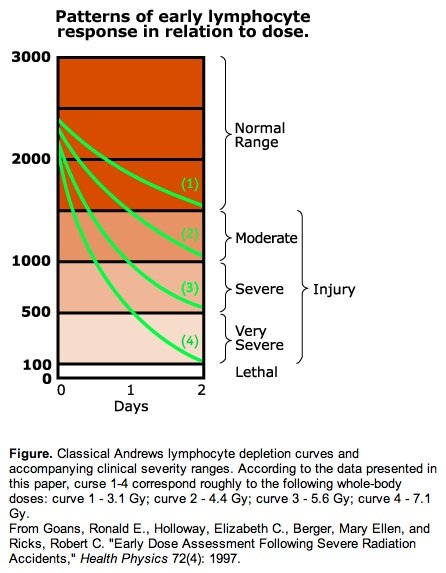
Dose response relationship in ARS. Number of lymphoctes per microliter on the y-axis. i1214.photobucket.com
by Peter Melzer via I1214.photobucket 8/31/2011 12:04:47 AM- @Edano Ah. The study i am reading mentions that a large percentage of younger patients make it to remission before they eventually died meaning almost half of the patients lived long enough to be treated, get better, go into remission.by lillymunster 8/31/2011 12:05:11 AM
- @lillymunster yes, but they could not be working in this time. the worker at fuku sufferered an acute radiation syndrome, not AML.by Edano 8/31/2011 12:06:55 AM
- sorry, lymphocytes. According to this graph you could be dead within a week after a 4-7 Sv exposure.by Peter Melzer 8/31/2011 12:07:42 AM
- @Peter Melzer yep. that's what happened. it fits to the hotspots they found exactly at the time he was working in fukushima.by Edano 8/31/2011 12:09:20 AM
- lilly, they must mean bone marrow transplants which only works with near perfect matches. The US transplantation team that went to the USSR to treat Chernobyl workers and first responders attempted roughly one hundred transplantations. If I remember correctly, no one survived. Early in the Fukushima fiasco, some foreign agency suggested to take bone marrow from the workers dispatched to the plant and store it away as a precaution. The Japanese government declined with the lapidar response that that was unnecessary.by Peter Melzer 8/31/2011 12:14:20 AM
- lilly, look at the ORISE article I posted. The time frame is dose dependent.by Peter Melzer 8/31/2011 12:16:35 AM
 Searching for Fuku video I happened to run into leakspinner on another channel with a new Fukushima video here www.youtube.com !! You may recall that leakspinner closed all the sudden. Not sure why, but perhaps Marc prefers a quieter youtube lifestyle. His concerned conscience will be forever etched in my mind wrt Fukushima!by Ian 8/31/2011 12:19:56 AM
- If they performed an autopsy, they should find the histological manifestations in the GI tract.by Peter Melzer 8/31/2011 12:21:18 AM
- I guess the REAC/TS refresher course in Tokyo Elaine found out about the other day came too late for these doctores.by Peter Melzer 8/31/2011 12:26:21 AM

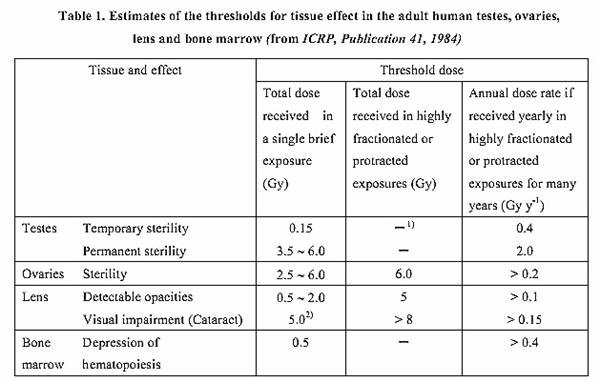
@Peter @Edano is this relevant it says a single dose in gy which is the same as msv isn't it? www.fsc.go.jp
by elainekirk 8/31/2011 12:34:59 AM- @elainekirk , assuming external exposure with gamma-radiation 1 Gy = 1 Sv.by Peter Melzer 8/31/2011 12:37:40 AM
- @Peter Melzer so .5 gy = .5msv? sry I am out of my depth technically speaking hard to believe my father was a pharmacistby elainekirk 8/31/2011 12:39:34 AM
- Looking at elaine's table, they could have checked for cataracts.by Peter Melzer 8/31/2011 12:39:38 AM
- it is from a paper drawn up in Japan in March
Emergency Report on
Radioactive Nuclides in Foods
2011 March
Food Safety Commission of Japanby elainekirk 8/31/2011 12:40:40 AM - @elainekirk , no: 0.5 Gy = 0.5 Sv = 500 mSv.by Peter Melzer 8/31/2011 12:40:47 AM
- @Peter Melzer ah D'oh
Radiation damage to the bone marrow may be
the most important for accidental releases from nuclear power plants, given the composition of
nuclides liable to be released.
Uniform irradiation of the bone marrow by acute exposure in the early phase of the whole, or a
substantial part, of the body to penetrating radiation at a sufficiently high rate can lead to death
within a few weeks. The value for the median lethal dose within 60 days (LD50/60) is thought to be
in the range 2.5 to 5 Gy; below about 1.5 Gy there is little possibility of early death. The
protraction of exposure will also reduce the probability of early death from bone marrow cell
depletion, but may not be important in practice since action may well have been taken to terminate
such exposures at an early stage. Consequently, early deaths should not occur if whole body doses
do not exceed about 1 Gy in the early phase.by elainekirk 8/31/2011 12:43:01 AM - but we have no evidence that he didnt have a massive dose because tepco didnt say they tested for internal and there was no wbcby elainekirk 8/31/2011 12:44:54 AM
- OK can I ask what a grain of plutonium would do?by elainekirk 8/31/2011 12:46:05 AM
- plutonium was in the tweetsby elainekirk 8/31/2011 12:46:23 AM
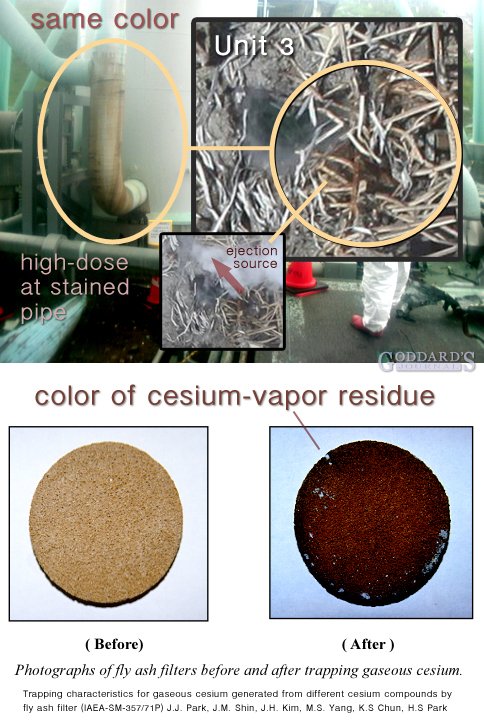
- @elainekirk, amazing that the color of the water in the U4 containment you posted below is the very same color (brownish red) that I used in my animation of U3 containment water posted here many pages back www.scribblelive.com !! How'd I figure it?! Easy, the color of off-gassed cesium!by Ian 8/31/2011 12:47:16 AM
- @Ian it is also at daini I found it very odd that we should have 2 or is it 3 PDF docs on daini in one dayby elainekirk 8/31/2011 12:48:26 AM
- That further speaks for the Unit 3 mushroom cloud being containment water, as you can a reddish hue in the cloud.by Ian 8/31/2011 12:48:51 AM
- @elainekirk , a histopathologist could have identified ARS as cause of death.by Peter Melzer 8/31/2011 12:50:31 AM
- @elainekirk, also at daini?!! Wtf! Even at Unit 4 suggests pervasive groundwater contamination or something, since Unit-4 core was empty. Bu I'd think stuff shouldn't even be leaking into the U4 containment. ??! Could this be a sing of a deep meltdown?by Ian 8/31/2011 12:51:23 AM
- @Ian ah yes the case for it is pretty certain now isn't it. Just off the cuff do you remember all the 'steam' events that people thought could be smoke but nobody could be sure because it had the behaviour of steam? could that have been cesium steam?by elainekirk 8/31/2011 12:51:55 AM
- @Peter Melzer I don't know whether they have any specialists at the hosp which one did they say he was taken to?by elainekirk 8/31/2011 12:52:58 AM
- @Ian , there are gates in the canal between the reactor and the pool that are normally sealed with inflatable rubber gaskets. The gaskets may be leaking.by Peter Melzer 8/31/2011 12:53:30 AM
 Re the color: Remember the bright orange-red Fiestaware? Uranium oxide was the pigment.by RadioGuy 8/31/2011 12:54:05 AM
- @elainekirk, I recall a lot of cases where the Tepco video showed misty days and some people were thinking it was steam from the Units. But that steam was white. There was I recall dark smoke from Unit 3 from between March 21-23.by Ian 8/31/2011 12:54:12 AM
- @Peter, yet the fuel-pool water in the video from a few months ago looked clear. Maybe no longer?by Ian 8/31/2011 12:55:02 AM
- @elainekirk , I don't know. Point is they could have found out, if they had wished.by Peter Melzer 8/31/2011 12:56:17 AM
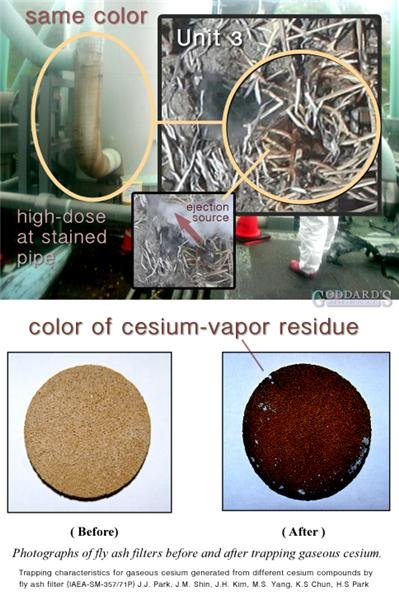
@RadioGuy, maybe this color is even found in uranium. ?? I'm sure about cesium-vapor color.
by Ian via Iangoddard 8/31/2011 12:57:19 AM- Sorry, I tried to embed that into a link so it wouldn't hog up so much space... didn't work.by Ian 8/31/2011 12:58:14 AM
- @Ian , nice comparison!by Peter Melzer 8/31/2011 1:02:39 AM
- elaine, just about any bigger hospital runs a pathology service, or has access to one, to diagnose biopsies.by Peter Melzer 8/31/2011 1:04:09 AM
- @Peter Melzer I think it is known, I think it has been the subject of much high level discussion and it has been decided that the truth shall be concealed as it would cause 'fear and panic'by elainekirk 8/31/2011 1:06:13 AM
- @elainekirk , perhaps, and we do not need to store bone marrow as a precaution, because that would have only frightened the workers, ostriches :(.by Peter Melzer 8/31/2011 1:08:51 AM
 @Ian TEPCO reckon Daiichi SFP #3 is corroding - Plant Status of Fukushima Daiichi Nuclear Power Station (as of 3:00 pm, Aug. 30): www.tepco.co.jp
"At 7:47 pm on June 30, we started cyclic cooling of Spent Fuel Pool of Unit 3 by using alternative cooling system of the Pool's cooling and filtering system. (On August 30, from 11:05 am to 1 pm, we additionally injected hydrazine, corrosion inhibitor.)"by es 8/31/2011 1:11:04 AM- @Peter Melzer and as it is announced on the day of they new PM can we also speculate that....................by elainekirk 8/31/2011 1:13:48 AM
Japan Earthquake | Page 2282
- Who's Blogging
-
 hudebnik
 alblee
 UKVal
UKVal Oliver (ScribbleLive)
 Jonathan Keebler
 kaykodh
 PKelley
 Markfm
 Angie
Angie Deb
Deb Mid Valley
 Pedro Jesus
 Matt (ScribbleLive)
 George Gibb
- elainekirk
- lillymunster
 dean
dean bo
bo- Edano
 IanGoddard