Japan Earthquake | Page 2346
 @lillymunster ooo I will see what I can findby elainekirk 9/14/2011 11:21:54 PM
 I think I found something! This is an old (May) article from Adelstein talking about the prosecutors office investigating TEPCO www.japansubculture.comby lillymunster 9/14/2011 11:41:56 PM
- @lillymunster just readingby elainekirk 9/14/2011 11:44:51 PM
- Found multiple references to this Aug 25th NISA release that TEPCO knew in 2008 that there was tsunami risk but only told NISA on March 7, 2011 www.seattlepi.com
by lillymunster 9/14/2011 11:52:22 PM - @lillymunster and nisa told them that they didnt want to be officially notified or something along those linesby elainekirk 9/14/2011 11:56:53 PM
- @elainekirk part of the committee investigating the accident found out that they had no manual on venting procedures (or how to do it). They used blueprints to figure out where the locations were. So they couldn't vent until they got blueprints from the subcontractors. mdn.mainichi.jpby lillymunster 9/15/2011 12:03:32 AM
- The amount of radiation that has seeped into the Pacific Ocean from Japan’s damaged Fukushima-Daiichi nuclear reactors is more than three times higher the original estimate conducted by Tepco, the company that owns the power plant. Takyua Kobayashi of the Japan Atomic Energy Agency said on Friday that the faulty estimate was likely the result of Tepco’s failure to measure the airborne radiation that landed at sea. Researchers found that, contrary to Tepco’s estimate of 4,720 trillion becquerels of cesium-137 and iodine-131, more than 15,000 trillion becquerels was released into the ocean between March 21 and April 30. On top of that, the researchers didn’t measure the presence of cesium-134, meaning that the true amount of radiation in the Pacific is higher still. In the aftermath of the nuclear meltdown caused by an earthquake and tsunami earlier this year, radiation has been found in seafood and seaweed off the coast of Japan. Tepco hopes to have the reactors in a state of cold shutdown by January. www2.macleans.caby elainekirk 9/15/2011 12:05:46 AM
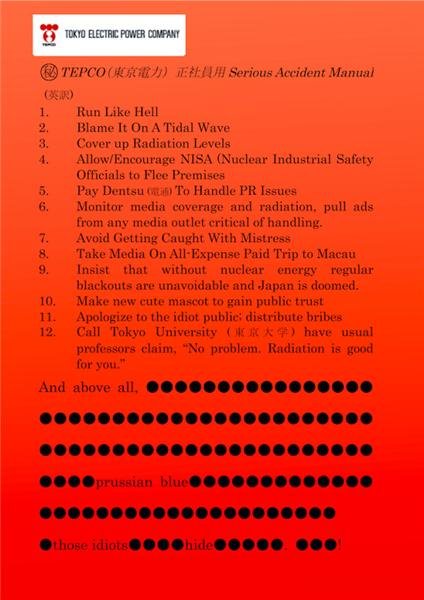
Courtesy of Jake Adelstein s1.proxy04.twitpic.com
by lillymunster via S1.proxy04.twitpic 9/15/2011 12:52:26 AM- Areva reorganizing to deal with dropping business www.reuters.comby lillymunster 9/15/2011 12:59:25 AM

@all Detailed presentation of water injection system
by smoss 9/15/2011 1:40:57 AM- @all Good Morning...Good Evening...Hello!by smoss 9/15/2011 1:41:00 AM
- @smoss Hi!by lillymunster 9/15/2011 1:42:16 AM
- @lillymunster Hi! Read earlier about Am241 being detected...searching for the source...by smoss 9/15/2011 1:50:08 AM
- @smoss yea that is new to me.by lillymunster 9/15/2011 1:50:30 AM
- @lillymunster Am241 sourced here www.scribd.com p11 (This is what enenews used...don't know what I think about the scribd post or enenews to be honest)by smoss 9/15/2011 1:55:49 AM
- @all Speaking to the dangerous nature of the Am241 isotope: lPlutonium-241 presents a more insidious threat. It is not very toxic, but as it slowly decays, it produces the much more dangerous isotope americium-241.
Mousseau said concentrations of americium are still increasing in Ukraine and Belarus, where unspent plutonium fuel from Chernobyl dispersed. “It looks like [americium-241] will peak in about 2050 in these areas,” he said.
www.washingtonpost.comby smoss 9/15/2011 2:00:51 AM - @smoss I saw the information (not the scribd doc) in an email about an hour ago. Said they sent sewer/gutter soil to someone in Germany with decent equipment. I didn't get the isotope chart in the email. That has americium and ruthiem I am not sure if those can travel or if they are heavy like plutonium. You expect concentrations in the gutter. We should see if we can get more eyes looking at that. My brain is pudding right now. :-)
by lillymunster 9/15/2011 2:01:11 AM - PU 241 has a 14 year half life. Unless it can be created in the reactor, then old fuel or the MOX fuel would be the likely sources?by lillymunster 9/15/2011 2:04:06 AM
- Did they not find plutonium or didn't test for it?by lillymunster 9/15/2011 2:04:26 AM
- @lillymunster That's kinda why I'm posting...my own brain is processing slow as well...may have to let it lay for consideration later on :-) I picked up a book today on nuclear forensics, hoping to expand my own knowledge base...but definately later :-)by smoss 9/15/2011 2:07:38 AM
- @smoss I left both links open so I can look at them in the morning. :-)by lillymunster 9/15/2011 2:12:33 AM
- The book sounds interesting.by lillymunster 9/15/2011 2:13:00 AM
- @lillymunster It became required reading with the NukeE Dept at Kansas State University...I will let you know...and on that note, I will say "good night/be well"by smoss 9/15/2011 2:21:29 AM
- @smoss nite. I'm off to sleep too.by lillymunster 9/15/2011 2:25:55 AM
 Reprocessed nuclear waste arrives in Japan for 1st time since crisis english.kyodonews.jpby Mid Valley 9/15/2011 5:28:08 AM
 morninby Edano 9/15/2011 7:13:49 AM
 Just saw a quake on botch cams.by DT 9/15/2011 8:51:08 AM
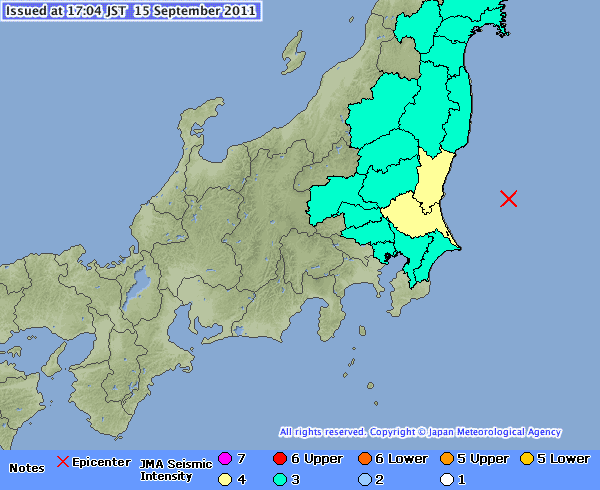
- Thursday September 15 2011, 08:00:07 UTC 28 minutes ago near the east coast of Honshu, Japan 6.2 10.0 Detail
Thursday September 15 2011, 08:00:07 UTC 28 minutes ago near the east coast of Honshu, Japan 6.2 10.0 Detail
Thursday September 15 2011, 07:53:12 UTC 35 minutes ago east of the North Island of New Zealand 6.0 13.4 Detailby Edano 9/15/2011 8:51:53 AM - very near fukuby Edano 9/15/2011 8:52:47 AM
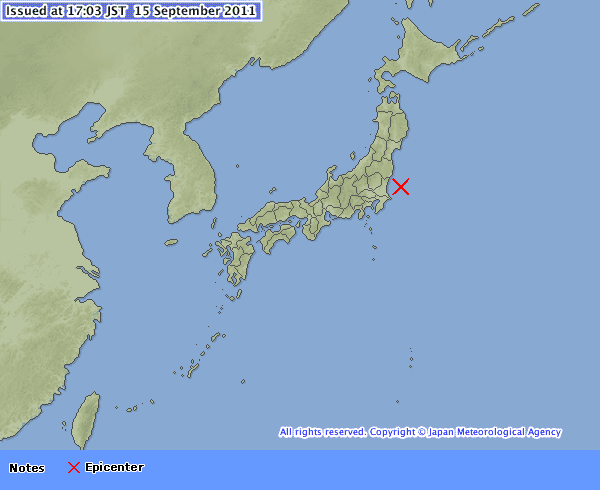 by Edano via Jma.go.jp 9/15/2011 8:53:06 AM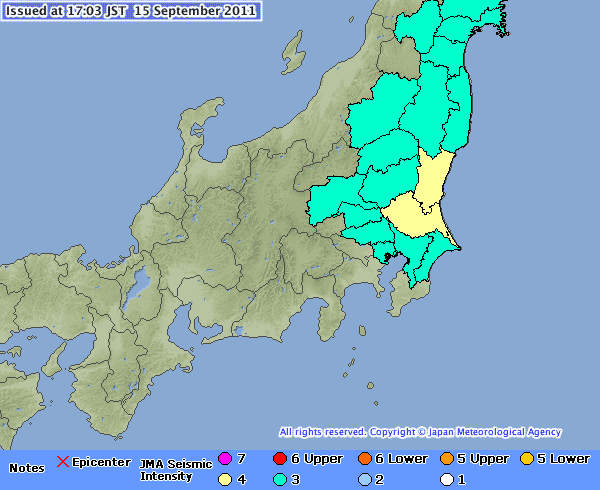
www.jma.go.jp only a 3 seismic intensity
by Edano via Jma.go.jp 9/15/2011 8:54:09 AM- 17:03 JST 15 Sep 2011 17:00 JST 15 Sep 2011 4
17:02 JST 15 Sep 2011 17:00 JST 15 Sep 2011 3
17:01 JST 15 Sep 2011 17:00 JST 15 Sep 2011 3 www.jma.go.jpby Edano 9/15/2011 8:55:15 AM - 17:10 JST 15 Sep 2011 17:00 JST 15 Sep 2011 Ibaraki-ken Oki M6.2 4
17:04 JST 15 Sep 2011 17:00 JST 15 Sep 2011 Ibaraki-ken Oki M6.2 4
www.jma.go.jp 2 or 3 quakesby Edano 9/15/2011 8:56:11 AM 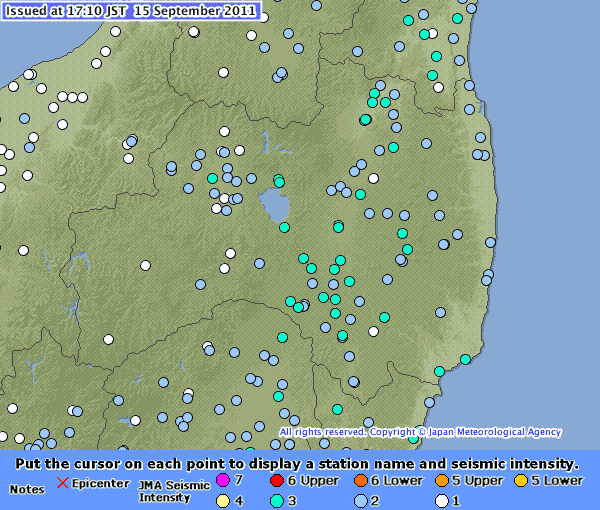 by Edano via Jma.go.jp 9/15/2011 8:57:20 AM
- okay, nothing serious, it appears.by Edano 9/15/2011 8:58:17 AM
 by Edano via Jma.go.jp 9/15/2011 9:00:37 AM
- "Although there may be slight sea-level changes in coastal regions, this earthquake has caused no damage to Japan." www.jma.go.jpby Edano 9/15/2011 9:01:32 AM
www3.nhk.or.jp
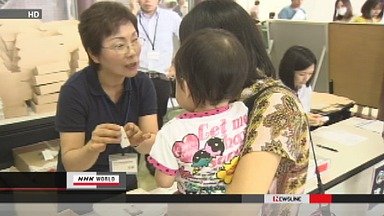
Infants to be tested for radiation exposure
Minamisoma City in Fukushima Prefecture has decided to include infants and small children in tests for radiation taken into their bodies.
Parts of the city are designated as evacuation zones following the accident at the Fukushima Daiichi nuclear plant.
Since July, the city has been testing residents for internal radiation exposure, but infants and small children were excluded as the equipment did not fit them. It has been studying other test methods for them.
A city-run general hospital, working with a Tokyo-based medical firm, has decided on a method to measure amounts of radioactive substances in urine and began accepting applications on Thursday.
The new test will be provided free of charge for children 6 years old and under. Results will be mailed about 2 weeks after urine samples are received.
A mother said she has not been allowed to go outside with her baby, adding she wants to have her baby tested as soon as possible.
An official at the hospital said many parents must be worried about the health of their children, and that he hopes the tests would ease their concerns.
Thursday, September 15, 2011 14:01 +0900 (JST)
www3.nhk.or.jpby Edano via Www3.nhk.or.jp 9/15/2011 9:04:08 AM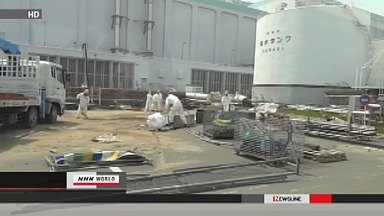
www3.nhk.or.jp
Plant workers fail to evacuate despite exposure
At least 4 workers at the Fukushima Daiichi nuclear plant failed to evacuate even though their radiation monitor indicated levels of beta rays exceeding the set limit.
The workers were replacing equipment in the plant's wastewater processing system on Wednesday.
Their beta ray counter indicated levels above the evacuation benchmark of 5 millisieverts per hour, but the workers did not evacuate and continued repairs.
Beta rays can not easily penetrate the skin and the legal limit of exposure in case of emergency is 1,000 millisieverts per hour.
The 4 workers' level of exposure is believed to have been 9.5 millisieverts at maximum, which poses no immediate health risks.
The plant's operator, Tokyo Electric Power Company, is looking into why the workers failed to leave despite hearing an alarm. It has also begun checking 17 other people who were working nearby for exposure to beta rays.
Late last month, 2 Tokyo Electric workers were exposed to high levels of beta rays. Another 2 workers were contaminated when they were accidentally sprayed with radioactive wastewater.
Thursday, September 15, 2011 09:51 +0900 (JST)
www3.nhk.or.jpby Edano via Www3.nhk.or.jp 9/15/2011 9:06:32 AM- @edano I wouldnt be able to trust them to test my child and give me the correct results I would assume that whatever they said the results were would be a lieby elainekirk 9/15/2011 9:08:36 AM
- @elainekirk yep, and urine testing does not say much about internal exposure.by Edano 9/15/2011 9:09:41 AM
- UN: Fukushima plant based on poor safety assesment
UN Secretary General Ban Ki-moon has blamed the nuclear accident at the Fukushima Daiichi power plant in northern Japan on its design which, he says, was based on poor hazard assessments of natural disasters.
The secretary general released a 43-page report on Wednesday, after studying the March accident with UN entities including the International Atomic Energy Agency and the World Health Organization.
The report says it is necessary for nuclear power stations to strengthen their safety standards.
It proposes the creation of a global system to allow the IAEA to internationally monitor radiation levels, citing the international impact of major nuclear accidents and emergencies.
The report calls for an international emergency response framework in the event of nuclear accidents, to secure human health and food safety.
The report also stresses the importance of the peaceful use of nuclear energy, in order to help improve the lives of the 2.4 billion people in developing countries suffering from energy poverty.
The UN secretary general is to convene a high-level meeting on nuclear safety and security on September 22nd in New York.
Thursday, September 15, 2011 16:40 +0900 (JST)
www3.nhk.or.jpby Edano 9/15/2011 9:09:56 AM - ooopsi ...... the UN ?by Edano 9/15/2011 9:10:17 AM
- @Edano mmm better goo find it hadnt weby elainekirk 9/15/2011 9:11:11 AM
- how many seminars we have iaea at it this week and next then this un one starts next Thurs ..by elainekirk 9/15/2011 9:14:36 AM




Japan Earthquake | Page 2346
- Who's Blogging
-
 hudebnik
 alblee
 UKVal
UKVal Oliver (ScribbleLive)
 Jonathan Keebler
 kaykodh
 PKelley
 Markfm
 Angie
Angie Deb
Deb- Mid Valley
- Pedro Jesus
 Matt (ScribbleLive)
 George Gibb
- elainekirk
- lillymunster
 dean
dean bo
bo- Edano
 IanGoddard