Japan Earthquake | Page 2348
 lilly here more from the EPA www.epa.gov : "Americium-241 in drinking water is covered under the Safe Drinking Water Act. This law establishes Maximum Contaminant Levels, or MCLs, for radionuclides and other contaminants in drinking water. The MCL for alpha particle activity applies to Am-241. The limit is 15 pCi/l alpha particle activity in drinking water." 15 pCi/l corresponds to 0.56 Bq/l. If I remember correctly the EPA bases its limits on lifetime exposure.by Peter 9/15/2011 4:04:56 PM
 They DO seem to be looking for Americium (from Chernobyl)...in bone tissue from knee and hip replacements. Human bones obtained from routine joint replacement surgery as a tool for studies of plutonium, americium and ⁹⁰Sr body-burden in general public. www.ncbi.nlm.nih.gov Interesting excerpt: "assessment of internal contamination by artificial radionuclides in humans can be achieved in several ways. Whole body counters with a modern gamma-ray spectrometric system (Ishikawa, 2006) made the in-body content of gamma-emitters studies relatively easy. The same equipment can be applied for pure beta-emitters provided contamination is high enough to apply secondary gamma-rays (so called bremsstrahlung) radiation (Kozheurov et al., 2002). For alpha emitters the body content can be determined either by measuring excreta (faeces or urine) (Hölgye, 1984; Khokhryakov et al., 2004) or by direct sampling of tissues.”by Cryptococcus 9/15/2011 4:11:44 PM
- They should test the mussels, scallops and abalone for bioaccumulation of radionuclides. www.ncbi.nlm.nih.govby Cryptococcus edited by lillymunster 9/15/2011 4:16:57 PM
- Americium suppresses the growth of a luminescent bacteria but increases its luminescence. Effect of americium-241 on luminous bacteria. Role of peroxides. www.ncbi.nlm.nih.govby Cryptococcus 9/15/2011 4:20:57 PM
 Grabbed all those posts and links. That found in Tokyo is way over US water standard.by lillymunster 9/15/2011 4:26:17 PM
- Twelve years of follow up of cases with old 241Am internal contamination. Can be downloaded free. Doesn't really give any health concerns. Just that Americium does not go away once it's absorbed into the body.by Cryptococcus 9/15/2011 4:27:02 PM
- @Cryptococcus was that from NIH?by lillymunster 9/15/2011 4:36:49 PM
 Japan Atomic Energy Body Sees Technical Hurdles Ahead online.wsj.comby elainekirk 9/15/2011 4:52:26 PM
- @lillymunster No, it was Polish research.by Cyptococcus 9/15/2011 5:01:58 PM
- @lillymunster It would be interesting to search the Chernobyl research, esp that done by the doctors, to see if they tested for Americium. But it's sort of like getting shot with different kinds of bullets. Who cares which bullets? However, a comparison of all the possible alpha, beta and gamma nuclides released from NPP accidents (or general releases) and those not mentioned in the Japanese press or research, would be educational.by Cyptococcus 9/15/2011 5:06:12 PM
A long-period usage of plutonium recovered in RRP pant in domestic LWRs is one of the options for future nuclear energy system in
Japan after the Fukushima Daiichi accident. Since in MOX fuel, especially at high burnup, the accumulation of platinum group elements
and americium is high in comparison with those in UO2 fuel, it is important to understand the change of chemical properties (oxygen
potential, phase relationship, etc.) with burnup progressing. In this study, high temperature data, such as ternary phase relations of
fission product element-actinide-oxygen system, are systematically examined based on the arrangement of present knowledge.
Furthermore, the database needed for analysis of irradiation behavior of high burnup MOX fuel are prepared, which will be also essential
for fuel safety evaluation www.jaea.go.jpby elainekirk 9/15/2011 5:24:28 PM
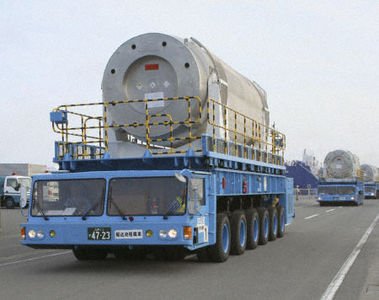
english.kyodonews.jp
Radioactive waste returned to Japan
Trucks transport metal containers holding high-level radioactive vitrified waste to a storage facility of Japan Nuclear Fuel Ltd. in the village of Rokkasho, Aomori Prefecture, on the northern tip of Honshu, on Sept. 15, 2011. The radioactive waste was returned to Japan after processing in Britain, in the course of reprocessing spent nuclear fuel at Japanese reactors. (Kyodo) english.kyodonews.jpby Edano via English.kyodonews.jp 9/15/2011 5:32:10 PM- how lucky that there were no transports on march 11 ..... or were there ?by Edano 9/15/2011 5:33:55 PM
- Edano says Fukushima Daini nuclear power plant's resumption difficult
TOKYO, Sept. 16, Kyodo
Japan's new industry minister Yukio Edano said Thursday it will be difficult to restart the Fukushima Daini nuclear power plant, in addition to the Nos. 5 and 6 reactors of the crippled Fukushima Daiichi plant, as local residents are unlikely to approve the resumption.
In an interview with Kyodo News and other media organizations, Edano said that winning approval of local municipalities where idled reactors are located is a ''precondition'' for their reactivation.
Tokyo Electric Power Co., which operates the two nuclear power complexes in Fukushima Prefecture, plans to scrap the troubled Nos. 1-4 reactors of the six-reactor Fukushima Daiichi plant, and Edano had earlier said when he was chief Cabinet secretary in the wake of the start of the Fukushima nuclear crisis that the remaining Nos. 5 and 6 reactors will likely be decommissioned, too. english.kyodonews.jpby Edano 9/15/2011 5:36:03 PM - ah, they plan to scrap daiichi 1-4. surprise surprise.by Edano 9/15/2011 5:38:10 PM
- Researchers say meltdown could have been avoided
A group of researchers says the meltdown of a reactor at the Fukushima Daiichi nuclear power plant could have been avoided if water injection had been carried out 4 hours earlier than it was.
The researchers at the Japan Atomic Energy Agency on Thursday reported the finding based on a computer simulation of the accident at the plant's No. 2 reactor.
The core meltdown took place within a few days after the reactor's cooling system failed due to the major earthquake and tsunami on March 11th.
The Tokyo Electric Power Company, or TEPCO, said earlier that data analysis shows that the cooling system may have stopped working shortly after 1 PM on March 14th.
The utility started injecting water to cool the reactor at around 8 PM that day, after reducing pressure in the facility. But by 8 PM the next day -- around 100 hours after the quake -- much of the reactor's fuel had melted and collected at the bottom of the reactor's pressure vessel.
The simulation suggests that if water had been injected by around 4 PM, it could have prevented the meltdown by lowering the temperature of the fuel before it reached 1,200 degrees Celsius, destroying the fuel's container.
Group leader Masashi Hirano says the damage to the fuel could have been avoided, and that he wonders why TEPCO did not start injecting water earlier despite difficulties.
TEPCO says it doesn't believe the operation was delayed, adding that workers did their best amid high radiation levels and other severe conditions.
Of the plant's 6 reactors, the No. 1 to No. 3 suffered meltdowns after losing cooling functions.
At the No. 2 reactor, a hydrogen explosion on March 15th caused the release and spread of massive amounts of radioactive substances.
Thursday, September 15, 2011 21:46 +0900 (JST)
www3.nhk.or.jpby Edano 9/15/2011 5:41:18 PM 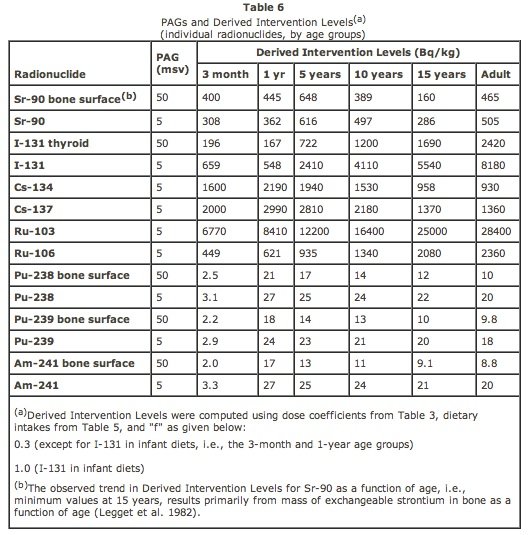
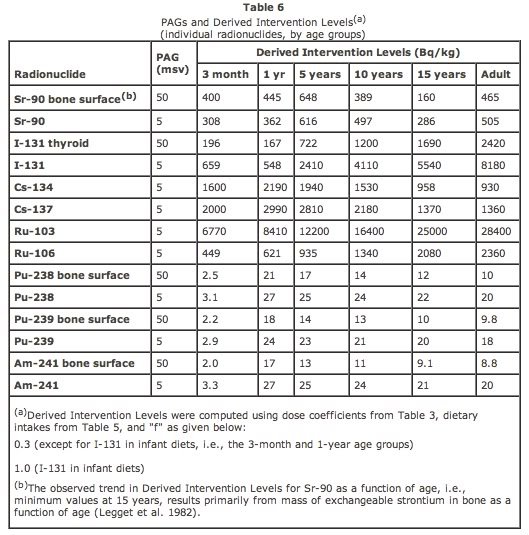
@lillymunster , I found the following info about AM-241 on this FDA webpage www.fda.gov : "By definition, a DIL (Derived Intervention Levels, ed.) corresponds to the radionuclide activity concentration in food present throughout the relevant period of time that, in the absence of any intervention, could lead to an individual receiving a radiation dose equal to the PAG (Protective Action Guide)."
According to their Table 6, the derived intervention level for Am-241 ranges from 3.3 (infant) to 20 Bq/kg (adult). i1214.photobucket.comby Peter via I1214.photobucket 9/15/2011 5:58:26 PM- @Edano tepco will be planning on restarting them you can bet. The best way to thwart them would be to insist they took out public liability insuranceby elainekirk 9/15/2011 6:11:16 PM
- @Peter that is much easier to understand vs. the americium they found in Tokyo.by lillymunster 9/15/2011 6:21:44 PM
- Did a write up on the Americium levels based on everyone's findings. houseoffoust.comby lillymunster 9/15/2011 7:29:53 PM
- @lillymunster will spreadby elainekirk 9/15/2011 7:32:34 PM
- Japan Banks Won't Forgive Tepco Loans, Lobby Chief Says
Sept. 15 (Bloomberg) -- Japanese banks won't forgive loans made to Tokyo Electric Power Co., the country's banking lobby chief said, responding to a government official's comments that creditors should help support the nuclear plant operator.
“We have repeatedly said we wouldn't accept forgiveness of loans to Tepco if we are asked to do so,” Katsunori Nagayasu, head of the Japanese Bankers Association, said at a news conference in Tokyo today. “I believe the government wouldn't let default of Tepco or forgiveness of loans happen.”
Yukio Edano, Japan's new trade minister, said this week that Tokyo Electric creditors and shareholders should help pay for the costs associated with the nuclear accident at its Fukushima Dai-Ichi plant. The government has set up an organization to support Tokyo Electric, known as Tepco, with 2 trillion yen ($26 billion) of funding.
Edano made similar remarks earlier this year in his previous role as chief government spokesman. Nagayasu and his predecessor Masayuki Oku said at the time that banks weren't prepared to forgive loans to Tepco.
Nagayasu is also chief executive officer of Mitsubishi UFJ Financial Group Inc., one of the Japanese banks that lent about 2 trillion yen to the utility after a March 11 earthquake and tsunami damaged reactors and caused a meltdown.
“We've given support to Tepco such as emergency loans after the disaster and will continue to do so,” Nagayasu said today. “The government's measures such as formation of the third-party body to compensate victims, contain the nuclear crisis and maintain Japan's power supply were taken based on the premise that a default of Tepco or a loan waiver won't happen.”
Edano said in parliament today that it wouldn't be “appropriate” to let Tepco go bankrupt.
--With assistance from Sachiko Sakamaki in Tokyo. Editor: Russell Ward
news.businessweek.comby elainekirk 9/15/2011 8:15:18 PM - @elainekirk I thought they were going to liquidate them?by lillymunster 9/15/2011 8:24:54 PM
- @lillymunster I think we have a situ where tepco are preparing to jump and everyone is getting nervousby elainekirk 9/15/2011 8:25:57 PM
 Areva suspends some uranium production after Japan quake. French nuclear giant Areva is suspending uranium production at two plants because of low demand from Japanese power stations in the wake of the Fukushima disaster, a spokeswoman said Thursday.
Production at subsidiary Comhurex's Malvesi and Tricastin sites will be suspended for two months because of the devastating earthquake and tsunami that struck Japan and swamped a nuclear site six months ago, the spokeswoman said.
"This decision is based on the events in Japan, which today has led to a drop in deliveries to Japanese power producers and short term downward pressure on prices in this market," Areva said in a statement.
"A certain number of orders placed by the Japanese have been cancelled," Areva chief executive Luc Oursel told AFP from New York. www.google.comby Majj 9/15/2011 8:42:32 PM- Japan Reactor Restarts Face Complications . The governor of Fukui prefecture, Issei Nishikawa, said Thursday after meeting with regulators in Tokyo that current stress tests are "not sufficient," signaling that local officials may demand tougher standards that envision a Fukushima Daiichi-scale disaster as a prerequisite for reactor restarts. Fukui, located on the Sea of Japan coast, hosts 13 reactors, the largest number of any prefecture in Japan.
Mr. Irikura, who now heads the panel studying the lessons of Fukushima, said formulating new guidelines is a long-term process, noting it took five years to complete the last revisions, and then another four years—until December 2010—to modify those standards to deal with the dangers of tsunamis. He served on the panel that drafted the 2006 standards, and, in the interview, reflected on what he now considers to have been the flaws in that process.
"We didn't focus on worst-case scenarios, but rather what were believed to be the most likely outcomes," said Mr. Irikura, 71, who coedited a book on advanced seismic-hazard assessment published earlier this year. "The risk of outliers like tsunamis was evaluated, but our advice...was that plant operators should be aware of these—not necessarily to expect them to occur." online.wsj.comby Majj 9/15/2011 8:48:01 PM - @Majj lets hope they get totally nobbledby elainekirk 9/15/2011 9:13:37 PM

This was just posted as a response to one of my videos. A book about Fukushima.
by Ian 9/15/2011 9:40:48 PM
This promo for a new book on Fukushima was just posted as a response to one of my videos. Sounds for real and good, but the "Why It Sucks" part of the title makes it sound non-serious.by Ian 9/15/2011 9:41:30 PM- Areva is reorganizing and refinancing things from an earlier story. I think they are really scrambling but don't want to panic investors.by lillymunster 9/15/2011 10:30:08 PM
- Print this out, line your cat box with it. www.google.comby lillymunster 9/15/2011 10:42:47 PM
- I am just waiting for the taxpayer funded prat who is going to stand up one day soon and tell us that Fukushima is proof that nukes accidents pose no immediate risk to human health.by elainekirk 9/15/2011 10:51:16 PM
- @elainekirk not to mention most of the reactors in the US are from the 60's and 70's the time period he says is unsafe. All these new reactors he mentions are the ones I was posting about the major flaws with them. The passive one he mentione is the AP 1000 Arnie Gundersen says the passive airflow will act like a chimney in a meltdown or fire.by lillymunster 9/15/2011 10:56:36 PM
- @elainekirk you are so right.by Edano 9/15/2011 10:57:08 PM
 Didn't mean to post it twice, feel free to delete one. My first post appeared for an instant then disappeared and so I tried again and only then saw it briefly said it was under moderation review, hence the first temporary disappearance.by Ian 9/15/2011 10:57:15 PM
- @Ian the gremlin is getting very devious he booted everybod out the other day kept us stood at the door till he got bored of the gameby elainekirk 9/15/2011 10:58:57 PM
- The guy who wrote that article and is a consultant to the IAEA is a freaking lobbyist! ::headdesk:: www.cov.comby lillymunster 9/15/2011 11:05:18 PM
- @lillymunster maybe we should start a hall of infamy and put mug shots with all present and previous just to show the incestuous relationships wthin nukedom
by elainekirk 9/15/2011 11:07:56 PM - He also works for PG&E while he is doing all this. For those not familiar they are the power utility in California and own nuclear reactors www.pgecorp.comby lillymunster 9/15/2011 11:11:05 PM
- @elainekirk Oh I think this is working itself into a story. This guy is his own brother.by lillymunster 9/15/2011 11:11:39 PM
- @lillymunster fancy that a family tree ..by elainekirk 9/15/2011 11:17:49 PM
- A lobbyist that works for a nuclear power company is an advisor to the IAEA. I wonder if there is a way to find out how much he gets paid by the IAEA? He went from being a lobbyist and working for PG&E to working for the NRC as the head from 99 to 2003 then right back to his old gigs.by lillymunster 9/15/2011 11:27:31 PM
- @lillymunster I will have a lookby elainekirk 9/15/2011 11:28:34 PM
- @you the accounts I found are pretty basic I will keep diggingby elainekirk 9/15/2011 11:42:08 PM
- found the budget but struggling with earnings will keep going www.iaea.orgby elainekirk 9/15/2011 11:49:35 PM

Japan Earthquake | Page 2348
- Who's Blogging
-
 hudebnik
 alblee
 UKVal
UKVal Oliver (ScribbleLive)
 Jonathan Keebler
 kaykodh
 PKelley
 Markfm
 Angie
Angie Deb
Deb Mid Valley
- Pedro Jesus
 Matt (ScribbleLive)
 George Gibb
- elainekirk
- lillymunster
 dean
dean bo
bo- Edano
 IanGoddard