Japan Earthquake | Page 2505
 Oversight and inspection kept within the current NRC.... Enforcement reporting to Attorney Generals office maybe and then Liscensingby dean 10/14/2011 1:25:05 PM
 @dean It might be worth exploring the idea of getting some of the various nuclear issue groups on board with this. It is a simple idea that could change lots of problems. There are lots of these localized groups trying to deal with issues at specific NPP's that the NRC is not properly addressing. I wonder if a petition would have any teeth to send to congress?by lillymunster 10/14/2011 1:27:51 PM
- @dean I saw something last week that license extension time frames are based on economics and anti trust issues, not on the technical ability for plants to operate that long. This was about the 40 or 20 year established time frames.by lillymunster 10/14/2011 1:30:06 PM
- @ lilly we should study it and become familiar with current work first, my initial thoughts are,, higher power means higher flux levels and higher flux levels mean higher flux affects on the shroud which could result in premature cracking etc.. and the reactor vessel wall fluence values would increase which could accelerate potential issues.by dean 10/14/2011 1:31:52 PM
- @.lilly, exactly the type of information we need to forward to our senators and representatives. I think the states need to beef up their nuclear approval presence with the NRC and step in when needed to be a final voteby dean 10/14/2011 1:33:19 PM
- The nuclear properties of fuel cladding material must also be satisfactory. For thermal reactors, it is important that the material have a reasonably small absorption cross section for neutrons. Only four elements and their alloys have low thermal-neutron absorption cross sections and reasonably high melting points: aluminum, beryllium, magnesium, and zirconium. Of these, aluminum, magnesium, and zirconium are or have been utilized in fuel-element cladding.
Aluminum, such as the 1100 type, which is relatively pure (greater than 99%), has been used in low power, water-cooled research, training, and materials testing reactors in which the operating temperatures are below 100°C. Magnesium, in the form of the alloy magnox, serves as cladding for the uranium metal fuel in carbon-dioxide cooled, graphite-moderated power reactors in the United Kingdom. The alloy zircaloy, whose major constituent is zirconium, is widely used as the fuel-rod cladding in water-cooled power reactors. The alloys in common use as cladding material are zircaloy-2 and zircaloy-4, both of which have mechanical properties and corrosion resistance superior to those of zirconium itself. Although beryllium is suitable for use as cladding, it is not used due to its high cost and poor mechanical properties.
The choice of cladding material for fast reactors is less dependent upon the neutron absorption cross section than for thermal reactors. The essential requirements for these materials are high melting point, retention of satisfactory physical and mechanical properties, a low swelling rate when irradiated by large fluences of fast neutrons, and good corrosion resistance, especially to molten sodium. At present, stainless steel is the preferred fuel cladding material for sodium-cooled fast breeder reactors (LMFBRs). For such reactors, the capture cross section is not as important as for thermal neutron reactors.by dean 10/14/2011 1:34:19 PM - @lilly.. over my career I am oldschool I guess, I don't like to assume that new fuel changes or major operational changes can be done on NPP's that would change the original safety basis and operating envelope of the facilityby dean 10/14/2011 1:36:22 PM
- @dean It sounds like a bit of an experiment even if the aspects have been researched on paper, to try them in a commercial NPP without extensive actual testing first.by lillymunster 10/14/2011 1:37:34 PM
- New codes and more sophisticated computing capability has been used to justify pushing the operational safety envelope on NPP's.. At times the new safety code analyses results show operation is outside or pushing a bounded condition in which case the utility co's get the paper pushing folks on board to figure a work around... that is an example of what has been done with the results of newer seismic activity code analysesby dean 10/14/2011 1:39:09 PM
- @ lilly.. they do test these in testing conditions first and that is another point, using a NPP for a test platform on new fuel design is WRONG in my view... they put an element in with the new mods and see how it performs, they calculate how it's supposed to behave but they never use a TEST REACTOR to proof test the system..STRIKE TWO..by dean 10/14/2011 1:40:44 PM
- and the consequence,,, possible fuel cladding problems leading to perhaps overheating or blistering, possible loss of fuel rod integrity leading to fuel pellets getting loose.. etc.by dean 10/14/2011 1:42:36 PM
- one of the reports talked about a fuel pellet container and NRC intervention was needed to decide what to do with the pellets, how long to store them in the container before removing.. photo's indicated the over heating of the container bottom and sides when it was lifted outby dean 10/14/2011 1:44:08 PM
- In 1977 the Carter Administration deferred indefinitely the reprocessing of nuclear fuels from commercial power reactors. This led the electric utility industry to conduct research on high-burnup fuels and programs that would allow an increase in the length of time that the fuel rods remain in the reactors. High integrity and performance of fuel cladding will become even more important as these high-burnup fuel rods are designed and programs for extended burnup of nuclear fuels are placed into operation. president Carter was a nuclear engineerby dean 10/14/2011 1:45:08 PM
- @dean right. I think I read that GE fuels has a test reactor but that doesn't mean every fuel mfg does or uses them. JAEA might have info on fuel experimentation or maybe Japan fuels? If the LEU is made domestically in Japan and they were tinkering with different cladding that would be good to know.
There is a public meeting on Cooper about procedural and whatnot type changes there. I think there may also be a meeting about the longer fuel cycle. It would be useful to get technical details on how/why they are going to make the fuel cycle longer. It is a Mark 1 unit. Ooh I just thought of something. We were looking at fuel cycles in Japan at one point when we were documenting the mOX inventories. I wonder if Japan was on a 18 or 24 month fuel cycle. Smoss or Elaine might remember otherwise I could go diving into old notes.by lillymunster 10/14/2011 1:48:02 PM - www.davistownmuseum.org @ lilly.. concerns over operating with fuel cladding failuresby dean 10/14/2011 1:49:12 PM
- I thought Japan had the shorter fuel cyclesby dean 10/14/2011 1:50:14 PM
- and remember.. Fuel Cladding is the first containment of nuclear fission products and is designed to prevent failure in accident conditions..by dean 10/14/2011 1:51:16 PM
- Fuel Cladding Failure Experience
Numerous fuel cladding failures from various causes have been reported over the years. For example, the water flowing through the reactor core has caused fuel rods to sway back and forth. In this situation, the fuel rods vibrate against the grid (shown in Figure 2) and damage the cladding. At other plants, debris in the reactor water, such as metal flakes from rusted piping, has lodged against the grid. The friction from the vibration of this debris damaged the cladding. Another failure mode results when fuel pellets expand faster than the fuel rod cladding (see Figure 1) as their temperatures increase. The expanding pellets stretch the cladding, sometimes until it cracks or splits. Finally, the welds holding the upper and lower end plugs to the fuel rod cladding (see Figure 1) have sometimes been defective, causing pinhole leaks or even cracks to form. Other failure modes have been experienced too. Many, if not all, nuclear plants have experienced fuel cladding failures during their lifetimes. Few plants have shut down early to remove failed fuel rods. @ lilly.. I have been involved on some of the testing with thisby dean 10/14/2011 1:52:08 PM - Leaking fuel rods (called LEAKERS)
are detected by increased radioactivity levels in the reactor vessel’s liquid and gaseous releases.4 Not surprisingly, the radioactivity levels rise significantly when fuel cladding fails. The causes of fuel cladding failures cannot be determined until the plant is shut down and the leaking fuel rods examined.by dean 10/14/2011 1:53:00 PM - by lillymunster 10/14/2011 1:54:03 PM
- Cladding on MOX rods at Fuku had visible faults. Cracks, corroded spots etc. they installed it anyway. I don't know the cladding details as far as what they used. The Greenpeace study showed that the fuel building process at the factory that made Fuku's MOX had a mixing problem and that the plutonium was not sufficiently mixed in the pellets. This causes hot spots where the cladding can bulge, blister, crack or fail first.by lillymunster 10/14/2011 1:57:10 PM
- older plants didn't have a 2:3 logic system which allows the maintenance on 1 channel while the logic then goes to 2:2... instrument upgrades were made to install these plant protective systems... thus.. if the older japan reactors didn't have the upgrades they would be forced to shutdown so that calibrations and maintenance could be done... now, one thing they could do is just change the periodicity on calibrations which is riskyby dean 10/14/2011 1:57:44 PM
- you just hit the nail on the head @ lilly... testing a perfectly built fuel pellet could be fine.. but mass assembling them could introduce flaws and those works... HOT SPOTS, BLUGING PELLETS push agains the tube surrounding the fuel and can over heat it and result in a cracked fuel rod...by dean 10/14/2011 1:59:32 PM
- IAEA released the report on decontamination remediation for Japan www.iaea.orgby lillymunster 10/14/2011 2:00:10 PM
- 'IF" the cladding has a problem and the activity goes up in the plant, they are faced with a decision... "can" we operate with the increased activity levels and.. are we willing to risk a degrading fuel element with out further damage.... PROFIT... hmmmmm ..by dean 10/14/2011 2:01:09 PM
- @dean Official comments on unit 3 claim the MOX had nothing to do with the epic explosion. Knowing the issues with the MOX fuel it has to have a role, degraded cladding when they started then a major accidentby lillymunster 10/14/2011 2:02:35 PM
- Notes also said MOX will vaporize cladding at a fairly low temp 500-700c IIRC.by lillymunster 10/14/2011 2:03:16 PM
- I say BOGUS on that official comment,, first thing bad about MOX is how it behaves in severe accident conditionsby dean 10/14/2011 2:05:06 PM
- I need to push of to the gym....by dean 10/14/2011 2:05:30 PM
 there is a radiation mapping release here for the 12th www.mofa.go.jpby elainekirk 10/14/2011 2:10:37 PM
- @dean Greenpeace released a very technical detailed report about the mOX issues.by lillymunster 10/14/2011 2:12:48 PM
- @elainekirk If you find more from MEXT that has details of the survey in Akita prefecture let me know. They finished the survey there. Curious how it compares to local detectingby lillymunster 10/14/2011 2:14:30 PM
- @lillymunster ok just finding hoseby elainekirk 10/14/2011 2:18:34 PM
 IAEA team praises Japan after Fukushima visit
www.google.comby Panserbjorne9 10/14/2011 2:36:16 PM Educational and fun at the same time. Researcher studies atoms hitting cells (low radiation effects on cells). Dr. Med"Evil" www.youtube.comby Cryptococcus 10/14/2011 2:52:34 PM
- Out to go stimulate the economy - back in a few hoursby lillymunster 10/14/2011 2:54:32 PM
I am done for the day and plan to sit doing whatever googling anybody can think upby elainekirk 10/14/2011 5:07:21 PM
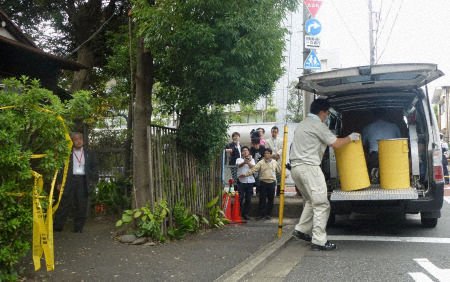
english.kyodonews.jp
Radioactive bottles removed from Tokyo house
Drums containing bottles with radioactive substances are loaded into a vehicle beside a house (L) in Tokyo's Setagaya Ward on Oct. 14, 2011. Several dozen bottles deemed to be the source of high levels of radiation detected in the area were found under the floor of the house by government officials. The Ministry of Education, Culture, Sports, Science and Technology is almost certain the powder inside the bottles is radium, easing public anxiety that the radiation could have been related to the nuclear crisis at the crippled Fukushima Daiichi nuclear plant over 200 kilometers away. (Kyodo) english.kyodonews.jpby Edano via English.kyodonews.jp 10/14/2011 5:17:33 PM- @Edano why do a think it is an elaborate farceby elainekirk 10/14/2011 5:20:05 PM
- @elainekirk it's strange indeed.by Edano 10/14/2011 5:20:54 PM
- @Edano sure isby elainekirk 10/14/2011 5:21:30 PM
- some dozen bottles of radium hidden there for decades sure would be more dangerous than some cesium since march, especially for the people living in the house. *shiver*by Edano 10/14/2011 5:24:49 PM
- @Edano yeah wonnder why it was emptyby elainekirk 10/14/2011 5:28:41 PM
- @elainekirk it was empty ?by Edano 10/14/2011 5:29:13 PM
- an empty building in tokyo is very unusual.by Edano 10/14/2011 5:33:26 PM

Japan Earthquake | Page 2505
- Who's Blogging
-
 hudebnik
 alblee
 UKVal
UKVal Oliver (ScribbleLive)
 Jonathan Keebler
 Matt (ScribbleLive)
 kaykodh
 PKelley
 Markfm
- dean
 Angie
Angie- Edano
 Deb
Deb Mid Valley
 Pedro Jesus
 George Gibb
- elainekirk
- lillymunster
 bo
bo IanGoddard