Japan Earthquake | Page 2498
 #2 was 15th. 6:15.by Edano 10/12/2011 11:52:46 PM
 Tokyo finds hot spot with higher radiation levels than evacuation zones around Fukushima. Japanese officials have found a small area in Tokyo with higher levels of radiation than evacuation zones around the Fukushima nuclear plant.
Tokyo’s Setagaya city’s mayor says concerned parents monitoring for radiation asked them to conduct further tests on a roadside spot near a kindergarten. Its radioactivity slightly exceeded that of an area about 25 miles (40 kilometers) from the Fukushima Dai-ichi plant. www.washingtonpost.comby Majj 10/12/2011 11:54:05 PM- Nuke Industry Insider: Fukushima spent fuel was damaged and released fission products, leading to a fire. Erin Alexander, American Nuclear Society’s 2011 Glenn T. Seaborg congressional fellow, [...] explained what happened at Fukushima. [...] At the Daiichi site, backup generators flooded, and an additional backup battery also was damaged, leading to the overheating of spent nuclear fuel.
Cladding around stored fuel cracked from the heat, fission products were released from damaged fuel, gas was released into the reactor service floor and a series of hydrogen explosions, plus a fire, followed, she continued [...] enenews.com www.somdnews.comby Majj 10/13/2011 12:02:14 AM  @Majj good findby elainekirk 10/13/2011 12:08:14 AM
- @Majj #4 i guess ?by Edano 10/13/2011 12:08:50 AM
- @Edano @all g'night hope you all sleep well/have a good dayby elainekirk 10/13/2011 12:43:22 AM
 by Edano via Graphics16 10/13/2011 12:44:13 AM
- @elainekirk Thanks @Edano Think so , the mystery #4 .....by Majj 10/13/2011 12:52:14 AM
Wednesday, Oct. 12, 2011
Yokohama finds high strontium-90 levels
Kyodo
YOKOHAMA — Radioactive strontium exceeding normal levels has been detected in sediment from atop an apartment building in Yokohama, some 250 km from the Fukushima No. 1 nuclear power plant, city officials said Wednesday. search.japantimes.co.jpby elainekirk 10/13/2011 12:52:50 AM- @Edano @Majj ty a lovely g'night and now I am going to sleepby elainekirk 10/13/2011 12:53:46 AM
 Fukushima spells fear , food contamination issues www.theglobeandmail.comby lillymunster 10/13/2011 1:21:43 AM
 Lilly, edano is almost correct. According to the additional NISA report, p II-94: "At 11:01, March 14, however, the explosion in the reactor building of Unit 3 occurred, ..."by Peter 10/13/2011 1:31:36 AM
- as to unit 2 on p II-98 same report: "...at around 6:00 to 6:10 on March 15, a large impulsive sound occurred. During the same time period, the pressure within the S/C indicated 0 MPa abs."by Peter 10/13/2011 1:36:50 AM
- as to unit 4 on II-106, same report: "...the reactor building was confirmed to be damaged after impulsive sound at around 06:00 on March 15."by Peter 10/13/2011 1:39:04 AM
- Trying to determine if specific events at the plant could have contributed to the excess fallout during that wind to the NWby lillymunster 10/13/2011 2:00:01 AM
 I can still see some trouble with keeping time around the world. Shouldn't we keep a specific reference. Like GMT - ? or GMT +?. When we talk about Pacific Time or Japan Time or Eastern Time, the majority of the people (me included) don't have a clue of what you're talking about and most of them don't even bother checking it. Let's stick to GMT, the international standard. What do you think? Of course, whenever you put a reference about another world time you can always add the relative time to GMT between brackets. That will keep everybody happy and well informed. =)by Pedro Jesus 10/13/2011 2:15:17 AM
- @Pedro Jesus I have never been able to quickly relate GMT, drives me crazy, It isn't used much in the US.by lillymunster 10/13/2011 2:19:21 AM
- @lillymunster I can understand that. I can't relate Japan Time, Western Time or Eastern Time either. The thing is if we stick to the scientific standard time than it's a bit easier for everyone around the world to know where they're at. Otherwise you end up stating that a certain situation happened in different days like it happened only a few lines down this thread. GMT (Greenwich Mean Time) can be followed in any cell phone, laptop or any other device that's connected to the internet. Other region specific time cannot. You'd have to Google all the time. I'm not saying this because I'm from GMT = 0, I'm saying this from a scientific perspective, if you want to make precise scientific analysis of events. Just my opinion, trying to make your (our) life easier.by Pedro Jesus 10/13/2011 2:26:10 AM
- @Pedro Jesus Maybe we need some sort of visual cheat sheet, would help people convert to GMT and those that are used to GMT to convert quickly. We have some world clocks on the web site home page. I should see if I can set one for GMT.by lillymunster 10/13/2011 2:39:52 AM
 TABLE-Japan nuclear plant ops (Tokai Daini under repair until Aug) af.reuters.comby Mid Valley 10/13/2011 2:39:55 AM
- @Mid Valley Hmm planned repair or due to the beyond design shaking it took?by lillymunster 10/13/2011 2:40:31 AM
- @lillymunster Well, but every Windows or Apple (Tiger, Leopard or whatever cat it is now) based software (ah even Google's Android) can give you the GMT relative time to wherever you are in the world. That's why I suggested to use GMT as a reference. Anyone who uses the internet can instantly relate to GMT.by Pedro Jesus 10/13/2011 2:44:03 AM
- Some helping guides... I'm pretty sure there should be better ones out there. It was only a quick search. wwp.greenwichmeantime.com wwp.greenwichmeantime.com
On the second link you can type in the name of your city (if it's in the data base) or your country to see what time it is relative to GMT.
Please, mind that real time around the world is always relative to Greenwich Mean Time (GMT) Zone (and so it has been since the 19th century). Other designations are only used locally, not globally (see military reference in the links).by Pedro Jesus 10/13/2011 2:57:49 AM - Here is what TEPCO is doing to make up for lost power caused by all those planned:) and unplanned nuclear outages described below. Tepco LNG usage rises 17 pct in September yr/yr af.reuters.comby Mid Valley 10/13/2011 2:57:59 AM
- Greeting @Pedro. Good to see you.by Mid Valley 10/13/2011 2:58:46 AM
- A better time reference: 24timezones.comby Pedro Jesus 10/13/2011 2:59:15 AM
- @Mid Valley Greetings. May I congratulate you for the great work you've been doing here and apologize for not having been of much (if any) help lately... it's been a tiring, busy season. Fortunately, it's coming to an end so I'll have some more spare time in the coming months.by Pedro Jesus 10/13/2011 3:01:20 AM
- @Pedro Jesus It will be great to see more of you. Take care!by Mid Valley 10/13/2011 3:04:35 AM
- @Mid Valley I'm always lurking to keep track of what's been going on, although I don't always post. Keep up the good work along with our scribble mates. I'm off to bed now. =)by Pedro Jesus 10/13/2011 3:14:02 AM
- @Pedro Jesus nighty nite. Sleep well.by Mid Valley 10/13/2011 3:14:57 AM
- Nite all headed to sleepby lillymunster 10/13/2011 3:28:14 AM
- @lillymunster Sleep well lilly! Sweet dreams.by Mid Valley 10/13/2011 3:36:07 AM
- Japan's food radiation limits set too high: Belarusian scientist mdn.mainichi.jpby Mid Valley 10/13/2011 4:28:40 AM
- morning ... dawn,,,coffeeby elainekirk 10/13/2011 8:10:21 AM
- Hi@all, morning elaine, this clip is pro nuke but has lots of good info on Thorium npp.
LFTR in 5 Minutes - THORIUM REMIX 2011
www.youtube.comby Liz 10/13/2011 8:53:52 AM - @Liz morning lizby elainekirk 10/13/2011 8:54:10 AM
 by Ian 10/13/2011 9:52:58 AM
- Radiation hotspots detected in Tokyo
Hotspots of radioactivity higher than levels within the exclusion zone imposed around the crippled Fukushima Daiichi nuclear plant have been found in residential areas of Tokyo and Yokohama, more than 150 miles away. www.telegraph.co.ukby Ian 10/13/2011 9:54:01 AM - @Ian glad the telegraph has covered itby elainekirk 10/13/2011 9:59:13 AM
- Here's a Gieger video from the hotspot in Tokyo, Setagaya ward. He measures up to 2.7 μSv/h : www.youtube.comby Ian 10/13/2011 10:22:57 AM
- @elainekirk, amazing how 7 months after the meltdowns hotspots are still being found, not to mention in a major metropolitan area.by Ian 10/13/2011 10:31:52 AM
- @Ian they must be everywhere it is just finding them people normally wont think to check vegetation etc but I should imagine there are some pretty high family pets aroundby elainekirk 10/13/2011 10:34:42 AM
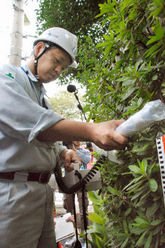
english.kyodonews.jp
High levels of radiation detected in Tokyo
TOKYO, Oct. 13, Kyodo
Significant levels of airborne radiation have been detected in an area of Tokyo's Setagaya Ward, exceeding readings in some evacuation zones around the crippled Fukushima Daiichi nuclear plant, prompting local officials to urge residents to stay away from the affected area.
Radiation of up to 3.35 microsieverts per hour was recorded Thursday at a height of 1 meter along a sidewalk in a residential area of Tsurumaki in Setagaya, some 230 kilometers southwest of the Fukushima plant, the officials said.
The ward is still investigating what type of radioactive material is involved, while trying to work out how to decontaminate the sidewalk, which is regularly used by pupils at a primary school. The area has been cordoned off as a precautionary measure. english.kyodonews.jpby Edano via English.kyodonews.jp 10/13/2011 10:41:57 AM- High levels of radiation detected in Tokyo
An expert measures radiation in a residential area of Tsurumaki in Setagaya Ward, Tokyo, on Oct. 13, 2011. Airborne radiation of up to 3.35 microsieverts per hour, exceeding readings in some evacuation zones around the crippled Fukushima Daiichi nuclear plant, was detected at a height of 1 meter in the area in the measurement commissioned by the ward office. (Kyodo) english.kyodonews.jpby Edano 10/13/2011 10:42:29 AM 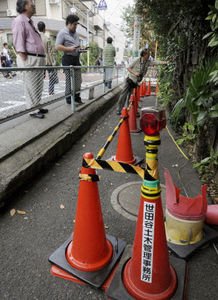
english.kyodonews.jp
High levels of radiation detected in Tokyo
Photo taken on Oct. 13, 2011, shows part of a sidewalk in a residential area of Tsurumaki in Setagaya Ward, Tokyo, where airborne radiation of up to 3.35 microsieverts per hour, exceeding readings in some evacuation zones around the crippled Fukushima Daiichi nuclear plant, was detected the same day. Road cones have been placed around the site by the ward office, as the sidewalk is used as a route to a nearby elementary school. (Kyodo) english.kyodonews.jpby Edano via English.kyodonews.jp 10/13/2011 10:43:09 AM



Japan Earthquake | Page 2498
- Who's Blogging
-
 hudebnik
 alblee
 UKVal
UKVal Oliver (ScribbleLive)
 Jonathan Keebler
 Matt (ScribbleLive)
 kaykodh
 PKelley
 Markfm
 dean
dean Angie
Angie- Edano
 Deb
Deb- Mid Valley
- Pedro Jesus
 George Gibb
- elainekirk
- lillymunster
 bo
bo IanGoddard