Japan Earthquake | Page 2499

english.kyodonews.jp
High levels of radiation detected in Tokyo
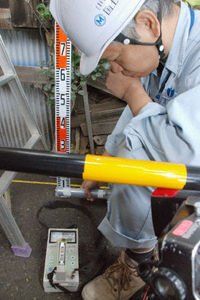
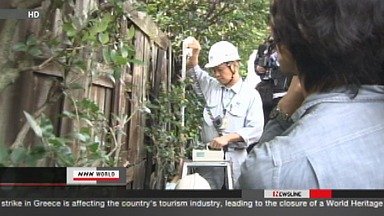
An expert measures radiation in a residential area of Tsurumaki in Setagaya Ward, Tokyo, on Oct. 13, 2011. Airborne radiation of up to 3.35 microsieverts per hour, exceeding readings in some evacuation zones around the crippled Fukushima Daiichi nuclear plant, was detected at a height of 1 meter in the area in the measurement commissioned by the ward office. (Kyodo) english.kyodonews.jpby Edano via English.kyodonews.jp 10/13/2011 10:43:49 AM- ooh they measure radiation with a ruler !by Edano 10/13/2011 10:44:14 AM
- High radiation dose readings marked in spots in Tokyo, Chiba
TOKYO, Oct. 13, Kyodo
High radiation doses were reported Thursday in spots in Tokyo and neighboring Chiba Prefecture, both over 200 kilometers away from the crippled Fukushima Daiichi nuclear plant, with their readings found to exceed current dose levels in some evacuation zones around the plant.
Airborne radiation of up to 3.35 microsieverts per hour was recorded Thursday along a sidewalk in a residential area in Tokyo's Setagaya Ward in an inspection commissioned by the ward, and a citizens' group detected up to 5.82 microsieverts close to the ground at a children's theme park in Funabashi, Chiba Prefecture, local officials said.
While officials are still investigating whether the radiation resulted from the nuclear accident, the levels detected were both higher than the 2.17 microsieverts per hour measured Wednesday at the village office in Iitate, Fukushima Prefecture. The village is 45 kilometers from the plant and designated as an evacuation zone due to the relatively high radiation. english.kyodonews.jpby Edano 10/13/2011 10:44:57 AM - Radiation 47 times higher than criteria detected from nuclear waste
FUKUOKA, Oct. 13, Kyodo english.kyodonews.jpby Edano 10/13/2011 10:45:29 AM  @Edano no immediate risk to healthby elainekirk 10/13/2011 10:47:06 AM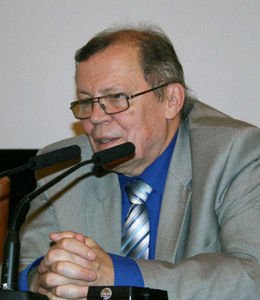
english.kyodonews.jp
Belarusian nuclear expert Babenko
Vladimir Babenko, deputy director of the Belrad Institute of Radiation Safety in Belarus, speaks at a press conference in Tokyo on Oct. 12, 2011. Babenko, who has offered advice to residents affected by the 1986 Chernobyl nuclear disaster, said he believes Japan's food radiation limits have been set too high and urged the nation to lower them to realistic levels. (Kyodo) english.kyodonews.jpby Edano via English.kyodonews.jp 10/13/2011 10:47:17 AM- a hotspot 7 months on a children theme park ....by Edano 10/13/2011 10:48:49 AM
- and more of the same stuff .........by Edano 10/13/2011 10:53:00 AM
www3.nhk.or.jp
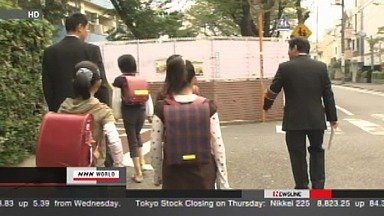
High radiation level affects school routes
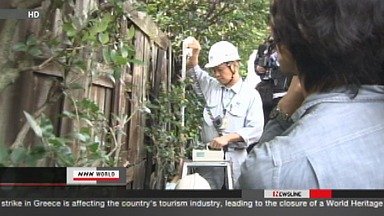
Tokyo's Setagaya Ward has changed school routes in order to keep children away from the small area where a relatively high level of radiation has been detected.
On Thursday morning, about 10 teachers and local officials stood at an intersection to redirect children on their way to a nearby elementary school.
Some children were accompanied by their parents. A mother of a first-grader said she is worried that her child may have passed along the radiation contaminated site every day for over 6 months since the Fukushima accident.
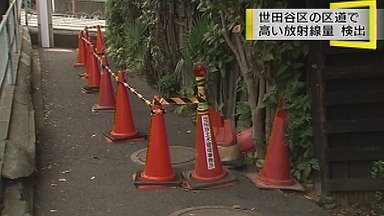
The ward had already made the 10-by-one-meter area along a sidewalk off limits after announcing the finding on Wednesday.
But the ward decided to change school routes in response to concerns voiced by parents.
A ward official said the changes in the school routes will stay in place until the ward determines what caused the high level of radiation and decontaminates it properly.
Thursday, October 13, 2011 16:47 +0900 (JST)
www3.nhk.or.jpby Edano via Www3.nhk.or.jp 10/13/2011 10:53:23 AM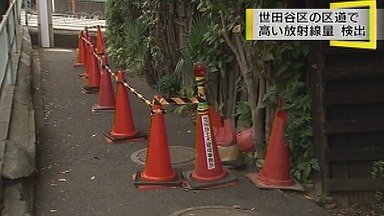
www3.nhk.or.jp
High radiation in Tokyo residential area
A sidewalk in Setagaya ward, in the western part of Tokyo, has shown a radiation level of 2.707 microsieverts per hour, much higher than other areas in the same ward.
Setagaya ward put the 10-meter by 1-meter area on the roadside off limits, as elementary school children walk by on their way to and from a nearby elementary school.
The ward tried to decontaminate the spot earlier this month by using a high-pressure washer, but it only brought down the highest radiation reading by about 0.1 microsieverts per hour.
The ward is consulting experts to figure out what to do about the highly contaminated area.
The radiation dose at a place with a reading of 2.7 microsieverts per hour would accumulate to 38.88 microsieverts a day, and to 14.2 millisieverts a year, in line with assumptions used by the science & technology ministry. The ministry assumes that people spend 8 hours outdoors and 16 hours indoors every day.
The exposure of 14.2 millisieverts a year is lower than the government designated evacuation level of 20 millisieverts per year.
Thursday, October 13, 2011 12:51 +0900 (JST)
www3.nhk.or.jpby Edano via Www3.nhk.or.jp 10/13/2011 10:54:12 AM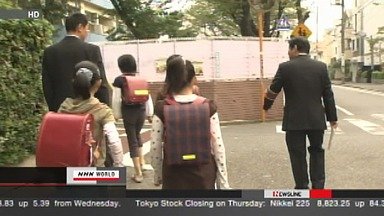
www3.nhk.or.jp
High radiation levels found in Tokyo
High radiation levels have been observed in Tokyo's Setagaya Ward.
Experts commissioned by the ward said on Thursday that up to 3.35 microsieverts per hour was detected 1 meter over a sidewalk near a residential fence.
The ward found a high of 2.707 microsieverts per hour a week ago in a 1-by-10-meter area, and made it off limits to protect schoolchildren and others.
The experts found that the most recently detected radiation is highly limited, as levels fall by almost half about 1 meter from the fence.
They added that up to 0.7 microsieverts per hour was recorded 4 meters from the strip.
The ward says it will work with residents to gauge radiation levels inside the fence and collect and analyze leaves at the site.
Environment official Yoko Saito says the survey has provided a rough picture of high-radiation spots. She says the ward will use the findings to find out the cause of the high levels and consider countermeasures.
Thursday, October 13, 2011 17:36 +0900 (JST)
www3.nhk.or.jpby Edano via Www3.nhk.or.jp 10/13/2011 10:55:28 AM- they forgot to say the no harm phrase ...by Edano 10/13/2011 10:56:35 AM
- Yokohama tests soil for radioactive strontium
Officials in Yokohama City are testing soil for radioactive strontium following a report from a local resident in September that the substance had been detected in sediment on the roof of an apartment building.
In September, radioactive cesium more than 80 times the government-set limit of 500 becquerels per kilogram was found in sediment collected from roadside ditches in Yokohama City, which is near Tokyo.
The city later removed sediment from the area.
But the city decided to retest the sample for radioactive strontium due to the request of a local resident.
The resident said a private testing institution had detected 195 becquerels of strontium per kilogram -- more than 6 times the government safety limit -- in the rooftop sample.
The science ministry says radioactive strontium can accumulate in bones if inhaled and that it poses a cancer risk.
The ministry added that it has found strontium in the soil in Fukushima Prefecture, site of the crippled Fukushima Daiichi nuclear plant. But the agency says it has conducted few checks for the substance outside the prefecture because the amounts detected in Fukushima Prefecture were very small.
Yokohama is located about 250 kilometers from the Fukushima plant.
Wednesday, October 12, 2011 19:28 +0900 (JST)
www3.nhk.or.jpby Edano 10/13/2011 10:57:05 AM - @Edano they are slippingby elainekirk 10/13/2011 10:57:11 AM
- @elainekirk read: "it poses a cancer risk" !!!!!by Edano 10/13/2011 10:57:47 AM
- Man drives car on railroad track, passing train
An 82-year-old man drove a car along a railway track for about 1 kilometer in Osaka Prefecture, western Japan, early on Thursday. No one was injured in the incident.
While driving along the track of the Kintetsu Corporation Nara line shortly after midnight, the car passed an out-of-service train, whose driver notified the railway office.
Railway officials and police stopped the car near Ishikiri Station in Higashiosaka City.
Police quote the driver as saying that his car got stuck at a crossing. He went into a panic on seeing the gate closing and drove the car onto the railway track.
Thursday, October 13, 2011 15:22 +0900 (JST)
www3.nhk.or.jpby Edano 10/13/2011 10:59:34 AM 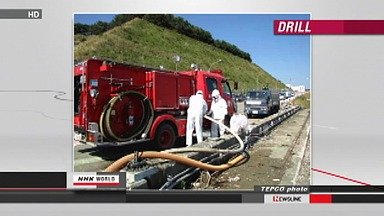
www3.nhk.or.jp
Drill confirms safety of Fukushima nuclear plant
The operator of the Fukushima Daiichi nuclear plant says the facility could be kept safe even if its reactor-cooling system is knocked out by another huge earthquake.
Tokyo Electric Power Company conducted a drill on Wednesday based on the scenario that its pumps and tanks were damaged by a magnitude-8 quake near the plant. It was the first such drill since trouble began at the plant in March.
Reactors at the plant must receive a continuous injection of water to be kept in a state of cold shutdown, with temperatures below 100 degrees Celsius.
During the drill, about 40 workers attached a 300-meter hose to a fire truck, and pumped up seawater to inject into the reactors.
It took about an hour and 10 minutes for water to resume being injected into a mock facility after fire trucks arrived at the scene.
Tokyo Electric says water injection at the three reactors, No.1 through No. 3, could be restarted in about 3 hours.
Thursday, October 13, 2011 10:03 +0900 (JST)
www3.nhk.or.jpby Edano via Www3.nhk.or.jp 10/13/2011 11:00:29 AM- they did not drill for a tsunami and station blackout .....by Edano 10/13/2011 11:01:39 AM
- @Edano totally safe we can all go homeby elainekirk 10/13/2011 11:01:40 AM
- @Edano lol gotta go catch you later :)by elainekirk 10/13/2011 11:02:04 AM
- is obama going crazy ? preparing a war against iran ? wth is going on in america ?by Edano 10/13/2011 11:08:39 AM
- "The drill assumed that tanks and pumps had been broken by an earthquake. 40 people installed fire trucks and 300 m of hoses, so that cooling was restored to one reactor in 1 hour 10 minutes. In the future Tepco will perform other drills assuming a tsunami with debris spread on roads, and occurrences at times when gathering people is more difficult, such as on holidays and during the night."
www3.nhk.or.jpby Edano 10/13/2011 11:11:22 AM - they don't have roofs anymore where they could safely place emergency generators and batteries...by Edano 10/13/2011 11:14:18 AM
 greetings to allby dean 10/13/2011 11:23:37 AM
- @dean hi deanby Edano 10/13/2011 11:23:57 AM
- @ Edano... the drill scenario is something else... shaking my headby dean 10/13/2011 11:25:44 AM
- @dean just PR ?by Edano 10/13/2011 11:26:21 AM
- www.colletonfire.com @ Edano.. fire truck statsby dean 10/13/2011 11:29:31 AM
- i doubt they have prepared countermeasures for another electricity breakdown.by Edano 10/13/2011 11:30:06 AM
- it's another smoke and mirrors... PRby dean 10/13/2011 11:31:54 AM
- that fire truck in the photo you posted looks pretty old and smaller... maybe 250gpm... plus the line loss in that 300 meter hose,,,, they didn't say how much water comes out the nozzle...by dean 10/13/2011 11:33:29 AM
- 400 meters = about 1300 feet... typical fire hose looses about 5 psi per 100 feet pumping at 200 gpm... so that is 13 x 5 or 65 psi loss in the hoseby dean 10/13/2011 11:38:39 AM
- www.firefightermath.org @ Edano.. water handling table... I think if one did the math... assuming the EQ of 8.0 didn't wipe out all the sea water pumps and hoses needed to lift the water to the tankers, there wouldn't be much flowby dean 10/13/2011 11:43:26 AM
- @dean interesting. though i can't do that kind of math... :)by Edano 10/13/2011 11:54:42 AM
 Reality check on fire pumps providing cooling water, NISA update, pp II-83: "Since all AC power was lost and emergency cooling system became unavailable due to tsunami, TEPCO worked for cooling the reactor with alternative water injection. The staff were forced to work under the severe environment where the major tsunami warning continued, evacuation and work were interrupted, there were no tools for lightening and communicating, and the debris and dirt were stranded by tsunami. The response status is described as follows in a chronological order.
17:12, March 11, TEPCO started to take into consideration using alternative water injection measure set as AM actions (fire protection system, FP) , make-up water condensate system (MUWC) and fire engines using fire cistern set up as a lesson from the Chuetsu-oki Earthquake.
In the main control room, in order to confirm the alternative water injection measures, the AM operational procedure was submitted to the shift supervisor, alternative water injection lines to reactors were confirmed, the preparation for activating diesel-driven fire pump have been started.
Regarding water injection to reactors, in order to develop alternative water injection line via the core spray system (CS) from FP line, staff entered the reactor buildings in the dark, manually opened valves of CS, etc, then after the depressurization of reactor pressure (less than 0.69MPa gage), made the condition available for water injection.
At 17:30, March 11, the diesel-driven fire pump was confirmed to be in a workable condition. Since the indicated value of the supervisory instrumentation in the main control room was invisible, the staff entered into the reactor building and confirmed that the pressure gauge indicated 6.9MPa gage (20:07, March 11). After that, the water-level gauge was restored at 21:19 on the same day, confirming the indication of TAF+200mm.
At 01:48, March 12, staff confirmed that the diesel-driven fire pump which had been in operation for injecting water to the reactor stopped at some point, thus they carried and supplemented light oil manually, carried batteries kept in cooperative firms on the site for replacement, etc, but could not restart the operation.
In order to start injecting water as soon as possible, preparation for injection of water via fire engines was implemented along with restoration of diesel-driven fire pump. One of three fire engines deployed in the NPS was used. Second one was broken down due to tsunami, and the third one was not usable as it could not be transferred from the side of Units 5 and 6. There were also many obstacles in deployment of the usable one. The road in front of the former main office building was not trafficable as it was blocked with a tank drifted by tsunami. As the gate of the security office could not be opened with any electricity, after thorough search for trafficable routes, they made the fire engine pass through by breaking a key of the locked gate located between Units 2 and 3.
The fire hydrant which should have been used for the water source was not usable as water spewed out from it, thus search for other water sources was implemented. As a result of it, fire cistern was confirmed to be usable.
At 02:45, March 12, it was found that the reactor pressure was 0.8MPa gage, meaning depressurization proceeded to the level enabling the injection of water via fire engine. At 05:45, March 12, injection of fresh water via fire engine from FP line was started.
As for the initial injection of water, the discharge pressure was considered to be insufficient from the position of the fire cistern, thus the series of work such as transferring water from the fire cistern to the tank of fire engine, the relocation of fire engine closer to the rector building, and injection of water from the water discharge canal of FP to the reactor, was repeatedly implemented.
The relocation of the fire engine, however, took long time as it needed to cautiously pass under the crumbling building. Therefore, as a result of try-and-error, with the development of continuous water injection line using the hoses attached to fire engine, continuous injection of water started.
With the arrival of a fire engine which was additionally arranged, transfer of fresh water from the fire cistern of Unit 3 to that of Unit 1 was repeatedly implemented. Since the fire cistern could accommodate only one hose, in case of fresh water feed, the hose for injecting water to the rector needed to be taken out, accordingly the water injection work were forced to be suspended each and every time. At 14:53, March 12, 80,000l (accumulated total) of fresh water injection was completed.
While fresh water injection was continued, since securing fresh water in the fire cistern had limitation, preparation for seawater injection was implemented.
At 14:54, March 12, the plant manager instructed to prepare for injecting seawater to the reactor. Since the fresh water in the fire cistern was depleted, quick transfer of fresh water from other fire cisterns as well as preparation for switching to seawater injection were implemented. For the injection of seawater, judging from the road condition on the site and the distance to Unit 1, backwash valve pit, which accumulated seawater due to tsunami, was set as water source rather than taking water directly from the sea, and in order to ensure lifting height, water injection line with three fire engines arranged in tandem was completed.
As for SLC, another alternative water injection measure, since the early dawn on March 12, work including laying of temporary cables to transfer power from power supply vehicle via power distribution panel of Unit 2 etc, was implemented, and around 15:30, March 12, cable connections inside the building to the primary side of power center (P/C) and connection with a high-pressure power supply vehicle were completed, then power was transmitted to just beside the SLC pump.
In the meantime, at 15:36, March 12, an explosion occurred in the reactor building of Unit 1.Evacuation from the site, aid and transfer of the injured due to the explosion were executed. The number of the injured of TEPCO was three, and that of the cooperative firms was two. Following this, in order to ensure safety, on-site inspection to study the effect of the explosion (condition of fire engines, damage situation of the building, situation of smoking ) was implemented. Windows of fire engines were broken, but the function was not damaged. Cable laid for operating SLC was damaged due to splattered debris, the high pressure power supply vehicle was automatically suspended. In addition, hoses which had been prepared for seawater injection were also damaged.
Until the evacuation from the site and safety check of the staff were executed and the situation of the site was confirmed, nothing could be done for restoration for some time.
Since highly radioactive debris were scattered around Unit 1, under the supervision of radiation control staff, work such as removing the scattered debris (steel panel of the reactor building of Unit 1, etc) and collecting hoses from yard fire hydrants for rebuilding, was implemented.
Finally, at 19:04, May 12, injection of seawater into the reactor using FP lines and fire engines was started." So much for fire engine drills!by Peter 10/13/2011 11:55:13 AM- @ Edano. it's not worth it.. the bottom line is the fire water theory lacks meat...by dean 10/13/2011 11:55:16 AM
- i did not know that there is a firefighter math :)by Edano 10/13/2011 11:56:16 AM
- nice input @ Peter.. hi Peterby dean 10/13/2011 11:57:10 AM
- hi, dean and edano. As you can see, this drill is a pr show.by Peter 10/13/2011 11:57:47 AM
- @ Edano.. in those emergency situations you just hook all the stuff up and turn on the pumper truck and hold the hose.. hopefully water will flowby dean 10/13/2011 11:57:54 AM
- sure is @ Peterby dean 10/13/2011 11:58:01 AM
- plus how long will those old fire trucks pump ocean water before they burn upby dean 10/13/2011 11:58:25 AM
 Morning! (afternoon - evening)by lillymunster 10/13/2011 11:58:32 AM
- morning lilly.. get your fire fighter hat on...by dean 10/13/2011 11:58:49 AM
- Yeee-ha a Japanese Fire Drill! :-)by lillymunster 10/13/2011 11:59:05 AM



Japan Earthquake | Page 2499
- Who's Blogging
-
 hudebnik
 alblee
 UKVal
UKVal Oliver (ScribbleLive)
 Jonathan Keebler
 Matt (ScribbleLive)
 kaykodh
 PKelley
 Markfm
- dean
 Angie
Angie- Edano
 Deb
Deb Mid Valley
- Pedro Jesus
 George Gibb
- elainekirk
- lillymunster
 bo
bo IanGoddard