Japan Earthquake | Page 2525
 @elainekirk, he saying he's involved is on a Oct 2 update. I suspect he's backed out given his last video.by Ian 10/19/2011 2:32:21 AM
- Meant : she says he's ...by Ian 10/19/2011 2:32:48 AM
 @Ian I would like to think soby elainekirk 10/19/2011 2:35:51 AM
- Junichi Matsumoto, a Tepco official, said the utility faces about 10 lawsuits so far. He declined to disclose details but said some were seeking more than the firm deemed appropriate. www.msnbc.msn.comby elainekirk 10/19/2011 3:55:38 AM
 @All Just wanted to drop a link to the Canadian Nuclear Safety Commission (CNSC). Given that radioactivity levels across Canada continue to be within normal background levels and that there is no cause for concern, on Thursday, August 11, 2011 Health Canada removed nine supplementary fixed point detectors that were installed in British Columbia and the Yukon in response to the Fukushima nuclear incident. In addition, on September 15, 2011, Health Canada will end its weekly data postings, resuming its previous schedule of quarterly postings of the fixed point network data and terminating Website Comprehensive Nuclear Test-Ban Treaty (CTBT) data reporting. www.hc-sc.gc.ca nuclearsafety.gc.caby M.I.A. 10/19/2011 5:48:58 AM
- by M.I.A. 10/19/2011 5:49:10 AM
- by M.I.A. 10/19/2011 5:49:34 AM
- oh well...sheeesh. night @Allby M.I.A. 10/19/2011 5:50:11 AM
- @M.I.A. hi just seen youby elainekirk 10/19/2011 5:55:18 AM
- hi Liz sorry was awayby elainekirk 10/19/2011 5:55:39 AM
- @Liz @M.I.A. Canada had better put those monitors backby elainekirk 10/19/2011 5:56:59 AM
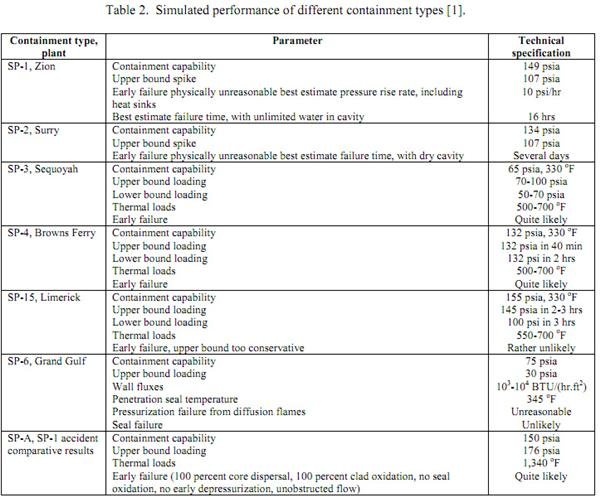
- One important aspect of the PCCV model response in the high pressure tests is the concept of failure. In the U.S., the
functional failure for the prototypical containment is defined in the regulations as containment leak rates exceeding 0.1
to 0.5% of the containment mass per day [18], considering maximum offsite dose rates due to fission product released
to the environment. In Japan, the functional failure is defined in design specifications made by the utility company, not
the regulations. (The specified leak rate for the PCCV prototype is 0.1% mass/day.) The functional failure criteria are
not particularly useful to test the structural capacity of a containment vessel model, especially when one of the objectives
is to generate large inelastic response modes for comparison with analytical predictions, which may be well beyond the
levels required to cause functional failure; and secondly to gain some insight into design margins, i.e. the functional and
structural capacity beyond the specified design load conditions. In the case of the PCCV model test, the pressurization
system allows the model to be pressurized to levels significantly above those expected to cause local strains in the model
to exceed the ultimate strain limits of the materials. The test(s) were terminated when the model and the pressurization
system were incapable of maintaining or increasing the model pressure due to excessive leakage or gross rupture. In this
report, the maximum pressure achieved prior to the termination of the tests will not be identified as the failure pressure,
since failure is defined in terms of some acceptance criteria, not the operational inability to maintain pressure in the
model. docs.google.comby elainekirk 10/19/2011 7:04:08 AM - Morning@all, here we go! Iran had two earthquakes last night. A 5.5 and a 4.0. Sure hope it wont drigger an earthquake closer to Bushehr. It sits right on a faultline or two that cross eachother?by Liz 10/19/2011 8:01:47 AM
- by elainekirk 10/19/2011 8:32:30 AM
 Keene: Miracle will happen in northeastern Japan
One of the world's top experts on Japanese literature, Donald Keene, says a miracle will happen in disaster-hit northeastern Japan.
Keene told reporters in Sendai, Miyagi Prefecture, on Wednesday that he shuddered when watching the March 11th tsunami on TV.
He said that during his stay in the region, he wants to see what escaped destruction and how survivors are living rather than what the tsunami has swept away.
Keene also said a miracle will happen, as people in northeastern Japan are determined to rebuild their lives just like those in Tokyo after the end of World War Two.
After March 11th, Keene moved to Japan from the United States. He said that he would become a Japanese citizen and live out his days in Japan in a show of love for the country.
The 89-year-old Professor Emeritus of Columbia University is known for translating into English Japanese literary works, including those written by playwright Chikamatsu Monzaemon and novelists Osamu Dazai and Yukio Mishima.
Wednesday, October 19, 2011 13:50 +0900 (JST)
www3.nhk.or.jpby Edano 10/19/2011 9:44:24 AM- Study: Half of cancer preventable in Japan
A new study by Japanese researchers shows that about half of cancer patients in Japan have developed the disease due to preventable causes.
A team at the National Cancer Center used data of patients diagnosed with cancer in 2005 to statistically analyze cancer causes in Japan.
They checked the data against statistics of people with preventable risk factors for cancer, such as smoking and drinking habits or viral infections.
Their analysis showed that the largest cause of cancer for Japanese males was smoking at 29.7 percent, followed by infection with the Helicobacter Pylori bacterium or hepatitis and other viruses at 22.8 percent, and alcoholism at 9 percent.
For female patients, infections topped the list at 17.5 percent, followed by smoking at 5 percent and drinking at 2.5 percent.
The study shows that about half of cancer cases in Japan were caused by preventable factors, indicating that cancer can be reduced by improving lifestyles and the environment.
The study also showed that only 0.8 percent of male patients and 1.6 percent of female patients developed cancer due to obesity. The figures are about one-third of those in the United States.
Shoichiro Tsugane, who heads the institution's Epidemiology and Prevention Division, points out that the research is a statistical analysis of the entire cancer population of Japan. He said he hopes people with preventable risk factors will make efforts to reduce them.
Wednesday, October 19, 2011 14:51 +0900 (JST)
www3.nhk.or.jpby Edano 10/19/2011 9:46:22 AM 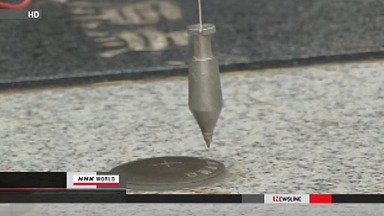
www3.nhk.or.jp
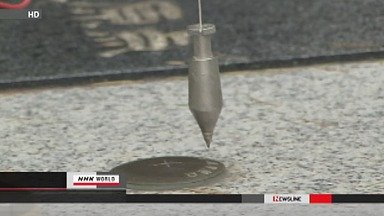
Japan to revise geodetic data
The Japanese government is officially revising some geodetic measurements after tectonic changes caused by the March 11th earthquake.
The massive quake and ensuing aftershocks have shifted the ground across Japan, mainly in the northeast and central regions. In Miyagi Prefecture, the ground has shifted east more than 5 meters.
Japan's Geospatial Information Authority says about 45,000 control points for measuring longitude, latitude and elevation have moved.
The authority's new measurements show the origin points of longitude and latitude have moved 27 centimeters east in Tokyo's Minato Ward. In Chiyoda Ward, elevation has sunk 2.4 centimeters.
The geospatial authority is revising its data on Friday by government ordinance.
It will be resetting measurement control points across Japan and will release the new data on October 31st.
It is the first such change since 1928. Elevation was revised then to account for changes in the earth's crust caused by the Great Kanto Earthquake of 1923.
Wednesday, October 19, 2011 12:44 +0900 (JST)
www3.nhk.or.jpby Edano via Www3.nhk.or.jp 10/19/2011 9:47:12 AM
english.kyodonews.jp
Japan industry minister Edano in Paris
Japanese Economy, Trade and Industry Minister Yukio Edano (R) shakes hands with Turkey's Energy and Natural Resources Minister Taner Yildiz in Paris on Oct. 18, 2011, prior to their talks held on the sidelines of a ministerial meeting of the International Energy Agency. In his conversation with the Turkish minister, Edano asked for Ankara to continue talks with Tokyo on a nuclear power plant deal in Turkey. (Kyodo) english.kyodonews.jpby Edano via English.kyodonews.jp 10/19/2011 9:52:49 AM- High radiation dose found in school ditch in suburban Tokyo
TOKYO, Oct. 19, Kyodo
Radiation much higher than surrounding levels has been detected in a ditch at an elementary school in Higashimurayama, a suburb of Tokyo, city officials said Wednesday.
Up to 2.153 microsieverts per hour of radiation was found Tuesday when the reading was taken several centimeters above the mud in a ditch near the school's kitchen, the officials said. The city's normal radiation dose is about 0.08 microsievert an hour.
The mud was cleaned up on Wednesday. The officials said the high radioactive concentration was likely caused by accumulated rainwater, but did not say whether the contamination is linked to radioactive materials leaked from the crisis-hit Fukushima Daiichi nuclear plant in Fukushima Prefecture. english.kyodonews.jpby Edano 10/19/2011 9:54:24 AM - @Edano so the blame the victim game is moving to cancer too now then ???????? that'll be to stop any silly demands for compensation from the mentally ill I supposeby elainekirk 10/19/2011 10:26:24 AM
 Morning! (afternoon-evening)
Is it possible to pinpoint a cause on an individual cancer case? I assumed most likely not or not all the time? I can see this being lawyer fodder. Oh you smoked, maybe you got a virus etc.by lillymunster 10/19/2011 11:49:15 AM- The US senate is investigating the Corps of Engineers and why the Missouri river dam system ended up with so much water upriver, why they didn't anticipate the spring flooding.by lillymunster 10/19/2011 11:55:38 AM
- Journal of Environmental Radioactivity, 2011 Oct 11.
Food safety regulations: what we learned from the Fukushima nuclear accident.
On 11 March 2011, the magnitude-9.0 earthquake and a substantial tsunami struck off the northeast coast of Japan. The Fukushima nuclear power plants were inundated and stricken, followed by radionuclide releases outside the crippled reactors. Provisional regulation values for radioactivity in food and drink were set on 17 March and were adopted from the preset index values, except that for radioiodines in water and milk ingested by infants. For radiocesiums, uranium, plutonium and transuranic α emitters, index values were defined in all food and drink not to exceed a committed effective dose of 5 mSv/year. Index values for radioiodines were defined not to exceed a committed equivalent dose to the thyroid of 50 mSv/year, and set in water, milk and some vegetables, but not in other foodstuffs. Index values were calculated as radioactive concentrations of indicator radionuclides ((131)I for radioiodines, (134)Cs and (137)Cs for radiocesiums) by postulating the relative radioactive concentration of coexisting radionuclides (e.g., (132)I, (133)I, (134)I, (135)I and (132)Te for (131)I). Surveys were thence conducted to monitor levels of (131)I, (134)Cs and (137)Cs. Provisional regulation values were exceeded in tap water, raw milk and some vegetables, and restrictions on distribution and consumption began on 21 March. Fish contaminated with radioiodines at levels of concern were then detected, so that the provisional regulation value for radioiodines in seafood adopted from that in vegetables were additionally set on 5 April. Overall, restrictions started within 25 days after the first excess in each food or drink item, and maximum levels were detected in leafy vegetables (54,100 Bq/kg for (131)I, and a total of 82,000 Bq/kg for (134)Cs and (137)Cs). This paper focuses on the logic behind such food safety regulations, and discusses its underlying issues. The outlines of the food monitoring results for 24,685 samples and the enforced restrictions will also be described. www.ncbi.nlm.nih.govby Ian 10/19/2011 12:24:43 PM - Does anyone have Elsevier access? The article Ian posted sounds like the full article has some early details on food contamination that might be new info. I am curious what the study's take is on the food system in Japan.
Does anyone remember restrictions on tap water back in March-April? I thought they were telling people it was safe? Not like anyone believed it.by lillymunster 10/19/2011 12:38:13 PM - @lillymunster, I can get it later this week.by Ian 10/19/2011 1:56:24 PM
- by Ian 10/19/2011 1:57:07 PM
 @all Good Morning...Good Evening...Hello!by smoss 10/19/2011 2:04:29 PM
@all TEPCO has made preparations as much as possible (that is to say, on a basis not to impede or detract from direct recovery work) to respond to another major natural disaster.
For the purpose of the drill in the video just released, then, it is assumed that another earthquake has knocked out the normal water injection cooling at the site and that it cannot be recovered. This would mean a total failure of all of the electric pumps (LOOP) and a failure of diesel generators placed on site to power the cooling and injection systems as they are now. In this eventuality, TEPCO has fire engines and other emergency equipment stationed in safe places, away from danger, which can be moved on site. For the purpose of this drill then TEPCO chooses to directly inject seawater to the reactor core - simulating a last resort to reestablish cooling.
Keep in mind that the location shown in the video for the drill is more toward No. 5 and No. 6 plants at the site. The building enclosure now surrounding No. 1 plant can be seen in the background briefly in a couple of the video shots. TEPCO has constructed an exact duplicate of the water injection manifolds being used on No. 1 through No. 3 plants at this area, complete even to the point of being instrumented. It is with this test rig TEPCO conducts the drill.by smoss 10/19/2011 2:05:55 PM- @smoss Morning!by lillymunster 10/19/2011 2:13:36 PM
- Municipalities decline nuclear power subsidies
Four Japanese municipalities have demonstrated their opposition to nuclear power by declining government subsidies for hosting nuclear plants.
The government this week began receiving yearly applications for subsidies from municipalities where nuclear-related facilities are located.
About 12 billion dollars have been allocated since the program started in 1974.
NHK has learnt that, in a rare move of opposition, 4 out of the 44 municipalities that host nuclear facilities around the country plan to skip the application this year.
One of them, Minamisoma City in Fukushima Prefecture, has demonstrated its anti-nuclear stance by refusing to accept subsidies for the planned Namie-Odaka power plant to be operated by the Tohoku Electric Power Company. In addition, Minamisoma City has decided to decline subsidies allocated for cities surrounding the Fukushima Daiichi plant.
City Mayor Katsunobu Sakurai said the city has made clear its rejection of nuclear power as part of its recovery plan.
Sakurai added the city will demand that the central government subsidize renewable energies.
Neighboring Namie Town has also declined subsidies related to the Namie-Odaka plant. The town said building new nuclear power facilities is not reasonable when Fukushima Prefecture and others are working to remove existing plants.
Wednesday, October 19, 2011 19:43 +0900 (JST)
www3.nhk.or.jpby Edano 10/19/2011 2:18:48 PM - nuclear victims stories www.abc.net.auby lillymunster 10/19/2011 2:19:13 PM
- Radioactive cesium detected in Tokyo tea leaves
Radioactive cesium in levels above the government standard has been detected in tea leaves produced in Tokyo and Saitama, north of the capital. The contamination is believed to have been caused by the Fukushima Daiichi nuclear plant accident.
The Tokyo Metropolitan Government says 3 brands of tea leaves grown in northwestern Tokyo have been found to contain 550 to 690 becquerels of radioactive cesium per kilogram. The government limit is 500 becquerels.
The Saitama prefectural government says it found 504 to 2,063 becquerels per kilogram in locally-grown leaves of 97 brands.
The samples tested by the prefecture were not early-picked leaves, which are said to be more likely to contain radioactive material. The prefecture had already found that such leaves of 14 brands contained radioactive cesium above the limit.
The authorities have asked the producers to dispose of their tea leaf stocks.
Wednesday, October 19, 2011 20:45 +0900 (JST)
www3.nhk.or.jpby Edano 10/19/2011 2:19:16 PM - Indian Point fight escalates www.npr.orgby lillymunster 10/19/2011 2:19:44 PM
www3.nhk.or.jp
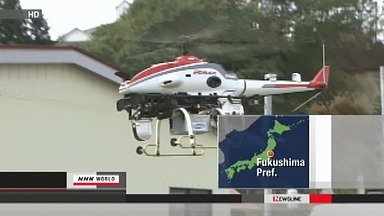
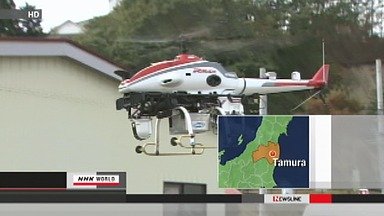
Radiation monitoring by drone begins in Fukushima
A city near the troubled Fukushima Daiichi nuclear power plant has begun monitoring radiation levels of farmlands and forests with a small unmanned helicopter.
The move comes after the central government lifted an evacuation advisory for parts of Tamura City and 4 other municipalities outside the 20-kilometer no-entry zone around the Fukushima Daiichi nuclear plant at the end of last month.
On Wednesday, the Japan Atomic Energy Agency began monitoring radiation using the drone at the request of the city. The agency tested a 300-meter-long, 150-meter-wide area of a rice field from a helicopter equipped with a measuring instrument about 20 meters above the ground. It also carried out tests on forests.
Data transmitted by the helicopter is reportedly translated into radiation levels 1 meter above the ground and indicated by instruments at ground level.
Aircraft are suitable for measuring radiation levels of large areas and other locations that are difficult for people to access.
In the areas of Fukushima Prefecture where the evacuation advisory has been lifted, residents had previously been advised to stay indoors and prepare for emergency evacuation. But many residents decided to evacuate their homes.
The tasks facing Tamura and the 4 other municipalities are decontamination and radiation monitoring for both residents and evacuees.
Wednesday, October 19, 2011 18:28 +0900 (JST)
www3.nhk.or.jpby Edano via Www3.nhk.or.jp 10/19/2011 2:20:00 PM- @lillymunster I listened to that NPR bit on my drive into work this morning...I sure hope they're right in projecting that Cuomo will get what he wants.by smoss 10/19/2011 2:24:39 PM
 In Dead Zone of Chernobyl, Animal Kingdom Thrives
tv.nytimes.comby Panserbjorne9 10/19/2011 2:25:19 PM- @smoss It seems like a no-brainer to shut down Indian Pt. It shows how little the local people and government have a say in having nuclear plants in their back yard. Both NY and Vt are fighting hard and the NRC seems to be fighting against them.by lillymunster 10/19/2011 2:28:44 PM
- old article, but re-posting to point out the great mentality of the head of Health and Safety in Tokyo.
"Kaoru Noguchi, head of Tokyo’s health and safety section, however, argues that the testing already done is sufficient. Because Tokyo is so developed, she says, radioactive material was much more likely to have fallen on concrete, then washed away. She also said exposure was likely to be limited.
“Nobody stands in one spot all day,” she said. “And nobody eats dirt.”
Citizens’ Testing Finds 20 Hot Spots Around Tokyo www.nytimes.comby Panserbjorne9 10/19/2011 2:28:50 PM - @Panserbjorne9 @Panserbjorne9 in a footnote in an article this week someone in Tokyo said the govt. will start working with citizens to identify hot spots. Six months ago they were threatening to arrest people for telling others there was radiation in Tokyo...by lillymunster 10/19/2011 2:31:01 PM
- "Yes, people eat dirt — especially children. The Environmental Protection Agency of the United States estimates that more than 20% of normal children eat around a teaspoon of soil on several occasions, usually between one and three years of age. Older children with a developmental delay may continue to eat dirt, and are at greater risk for the medical problems that ingesting soil may cause." The hazards and benefits of eating dirt
aboutkidshealth.comby Panserbjorne9 10/19/2011 2:34:34 PM - @lillymunster well i hope "working with" doesn't mean "shove into trunks of cars and drive off cliffs"by Panserbjorne9 10/19/2011 2:39:43 PM
- @Panserbjorne9 OMG LMAO. I think they were going to start an office to turn in hot spots to so they could be reported and cleaned. But your idea doesn't sound totally off base from what we have seen. :-)by lillymunster 10/19/2011 2:47:30 PM
- @all This is me admitting now in public that I never truely gave up on the MOX hunt, just had to set it aside for awhile. Discovered this shipment (that we hadn't previously catagorized) Jan - March 2001 Pacific Teal/Pacific Pintail Mixed Oxide Fuel shipped containing approx 195kg Pu source is Green Action p. 12 of this doc www.docstoc.comby smoss 10/19/2011 3:08:28 PM
 greetings to allby dean 10/19/2011 3:09:36 PM
- @smoss Ah-HA! Correct - we don't have that one...off to read Dang! It doesn't say where it went.by lillymunster 10/19/2011 3:10:22 PM

Japan Earthquake | Page 2525
- Who's Blogging
-
 hudebnik
 alblee
 UKVal
UKVal Oliver (ScribbleLive)
 Jonathan Keebler
 kaykodh
 PKelley
 Markfm
 Angie
Angie Deb
Deb Mid Valley
- Pedro Jesus
 Matt (ScribbleLive)
 George Gibb
- elainekirk
- lillymunster
- dean
 bo
bo- Edano
 IanGoddard