Japan Earthquake | Page 2527
 I have a question that's puzzling me all day now. In that new released tepco-vid (Emergency Seawater Injection Practice, smoss linked to below) they state:
"in case the water injection into the reactor stops .. the core temperature will reach 1200°C within ~18-19hours" ( youtu.be )
As I remember a critical temperature may already been reached within 2 hours after the cooling fails under 'normal' power-loss conditions. (that might be wrong?)
How can they know in what situations the 3 cores are in? Where they are located at the moment? If they have given up melting already? In case yes - could they recover into a new melting after having lost already energy/substance/coherence?
How can they come to such a conclusion?
@elaine ~ good eve 2y2 ;-)by Vivre 10/19/2011 6:15:13 PM @Vivre I think they use a dart board. Seriously. :-) There are some assumptions that could be made via calculations if the known is fully melted fuel at a specific time frame from meltdown. Since they don't know where the fuel is and can't peg the exact temperature I think it is largely just guessing.by lillymunster 10/19/2011 6:27:03 PM
The ostriches are still alive, well some of them. They have escaped and are wandering the abandoned town nearby.
by lillymunster 10/19/2011 6:44:12 PM- @lilly ~ dart board :lol: ~ I always loved to play it
ok - at least that eases me that I'm not alone in just guessing ;)
It's a shame they can't be forced to lay it all open (disclose).by Vivre 10/19/2011 6:46:30 PM  New TEPCO Photographs Substantiate Significant Damage to Fukushima Unit 3. fairewinds.comby Majj 10/19/2011 7:02:30 PM
- @Vivre it may be a bit of both. They can't get people into the buildings and for some reason won't try to bore holes to run a camera in. It might be a safety issue at this point or they don't see a benefit to the work.by lillymunster 10/19/2011 7:03:17 PM
- Out for a bit, will check in later this afternoon (my time) I couldn't get the Fairewinds video to play, if anyone finds it on youtube please postby lillymunster 10/19/2011 7:07:58 PM
- @lillymunster I don't manage also.I'm looking for a copy.....by Majj 10/19/2011 7:08:38 PM

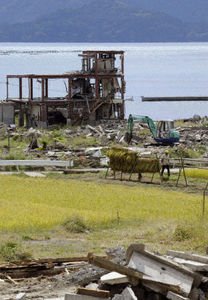
english.kyodonews.jp
Rice harvest in tsunami-hit Iwate Pref.
Photo taken on Sept. 24, 2011, shows Seiichi Konno's rice paddy in Rikuzentakata, Iwate Prefecture, that was hit by the March 11 tsunami. (Kyodo) english.kyodonews.jpby Edano via English.kyodonews.jp 10/19/2011 7:13:12 PM- ABC Australia: Japan communities record Chernobyl-level radiation — “I have absolutely no trust in the Government” … “All they do is cover up and hide data” (VIDEO). enenews.comby Majj 10/19/2011 7:16:38 PM
- Local Official: “We are not human guinea pig” — Tells young people to leave Japan. enenews.comby Majj 10/19/2011 7:17:55 PM
- by Majj 10/19/2011 7:20:19 PM
- Minami soma shi, in Fukushima.
Government lifted mandatory evacuation area for this place on 9/30.
Schools and elementary schools were re-opened, innocent people, and innocent children are coming back to the place.
However, it’s still 3 uSv/h. Children can’t be without dose meter.
Being a city councilor of the city, Mr.Oyama Koichi is having his “last fight”.
“I had my wife, kids, and employees all evacuate here. People worry about me. I much appreciate for it, but I just wish my body could be a fertilizer for the next generation.”
He knows he may die of exposure.
He became a city councilor since last December. fukushima-diary.comby Majj 10/19/2011 7:24:18 PM  "dying for Tepco" older article sheds light on how hard it is to get workers comp for radiation. Worker with just 70msv shows lots of symptoms. www.japanfocus.orgby artnuke 10/19/2011 7:26:41 PM
 @lillymunster Maybe this has led to our confusion: For about a month from late Jan. 2001, two
separate shipments of Japanese nuclear materials
─ a cargo of high-level waste (HLW) via
the Cape Horn and a shipment of mixed uranium-
plutonium oxide (MOX) fuel via the Cape
of Good Hope ─ were simultaneously moving
through international waters......The British-flagged Pacific Swan left Cherbourg,
France on 19 Dec. 2000 with 192 canis-ters of HLW......Meanwhile, the British-flagged Pacific Pintail
and Pacific Teal left Europe on 19 Jan.
2001 to transport 28 assemblies of MOX fuel
manufactured by a Belgian company, Belgonucleaire
(BN), for Kashiwazaki-Kariwa plant in
Niigata Prefecture. cnic.jpby smoss 10/19/2011 7:28:28 PM- @artnuke - I left a note for you belowby Vivre 10/19/2011 7:33:46 PM
- Decon Bubble in Fukushima: Contractors Charging US$13,000 Per House
Yet another fine example of how a government is so good at misallocating the resource. By pledging to pour hundreds of billions of yen (probably in trillions) into "decontaminating" Fukushima, the Japanese government has already spawned a brand-new industry of residential decontamination. Who are the industry participants? Cleaners, painters, just about anyone who has a high-pressure washer.
Some are apparently charging 1 million yen (US$13,000) to hose down your house. As you can see in the video in the previous post, their idea of "decontamination" looks little more than year-end cleanup. Power washing seems to somehow turn cleanup into "decontamination". ex-skf.blogspot.comby Majj 10/19/2011 7:36:00 PM  @Majj @Majj good advice from that officiallby elainekirk 10/19/2011 7:36:13 PM
- @Majj farcical and any they do remove will be on the ground and in water coursesby elainekirk 10/19/2011 7:37:24 PM
 Finally found a calcium vs strontium study from this century. It concludes : "The study clearly shows that inadequate nutritional calcium intake significantly increases uptake of Sr in serum as well as in trabecular bone matrix." www.ncbi.nlm.nih.govby Ian 10/19/2011 7:38:07 PM
Radio-analysis a CT scan. Note the radiation-induced 'static' (aka, 'visible radiation') on the camera. JFC, a CT scan is like taking a visit to Fukushima Daiichi, with no protection on! And there's not a completed study on the actual cancer incidence from CT scans, so they're still an ongoing public experiment. A good CT review to read states:
"There was a significant increase in the overall risk of cancer in the subgroup of atomic-bomb survivors who received low doses of radiation, ranging from 5 to 150 mSv27-29; the mean dose in this subgroup was about 40 mSv, which approximates the relevant organ dose from a typical CT study involving two or three scans in an adult." http://www.nejm.org/doi/full/10.1056/NEJMra072149by Ian 10/19/2011 7:55:04 PM- @elainekirk I keep ask me this question : How long will take to people in Japan to open the eyes. I understand the Americans , Brazilians and other country's accepting nuclear power , no accidents so far , but Japan. Japan is dying and they don't revolt, the don't want to know. Is so sad :-(((by Majj 10/19/2011 8:11:26 PM
- @Majj there are lots of people working hard to try to put nuclear power to an end in Japan. They are up against a huge beast. There is so much money and corruption tied up in it. I think they will eventually prevail, but it will be a long hard fight.by lillymunster 10/19/2011 8:13:09 PM
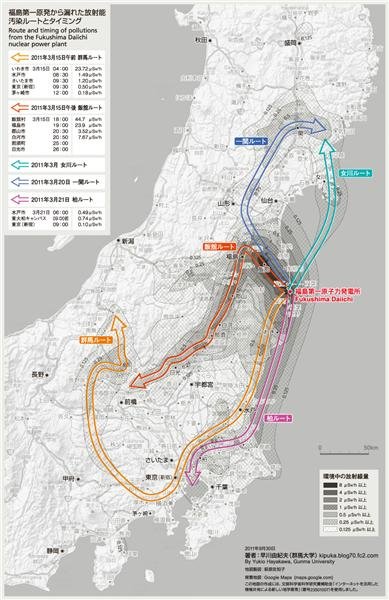
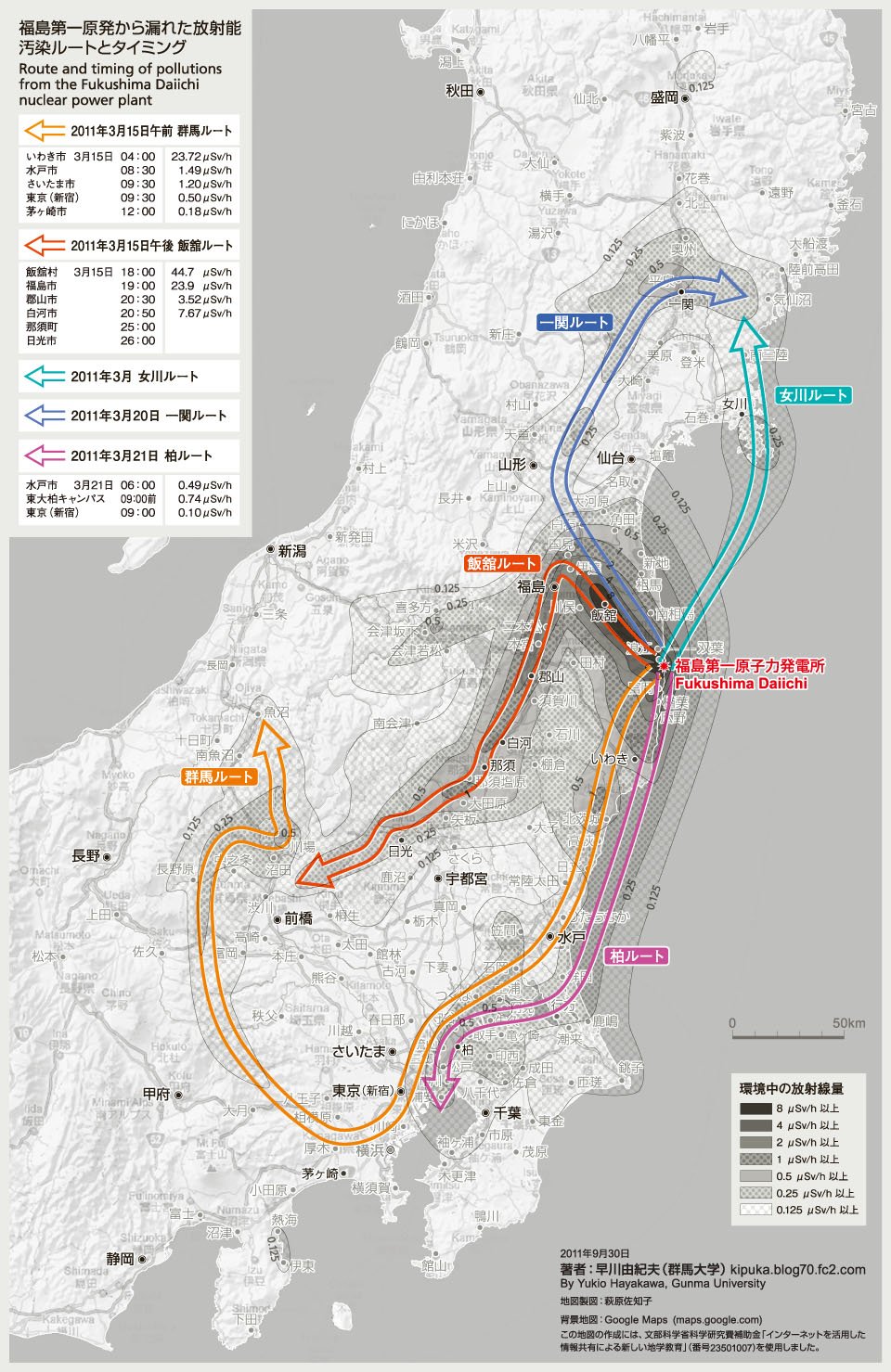
- Map purports to show major contamaination routes after unit 3 blow up
lh4.googleusercontent.com
lh4.googleusercontent.comby artnuke 10/19/2011 8:14:13 PM - Oh just read Majj's post about $13,000 to power wash a house. I doubt homeowners insurance will pay for it. I hope local cities buy a bunch of pressure washers to borrow out and maybe organize neighborhood teams to do homes. That is insane.by lillymunster 10/19/2011 8:17:18 PM
- @smoss That CNIC report makes sense, maybe the earlier accounts we found were not totally correct. I do remember many not being heavily detailed. What still does not make sense why they needed both ships to send 28 assemblies. They sent more than that on one ship in the other shipments. Either one of the pair (Pintail & Teal) was actually hauling back waste or something is fishy in the accounting.by lillymunster 10/19/2011 8:19:51 PM
- @lillymunster why are the people paying to clean their homes it is tepco who are liableby elainekirk 10/19/2011 8:20:02 PM
- @elainekirk because it will take forever to get compensation out of TEPCO and winter is coming, plus in order to get compensated you usually have to produce an invoice or receipt proving you had it done or spent the money.by lillymunster 10/19/2011 8:20:57 PM
- by Edano via Gunma.zamurai.jp 10/19/2011 8:23:47 PM
- @Edano nice map - makes everything they are now finding make sense.by lillymunster 10/19/2011 8:34:28 PM
- vimeo.com Arnie's new video. Not seen it, I keep getting an error message.by Ian 10/19/2011 8:45:59 PM
- @lillymunster i find it a little simplifying .... i doubt you can explain everything with 5 arrows .... :)by Edano 10/19/2011 8:47:53 PM
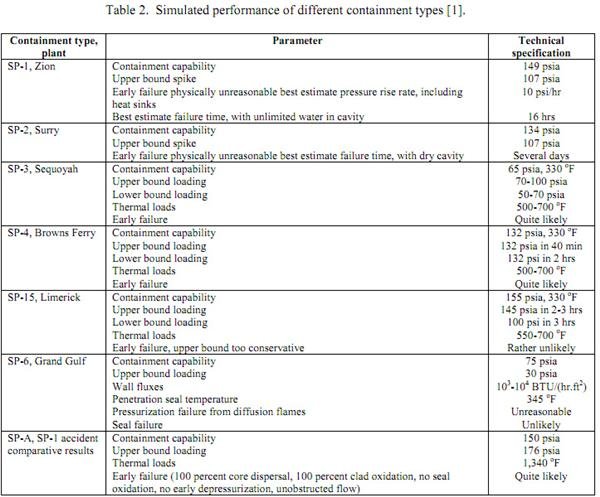
I don't know if these will interest people there were a lot of tests done on bwr containments I found the papers this morning netfiles.uiuc.edu
by elainekirk 10/19/2011 8:55:51 PM- One important aspect of the PCCV model response in the high pressure tests is the concept of failure. In the U.S., the
functional failure for the prototypical containment is defined in the regulations as containment leak rates exceeding 0.1
to 0.5% of the containment mass per day [18], considering maximum offsite dose rates due to fission product released
to the environment. In Japan, the functional failure is defined in design specifications made by the utility company, not
the regulations. (The specified leak rate for the PCCV prototype is 0.1% mass/day.) The functional failure criteria are
not particularly useful to test the structural capacity of a containment vessel model, especially when one of the objectives
is to generate large inelastic response modes for comparison with analytical predictions, which may be well beyond the
levels required to cause functional failure; and secondly to gain some insight into design margins, i.e. the functional and
structural capacity beyond the specified design load conditions. In the case of the PCCV model test, the pressurization
system allows the model to be pressurized to levels significantly above those expected to cause local strains in the model
to exceed the ultimate strain limits of the materials. The test(s) were terminated when the model and the pressurization
system were incapable of maintaining or increasing the model pressure due to excessive leakage or gross rupture. In this
report, the maximum pressure achieved prior to the termination of the tests will not be identified as the failure pressure,
since failure is defined in terms of some acceptance criteria, not the operational inability to maintain pressure in the
model. docs.google.comby elainekirk 10/19/2011 8:57:34 PM - @Edano as far as explaining the general wind corridors. Been trying to figure out an easy way to make some sort of google map with all the various contamination maps and sources
merged into oneby lillymunster 10/19/2011 9:14:41 PM - @Ian So did I.by lillymunster 10/19/2011 9:16:38 PM
- Just saw a letter via NRC email. They want more information out of Ft. Calhoun regarding the river use as the ultimate heat sink. Including river level and temperature. That made me wonder. What do you do in a massive drought? We do sometimes get really bad years where it will be hot and drought conditions at the same time and the river gets quite low. They will hold back water to try to keep enough for drinking water and basic navigation behind the dams. Could a NPP on a river potentially end up in a situation where the river can't properly act as the heat sink?by lillymunster 10/19/2011 9:21:56 PM
- @lillymunster, odd thing is I was getting the error message way back when the views where < 300, and yet now they're 3,769 and I'm still getting the error message. So lots of people must be seeing it even as others can't. vimeo.comby Ian 10/19/2011 9:30:05 PM
- Arnie's video is a snooze for us. 1. Unit 1 cover will pump air through filters and up stack. OK, that's news. 2. View of northeast corner shows that crane has fallen off tracks onto floor of top level. Yeah, we knew that, and he still doesn't notice that the !@#$% walls and corner are completely blown out, including massive vertical concrete beams. 3. Roof is missing over the spent fuel pool, which we could see from the 1st photos as well, his theory is that explosion was not uniform. He also doesn't notice the massive "dragons tail" girders that are bent from E-W to pointing north or the massive debris field under the wreckage of the fitting carousel. Says it supports his prompt critical theory, but he evidently has not heard of or does not accept Ian's more plausible steam explosion theory. 4. NOW he notices the steam plume from under the crane. He does not note it is at the edge of the circular cap and the equipment pool, but he correctly states that the steam is obviously escaping from a containment that is definitely not containing steam, we we pretty much all knew. Maybe Lilly should start doing videos, I don't think we've seen her pretty face yet. A puppet would work too....by artnuke 10/19/2011 9:50:29 PM
- if a massive drought ever makes the river go dry due to global warming because we've shut down all our nukes, we won't survive anyways.by artnuke 10/19/2011 9:50:37 PM
- that map was two maps combined, neither one shows how mountains and valleys may have channeled the plume.by artnuke 10/19/2011 9:50:43 PM
- on that map, my notes say unit 3 blew up on march 14, the day before the red and tan arrows. The first tan arrow loops around Tokyo in the morning, the red arrow is the one that deposits the massive red NW direction splotch and the rest of the downward blue plume from noon to midnight. None of the arrows corresponds to the unit 1 hydrogen explosion, but the much dirtier and higher gray cloud of #3, so there was lots of nasty stuff in that plume, not to mention the continuing steam plumes.by artnuke 10/19/2011 9:50:56 PM
- @artnuke I could animate my dog to do videos about fuku. :-) I am leaning towards Ian's theory with some involvement of the yellow containment cap bolt stretching, containment cap gasket failure and fuel gate area as a path out of containment during the blast. The fuel gate area was in the BWR training manual I read as a "weak spot". So if lots of the blast went out that side it could have damaged the fuel pool and explains why the refueling crane is nowhere to be found.by lillymunster 10/19/2011 9:55:45 PM
- by Ian 10/19/2011 10:01:55 PM
- it's quite early in japan, but we already had 3 quakes of seismic intensity 3 near the plants.by Edano 10/19/2011 10:10:31 PM

Japan Earthquake | Page 2527
- Who's Blogging
-
 hudebnik
 alblee
 UKVal
UKVal Oliver (ScribbleLive)
 Jonathan Keebler
 kaykodh
 PKelley
 Markfm
 Angie
Angie Deb
Deb Mid Valley
- Pedro Jesus
 Matt (ScribbleLive)
 George Gibb
- elainekirk
- lillymunster
 dean
dean bo
bo- Edano
 IanGoddard