Japan Earthquake | Page 2586

english.kyodonews.jp
Search for radiation source in Tokyo
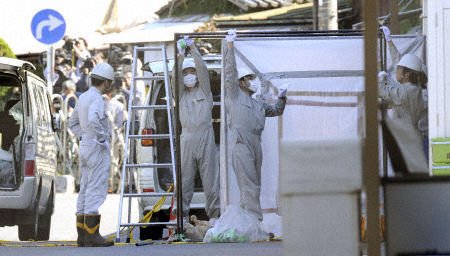
Workers begin the process around a supermarket in Tokyo's Setagaya Ward on Nov. 1, 2011, to discover and remove radioactive material believed to be buried underground. High levels of radiation have been detected at the site but they are unlikely to be related to the nuclear crisis at the Fukushima Daiichi plant, according to the science ministry. (Kyodo) english.kyodonews.jpby Edano via English.kyodonews.jp 11/1/2011 11:38:38 AM @lillymunster, the man needed to do his PR stunt only once. The burghers of Fukushima must drink this water for a lifetime. ;)by Peter 11/1/2011 11:39:18 AM
- Media to tour Fukushima nuclear plant
Nuclear crisis minister Goshi Hosono says he will allow media into the Fukushima Daiichi nuclear power plant on Saturday next week, for the first time since the March 11th disaster.
Hosono spoke to reporters on Tuesday about the government plan to achieve cold shutdown, maintaining the temperature of reactors at less than 100 degrees Celsius, by the end of the year.
He said work is underway and in order to confirm the process, he will visit the plant on November 12th and exchange views with people directly involved in the operation.
Hosono said the situation at the plant is gradually settling down so he will allow a fixed number of journalists to accompany him.
Tuesday, November 01, 2011 13:08 +0900 (JST)
www3.nhk.or.jpby Edano 11/1/2011 11:41:41 AM - Govt lowers land assessments for disaster zone
The government has lowered its land price assessments for areas of northeastern Japan affected by the March 11th earthquake and tsunami.
Land assessments for inheritance and gift tax calculations are set annually on January 1st. This means that damage from the March disaster is not reflected in this year's calculations.
The National Tax Agency on Tuesday released land price adjustment rates for locations in 10 prefectures, including a plunge of 80 percent for Onagawa in Miyagi Prefecture. Many of the town's residents were killed by the tsunami.
Other municipalities in Miyagi, Iwate and Fukushima prefectures were assessed with a 70 to 75 percent drop in land prices.
This is the second time the agency has had to adjust land price rates in the wake of a disaster.
After the 1995 Great Hanshin Earthquake that struck Kobe and vicinity in western Japan, land prices in affected areas were downgraded, but the maximum price fall then was 25 percent.
The adjustments do not apply to areas around the crippled Fukushima Daiichi nuclear plant. Land prices there will be assigned zero as it is nearly impossible to evaluate the commercial effect of radioactive contamination on property.
Tuesday, November 01, 2011 16:37 +0900 (JST)
www3.nhk.or.jpby Edano 11/1/2011 11:43:48 AM - Kyushu Power hopes to restart Genkai by Wed.
The operator of the Genkai nuclear power plant in western Japan is set to restart its Number 4 reactor that shut down on October 4, due to a procedural error.
It will become the first reactor in Japan to come back on line since the accident at the Fukushima Daiichi nuclear power plant in March.
Kyushu Electric Power Company's Vice President Haruyoshi Yamamoto visited Genkai Town Mayor Hideo Kishimoto on Tuesday.
Yamamoto said that he would like operations to resume as soon as preparations are completed.
Yamamoto told reporters that he wants the reactor back on line by Wednesday, so that it can be operating normally by the end of the week.
Mayor Kishimoto said he has no objection to the restart if the government has confirmed the reactor's safety. He said he wants Kyushu Power to put a system in place that will eliminate human errors.
Tuesday, November 01, 2011 16:00 +0900 (JST)
www3.nhk.or.jpby Edano 11/1/2011 11:45:06 AM  If anyone has time to take a look at the write up on the condensate tank information - I have it compiled into an article but it is in peer review wp.meby lillymunster 11/1/2011 11:59:36 AM
- @lillymunster reviewed, okayed :) what is "hot well" ??by Edano 11/1/2011 12:31:03 PM
- i think the cst story is another proof for the weakness of bwr design, and it is probably the first article that deals with this problem in fukushima. remember how long it took us to simply identify those tanks. it is a miracle that they still seem operable.by Edano 11/1/2011 12:39:39 PM
 greetings to allby dean 11/1/2011 12:40:40 PM
- @dean hiby Edano 11/1/2011 12:41:28 PM
- @ lilly.. I am reading through the condensate tank articleby dean 11/1/2011 12:42:44 PM
- @lilly.. very good cst articleby dean 11/1/2011 12:54:49 PM
- rt.com refugees shunned by Japanese society.
In one of the many shelters in the Fukushima region tens of thousands of people are still displaced. They have fled the earthquake, the tsunami and now the nuclear disaster. Now they are having to endure the harsh judgements of their countrymen who see their choice to flee their homes in the disaster-hit area as “un-Japanese”.by dean 11/1/2011 12:55:45 PM - www2.jnes.go.jp @ lilly.. here is some back up information on the condensate storage tanks.. The Shimane Nuclear Power Station Unit-1 had been under the periodical inspection. When the condensate storage tank (Note 1) was inspected, it was recognized that part (about 8 mm in minimum plate thickness) of the installation portion of the tank water level meter piping was less than the necessary plate thickness (9.9 mm) specified in the technical standards (Note 2) due to corrosion.by dean 11/1/2011 1:06:17 PM
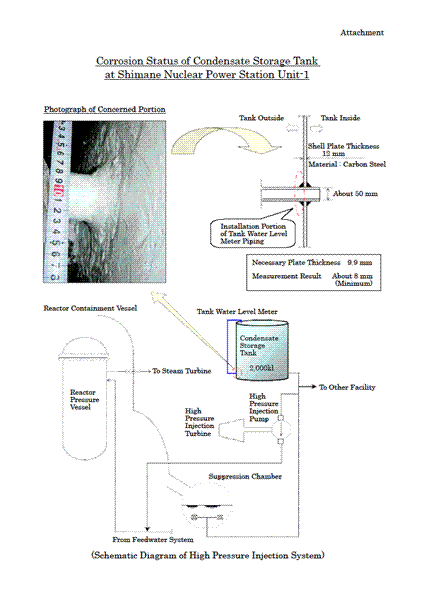
Shimane NPP Unit 1 condensate tank inspection
by dean 11/1/2011 1:08:41 PM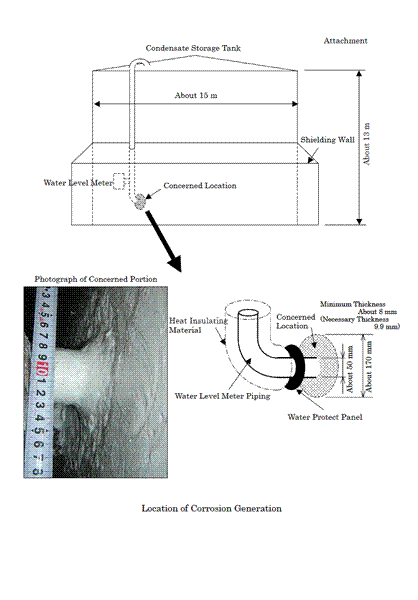
closer view of condensate tank.. carbon steel fabrication
by dean 11/1/2011 1:13:42 PM- thanks Dean - had to step away for a few. Will add that info into the articleby lillymunster 11/1/2011 1:14:58 PM
- @lilly.. here is some information about a CST at Vermont Yankee, note the fact that the CST which is used as one source for ECCS is not a TECH SPEC SYSTEM and thus made of carbon steel and not built to safety system component requirements... "The Condensate Storage Tank (an outside tank) communicate with the reactor primary system by buried piping, aka the Condensate Transfer System. Your plant has this, and so does Vermont Yankee. This is how tritiated water gets into the groundwater via leaks. "Covering it on rounds" is not going to reveal this - your environmental ground well monitoring is about the only way, unless it is a large leak that radwaste processing balances can reveal. It is not a Tech Spec system and therefore has been neglected on monitoring/upkeep in the past"
.by dean 11/1/2011 1:20:07 PM - "Although no credit is taken in the safety analyses for the condensate storage tank (CST), it is
capable of providing a source of water for HPCI and RCIC"
The suppression pool is the credited source, which it why the instrumentmation to swap the suction to the suppression pool at low CST level or high suppression pool level are the only Tech Spec required components.by dean 11/1/2011 1:21:41 PM - So the cst isn't considered a critical system?by lillymunster 11/1/2011 1:24:16 PM
- The ECCS pumps are provided with minimum flow bypass lines, which
discharge to the suppression pool. The valves in these lines
automatically open to prevent pump damage due to overheating when
other discharge line valves are closed. To ensure rapid delivery of water
to the RPV and to minimize water hammer effects, all ECCS pump
discharge lines are filled with water. The LPCI and CS System discharge
lines are kept full of water using a "keep fill" system (jockey pump
system). The HPCI System is normally aligned to the CST. The height of
water in the CST is sufficient to maintain the piping full of water up to the
first isolation valve. The relative height of the feedwater line connection
for HPCI is such that the water in the feedwater lines keeps the remaining
portion of the HPCI discharge lineby dean 11/1/2011 1:24:39 PM - @lilly.. correct, however it may differ from NPP to another in USA.. it appears that most use the suppression pool as the credited system and the CST as alternate and thus not robust in design or fabricationby dean 11/1/2011 1:25:45 PM
- www.nukeworker.com @ lilly.. read through this link for some insight on ECCS, RCIC and CST at different plants in USAby dean 11/1/2011 1:28:18 PM
- taking a breakby dean 11/1/2011 1:29:29 PM
- @Edano - I think hot-well refers to the tank inside the turbine building where they collect water before pumping it back out to the condensate tank.by lillymunster 11/1/2011 1:32:54 PM
- I cleaned up the unit 5 notes into an article. I had forgotten about it until I was going through things this morning. I cleaned it up into a post. Let me know if there is something that should be added. wp.meby lillymunster 11/1/2011 1:39:36 PM
- THanks Dean.by lillymunster 11/1/2011 1:39:43 PM
- @all - the nukeworker conversation Dean posted is pretty informative if you ever wanted to know how tritium leaks happen. :-)by lillymunster 11/1/2011 1:43:46 PM
- @lillymunster Here's a dandy explaination of condensate system, incl. hot well. When the tsunami hit, it silted up the seawater intake screen and pipes for sure. I wonder how much gunk got into other systems? Also, note the mention of its function of avoiding build-up of sodium and chlorides in a bwr reactor (can you say "salt"? I thought you could :-) )) www.nucleartourist.comby M.I.A. 11/1/2011 1:50:00 PM
- @M.I.A. :-) thanks! BTW, the videos of the intakes at 5 and 6 show the nasty mess made in the intakes. Links to the videos are in my post below about unit 5 notes. I remember discussions early on about the ramifications of putting salt water into the reactors.by lillymunster 11/1/2011 2:00:44 PM
- @lillymunster , I found a few references for the CSTs. For the tank capacities at Dai-ichi, see here: www.neimagazine.com . For the fill percentages on Mar. 11, see the operations logs for Units 1/2 here: www.tepco.co.jp , and Units 3/4 here: www.tepco.co.jp . Unit 2's tank was 67% filled on Mar. 11 and its supply should have lasted for 18 hours, if the water had been used for the RCIC alone. It lasted about 12 hours instead, according to the NISA reports to the IAEA: “From 04:20 to 05:00, March 12, as water level of the Condensate Storage Tank (CST) decreased and also in order to control rising of the S/C water level, the water source for the RCIC was switched from the CST to the S/C for the RCIC to continue injecting water.” The problems mounted after that. The tanks may have been more or less intact. Attempting to provide cooling water from the suppression pool must have precipitated the demise of the ECCS.by Peter 11/1/2011 2:02:50 PM
- @all - did anyone have any thoughts on the iodine 131 being found in rice harvested in Oct? I didn't think iodine was readily absorbed by plants and having noticeable amounts now, could it be anything other than recriticality?
by lillymunster 11/1/2011 2:04:52 PM - @made a mistake, should have lasted for 16 hours, instead of 18 hours.by Peter 11/1/2011 2:09:31 PM
- changed it in my notes Peter. I will do an update on the document this evening. Since there was so much additional input added today I think I will send it back here for one more look before publishing to make sure I have things added in correctly.
I have a list of news articles to go through from last night, some to get worked into articles, others to get put into the new news feed.by lillymunster 11/1/2011 2:55:29 PM - @lillymunster , this reminds me of two other interesting issues for a sleuth: Unit 1 possessed the smallest tank. The core sprayer and the HPCI should have tapped its water. Did the fact that the tank was smaller contribute to its early meltdown? The other issue that I still do not understand is how the isolation condenser could have boiled dry at about two hours after the quake/tsunami. Such trivial thing! They said the water is expected to reach boiling temps when the IC is in operation. It is so obvious that provisions must have been to replenish the water that is boiling off. I have not seen on any diagram where that make-up water was supposed to come from and why it did not get there anymore.by Peter 11/1/2011 3:19:05 PM
- Japanese MP drinks decontaminated water
www.youtube.comby alphaspheric 11/1/2011 3:54:19 PM - @ lilly.. I am in travel to return home and will add to this later,.. one thing, I've talked to my colleagues in nuclear safety and the common comment.. classic boil off.. which with what the EQ and TSUNAMI did was not preventable.. Once boil off started it overwhelmed the capabilities of the systems to stop it....There could have been things to slow it but at this point I am just not convinced that anything could have been done..by dean 11/1/2011 3:54:47 PM
- @Peter, Dean - I wondered about water hitting boiling points in an accident where you don't have an operating way to cool off the water loop. I should be around this afternoon and evening - let me know what you both have on this. It could be an important factor. I can't think of anything in the emergency systems to deal with this in a situation such as fuku because everything is closed loop - if you don't have water running the other side of the loop to the ultimate heat sink wouldn't all the water eventually get too hot to do much good?by lillymunster 11/1/2011 3:58:10 PM
- @elaine.. exactly the ultimate heat sink (ocean water) was wiped out,, the building itself is considered a heat sink for safety analysis but all the systems designed to handle the steam from boil off was overwhelmed in their ability to stop it .by dean 11/1/2011 3:59:47 PM
- This link to Mitsubishi products gives a brief description of all the pumps and what they're for: www.mhi.co.jpby M.I.A. 11/1/2011 4:00:24 PM
- @lillymunster You are correct about water temp. getting too high. "The water from the circulating water system enters the condenser in a waterbox. The level in the waterbox must be maintained above the level of the uppermost tubes, otherwise the condenser will not be efficient. Generally the colder the circulating water, the more efficient the plant is. Power plants become less efficient when either the condenser tubes are fouled, e.g. by mud, plugging, or accumulation of other materials that reduce the ability to transfer heat from the steam to the water.
A condenser may heat the circulating water passing through as much as 40 degrees Fahrenheit." www.nucleartourist.comby M.I.A. 11/1/2011 4:04:02 PM - ooops- baby crying, gotta go. TY Lilly, Dean, Edano, Elaine, et al. Wish I could linger...by M.I.A. 11/1/2011 4:05:43 PM
- out for a bit - will check in when I returnby lillymunster 11/1/2011 4:10:14 PM
- NRC released this report Oct. 6. Up for public comment by Nov 2. RE: Fukushima and their fiscal/safety plan thru 2016. (link is to a 40 pg. pdf) www.regulations.gov!documentDetail;D=NRC-2011-0233-0002
by M.I.A. 11/1/2011 4:39:02 PM - Maybe wrong link. Its NUREG-1614, vol. 5, or pdf: NRC-2011-0233-002.pdf. Sorry, I'm a computidiot.by M.I.A. 11/1/2011 4:40:48 PM

Japan Earthquake | Page 2586
- Who's Blogging
-
 hudebnik
 alblee
 UKVal
UKVal Oliver (ScribbleLive)
 Jonathan Keebler
 kaykodh
 PKelley
 Markfm
 Angie
Angie Deb
Deb Mid Valley
- Pedro Jesus
 Matt (ScribbleLive)
 George Gibb
 elainekirk
- lillymunster
- dean
 bo
bo- Edano
 IanGoddard