Japan Earthquake | Page 2731
 @lillymunster madnessby elainekirk 12/2/2011 1:54:37 AM
 @you a few experts are calling nonsense on it. They found a couple to declare it accurate so the newspapers could have some credibility.by lillymunster 12/2/2011 1:59:45 AM
- @lillymunster it is so frustrating that nobody is verifying tepco's data 'on the ground'by elainekirk 12/2/2011 2:03:53 AM
- @elainekirk there was some hint about NISA reviewing things. I hope Edano doesn't let them get away with it.by lillymunster 12/2/2011 2:05:40 AM
- I think if any other agency were going to get in that plant it would have happened by now, terrible that the world has stood by and l;et tepco call the shotsby elainekirk 12/2/2011 2:08:12 AM
- @elainekirk at some point they will run out of excuses. What worries me is if they try to open the 20km zone. Right now there is just no promise things would be safe. They have such a hydrogen problem they have to now drain it off.by lillymunster 12/2/2011 2:36:06 AM
- @lillymunster I must try to sleep get up early and find a plumber wish me luck and tis good to be backby elainekirk 12/2/2011 2:40:22 AM
- TEPCO claims Yoshida's health resignation was not due to radiation www3.nhk.or.jpby lillymunster 12/2/2011 2:45:07 AM
- @elainekirk good to have you back! I am off to sleep too. I think I might be catching the bug going around. Should be around in the early AM.
@all - please make sure to post any news overnight and bump the page if you stop byby lillymunster 12/2/2011 2:46:05 AM - Some randomness before I go. Hatchiko Coalition found a minature pony in the evac zone:
Do you know what animal was found recently in Fukushima, surviving on his own for the last 9 months? A miniature pony. Its not just cats and dogs in the zone, there are a large variety of animals there. The people who found him couldn't believe their eyes. Survived for 9 months on his own. His hoofs are in rough shape as they havent been trimmed since disaster struck in March likely. But he's aliv... www.facebook.comby lillymunster 12/2/2011 2:49:55 AM  @lilly so what was the end conclusion about the fire? That it was burning off hydrogen?by bo 12/2/2011 3:37:51 AM
 Fukushima Earthquake Moved Seafloor Half a Football Field
The massive shift, laterally and upward, caused the epic March 2011 tsunami www.scientificamerican.comby Mid Valley 12/2/2011 3:53:36 AM- hi bo & lillyby Mid Valley 12/2/2011 3:53:45 AM
- Hi @MVby bo 12/2/2011 4:04:51 AM
- Insights from the great 2011 Japan earthquake www.physicstoday.orgby Mid Valley 12/2/2011 4:20:00 AM
- bumpby Mid Valley 12/2/2011 5:50:32 AM
 "Special Report: In Chernobyl, a disaster persists" uk.reuters.com
"Japan may announce Fukushima cold shutdown on Dec. 16: Yomiuri" uk.reuters.comby Pedro Jesus 12/2/2011 7:01:46 AM The flashing is back : www.youtube.com I'm not persuaded it's a fire.by Ian 12/2/2011 7:10:02 AM
- @Ian yesterday in the dark the light was coming from between the buildings. The flashing now is precisely beside #3.by bo 12/2/2011 7:12:59 AM
- @Ian as it gets darker I am changing my mind. That does seem to be in the same exact place as last night. But the volume of light seems more steady than last night.by bo 12/2/2011 7:53:28 AM
 and now the big crane has a flashing red light.by Edano 12/2/2011 9:09:45 AM
- Tsunami was direct cause of nuclear crisis: TEPCO investigation
TOKYO, Dec. 2, Kyodo
Tokyo Electric Power Co. said Friday it has determined that the direct cause of the nuclear crisis at its Fukushima Daiichi power plant was the larger-than-expected tsunami that flooded key buildings after the March 11 earthquake.
''We had prepared for accidents at a certain level and had documented procedures, but in this case the situation developed into one that deviated from our accident-response assumptions,'' TEPCO said in an interim report on an in-house investigation into the world's worst nuclear accident in 25 years.
''As a result, we were not able to take measures to counter the accident at the Fukushima Daiichi plant and could not prevent reactor cores from sustaining damage,'' it said.
According to the report, key facilities at the plant did not lose their functions as a direct result of the magnitude 9.0 earthquake, but the flooding caused by the 13-meter-high tsunami led to a ''simultaneous loss of multiple safety functions.''
The prolonged loss of backup power sources and functions to cool the reactors resulted in the meltdown of the nuclear fuel in the Nos. 1 to 3 reactors, leading to the massive release of radioactive substances into the environment.
Executive Vice President Masao Yamazaki stressed that the company had been taking ''the best possible measures at the time'' to secure the safety of the power plants.
But he also acknowledged this view differs from that of an advisory panel set up in the company, which concluded that TEPCO's ''insufficient'' safety measures were also a factor in the accident and in the deterioration of the situation.
TEPCO plans to compile a final investigation report by around June.
Another panel set up at the government's initiative is also looking into the causes of the accident and is set to compile an interim report in late December.
==Kyodo english.kyodonews.jpby Edano 12/2/2011 9:16:37 AM - oooh, bad bad tsunami, bad water, bad weather. poor teppy.by Edano 12/2/2011 9:17:15 AM
- TEPCO: Cooling stoppage info was not shared
A miscommunication between workers at the Fukushima Daiichi nuclear plant could have delayed a response to the accident on March 11th.
The operator says the plant's chief did not know for several hours that the only backup cooling system for the Number 1 reactor was manually shut down on the day of the earthquake and tsunami.
NHK has obtained Tokyo Electric Power Company's interim report on the accident to be released on Friday.
The report says workers in the reactor's control room stopped an emergency cooling system shortly after 6 PM. It says the plant chief, Masao Yoshida, and others in the facility's office building were unaware of the manual shut-down.
TEPCO says it was not until around midnight that the plant chief noticed the system was not working. A rise in the radiation levels at the reactor building alerted him to the possibility of damaged fuel rods.
The emergency system uses steam to cool down a reactor when there is no electricity supply. It was the only workable cooling system at the reactor after the plant lost its major power sources.
The report says the misunderstanding occurred because a malfunctioning gauge failed to show that the water level had dropped, exposing the fuel rods.
TEPCO estimates that damage to the exposed fuel rods occurred about 4 hours after the quake. It says this generated large amounts of hydrogen that caused the first explosion at the plant on the following day.
Friday, December 02, 2011 10:20 +0900 (JST)
www3.nhk.or.jpby Edano 12/2/2011 9:20:01 AM  After Fukushima: Enough Is Enough :The nuclear power industry has been resurrected over the past decade by a lobbying campaign that has left many people believing it to be a clean, green, emission-free alternative to fossil fuels. These beliefs pose an extraordinary threat to global public health and encourage a major financial drain on national economies and taxpayers. The commitment to nuclear power as an environmentally safe energy source has also stifled the mass development of alternative technologies that are far cheaper, safer and almost emission free — the future for global energy. www.nytimes.comby Majj 12/2/2011 10:24:02 AM
- well nothing from tepco today yetby elainekirk 12/2/2011 12:30:37 PM
- Japanese only -suprise - suprise
www.tepco.co.jp
Press Release (Dec 02,2011)
Release of the interim report of Fukushima Nuclear Accidents Investigation Committeeby elainekirk 12/2/2011 12:31:58 PM - nuke energy also burns fossil fuel. uranium is a fossil element which is produced over millions of years and cannot be renewed either. it produces environment toxic waste as well. the difference to coal and gas is not so big as the nuke industry suggests. the nuke fuel must be extracted, enriched, industrially premanufactured and transported before use. nuke energy is not at all emission free, not even co2 free.by Edano 12/2/2011 12:32:32 PM
- Fukushima firms advised to put safety labels on products
NEW YORK, Dec. 1, Kyodo
Internationally active Japanese companies Thursday advised Fukushima Prefecture firms to put labels on food and other products to show they had passed safety tests to reassure overseas consumers worried by the impact of the nuclear crisis at the Fukushima Daiichi power plant.
The advice came as Fukushima business leaders met with representatives of Japanese companies operating in the United States at the Japanese Consulate-General in New York to discuss how best to cope with the impact of the nuclear crisis on Fukushima products, meeting participants said.
Fukushima products ranging from food to screws were initially subject to import restrictions overseas due to radioactive contamination fears after the March 11 earthquake and tsunami crippled the Fukushima Daiichi nuclear plant.
The safety labels would be put on products that clear radiation tests, recognizing them as free from radioactive contamination.
''I thought that the safety label proposal was a good idea,'' said Kenichi Shishido, who runs an insurance agency in Koriyama in the prefecture. ''I would like to tell my business colleagues in Fukushima that we should positively sell our products in the world.''
The companies also recommended Fukushima business leaders consider investment in wind and other non-nuclear electricity generation projects as well as advanced medical technology and other areas to create employment in the prefecture.
==Kyodo english.kyodonews.jpby Edano 12/2/2011 12:40:47 PM - @Edano the voice of reasonn but I doubt the Japanese will embrace itby elainekirk 12/2/2011 12:42:09 PM
- TEPCO pays 39.1 bil. yen to farmers in 17 pref. over nuclear crisis
TOKYO, Dec. 2, Kyodo
Tokyo Electric Power Co. said Friday it has paid 39.1 billion yen in compensation to agricultural organizations in 17 prefectures for damage caused by the Fukushima Daiichi nuclear power plant accident, bringing the total sum given to the farmers so far to about 88.9 billion yen.
Councils comprising mainly of agricultural and dairy cooperatives in Fukushima, Iwate, Miyagi, Hokkaido, Chiba and 12 other prefectures have sought a total of 111.3 billion yen in compensation by Nov. 15 on behalf of the farmers. TEPCO did not provide details on individual sums paid to each organization.
For the remaining claims, TEPCO said in a statement that it will pay the compensation once it completes verifying the applications. The company has drawn criticisms for its slow handling of compensation issues related to the nuclear crisis.
==Kyodo english.kyodonews.jpby Edano 12/2/2011 12:42:25 PM - @elainekirk yes, i would feel better with a big red sticker on all products from fukushima. :)by Edano 12/2/2011 12:43:15 PM
- i simply would not buy them, no matter what is written on the sticker.by Edano 12/2/2011 12:44:11 PM
- UPDATE1: Tsunami was direct cause of nuclear crisis: TEPCO investigation
TOKYO, Dec. 2, Kyodo
Tokyo Electric Power Co. said Friday it has determined that the direct cause of the nuclear crisis at its Fukushima Daiichi power plant was a larger-than-expected tsunami that flooded key buildings after the March 11 earthquake, and not the magnitude 9.0 jolt itself.
''We had prepared for accidents at a certain level and had documented procedures, but, because of the impact of the tsunami far larger than our expectations, the situation developed into one that deviated from our accident-response assumptions,'' TEPCO said in an interim report on an in-house investigation into the world's worst nuclear accident in 25 years.
''As a result, we were not able to take measures to counter the accident at the Fukushima Daiichi plant and could not prevent reactor cores from sustaining damage,'' it said.
According to the 130-page report, the facilities important to the plant's safety measures did not sustain damage as a direct result of the massive quake, but the flooding from the 13-meter-high tsunami led to the ''simultaneous loss of multiple safety functions.''
The prolonged loss of backup power sources and functions to cool the reactors resulted in the meltdown of nuclear fuel in the Nos. 1 to 3 reactors, leading to a massive release of radioactive substances into the environment.
In compiling the report, TEPCO sought advice from a panel of experts, which also announced its views in a separate paper also Friday, saying TEPCO's ''insufficient'' safety measures were a factor in the accident.
The panel's paper also noted that TEPCO may have been stuck on the ''myth'' that atomic power is safe.
However, Executive Vice President Masao Yamazaki said in a news conference that TEPCO had taken ''the best possible measures at the time'' for safety.
The TEPCO report said the utility had taken enough measures to withstand tsunami waves as high as 6.1 meters, but the latest tsunami that set off the nuclear crisis at the plant in northeastern Japan was ''far larger than the company's expectations.''
TEPCO projected in an in-house study in 2008 that a tsunami as high as 10.2 meters could hit the plant, but the figure was ''just something based on an assumption without specific evidence,'' the report also said, justifying the company's decision not to take immediate action.
TEPCO's report also included measures to prevent a recurrence, such as setting barriers to block water from entering the buildings and installing functions that would not allow reactor cores to be damaged even in case of a loss of power.
TEPCO plans to compile a final investigative report by around June.
Another panel set up at the government's initiative is also looking into the causes of the accident and is set to compile an interim report in late December.
==Kyodo english.kyodonews.jpby Edano 12/2/2011 12:44:54 PM - UPDATE2: Japan to export nuclear technology if wanted, Noda says
TOKYO, Dec. 2, Kyodo
Prime Minister Yoshihiko Noda said Friday that Japan will consider exporting its nuclear technology, in principle, as long as it is still wanted by other countries.
Noda said Japan will not provide its nuclear technology and expertise to any country without restriction, noting that peaceful use and other requirements must be ensured.
But Noda told a House of Representatives panel he believes it is ''meaningful to provide things with high levels of safety'' to other countries.
Noda's remarks came as Japan's bilateral civil nuclear cooperation accords with Jordan, Russia, South Korea and Vietnam are due to be approved by parliament this month, despite public concerns about the safety of atomic power in the wake of the Fukushima disaster.
The accords, which will lay the legal foundations for Japanese companies to supply nuclear equipment and technology to other countries, were approved by the committee on foreign affairs in the afternoon.
Japan signed the pacts with the four countries before the world's worst nuclear crisis since Chernobyl occurred at the Fukushima Daiichi power plant, following the March 11 earthquake and tsunami.
Before the crisis, the government led by the Democratic Party of Japan regarded exporting the country's nuclear technology, especially to fast-growing economies, as one of the most promising ways to generate economic growth.
Noda told the lower house panel that the government is seeking the parliamentary passage of the accords as necessary domestic procedures have already been completed in Jordan, Russia, South Korea and Vietnam. He said those countries are still hoping to have Japan's cooperation even after the nuclear crisis -- which has yet to be brought under control.
Noda said diplomatic relations must be taken into account with regard to the four accords as well as others Japan began negotiating prior to the crisis, including with Brazil, India and Turkey.
As for new agreements, Noda said the government must examine how Japan can cooperate for the peaceful use of nuclear energy taking into account the findings on the Fukushima accident.
To date, Japan has concluded bilateral nuclear accords with seven countries -- Australia, Britain, Canada, China, France, Kazakhstan and the United States -- and the European Atomic Energy Community.
A vote on the four nuclear accords in a lower house plenary session, which was initially due to take place on Friday, has been rescheduled for next week.
If all goes smoothly, they will come into force early next year after also being approved by the opposition-controlled House of Councillors during the current parliamentary session, which will end Dec. 9 unless extended.
In Jordan, a consortium of Mitsubishi Heavy Industries Ltd. and French nuclear power company Areva is competing with Russian and Canadian companies for contracts.
Jordan, which plans to conduct a bid to build a nuclear power plant by the end of this year, has urged Japan to approve their nuclear cooperation accord soon, according to diplomatic sources.
==Kyodo english.kyodonews.jpby Edano 12/2/2011 12:47:33 PM - hipocrits.by Edano 12/2/2011 12:49:36 PM
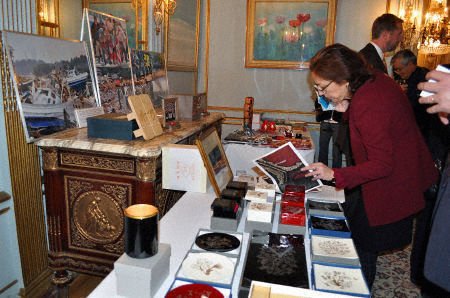
english.kyodonews.jp
Fukushima firms advised to put safety labels on products
Visitors view products from Fukushima Prefecture at the official residence of the Japanese consul-general in New York on Dec. 1, 2011. During a meeting earlier in the day, internationally active Japanese companies advised Fukushima Prefecture firms to put labels on food and other products to show they had passed safety tests to reassure overseas consumers worried by the impact of the nuclear crisis at the Fukushima Daiichi power plant. (Kyodo) english.kyodonews.jpby Edano via English.kyodonews.jp 12/2/2011 12:52:12 PM- Gov't panel calls for ways to ensure 'effective' nuclear regulation
TOKYO, Dec. 2, Kyodo
A government panel agreed Friday to compile a proposal seeking to legally require atomic power plant operators to implement the latest nuclear safety practices and technology in the operation of existing facilities.
The report would be used in the process to launch a new nuclear safety agency under the Environment Ministry in April, after public confidence in the country's nuclear regulation system was seriously undermined amid the nuclear crisis at the Fukushima Daiichi complex.
''To heighten the effectiveness of nuclear safety regulations, it is expected that (the country) exits from regulations that have been a mere facade, and create a new regulation system which encourages higher nuclear safety at any time based on the latest knowledge,'' the report said.
Toward that end, Japan should introduce a system to legally require so-called ''backfitting'' to make sure that new knowledge and technology are reflected in the nuclear facilities or the operation of the facilities.
The proposal also stressed the need to ensure the independence of the new nuclear safety agency, after questions were raised over whether it is appropriate to have the Nuclear and Industrial Safety Agency, the current primary nuclear regulator, under the Economy, Trade and Industry Ministry, which promotes nuclear power.
The launch of the new agency is also aimed at rectifying the current situation in which various government organizations are involved in nuclear safety issues.
Under the envisioned regulatory system, a new third-party council consisting of experts would check the overall handling of nuclear affairs, the proposal said.
After some further fine-tuning, the panel plans to submit the report to Environment Minister Goshi Hosono, government officials said.
The panel was led by Shojiro Matsuura, a former chairman of the Nuclear Safety Commission, another oversight body.
==Kyodo english.kyodonews.jpby Edano 12/2/2011 12:55:17 PM - Edano, what was the rough tons of fuel you were using for the calculation from yesterday? TEPCO is claiming 68 tons?by lillymunster 12/2/2011 12:55:31 PM
- @lillymunster i had no weight, only a volume of 13-20m³.by Edano 12/2/2011 12:56:54 PM
- Expert urges more disclosure from TEPCO
Professor Hisashi Ninokata of the Tokyo Institute of Technology, who is analyzing the accident, says the report explains more clearly how it progressed and puts forward measures to prevent similar incidents.
But he says the in-house probe by the utility had its limitations, as the report has no mention of why workers stopped the emergency cooling system at the No.1 reactor, an act that eventually led some fuel rods to meltdown.
He says officials in charge of the probe may have feared that providing details could force someone in the company to take responsibility.
He urges TEPCO to disclose more about the chain of command and communications at the plant, saying that such information is necessary to learn lessons from the accident and regain public trust in nuclear power.
Friday, December 02, 2011 19:17 +0900 (JST)
www3.nhk.or.jpby Edano 12/2/2011 1:02:52 PM - TEPCO issues interim report on Fukushima accident
The Tokyo Electric Power Company has released an interim report on its in-house probe into the nuclear disaster at the firm's Fukushima Daiichi power plant.
But the report issued on Friday fails to clarify how or why a huge amount of radioactive materials leaked outside the facility.
Based on data and interviews of more than 250 workers since June, the report describes how the giant tsunami on March 11th knocked out almost all of the plant's power sources and all of its fail-safe mechanisms. The report also details how meltdowns occurred at some of the plant's reactors after the accident.
The report says the firm had worked with the government and obtained its endorsement in taking measures to guard the plant from severe accidents before March 11th.
The report also defends as reasonable the utility's effort to contain the damage from the accident.
The report says that the plant lost all of its safety mechanisms because the tsunami was much larger than expected, that workers could not keep up with developments, and that core meltdowns occurred.
The report calls for thorough steps to protect the cooling and power systems of power plants from tsunamis and for installation of an emergency power source in a safe place.
The report calls on the utility to ensure that it has ways to cool reactors in case of further accidents.
The report does not contain an in-depth examination of the utility's failure to immediately submit to the government the firm's 2008 estimate that a tsunami higher than 10 meters could hit the plant. The utility has said it did not submit the estimate immediately because it was based on a groundless hypothesis. The firm eventually submitted the estimate only 4 days before the March 11th disaster.
Much remains unknown about how workers tried to cool the plant's Number 1 reactor -- where a meltdown occurred -- or why the Number 2 reactor ended up releasing a large amount of radioactive materials.
Friday, December 02, 2011 17:59 +0900 (JST)
www3.nhk.or.jpby Edano 12/2/2011 1:05:14 PM - TEPCO: Cooling stoppage info was not shared
A miscommunication between workers at the Fukushima Daiichi nuclear plant could have delayed a response to the accident on March 11th.
The operator says the plant's chief did not know for several hours that the only backup cooling system for the Number 1 reactor was manually shut down on the day of the earthquake and tsunami.
NHK has obtained Tokyo Electric Power Company's interim report on the accident to be released on Friday.
The report says workers in the reactor's control room stopped an emergency cooling system shortly after 6 PM. It says the plant chief, Masao Yoshida, and others in the facility's office building were unaware of the manual shut-down.
TEPCO says it was not until around midnight that the plant chief noticed the system was not working. A rise in the radiation levels at the reactor building alerted him to the possibility of damaged fuel rods.
The emergency system uses steam to cool down a reactor when there is no electricity supply. It was the only workable cooling system at the reactor after the plant lost its major power sources.
The report says the misunderstanding occurred because a malfunctioning gauge failed to show that the water level had dropped, exposing the fuel rods.
TEPCO estimates that damage to the exposed fuel rods occurred about 4 hours after the quake. It says this generated large amounts of hydrogen that caused the first explosion at the plant on the following day.
Friday, December 02, 2011 10:20 +0900 (JST)
www3.nhk.or.jpby Edano 12/2/2011 1:06:19 PM - Red light on TEPCO cam crane near unit 1. Can see a small orange glow at the base of 3-4 vent tower. TBS cam is off.by lillymunster 12/2/2011 1:07:01 PM
- Proposal made for new "nuclear safety agency"
A panel of experts has proposed creating a third-party watchdog to monitor the performance of Japan's new nuclear safety agency to be launched next April.
The panel said in its report on Friday that the existing system is inadequate as it involves 2 different bodies both checking nuclear safety.
It said the system has come to function in name only, and failed to prevent the accident at the Fukushima Daiichi nuclear plant.
The 2 regulatory bodies are the industry ministry's Nuclear and Industrial Safety Agency and the Nuclear Safety Commission of the Cabinet Office.
The panel proposed uniting the 2 bodies under the new nuclear safety agency. It also proposed creating a third-party commission to monitor and advise on the agency's regulatory performance.
The panel also called for a new legal framework to ensure the latest knowledge and technologies are duly reflected in nuclear plants and utilities.
The panel's chief said the new agency should be supervised by the third-party body of experts who can point out any shortcomings.
The new nuclear regulator is due to operate as an outside body of the Environment Ministry and not the industry ministry, which is in a position to promote nuclear power.
The government is to submit a bill to create the agency early next year.
Friday, December 02, 2011 18:12 +0900 (JST)
www3.nhk.or.jpby Edano 12/2/2011 1:07:40 PM

Japan Earthquake | Page 2731
- Who's Blogging
-
 hudebnik
 alblee
 UKVal
UKVal Oliver (ScribbleLive)
 Jonathan Keebler
 Matt (ScribbleLive)
 kaykodh
 PKelley
 Markfm
 dean
dean Angie
Angie- Edano
 Deb
Deb Mid Valley
 Pedro Jesus
 George Gibb
- elainekirk
- lillymunster
- bo
 IanGoddard