Japan Earthquake | Page 2737
 @Semyon Grigoriev Wow, that's cold. Brrrrby Pedro Jesus 12/3/2011 12:22:58 PM
 @Pedro, previously you've cited that France is the odd ball country whose science academy disagrees with the no-threshold linear model. It hadn't escaped my notice that it was, of all places, pro-nuclear France. Well here's a related excerpt from Bulletin of the Atomic Scientists, Nov 1997, that indicates Frances' crackpot postion was based on nuclear-industry pressure: books.google.comby Ian 12/3/2011 12:37:39 PM
- @Ian Thanks, will read later. However, please don't misunderstand that citation of mine with any personal position regarding the LNT model. I do have one but I was not discussing it at the time. I was discussing facts that had been distorted. I also have some good read for you from one of the many pro LNT groups that supports allegations that the LNT model doesn't reflect the reality in all different radiation exposure scenarios. Check it out: www.cancer.org
I will come back later. =)by Pedro Jesus 12/3/2011 12:43:17 PM  Good morning, off-topic. @Semyon Grigoriev, I wonder how large the Siberian mammoths were.by Peter 12/3/2011 2:31:49 PM
 morning (afternoon-evening)by lillymunster 12/3/2011 2:53:04 PM
- The earlier discussion about nuclear weapons vs. nuclear power. There are some things that we found do tie them together and in some cases require ongoing nuclear reactors. The one in the US is tritium. The US has a massive stockpile of nuke weapons and material, they struggle to get rid of it all to meet disarmament agreements.
The warheads the US keeps still require tritium (hydrogen bomb). Since tritium has a fairly short (compared to plutonium) half life it has to be replenished in bombs periodically. For some reason instead of restarting or building a new military reactor the US decided to use the TVA's civilian reactors to make tritium.
There may be some agreement to not continue to have military reactors but there are still research facilities. The whole thing just doesn't make sense to me. Watts Barr runs some special fuel rods that breed high levels of tritium. Watts Barr has also had problems with massive tritium releases into the river since 2005 when they started breeding tritium for the US govt.
So even somewhere with a ready stockpile now needs a civilian reactor. In a country like Japan they have somewhat admitted to the civilian program at least in the 60's and the assumption that they could quickly convert civilian fuel to military use if needed. The old fuel in Japan goes to France or the UK to be put into glass or turned into MOX before it is returned. Rokkasho is an admitted failure. I would hope this would be enough for politicians in Japan to end the under the table need for civilian nuclear as a
source for weapons.
by lillymunster 12/3/2011 3:04:16 PM - I think the better solution is to refuse nuclear power to all the developing countries that want it. Put harsher timelines for countries that have nuclear weapons to disable them all permanently. Then put all countries that have nuclear power on a timeline to put them out of service with more effort on putting spent fuel into unusable forms like glassification.by lillymunster 12/3/2011 3:06:36 PM
- Nissan's Leaf electric vehicle wins Car of the Year Japan award
TOKYO, Dec. 3, Kyodo
Nissan Motor Co.'s Leaf electric vehicle won Car of the Year Japan for 2011-2012 on Saturday, the executive committee for the award announced at the Tokyo Auto Show.
The Leaf, launched last December, is Nissan's first mass-produced electric car and the company has sold about 20,000. The five-seater hatchback is powered by lithium ion batteries and has a driving range of 200 kilometers per charge.
The Leaf also won the RJC Car of the Year award in November by the Automotive Researchers' and Journalists' Conference of Japan, a nonprofit group consisting of Japan-based automotive critics and journalists.
The award announced during the Tokyo Motor Show is given to the best passenger car selected from all vehicles marketed in Japan between Nov. 1 of the previous year and Sept. 30 of the current year.
The award committee, which is made up of about 60 motor experts from motor magazines and media organizations, said the Leaf was extremely practical and had helped popularize electric vehicles.
The motor experts also selected Mercedes-Benz Japan Co.'s C-class sedan/station wagon as the Import Car of the Year.
==Kyodoby lillymunster 12/3/2011 3:30:08 PM  Leaf electric car: Only problem is that in a place like Japan, unless nuclear power is a good option (which it obviously isn't) the only other good way to make power is to burn oil or gas, which is more efficient if you just burn it in the car and makes just as much co2. Leafs are pretty easy to spot in seattle now, you'll see 2 or 3 on any given day.by artnuke 12/3/2011 3:42:23 PM
- fukunukeblog.blogspot.com
Chris Busby claim that shoulder fired rockets have uranium mixed in with high explosive, wondering why nobody debunks this. Makes no military sense, it would have to be top secret, and nobody else has supporting evidence. Based solely on hair test.by artnuke 12/3/2011 3:42:24 PM - @artnuke many of the set ups in Japan include an option for solar panels and batteries on the house or garage. Japan's non nuclear power is not all oil or nat gas, they do have some hydro and thermal. IIRC they have way more thermal potential than is currently used. We have lots of wind generation just over the border where I live, unfortunately we don't have a purchase option like other states. I would be all about getting a Leaf wagon, saw one in a Japan news story. But it would need to be capable of some longer distance driving. Some of the places I need to go are 80 miles round trip.by lillymunster 12/3/2011 3:45:23 PM
- @artnuke military people would have to have some familiarity with what is in weapons they use regularly for handling procedures. Things like atomic Annie or infantry nuclear weapons were scratched by the military decades ago because they pose risk to troops due to the close proximity needed to use.by lillymunster 12/3/2011 3:47:36 PM
- Cesium-137 deposits 50 times more than previous record
TSUKUBA, Ibaraki Prefecture - Nearly 30,000 becquerels per square meter of cesium-137 fell on Tsukuba in March as a result of the accident at the Fukushima No. 1 nuclear power plant, the government's Meteorological Research Institute said Dec. 1. www.asahi.comby lillymunster 12/3/2011 3:52:53 PM - Cesium-tainted ash being returned to Tokyo area
KOSAKA, Akita Prefecture--Rejected by residents, incinerated waste containing radioactive cesium is being returned to the Tokyo metropolitan area where it originated. read rest here ajw.asahi.comby lillymunster 12/3/2011 3:54:23 PM - TEPCO's interim Fukushima report short on answers ajw.asahi.com
Interesting read. Now TEPCO is trying to blame the govt regulators. They also mention the IC system at unit 1 if it had worked would have done nothing to stop the meltdown?? So they are admitting the one final safety system is worthless?by lillymunster 12/3/2011 3:55:26 PM - Bank stops using TEPCO power, buys power from alternative producer for all branches, encourages customers to do the same ajw.asahi.comby lillymunster 12/3/2011 4:01:53 PM
- @artnuke Claims that the US Military have used low level radioactive material in some weapons in military operations in Europe and the Middle East have been confirmed by the US Military years ago. It cannot be debunked because it is true.by Pedro Jesus 12/3/2011 4:08:57 PM
- @lillymunster Indeed, car manufacturers are aiming at providing power to electric cars via renewable energy. It wouldn't make much sense, on the long term, otherwise. That's the aim of BMW, Honda and Toyota hydrogen-cell powered cars.
BMW has announced today an agreement with Toyota for sharing technology and engines. The two brands aim at enhancing the efficiency and capacity of lithium-ion batteries and BMW will be providing diesel engines for future Toyota hybrid cars. At least one industry in the world strives to go «clean».by Pedro Jesus 12/3/2011 4:13:33 PM 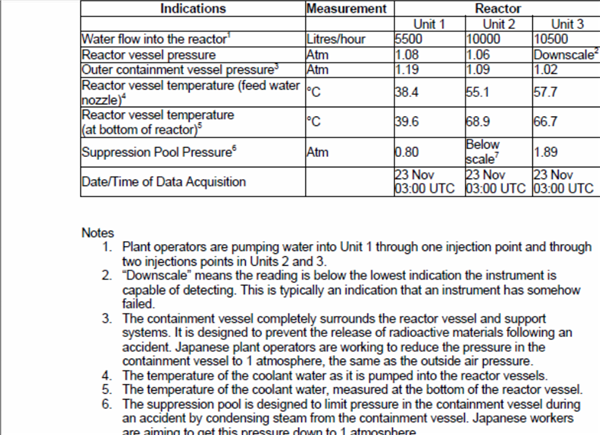
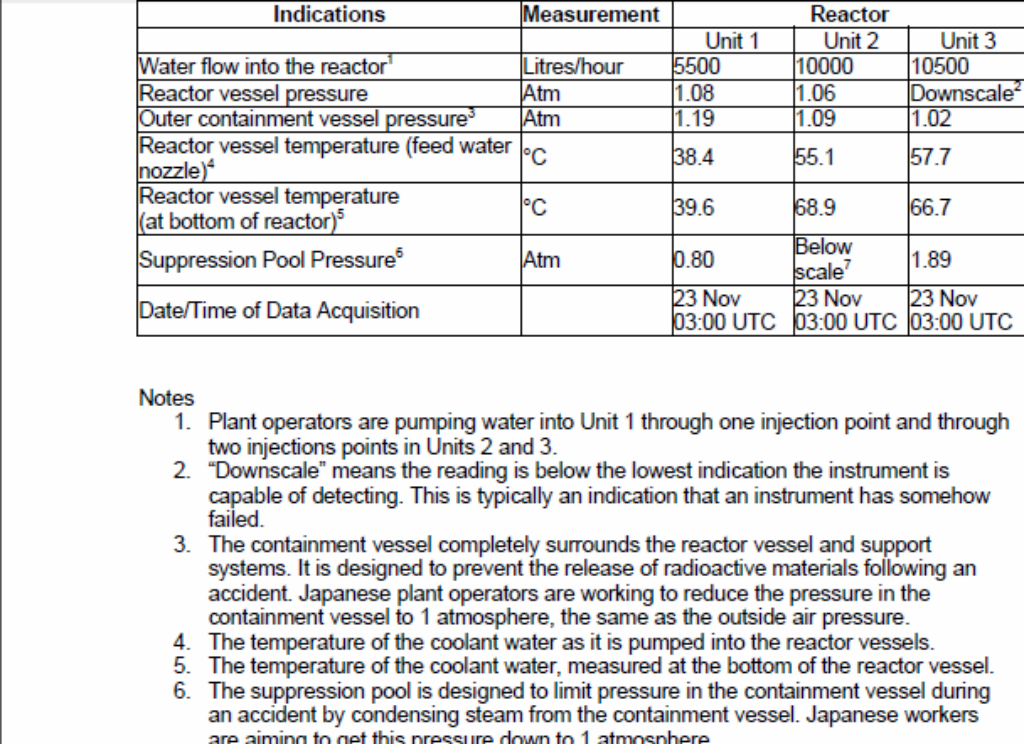
@All OT, but I'pics\IAEAgraph.png[/IMG] www.iaea.org
by M.I.A. via I1207.photobucket 12/3/2011 4:19:56 PM- @Pedro Jesus I'm guessing I have maybe 5 years left on my VW before I will trade it in. Hoping by then they have the home storage batteries and charging systems as a package deal with electric cars by then.by lillymunster 12/3/2011 4:20:15 PM
- @M.I.A. could hydrogen production be increasing the pressure? I thought unit 3 would lack pressure over atmosphere due to all the damage?by lillymunster 12/3/2011 4:22:05 PM
- @lillymunster Yes, I think so. The readings from tepco show them all below atmosphere. WTH? Who's right and who's, er, stupid? And I checked to make sure all numbers quoted were at atmosphereby M.I.A. 12/3/2011 4:27:52 PM
- @lillymunster For sure but some car companies have there hydrogen-cell technology more advanced than others and it won't be cheap at first. Hopefully governments will give tax reductions and other financial incentives to make it commercially viable in the short term. BMW will release their Series 7 next year. It is already available for businessmen in some countries. Toyota has recently shown their first hydrogen sedan which they say will be commercially available in 2015. Honda has a few models ready to go commercial as well. The technology is ready; the biggest challenge is to set up a good coverage of available clean hydrogen fuel on the market (hydrogen produced by renewable energy sources).by Pedro Jesus 12/3/2011 4:28:30 PM
- @Pedro, your source www.cancer.org says: But there is no threshold below which ionizing radiation is thought to be totally safe.by Ian 12/3/2011 4:40:17 PM
- @lillymunster And how could I forget Mercedes-Benz! This year they did a world tour with a fleet of their Class B hydrogen mini SUV to show that the technology is ready to hit the market. Unfortunately, energy companies will have a say on how fast we can have hydrogen stations grids ready for the public. It is quite fortunate, though, that the mileage of hydrogen-cell cars is quite good compared to other technologies, even when compared with hybrid models. Far better than electric cars. I think in the near future electric propulsion will be aimed at small city cars whereas hydrogen-cell propulsion will be aimed at long distance vehicles.by Pedro Jesus 12/3/2011 4:40:26 PM
- @Pedro Jesus California is the testing ground for things like this due to pollution problems and population density. I saw a plan somewhere for these sprawling corporate and retail parking lots in the US to be "roofed" with solar panels so people could charge cars for free while shopping or at work as incentive.by lillymunster 12/3/2011 4:41:02 PM
- @Ian It also says other things besides that, regarding my point on early discussions, for example:
"Most studies on radiation and cancer risk have looked at people exposed to very high doses of radiation in the settings above. It is harder to measure the much smaller increase in cancer risk that might come from much lower levels of radiation exposure. Most studies have not been able to detect an increased risk of cancer among people exposed to low levels of radiation. For example, people living at high altitudes, who are exposed to more natural background radiation from cosmic rays than people living at sea level, do not have noticeably higher cancer rates."by Pedro Jesus 12/3/2011 4:43:30 PM - @M.I.A. hard to say. I don't totally trust TEPCO but where is the IAEA getting their info? I know TEPCO is not being totally honest right now about goings on at the plant. They mention as an afterthought and in very vague terms that they are extracting hydrogen out of unit 2. They took the worker exposure report and tucked it in between routine reports the day they presented their analysis report.by lillymunster 12/3/2011 4:43:39 PM
- Re higher-elevation having higher radiation but not a detectable effect on cancer, I thought to google hypoxia longevity to test a theory that low-oxygen might trigger a calorie-restriction-like promotion of longevity and immediately hit evidence to the effect reviewed here ouroboros.wordpress.comby Ian 12/3/2011 4:45:27 PM
- @Pedro Jesus One of the big problems is not being able to sort out other exposure types, smoking, chemical exposure etc. In trying to find internal exposure data everything I read last night mentioned how hard it is to get consistent data on worker exposures from when so many happened back before 1970. So the bulk of the exposed people have patchy data. Then at low levels it is harder to sort out the other factors
They also mention the frustration where one study group will give a conclusion such as internal contamination causes lung cancer, then another study group will show no connection.by lillymunster 12/3/2011 4:45:52 PM - @Ian Yes, there might be (there probably are) other contributing factors, one way or the other that are very hard to isolate. But I point out the fact that a small group of the scientific community has been alerting to the fact that some studies suggest that the LNT model might not even be sufficiently conservative regarding low term exposure to high level radiation. This is of the utmost importance: if the LNT model is not sufficiently conservative in that exposure scenario, we are not doing a good job at protecting nuclear facilities workers that operate in emergency scenarios such as the one at Fukushima.by Pedro Jesus 12/3/2011 4:50:51 PM
- @Pedro, I don't read that as their saying the LNT model does not reflect the reality in all different radiation exposure scenarios. Saying "have not been able to detect" isn't the same as saying "have detected that there is a threshold." It's just as well a way of saying an increase was too low to produce a statistical signal. On the other hand, the statement I quoted was how they closed the issue.by Ian 12/3/2011 4:51:00 PM
- @Ian , hypoxia leads to the formation of free radicals. Not such a great idea!by Peter 12/3/2011 4:51:29 PM
- Iwaki City 1400 rally demanding full compensation for all people and businesses in Futuba and Fukushima
www.fnn-news.comby lillymunster 12/3/2011 4:53:49 PM - @Peter, the bottom line is the biological response. Low-oxygen might trigger life-preserving responses as a low-energy diet does.by Ian 12/3/2011 4:54:21 PM
- @Ian True, I don't argue that. But if you do not have studies that suggest the no-threshold for certain conditions, than you are only guessing that it might apply to any situation. Scientifically, you cannot disregard the possibility that it might not be the case. That's the whole point of my comments on the subject.by Pedro Jesus 12/3/2011 4:54:59 PM
- @lillymunster , as a thought to the five tepco employees with the greatest exposures. One should hope that they are afforded the best possible medical supervision. Even though I am not a great fan of personalized medicine, the employees might benefit from having the genomes sequenced.by Peter 12/3/2011 4:55:11 PM
- @Ian , we ought to check life expectation and cancer rates in people living at high altitudes.by Peter 12/3/2011 4:57:09 PM
- "The annual rate of new melanoma diagnoses in Colorado was 15% higher than the national average from 2002-2006 and was the 13th highest in the U.S." www.epa.gov
Hypoxia may not help.by Peter 12/3/2011 5:05:09 PM - @Pedro, understood!by Ian 12/3/2011 5:05:17 PM
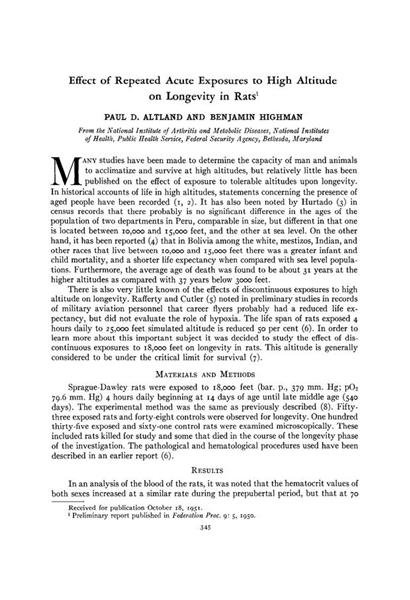
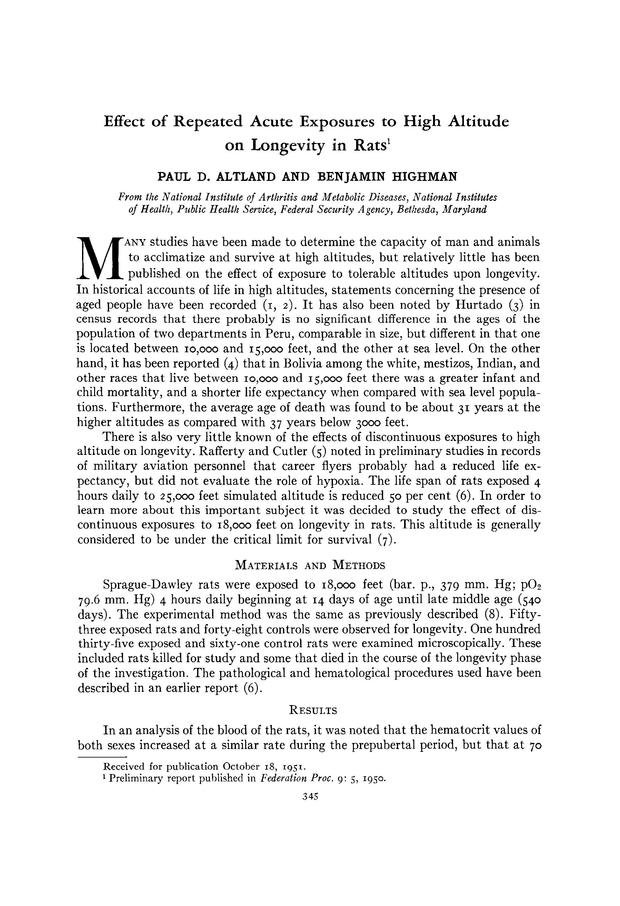
@Peter, here's an interesting paper that reports shorter lifespan at higher elevation ajplegacy.physiology.org Of course so many factors could account for that like harsher living conditions.
by Ian via Ajplegacy.physiology.org 12/3/2011 5:06:44 PM- @Peter I think these high exposure employees would be good candidates for personal medicine or at least a different model of how their care is managed. Right now there is no program to deal with workers post work health needs over time.by lillymunster 12/3/2011 5:26:12 PM
- @Peter, the longevity effect of hypoxia seems confined to specific cell types. Also, 'hypoxia' is not the preferred term for the lower levels of oxygen people experience in mountainous regions. 'Hypoxia' refers to inadequate oxygen levels, whereas we're talking about lower adequate levels.
An interesting fact is it's been recently shown that Tibetans have a genetic trait for survival at higher elevations. www.eurekalert.org This suggests to me that indigenous high-elevation populations are not a suitable model for testing a variable like radiation, which should be tested on non-adapted populations. For example, a study of people living in Ramsar, Iran should isolate the cohort into natives versus recent arrivals who many not have adapted over generations.by Ian 12/3/2011 5:27:07 PM  @M.I.A. @lillymunster : if you want more information about the pressure in the plants, i warmly recommend this: www.houseoffoust.com :)by Edano 12/3/2011 6:21:22 PM
- @Ian , note how short the life expectancy of the Peruvian cohortes was in the study the abstract of which you posted. That must have improved in the half-century since then. Perhaps statistics from modern-day Switzerland would help. I find it interesting that we can observe evolutionary pressures in us.by Peter 12/3/2011 6:48:19 PM
Japan Earthquake | Page 2737
- Who's Blogging
-
 hudebnik
 alblee
 UKVal
UKVal Oliver (ScribbleLive)
 Jonathan Keebler
 Matt (ScribbleLive)
 kaykodh
 PKelley
 Markfm
 dean
dean Angie
Angie- Edano
 Deb
Deb Mid Valley
- Pedro Jesus
 George Gibb
 elainekirk
- lillymunster
 bo
bo IanGoddard