Japan Earthquake | Page 2805
 @Edano I am not sure where all the battery banks are. There are battery banks on the docks for the intake/pump systems. They had one bank start on fire later on so we got pictures of the units. I am not totally sure where the emergency batteries are in the reactor buildings. That is a good question. Are they housed in a stupid location like the generators?by lillymunster 12/22/2011 1:16:26 PM
 They never really knew whether the RCIC was working properly after the suction was switched from the tank to the torus. The performance of the HPCI was also in question. Tepco insinuates that the explosion was somehow linked to its failure.by Peter 12/22/2011 1:17:30 PM
 @lillymunster i think next to the generators. i recall a graphic i saw once.by Edano 12/22/2011 1:18:47 PM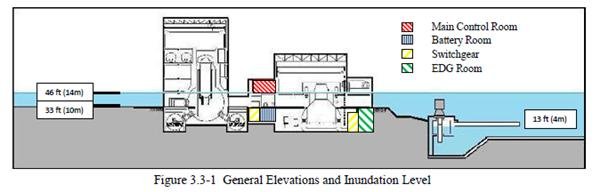
i found it !
by Edano 12/22/2011 1:23:15 PM- the batteries were underwater, like the generators.by Edano 12/22/2011 1:23:41 PM
- So they were able to operate on battery power but the valve batteries didn't work or the battery bank was depleted by then?by lillymunster 12/22/2011 1:25:32 PM
- the graphic is from here: www.nei.org
Special Report on the Nuclear Accident at the Fukushima Daiichi Nuclear Power Stationby Edano 12/22/2011 1:26:34 PM - 3.4 Loss of Power
In the control rooms, as plant equipment and distribution panels flooded, lighting gradually faded and instruments began to fail. Station batteries, which were designed to last for 8 hours, were lost when the flooding grounded or damaged DC distribution systems. The loss of DC power resulted in a loss of all lighting in the units 1-2 control room within 51 minutes after the scram. (Note: Units 1 and 2 share a common control room, as do units 3 and 4.) Normal lighting in the units 3-4 control room was lost, and only emergency lighting remained.by Edano 12/22/2011 1:29:49 PM - The tsunami inundated the area surrounding units 1ƒ{4 to a depth of 13 to 16 feet above grade (4 to 5 meters), causing extensive damage to site buildings and flooding of the turbine and reactor buildings. Intake structures at all six units were unavailable because the tsunamis and debris heavily damaged the pumps, strainers, and equipment, and the flooding caused electrical faults. The damage resulted in a loss of the ultimate heat sink for all units. The diesel generators operated for a short time; but by 1541, the combination of a loss of cooling water, flooding of electrical switchgear, and flooding of some of the diesel generator rooms (located in the basement of the turbine buildings and not designed to withstand flooding) caused a loss of all AC power on site for units 1ƒ{5. (Refer to Figure 7.4-7.)by Edano 12/22/2011 1:31:32 PM
- Three air-cooled emergency diesel generators (EDGs) had previously been installed at the station as a modification (2B, 4B, and 6B EDGs). These EDGs had independent fuel systems and were capable of providing power to vital AC systems following a complete loss of the seawater ultimate heat sink. Furthermore, AC distribution system cross-ties had been installed between units, which allowed power to be transferred among units 1-2 and 3-4 or between units 5-6 for both the 6.9-kV and 480-V distribution systems. The air-cooled EDGs were located above grade, and some of them survived the tsunami. The distribution systems for the Unit 2 and the Unit 4 air-cooled EDGs, which were located below grade, flooded and failed during the tsunami. The Unit 6 air-cooled EDG and portions of the electrical distribution system survived the tsunami and were used to reestablish cold shutdown on units 5 and 6. Figure 7.4-7 illustrates the damage to the electrical distribution system caused by the tsunami.by Edano 12/22/2011 1:32:18 PM
- Units 2 and 3 were relatively stable, with RCIC in operation after the tsunami. However, injection was eventually lost on these units, resulting in core damage.
On Unit 3, following the loss of high pressure coolant injection at 0242 on March 13, approximately 36 hours after shutdown, TEPCO estimates that there was no injection into the reactor for 6 hours and 43 minutes. The core began to uncover at approximately 0400 the second day after the tsunami. Inadequate core cooling resulted in subsequent fuel damage. Conservative calculations indicate that some of the core may have relocated to the bottom head of the reactor vessel, although this has not been confirmed. Core cooling was eventually established when a fire engine was used to inject seawater.by Edano 12/22/2011 1:34:10 PM - back on the 14,000 dead study: Ian found this in the abstract. They are basing that huge number on all deaths, the infant deaths are much lower.
""Projecting these figures for the entire United States yields 13,983 total deaths and 822 infant deaths in excess of the expected."by lillymunster 12/22/2011 1:34:36 PM  "[Portuguese] Government to announce today which bidder will buy EDP's 21,35% share"
German E.on or Chinese Three Gorges are more likely to win the bid. economia.publico.pt
I'll let you know as soon as they release the information.by Pedro Jesus 12/22/2011 1:36:48 PM- @Pedro Jesus will the govt still have a level of control over things?by lillymunster 12/22/2011 1:39:05 PM
- @lillymunster That research paper is plagued with conflicting statements. It doesn't require much effort to debunk their claims. They kind of debunk themselves, lol. I sincerely think they're only looking to get attention into the subject for whatever reason. I don't think they have really found anything.
There will be some guide lines that must be respected. But the Governmental control will be limited from now on. We won't see EDP's administration changing with every elections any longer, which is a good thing, I believe. We have a very strong political faith in the jobs for the boys concept. It's terrible.by Pedro Jesus 12/22/2011 1:41:23 PM - When they privatized things out here I don't think they expected it to be the way it is decades later where the power company bullies the govt oversight. Then again ours could be a situation of govt. complacency that allowed such a relationship to developby lillymunster 12/22/2011 1:48:50 PM
- 6 utilities in western Japan to tie up to expand wind-power generation bit.lyby lillymunster 12/22/2011 1:51:52 PM
- @lillymunster I believe so. In Portugal, the companies that have been privatized so far have been behaving quite well. Most corruption here stems from the political circles. Once these former public companies step away from the political grip they usually become a lot more open, straightforward and law abiding. Our courts keep them on their toes. Courts in Portugal are still quite independent from the political power. Although we have a lot of corruption, it is still under control by the courts. And the situation is likely to get better as more and more corrupt politicians get convicted and sentenced for past corrupt acts. It's a slow and silent but thorough revolution.by Pedro Jesus 12/22/2011 1:57:58 PM
- "Large Hadron Collider team detect 'new particle'" (John von Radowitz) www.independent.co.ukby Pedro Jesus 12/22/2011 1:58:58 PM
- Anyone know a trick to make an RSS feed out of a page that doesn't have one? I found some services that do it, wondering if there is an easier way to do it?by lillymunster 12/22/2011 2:01:44 PM
- @lillymunster I've never figured out how to make RSS work with Google Chrome. I'm absolutely lame on this department.by Pedro Jesus 12/22/2011 2:15:40 PM
- Does anyone have a link to TEPCO's English photo resources page? I can't find my link, only have the JP one for some reason.by lillymunster 12/22/2011 2:18:14 PM
- I used this widget to make a feed for my iGoogle page and it seems to have worked. Now trying to figure out how to get the same feed I made for TEPCO press releases to display on our website.. www.page2rss.comby lillymunster 12/22/2011 2:19:09 PM
- Gourmet nori from Tokyo Bay has cesium in it. ex-skf.blogspot.comby lillymunster 12/22/2011 2:21:31 PM
- i read something the other day that pressure was not checked at one of the reactors the day before it exploded. Anyone remember if that was unit 3?by lillymunster 12/22/2011 2:29:40 PM
- Found more on unit 3, this says there was too much pressure inside containment and the fire pump system could not force water in. It is lower pressure and needs 7 atmospheres or less and the unit had 40 so this says it wasn't valve actuation but pressure failed the pump system. www.yomiuri.co.jpby lillymunster 12/22/2011 2:34:11 PM
- So who is right? NHK says batteries & valves, yomiuri says too much pressure?by lillymunster 12/22/2011 2:46:19 PM
- Maybe NHK just words it in a vague way?
"But the panel says the operators could not pump water into the reactor since there was no power to open the reactor's valves"
Did they really mean the pressure venting valve? We know someone went in to open that soon before the explosion, the guy whose boots melted to the torus.by lillymunster 12/22/2011 2:49:31 PM the goaly kicked a fan, got the red card for it and his team left the stadium. yesterday dutch premier league.
by Edano 12/22/2011 3:04:17 PM- Another oddity. They say that 7 hours later they got the valve open to vent and started the fire pump system at 3. I thought all the vent attempts at unit 3 were thought to have failed?by lillymunster 12/22/2011 3:05:45 PM
- This just says venting happened at 3 on the 13th www.nirs.orgby lillymunster 12/22/2011 3:08:30 PM
- by Edano 12/22/2011 3:09:38 PM
- This sounds like they did get it vented:
Fukushima Nuclear Accident Update (13 March 2011, 12:35 UTC)
Japanese authorities have informed the IAEA's Incident and Emergency Centre (IEC) that venting of the containment of reactor Unit 3 of the Fukushima Daiichi nuclear power plant started at 9:20 am local Japan time of 13 March through a controlled release of vapour. The operation is intended to lower pressure inside the reactor containment.
Subsequently, following the failure of the high pressure injection system and other attempts of cooling the plant, injection of water first and sea water afterwards started. The authorities have informed the IAEA that accumulation of hydrogen is possible. www.iaea.orgby lillymunster 12/22/2011 3:10:37 PM - interesting side note. The worker that vented unit 3 was taken to the hospital for high radiation exposure "One Tepco worker working within the reactor building of Fukushima Daiichi unit 3 during “vent work” was taken to hospital after receiving radiation exposure exceeding 100 mSv, a level deemed acceptable in emergency situations by some national nuclear safety regulators." mitnse.comby lillymunster 12/22/2011 3:18:01 PM
- As to Unit 3, the NISA Sep update to IAEA (pp IV-71) states:
"At 15:38, as a result of the impact of the tsunami, two emergency DGs stopped operating and all AC power was lost due to the drenching/submersion of the cooling seawater pumps, the metal-clad switchgear and the emergency bus of Unit 3.
The inability to use the residual heat removal system seawater pumps meant the loss of residual heat removal system (RHR) functions, resulting in a failure to shift the decay heat in the PCV to the sea, the final heat sink.
However, the DC bus of Unit 3 escaped being drenched. Power was not supplied through AC-DC transfer from the DC bus, but rather the backup storage batteries supplied power to the loads (RCIC valves, recorders, etc.) that required direct current for an extended time compared to those of other units.
Because of the drawdown resulting from the shutdown of the RCIC at 15:25, the RCIC started again at 16:03 and stopped at 11:36 on March 12.
The reason why the RCIC stopped at 11:36 on March 12 is unknown at this time, but the storage batteries for valve manipulation might have become exhausted as more than 20 hours had passed since the RCIC started operation.
Afterwards, the HPCI started automatically at 12:35 on March 12 due to the low water level of the core and stopped at 2:42 on March 13. At that time, the plant-related parameters did not indicate any water level, and so the core coolant injection system stopped as the water level in the core was unknown.
At 3:51, after more than one hour had passed since the HPCI stopped, the power was restored to the water level gauge, which showed that the water level for the reactor fuel was -1600 mm (TAF-1600 mm).
It is thought that the HPCI stopped as a result of the lower reactor pressure."by Peter 12/22/2011 3:34:06 PM - And on pIV-73 re pressure: "The reactor pressure transitioned fairly stably after the scram, but at around 9:00 on March 12, the reactor pressure began to show larger fluctuations. From 12:30 to about 19:00, it decreased by more than 6 MPa.
From around 19:00 on March 12, the reactor pressure was being stable around one MPa, but from 2:00 to 2:30 on March 13, being decreased once and then increased to 7 MPa by around 4:00 on the same day. During the initial stage of this reactor pressure change, the HPCI was working, but by stopping the HPCI. When it stopped, the reactor pressure may have risen suddenly.
Considering that the reactor pressure dropped for more than six hours from 12:30 on March 12, it is considered unlikely that a large-scale pressure leak occurred. Steam may have leaked from the HPCI, since the pressure began to drop at around the same time as the HPCI started and the reactor pressure began rising after the HPCI stopped.
At around 9:00 on March 13, the reactor pressure dropped rapidly down to approximately 0 MPa. This may have occurred because of rapid depressurization resulting from the operation of the major steam SRV."by Peter 12/22/2011 3:38:26 PM - And on countermeasures (pIV-73):
"In order to lower the PCV pressure after the HPCI stopped at 2:42 on March 12, TEPCO carried out wet venting from 8:41 the same day. From approximately 9:25 on the same day, though TEPCO started injecting fresh water containing boric acid through the fire extinguishing system by using fire engines, the RPV water level still dropped. Even taking this injection into account, this meant that no injection had occurred for six hours and 43 minutes since the HPCI stopped. At 13:12 the same day, water injection was changed to seawater.
To reduce the PCV pressure, wet venting was carried out at 5:20 on March 14."by Peter 12/22/2011 3:43:10 PM - Via NRC email:
NRC APPROVES RULE TO CERTIFY AMENDED AP1000 REACTOR DESIGN
The Nuclear Regulatory Commission has voted to approve a rule certifying an amended version of Westinghouse’s AP1000 reactor design for use in the United States. The amended certification, which will be incorporated into the NRC’s regulations, will be valid for 15 years. “The Commission is able to reach this final step in approving the amended AP1000 reactor design due to the staff’s dedicated work ensuring the design meets NRC’s safety requirements,” said NRC Chairman Gregory B. Jaczko. “The design provides enhanced safety
margins through use of simplified, inherent, passive, or other innovative safety and security functions, and also has been assessed to ensure it could withstand damage from an aircraft impact without significant release of radioactive materials.”by lillymunster 12/22/2011 3:54:30 PM - Looks like tepco is nebulous on the reasons for starting and stopping the emergency cooling system at crucial inflection points. Since the news report on events on March 13, the system tepco operators deliberately switched off must have been the HPCI.by Peter 12/22/2011 3:54:46 PM
Fukushima - Total Cost
by MaryW 12/22/2011 3:59:54 PM- @Peter yes, but tepco does not report that it has been stopped manually. it is strange, how can they omit this fact ? this is close to a lie, actually it is the same.by Edano 12/22/2011 4:17:43 PM
- Dec 22, 11:18 AM EST
NRC approves new nuclear reactor design
WASHINGTON (AP) -- Federal regulators have approved a nuclear reactor designed by Westinghouse Electric Co. that could power the first nuclear plants built from scratch in a generation. hosted.ap.orgby MaryW 12/22/2011 4:25:55 PM - Look here on pIV-74: "When TEPCO’s analysis showed that the flow volume of the alternative injection water was low, it resulted in damage to the RPV due to melted fuel. TEPCO has used these results in addition to the existing PRV temperature measurement results to evaluate that the greater part of the fuel has in fact been cooled at the bottom of the RPV.
TEPCO estimated that during this process the reactor fuel was exposed for about four hours from 2:42 on March 13, when the HCPI stopped (about forty hours after the earthquake hit), and two hours later, damage to the core began. Later, as the reactor water level was not able to be maintained around the fuel, flow volume for the alternative water injection was assumed. The decay heat began melting the core and the melted fuel shifted to the lower plenum and then some 66 hours after the earthquake, it started to damage the RPV.
The analysis results show that, along with the damage to the core and the core melt of reactor fuel, the embedded radioactive materials were released into the RPV and moved to the S/C, with the noble gases almost all being released into the environment through PCV vent operation, and approximately 0.5% of the radioactive iodine was released.
Note that TEPCO carried out an additional analysis, which assumed leakage from the HPCI steam system as the RPV and D/W pressures had dropped while HPCI was operating. The analysis results show that the RPV pressure changes and the D/W pressure changes were generally in alignment, but, including the problems with instrumentation, it is not possible to pinpoint the reason the RPV and D/W pressures dropped, nor their current status."
Steam leaking from the HPCI means that the reactor steam-driven turbines turning the HPCI pumps lost torque and the pumps could not deliver the necessary volume of coolant.by Peter 12/22/2011 4:29:19 PM - @Edano , correct, that they thought they could get away with that? Whoever did it must have sought to prevent reactor steam from escaping into the building.by Peter 12/22/2011 4:32:57 PM
- i wonder about their reason to hide this fact. liability probably. but they normally like to blame their workers.by Edano 12/22/2011 4:35:36 PM
Japan Earthquake | Page 2805
- Who's Blogging
-
 hudebnik
 alblee
 UKVal
UKVal Oliver (ScribbleLive)
 Jonathan Keebler
 kaykodh
 PKelley
 Markfm
 Angie
Angie Deb
Deb Mid Valley
- Pedro Jesus
 Matt (ScribbleLive)
 George Gibb
 elainekirk
- lillymunster
 dean
dean bo
bo- Edano
 IanGoddard