Japan Earthquake | Page 2931
 lilly, dead bikini link @ organizeby eyes 1/31/2012 9:43:29 PM
 back greetings to allby dean 1/31/2012 9:49:52 PM
- www.ceus-ssc.com
CENTRAL EASTERN UNITED STATES - SEISMIC SOURCE CHARACTERIZATION
FOR NUCLEAR FACLITIES The Central and Eastern United States Seismic Source Characterization for Nuclear Facilities (CEUS SSC) Project was conducted from April 2008 to December 2011 to develop a new, regional seismic source model for use in conducting and reviewing probabilistic seismic hazard analyses (PSHAs) for nuclear facilities in the CEUS. PSHA is a method for assessing site-specific seismic hazard that includes getting the best estimate of ground motions and a transparent quantitative accounting of uncertainty. The results of PSHA are used in seismic design and in calculating seismic risk.
The CEUS SSC Project was funded by the Electric Powered Research Institute (EPRI), the Nuclear Regulatory Commission (NRC) and the Department of Energy (DOE), and it was conducted using the Senior Seismic Hazard Analysis Committee (SSHAC) Study Level 3 assessment process. The SSHAC process ensures consideration of the full range of knowledge and uncertainties of the larger technical community within a robust and transparent framework. The objective of the CEUS SSC project was to develop an up-to-date seismic source characterization model for the CEUS
by dean 1/31/2012 10:03:55 PM - YET another approach for seismic analyses and request for commercial plants to follow guidelines to re-evaluate probability risk assessmentsby dean 1/31/2012 10:04:42 PM
 An article worth reading [USA]:
"New Quake Risks Seen for Nuclear Plants"
"Nuclear reactors in the central and eastern U.S. face previously unrecognized threats from big earthquakes, [...] upgrading the plants [...] would be costly and could force some to close."
"The NRC plans to give nuclear-plant operators four years to re-evaluate risks at their operations by running complex calculations for all structures, systems and components. " (Rebecca Smith) online.wsj.comby Pedro Jesus 1/31/2012 10:14:09 PM- good article @ Pedro.. this statement made by a risk advisor tells the story, previous upgrades in seismic analyses have indicated that the plants need upgrades to meet more stringent requirements,,, this was done already and the new analyses may push the cart over the clifffor retrofits.. .
If retrofits are required, they will be expensive. "To go back into some of these older plants and deal with seismic issues might end up costing more than the plants are worth," said Stephen Maloney, a partner at Azoulas Risk Advisors in Boston, a consulting firm that often works with the nuclear industry. That could force such plants to close.by dean 1/31/2012 10:19:00 PM - Mr maloney is confessing that older plants have not been upgraded to meet current seismic requirements.. hmmmmmby dean 1/31/2012 10:19:41 PM
 Interesting. NEI was whining about the post Fuku safety changes and hinting they want them weakened or further delayed due to cost. In an article on their website this morning.by lillymunster 1/31/2012 10:20:34 PM
 another quake near Fuku: 4.8
Mercalli scale: 5
Date-Time [UTC]: 31 January, 2012 at 19:35:24 UTC
Local Date/Time: Tuesday, January 31, 2012 at 19:35 in the evening at epicenter
Location: 37° 11.910, 141° 35.160 Fukushima Daiichi Npp 34.57 km
Japan Fukushima Daini Npp 31.81 km hisz.rsoe.huby UKVal 1/31/2012 10:24:27 PM- @lilly.. how did it go today?by dean 1/31/2012 10:27:26 PM
- @lilly, it remains to be seen if the new seismic numbers are lower or higher than the last ones they put out last year.. lots of people were upset over themby dean 1/31/2012 10:28:08 PM
- The article I posted emphasises the significance of the "low probability/high consequence" events. This has been neglected by the nuclear industry and its regulators for far too long. It's time to put an end to this insanity.by Pedro Jesus 1/31/2012 10:28:34 PM
- @dean the NRC meeting today seemed to frustrate everyone who did the webmeeting. Lots of people with relevant concerns and questions on the spent fuel issue but the only people running the meeting were from a team coordinating the projected "scenario" for maybe a solution? They had nobody with core technical knowledge or answers. It was hardly the public meeting it should have been.
So far nothing new I saw on Byron but I was busy following the meeting most of the afternoonby lillymunster 1/31/2012 10:30:15 PM - @Pedro good commentby dean 1/31/2012 10:32:08 PM
- @lilly, I am going to send off a gmail on the seminar and will then get a more detailed email back of expectations..by dean 1/31/2012 10:32:39 PM
- @Pedro Jesus indeed. Peter's article he wrote about current approaches to risk is quite relevant. I don't buy the industry meme that because they think the probability is low it really is. They tend to think a bit too uncreatively at risks. Such as will and earthquake of over 7.0 hit such and such area. When the more important question is what will happen if a set of failures happens like station blackout plus LOCA plus ANY disaster that impedes people and equipment from working.by lillymunster 1/31/2012 10:32:40 PM
- will returnby dean 1/31/2012 10:32:42 PM
- There is a set of issues compounding on the US nuclear industry (and also in some other places) where post Fuku safety changes are considerable and possibly impossible to do. Those changes are expensive. Earthquake reassessment is being done and may require changes, cost or impossible to fix problems. The spent fuel issue has hit a wall where they can't ignore it anymore and are well past the point of unacceptable public safety risk.by lillymunster 1/31/2012 10:35:34 PM
- One thing I got out of the variety of public questions asked today was that the public has a considerable concern about the plan to store fuel at reactor sites vs. a repository.by lillymunster 1/31/2012 10:38:26 PM
NRC BEGINS SPECIAL INSPECTION AT BYRON NUCLEAR PLANT
The U.S. Nuclear Regulatory Commission has started a Special Inspection to review the circumstances around the loss of offsite power that led to a Unit 2 reactor shutdown on Jan. 30 at the Byron nuclear power plant.
The two-unit plant is operated by Exelon Generation Co. and is located in Byron, Ill., about 17 miles southwest of Rockford.
The special inspection team began work today and will look into how plant equipment responded to the loss of offsite power. They will review the sequence of events, evaluate the facts and circumstances, and review the plants actions surrounding the incident. The team will also review the
plant’s evaluation of what happened, their plan for addressing the cause of the event, and the implementation of their corrective actions.
Unit 2 remains in a safe and stable shutdown condition and the diesel generators continue to supply power to the plant as planned for this type of incident. There was a steam release from the non-nuclear side of the plant with trace amounts of tritium. This type of steam release is used by nuclear power plants to release pressure in order to maintain the plant in a stable condition. Doses to the public from this type of release are significantly below even the most stringent Federal protective limits and, therefore, do not pose a risk to public health and safety. The NRC’s special inspection report will be available within 45 days of the inspection’s completion of through the NRC RIII Office of Public Affairs or through the Agencywide Documents Access and Management System (ADAMS) at the NRC website
VIA nrc emailby lillymunster 1/31/2012 10:56:17 PM- This was posted earlier today but worth a re-post
Ministers 'misled MPs over need for nuclear power stations'
www.guardian.co.ukby lillymunster 1/31/2012 11:19:53 PM - @lilly.. we could benefit from our group trying to get procedures etc for recovery from an off site power to bryon to work along with what NRC finds. A major event and it's lasted for a long time, perhaps longer that designed.by dean 1/31/2012 11:23:02 PM
- Environment Minister Rules Out Future For 2 Aging Reactors
e.nikkei.comby lillymunster 1/31/2012 11:23:29 PM - @dean there are some documents on loss of offsite power from NRC. Would Generic Safety issues documents be useful enough?by lillymunster 1/31/2012 11:24:48 PM
- @lilly, they could help.. as far as I know they don't have the power back on yet?by dean 1/31/2012 11:28:06 PM
- status of batteries, problems with operating diesels etc would be good to know from bryon... would be nice to get the daily status sheets somewhoeby dean 1/31/2012 11:28:42 PM
- LOSS OF OFFSITE POWER UPON AN AUTOMATIC BUS TRANSFER www.nrc.gov
Loss of all alternating current power
www.nrc.govby lillymunster 1/31/2012 11:30:28 PM - @dean I tried to find details on byron's emergency diesels this morning via google and didn't score anything. I may try using the PWR type and see if I can find anythingby lillymunster 1/31/2012 11:31:22 PM
- good @ lillyby dean 1/31/2012 11:31:58 PM
- Appendix A to Part 50—General Design Criteria for Nuclear Power Plants www.nrc.gov
Resolution of Generic Safety Issues: Issue 17: Loss of Offsite Power Subsequent to a LOCA ( NUREG-0933, Main Report with Supplements 1–34 ) www.nrc.govby lillymunster 1/31/2012 11:32:18 PM - They are Westinghouse PWR units built in the 1980's by Babcock & Wilcox. I can't find a designation or model though? I assume they would have a more specific model than PWR?by lillymunster 1/31/2012 11:34:35 PM
 Q&A: Illinois nuclear plant loses power. What got vented into the air?
A nuclear plant in Illinois shut down one reactor Monday after a transformer failed. The problem is growing for aging nuclear plants. But in this case, the public was never in danger, officials say. www.csmonitor.comby Majj 1/31/2012 11:37:33 PM- would be nice to get data for BWR's as the plant response to off site power loss is different... overall. the diesels have to supply power to the emergency core coolingby dean 1/31/2012 11:38:08 PM
- @dean looking for details on EDG and other systemsby lillymunster 1/31/2012 11:38:55 PM
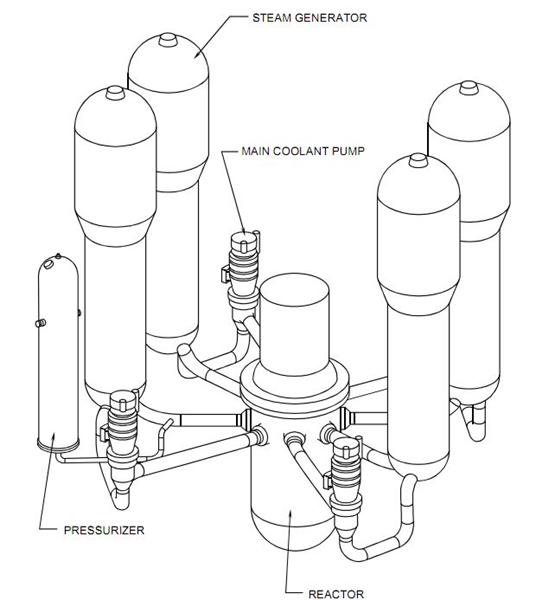
Westinghouse 4 loop PWR like Byron
by lillymunster 1/31/2012 11:39:17 PM- from this document www.nrc.govby lillymunster 1/31/2012 11:39:33 PM

Byron Station, Units 1 and 2
Facility Operating License Nos. NPF-37 and NPF-66
NRC Docket Nos. STN 50-454 and STN 50-455
Subject: Annual Report of the Emergency Core Cooling System Evaluation Model
Changes and Errors Required by 10 CFR 50.46, “Acceptance criteria for
emergency core cooling systems for light-water nuclear power reactors
pbadupws.nrc.govby elainekirk 1/31/2012 11:42:12 PM- spot on @lillyby dean 1/31/2012 11:42:53 PM
- ECCS and diesel generators:
To perform this function of injection of large quantities of borated water, the emergency core cooling systems consist of four separate systems (page 4-25). In order of highest pressure to lowest pressure, these systems are: the high pressure injection (or charging) system, the intermediate pressure injection system, the cold leg accumulators, and the low pressure injection system (residual heat removal). Even though the diagram shows only one pump in each system, there are actually two, each of which is capable of providing sufficient flow. Also, these systems must be able to operate when the normal supply of power is lost to the plant. For this reason, these systems are powered from the plant emergency (diesel generators) power system.
More on cooling and emergency functions here www.nrc.govby lillymunster 1/31/2012 11:42:59 PM - erm this looks extremely relevant www.nrc.govby elainekirk 1/31/2012 11:45:55 PM
- PWRs currently operating in the United States are considered Generation II reactors. en.wikipedia.org
Boron is actively used as part of the control system - details here
en.wikipedia.orgby lillymunster 1/31/2012 11:46:12 PM - NRC detailed document "notebook" specifically on the reactor type at Byron pbadupws.nrc.gov
This may have the generator detailsby lillymunster 1/31/2012 11:49:13 PM - pwr's operate at higher pressure temperatures and take longer to cool down and depressurize...by dean 1/31/2012 11:50:41 PM
- 3 standby diesel generators and total loss of offsite power is listed in the risk asseessment of the document I just posted
Each of the three standby diesel generators per unit has individual fuel oil storage tanks with enough fuel for seven days'. These tanks are
mounted above the diesel generator bays. The fuel oil is gravity fed to the individual engine driven booster pump and to the standby booster
pump.
5. The BOP diesel generator supplies power to instrument air compressor 12 and the auxiliary cooling water pump. On loss of offsite power,
operator action is necessary to restore these components to operation.by lillymunster 1/31/2012 11:50:59 PM - #1 byron water system drawings pbadupws.nrc.govby elainekirk 1/31/2012 11:54:55 PM
Japan Earthquake | Page 2931
- Who's Blogging
-
 hudebnik
 alblee
 UKVal
UKVal Oliver (ScribbleLive)
 Jonathan Keebler
 kaykodh
 PKelley
 Markfm
 Angie
Angie Deb
Deb Mid Valley
- Pedro Jesus
 Matt (ScribbleLive)
 George Gibb
- elainekirk
- lillymunster
- dean
 bo
bo Edano
Edano IanGoddard