Japan Earthquake | Page 2925
 @elainekirk I think it should be a contingency on continued operation of existing plants. Of course the corps running the plants won't like it but they created this mess and didn't bother to deal with it for decades.by lillymunster 1/30/2012 3:49:02 PM
- Spent Nuclear Fuel Dilemma; Strategies Around The World www.simplyinfo.orgby lillymunster 1/30/2012 3:49:50 PM
- We will be live blogging the NRC public meeting on spent fuel disposal policy tomorrow at 1pm CST January 31st.
19:00:00 Tuesday January 31, 2012 in GMT
04:00:00 Wednesday February 1, 2012 in Asia/Tokyoby lillymunster 1/30/2012 4:38:23 PM  Here's a Japanese study on I-131 in sewage sludge : www.journalarchive.jst.go.jp It's mostly in Japanese, but enough is in English to understand key facts like a data table of sludge measures of I-131 going back to 1983. The units are Bq/g, whereas most reports of sewage I-131 I've seen post-Fuku are Bq/kg, so that a thousand times larger volume of sludge. So you'd multiply the measures there by 1,000 to get a Bq/kg measure.by Ian 1/30/2012 5:00:40 PM
- @Ian that sounds like medical waste from treatments...?by lillymunster 1/30/2012 5:02:39 PM
- @lillymunster, definitely!by Ian 1/30/2012 5:27:49 PM
- The data table there only goes up to 1994, so a consideration would be to what extent I-131 medical use may have changed since then. Figure 2 in that study shows "Quantities of unsealed radioisotopes used in hospitals and clinics" between 1983 - 1995, and I-131 steadily increases. So we might assume it's higher now than the data show there.by Ian 1/30/2012 5:32:10 PM
 @all Just popping in to say Hello! Thank You for committing to blogging the NRC meeting tomorrow, I will definately be lurking :-)by smoss 1/30/2012 6:19:04 PM
- @smoss Hi! Good to see you stop by! :-)by lillymunster 1/30/2012 6:24:12 PM
 Hi folks, greetings from SoCal!by bo 1/30/2012 6:52:51 PM
 Radiation Experts Begin Assessment Of Fukushima Nuclear Accident
www.newsroomamerica.comby Panserbjorne9 1/30/2012 6:59:14 PM Radiation fears slow clean-up in Tohoku
"Giant piles of debris from Japan’s earthquake and tsunami ... worries over nuclear contamination mean virtually no one elsewhere in Japan wants the debris processed near them."
www.japantoday.comby VesaVA 1/30/2012 7:02:28 PM- hi BO!
Vesa your on auto nowby lillymunster 1/30/2012 7:02:48 PM - Did those recent quakes do any noticeable damage over the last few days?by bo 1/30/2012 7:06:42 PM

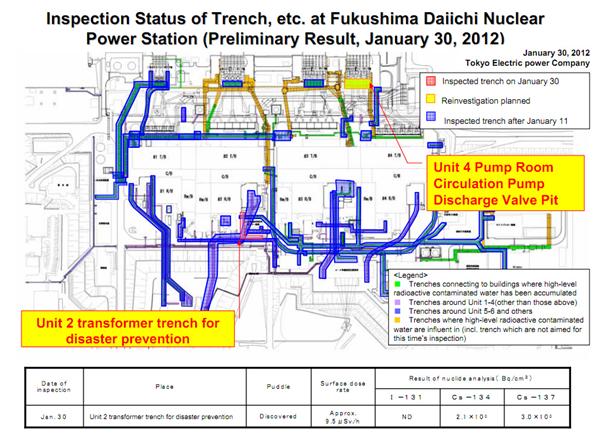
with charts www.tepco.co.jp
by elainekirk 1/30/2012 8:51:21 PM- New Water leaks at Daiichi confirmed since the last batch meaning after 18.00 on the 29th www.tepco.co.jpby elainekirk 1/30/2012 8:53:10 PM
- @elainekirk eep. Are they big/high rad?by lillymunster 1/30/2012 8:58:08 PM
- duno lilly I havent read them yet another here on draining www.tepco.co.jpby elainekirk 1/30/2012 9:00:46 PM
- Looked at them. At least most of the new stuff is filtrate water.by lillymunster 1/30/2012 9:19:49 PM
- Byron nuclear reactor loses power, venting steam...steam contains low levels of tritium, a radioactive isotope, but not at unsafe levels.by MaryW 1/30/2012 10:22:30 PM
- by MaryW 1/30/2012 10:22:58 PM
- link goes with that post on Rockford IL nuke plant's loss of powerby MaryW 1/30/2012 10:23:43 PM
- Shutdown At Exelon Nuclear Plant Near Rockford
January 30, 2012 2:21 PM
BYRON, Ill. (CBS) – Exelon was working to restore operations at a nuclear reactor unit near Rockford, after the reactor went down Monday morning.
Exelon spokeswoman Krista Lopykinski said the problem started at 10:18 a.m. in reactor Unit No. 2 at The Exelon Byron Nuclear Generating Station, located in Ogle County, about 100 miles west of Chicago, near Rockford.
The supply of power from off-site (needed to maintain backup for safety systems) went down, forcing Exelon to take Unit No. 2 offline, according to Lopykinski.
She said the problem is officially described as an “unusual event.”
“This is the lowest of four emergency classifications that’s established by the U.S. Nuclear Regulatory Commission and the reason they did that is because we had loss of off-site power,” Lopykinski said. “Also, our Unit 2 came offline as well.”
LISTEN: WBBM Newsradio’s John Cody reports
Lopykinski said depressurization of Unit 2 has required Exelon to release steam containing tritium – a radioactive isotope – into the air. She said the amount of tritium released was minimal and well within federal limits.by MaryW 1/30/2012 10:26:21 PM - here's the link chicago.cbslocal.comby MaryW 1/30/2012 10:26:58 PM
- @MaryW gosh we have safe levels of tritium do we ?? they been taking lessons from tepco in lying to the public methinksby elainekirk 1/30/2012 10:28:12 PM
- @elainekirk Safe levels of any radiation is BS :)by MaryW 1/30/2012 10:29:15 PM
- I wonder if the venting is the steam release they need to do when they do a scram? I remember we saw that during N. Anna. It isn't the same thing as the venting attempts at Fuku. But why is there tritium in it? I thought that steam should be filtered or out of the "clean" side of the cooling loop?by lillymunster 1/30/2012 10:30:07 PM
- If anyone finds out this was more than the typical shutdown venting please post! Oh and nothing about the back up generators? What about other power lines are they not supposed to have multiple offsite power lines coming in? Does Byron only have 1???by lillymunster 1/30/2012 10:30:51 PM
- @lillymunster Maybe the truth is, all steam contains tritium.? Can a filter make a difference?by MaryW 1/30/2012 10:32:19 PM
- "Officials say engineers are investigating why the unit lost offsite power. Unit 1 continues to operate normally." So they lost all offsite to one unit not the other? How does that happen?by lillymunster 1/30/2012 10:33:33 PM
- Diesel generators began supplying power to the plant equipment and operators began releasing steam from the non-nuclear side of the plant to help cool the reactor abclocal.go.comby lillymunster 1/30/2012 10:35:09 PM
- Chicago winds now are SSW @20-25 mphby MaryW 1/30/2012 10:36:05 PM
- ABC had details: transformer seen smoking. Previous loss of offsite due to transformer in 2008. Byron had issues with back up pumps previously. abclocal.go.comby lillymunster 1/30/2012 10:37:42 PM
- The news broke about 2 hours ago, but the no power occurred at 10:18 am. Quite a delay, don't you think?by MaryW 1/30/2012 10:40:43 PM
- Tritium, an Excelon spokesman said, is formed naturally in the upper atmosphere, is a component of rain and is found in virtually all of the Earth's surface water. It naturally breaks down into helium, said spokesman Paul Dempsey.
Source: www.nbcchicago.comby lillymunster 1/30/2012 10:41:06 PM - @lillymunster Yes, that may be, but this is nuclear tritium, not the natural stuff.by MaryW 1/30/2012 10:42:08 PM
- Here's a blogger's comment posted on Chicago's ABC news article.
'Post A Comment
zawadzki6801
1/30/12 3:16 PM CST
Do not wait, I would leave area now, com-ed government bunch of lairs better safe than sorry they said radioactive steam release is at safe levels.'by MaryW 1/30/2012 10:48:05 PM - :)by MaryW 1/30/2012 10:48:25 PM
- This is not good, I live outside the Quad Cities and Rockford isn't that far away and with winds out of the ssw I would be in the path. Sure hope they get the problem fixed but I did read that NRC is monitoring from their office in Lisile Ilby long time lurker 1/30/2012 10:50:17 PM
 @MaryW Tritium is always tritium, I'm afraid. It's a radioactive isotope of hydrogen, and it is true that it forms naturally in the upper atmosphere when cosmic rays interact with water molecules. However, it is a rare element. But there is no chemical difference whatsoever regarding its nature.by Pedro Jesus 1/30/2012 10:50:30 PM
- 'Naturally occurring tritium is extremely rare on Earth, where trace amounts are formed by the interaction of the atmosphere with cosmic rays.' en.wikipedia.orgby MaryW 1/30/2012 10:50:47 PM
- I posted this about tritium a few days ago: www.scribblelive.comby Peter 1/30/2012 10:51:41 PM
- @long time lurker Close your windows. Its winter and its tritium.by MaryW 1/30/2012 10:52:01 PM
- Here is the text of the comment: As to tritium, I imagine it is difficult to 1) detect tritium at very low activity and 2) to eliminate it from water. The tritium is bound to water and cannot be filtered out. You would have to electrolyze the water and separate the tritium from the other isotopes of hydrogen instead. The method I know to measure tritium is liquid scintillation counting, which entails adding a small amount of the isotope to a scintillation cocktail which is based on organic solvents and can absorb only a small amount. If the radioactivity is low to begin with, you may not be able to add enough volume of sample to the scintillation cocktail to be able to detect the contamination. The tritium problem is not trivial.by Peter 1/30/2012 10:52:46 PM
- @Pedro Jesus thanks, we were in the same mind-set on that oneby MaryW 1/30/2012 10:53:07 PM
Japan Earthquake | Page 2925
- Who's Blogging
-
 hudebnik
 alblee
 UKVal
UKVal Oliver (ScribbleLive)
 Jonathan Keebler
 kaykodh
 PKelley
 Markfm
 Angie
Angie Deb
Deb Mid Valley
- Pedro Jesus
 Matt (ScribbleLive)
 George Gibb
- elainekirk
- lillymunster
 dean
dean- bo
 Edano
Edano IanGoddard