Japan Earthquake | Page 1210
 @Markfm lol!by UKVal 5/16/2011 2:48:17 PM
- @dean hi!by UKVal 5/16/2011 2:48:30 PM
 @dean hiby elainekirk 5/16/2011 2:48:56 PM
 Holy smoke! RPV melt and a side of fried rods. I'm gonna miss all this for the next 60 hours or so (be on the road yet again). Wishing everybody the unfathomable depth of insight and discernment and utter good cheer.by ALBLEE 5/16/2011 2:50:04 PM
 @all, I am going through my batch of TBS cam photos from Saturday looking for more details on #4 leaning etc. I think the tower for 3-4 may have a very small lean to the right, about a 2 degree lean.by Nancy 5/16/2011 2:50:16 PM
 I believe that this thursday the NRC will be briefed on the study of fukushima that was requested with updates 30, 60, and final report 90 days outby dean 5/16/2011 2:50:58 PM
- travel safely Albleeby dean 5/16/2011 2:51:44 PM
- hi elaine & UKby dean 5/16/2011 2:51:59 PM
- @dean - interesting to hear about that briefing -would be even more interesting to see the reportsby UKVal 5/16/2011 2:52:56 PM
- @ALBLEE safe journey & hurry backby UKVal 5/16/2011 2:53:31 PM
- yes UK they should release it and/or we can get it with FOIAby dean 5/16/2011 2:54:23 PM
- @dean back to those control rods January 2011 this is the translation
docs.google.com
this is original doc
translate.googleusercontent.comby elainekirk 5/16/2011 2:54:36 PM - ty elaine.. checking nowby dean 5/16/2011 2:55:10 PM
- 'With offsite power and the diesel generators unavailable, the reactor core isolation cooling (RCIC) systems in Units 2 and 3, and the isolation condenser system in Unit 1, relied on battery power for several hours after the tsunami struck to keep the fuel in the reactors cool. The Unit 1 isolation condenser boiled dry at 4:36 pm on March 11, leading to the loss of ability to cool the reactor. Subsequently the Unit 3 RCIC failed at 5:10a on March 13, and the Unit 2 RCIC at 1:25p on March 14'. I hadn't seen these exact timings before - had you all? source: BRC MEMORANDUM
Date: May 10, 2011
Memorandum for: Commissioners
From: BRC Staff
Subject: Overview of the Accident at the Fukushima-Daiichi Nuclear Complexby UKVal 5/16/2011 2:57:29 PM  Any bets on the new NRC report also being tagged as FOUO, so it's exempt from official release, will take weeks for someone like NYT to get a leaked copy?by Markfm 5/16/2011 3:00:56 PM
- elaine.. that report is something else.. all the testing and checking the cracks and they come out more than one time .. does not pose safety problem.... BOGUS!!!!!!!!!by dean 5/16/2011 3:01:48 PM
- Markfm... NRC has to report to Congressional hearing so we will be able to see it on c-spanby dean 5/16/2011 3:02:33 PM
- and I will try to get a copyby dean 5/16/2011 3:02:39 PM
- @dean I seem to have others maybe blocked pages been unblocked will keep you postedby elainekirk 5/16/2011 3:04:25 PM
- UK that's part of the information I gleaned out,,, however, One thing of interest, when the EQ happened at fukushima it put of service a transformer station which cut out the connection to the electrical grid. This condition lasted for approximately 50 minutes before being restored. After the scram the main steam turbine isolation valves shut which isolated steam to the main turbine and caused it to trip. At this point the electrical facility power that is generated by the turbine and used by various plant systems and instrumentation was also lost.by dean 5/16/2011 3:08:24 PM
- @dean gosh! as the info mounts it's clear there was 1 prob after another. Must have been hell for those working there at the timeby UKVal 5/16/2011 3:10:52 PM
- ty elaine.. a couple of points of interest... commercial plants like to keep operating costs down to shed profits in my opinion.. and, consequently the life of the control rods plays into the expense to operate. there are lifetime limits on the control rods and for hafnium it's about 2.1 x 10 e15 neutrons/cm2.... the connecting rods would also have limits. In the reactor, the rods are exposed to intergranular induced stress due to the interaction with neutrons with the metal usually causing a build up of internal helium which goes on and eventually results in cracking...by dean 5/16/2011 3:11:21 PM
- @dean it is farcical that their kk plant also had problems with those rods I will find thee kk quake '07 report and see if they caused problems because it is at the back of my mind that they failed to fully insertby elainekirk 5/16/2011 3:15:33 PM
- UK VAL.. correct.. imaging you being in the control room for one unit.. and then the control room for 2 units,, and all of a sudden the whole alarm board lites up alarms every where, systems trying to perform their functions with interlocks,, all of which designed to take reactor to safe condition,,, then systems not acting right.. no backup power to some systems.. damage from EQ. Once that scram occured the steam isolation valves closing which takes out the turbine and some of the aux system power supplied by the turbines.. I'm thinking it was all a blurr for several minutes.. .my contention is even with the diesel generators (which by the way have to be cooled by aux water) the diesel didn't last as long as they say.. and then the water level in the reactor reducing quickly and no feed water working.. I'll be surprised if core melt did not start within the first hour.by dean 5/16/2011 3:15:40 PM
- Elaine, control rods typically have whats called a worth curve which is an "S" shaped curve where the first movement of the rod is low in negative reactivity worth but with in the first 1/4 to 1/5 of the length of the safety rods is enough to stop the criticality and take it to sub criticalby dean 5/16/2011 3:17:44 PM
- and there would be "how many rods are necessary" to keep it subcritical.. they account for some failure to have a minimum shutdown margin..by dean 5/16/2011 3:18:20 PM
- the safety rods drive up from the bottom in the BWR's and when they are withdrawn out of the core they typically compress a spring and have a clutch assembly which when released from the scram signal.. quickly drives the rods in the core in less than 4 seconds..by dean 5/16/2011 3:19:51 PM
- the other control rods which drive systems then insert slowerby dean 5/16/2011 3:20:15 PM
- @dean and a stuck valve 'ver the first twelve hours pressure inside the containment structures increased steadily and led to venting from the suppression chamber via the dry containment to the service floor at the top of the reactor building, starting with unit 1 early on Saturday 12th, where pressure had reached twice the design level (over 750 kPa in PCV compared with 'maximum' 430 kPa - both gauge pressures). This would damage pump seals and in addition the safety relief valve on the main steam line from the RPV in unit 1 stuck open. Inside unit 1 water levels dropped dramatically early on 12th, exposing fuel, and this was addressed by pumping seawater into the reactor pressure vessels (RPV) using external pumps brought to site, starting with unit 1 at 8.20 pm on 12th. This was apparently via the Low Pressure Coolant Injection System, connected into the RHR system'. !!!!!http://www.world-nuclear.org/info/fukushima_accident_inf129.html>by UKVal 5/16/2011 3:21:27 PM
 I believe #4 is steamingby Veenie 5/16/2011 3:21:32 PM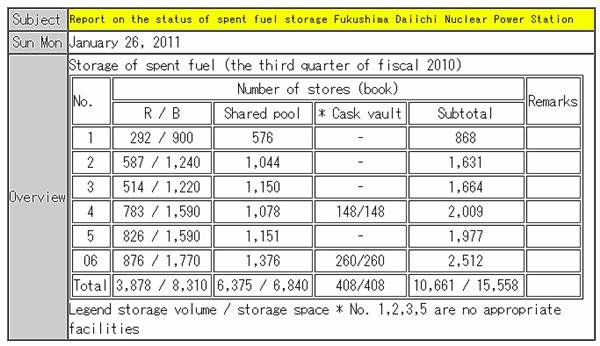
oopsadaisy they had their inspection on the 10th March had the work been completed and casks moved in ? Approval of the construction plan of Unit 4 Fukushima Daiichi Nuclear Power Station (additional spent fuel dry storage containers) December 27, 2010 There's application dated October 22, 2010, pertaining to the expansion plans for the construction of a spent fuel dry storage containers, Unit 4 Fukushima Daiichi Nuclear Power Station Tokyo Electric Power Company, an Electricity Business Act, Article 47 Pursuant to the provisions of Section 12 to 27 approved 2010. [Contact] NISA Division of Nuclear Safety Review ,3501 -6289 (direct) translate.google.com
by elainekirk 5/16/2011 3:22:28 PM @dean: What is the maximun Temperature a reactor vessle can experience for an extended period of time and maintain its integrity?by DonnerT 5/16/2011 3:23:12 PM
- @Veenie 4 does appear to be steaming.by Nancy 5/16/2011 3:25:44 PM
- @elainekirk interesting 'the expansion plans for the construction of a spent fuel dry storage containers, Unit 4 Fukushima' I wonder where exactly & whether this work was still going on at the time of the quake? ( as well as the shroud work)by UKVal 5/16/2011 3:28:18 PM
- Donner trying to dig up my design specsby dean 5/16/2011 3:28:35 PM
- @uk val the doc shows it as having 148 dry casks in store at #4 here is the doc I got it from
translate.googleusercontent.com
yet again tepco have sought permission retrospectively it would seemby elainekirk 5/16/2011 3:35:33 PM - Donner,,, I'm having trying to locate the accident analysis for the max vessel temp... the normal ops temp is around 550Degrees F,,,the trip level would be probably 125% above that and the design temp 150% above that however, even at the design temp it's not an instantaneous failure.. .and, there are other temp limits on the fuel which would probably be reaced firstby dean 5/16/2011 3:39:30 PM
- @elainekirk I want to make sure I am understanding right. Is this some sort of additional cask storage AT #4 or wanting to offload rods in #4's SFP into existin cask storage?by Nancy 5/16/2011 3:42:10 PM
- one thing on the temps on the RPV analysis is the melting point of the carbon steel vesselby dean 5/16/2011 3:45:39 PM
- @elainekirk I don't understand -what they were doing - why was #4 suitable but not the others? why not expand the on site dry cask storage facility?by UKVal 5/16/2011 3:49:11 PM
- @nancy it was a done deed as in december they had casks in storage it appears their storage was discovered in the autumn as #4 was stopped foor its overhaulby elainekirk 5/16/2011 3:49:13 PM
- erm #6 has some and I think #5 is in line just trying to clamp my jaw in position to lookby elainekirk 5/16/2011 3:50:50 PM
- Donner.. I am going to post one of the analyses which I am using to try to estimate timelines to failure, it is assumed for a mark 1 reactor pressure vessel and talks of steel melting point
temps approx 1775 kelvin = 2735.33 degree Fahrenheitby dean 5/16/2011 3:52:20 PM - www.osti.gov one of the resource documents I am using.. a very interesting read close to what happened at fukushima reactorsby dean 5/16/2011 3:53:06 PM
- 'The central fuel storage on site near unit 4 has a pond about 12 x 29 metres, 11 m deep, with capacity of 3828 m3 and able to hold 6840 fuel assemblies. Its building is about 55 x 73 m. (There are 6375 assemblies in the undamaged central pool storage on site, with very low decay heat, and 408 in dry cask storage - utilized since 1995 for used fuel no longer needing much cooling.)'by UKVal 5/16/2011 3:53:16 PM
Japan Earthquake | Page 1210
- Who's Blogging
-
 hudebnik
 alblee
 UKVal
UKVal Jonathan Keebler
 Oliver (ScribbleLive)
 kaykodh
 Markfm
 Angie
Angie Mid Valley
 Matt (ScribbleLive)
 George Gibb
- elainekirk
 PKelley
 lillymunster
 dean
dean bo
bo Edano
Edano Deb
Deb Pedro Jesus
 IanGoddard