Japan Earthquake | Page 1357
 @Angie That's the trouble. But it should be a big radioactive pool down there.by Rob in SF 5/24/2011 9:21:48 AM
 @rob - er pool of what exactly?by hudebnik 5/24/2011 9:22:44 AM
 @Rob in SF Should be........But do they have any idea on how much water they have down that far?by Angie 5/24/2011 9:22:54 AM
- @hudebnik Sea water. And Corium.by Rob in SF 5/24/2011 9:23:03 AM
- My theory about the flash was that some sort of release of high radioactivity caused a corona in the steam-heavy air above the plant - it turned out to be a 'big steam' night. The
video @deb grabbed is especially mesmerising, especially viewed on a tilted LCD screen.by hudebnik 5/24/2011 9:24:40 AM  If fuel is in fact leaking through into areas like this, how will they stop the whole issue with hydrogen buildup?by Rexz 5/24/2011 9:24:44 AM
- Well the outer building are like sieves but I suppose something could happen in one of the lower galleries if H2 gets trapped. Hence the N2 I suppose.by hudebnik 5/24/2011 9:26:14 AM
 AlJazeera picked it up :
Tepco confirms extra reactor meltdowns: Operator of Fukushima Daiichi plant says fuel rods at three of the plant... aje.meby Veenie 5/24/2011 9:28:46 AM- Good night.....by Veenie 5/24/2011 9:29:29 AM
- OK chaps taking a coffee and eye break for a while. If you get a chance to look at the flash stuff on the wiki I'd be very interested in your thoughts. See you later.by hudebnik 5/24/2011 9:29:47 AM
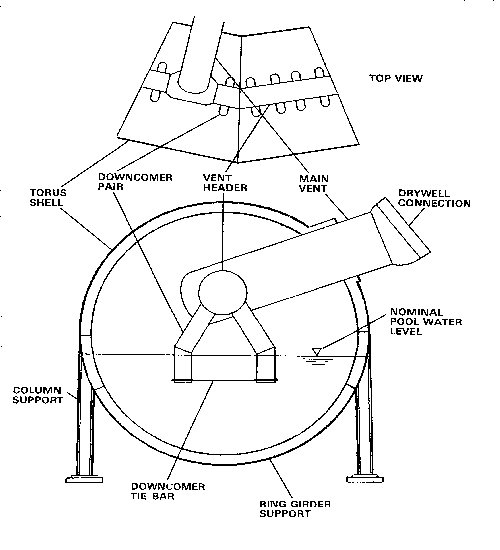
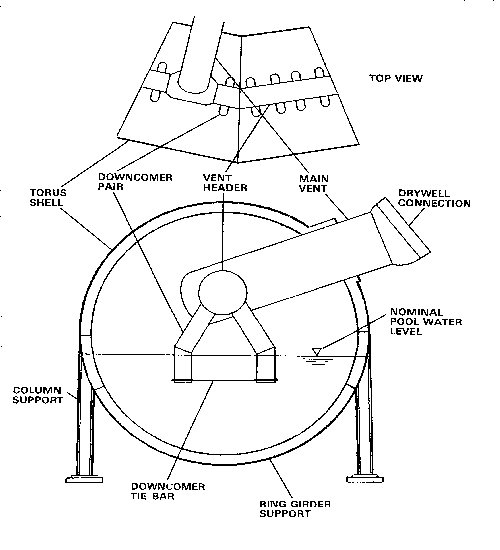
Wish I had a better idea of how they engineer the D/W end mouth of the vent...
www.nrc.govby Rob in SF via Nrc.gov 5/24/2011 9:30:51 AM- Night Veenie sleep well!by Angie 5/24/2011 9:30:58 AM
- @Rob I heard they used a number of things like, masking tape, cardboard tube, bottle tops and PVA glue. Lets hope it holds!by Rexz 5/24/2011 9:34:08 AM
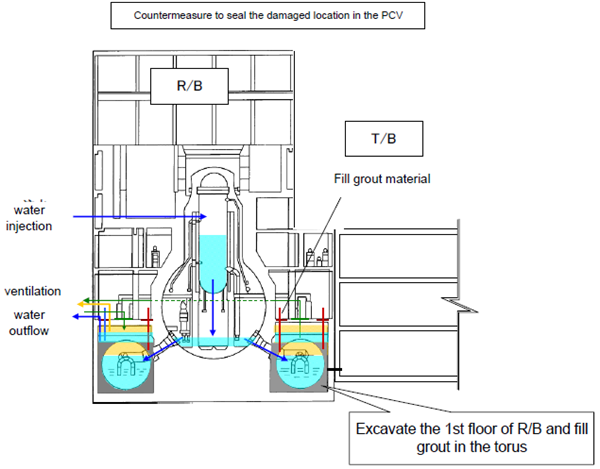
They should use Gorilla Glue.
atomicpowerreview.blogspot.com
4.bp.blogspot.comby Rob in SF via 4.bp.blogspot 5/24/2011 9:36:12 AM Hope they've got enough duct tape too!by Ian 5/24/2011 9:38:15 AM
 Toyota just stuck a spanner in the PR machine NHK and KYODO are complicit in
(Reuters) - Toyota Motor Corp (7203.T) denied media reports on Tuesday that its vehicle production in Japan would recover to 90 percent of pre-quake levels in June, higher than the 70 percent it had flagged on May 11.
www.reuters.comby elainekirk 5/24/2011 9:39:38 AM- @Ian And Trench Plugs.
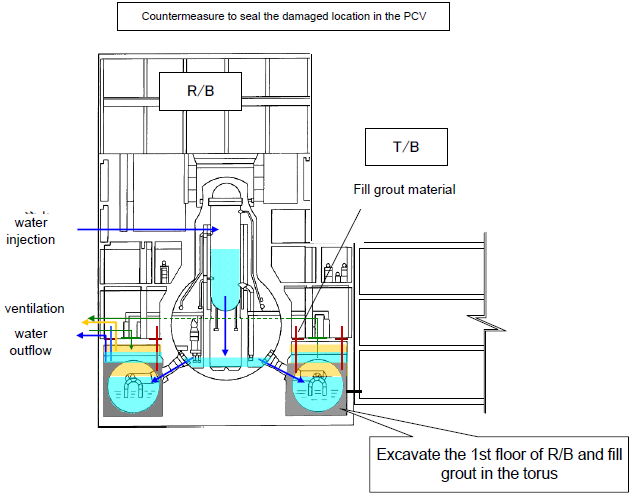
(Tepco).jpgby Rob in SF 5/24/2011 9:44:52 AM 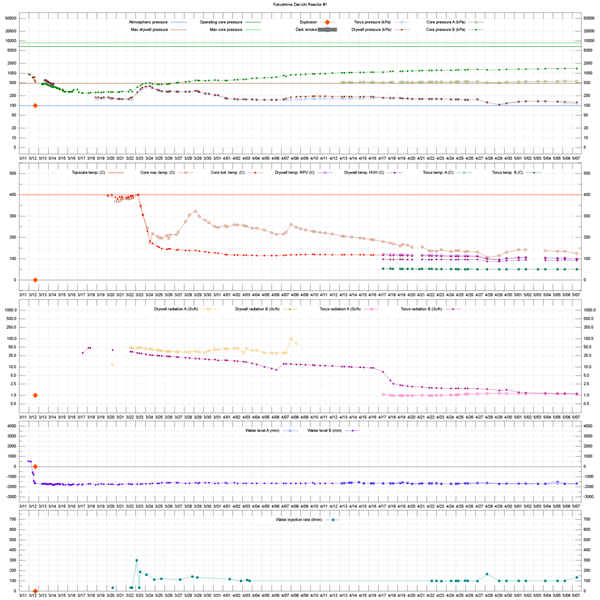
Wish Stolfi would update the excellent chartage...
www.ic.unicamp.brby Rob in SF via Ic.unicamp.br 5/24/2011 9:45:48 AM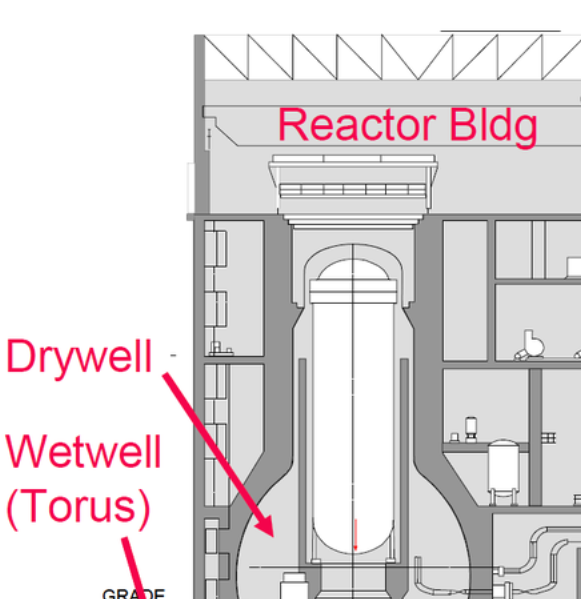 by Rob in SF via Lh4.googleusercontent 5/24/2011 9:54:52 AM
- However, there are several reasons why the containment overpressure may not be available. The accident scenario outlined above involves a pipe breaking inside containment. The energy released from that broken pipe pressurizes the drywell first and very quickly thereafter heats up the suppression pool water. Assuming no other complications, containment overpressure is virtually guaranteed because its arrival precedes that of the warmed suppression pool water.
Other possible accident scenarios yield different outcomes. One such scenario involves a stuck-open relief valve—a very real part of the very real meltdown at the Three Mile Island nuclear plant. When a safety/relief valve opens, energy "bypasses" the drywell to flow directly through the vent system into the suppression pool water in the wetwell. The suppression pool water gets heated before the drywell gets pressurized. Containment overpressure is definitely not guaranteed for this scenario.
www.ucsusa.orgby Rob in SF 5/24/2011 9:55:31 AM - During a recent refueling outage at Nine Mile Point Unit 1 (NMP1),
unanticipated standing water was found inside the vent header/vent line (VH/VL) spherical
junctions (vent system low point or “bowl”). The weight of this standing water inside the VH/VL
spherical junctions was not included in the generic Mark I containment accident analysis
because the spherical junctions are assumed to remain dry. This standing water inside the
VH/VL spherical junction increases the thrust loads on the vent system. The primary concern is
that this standing water will increase vent system thrust loads during reactor blowdown after a
loss-of-coolant accident inside containment beyond design limits.
www.nrc.govby Rob in SF 5/24/2011 9:58:30 AM - they know damn well about the junction problem even I have read the paper on it!! it also highlighted the fact that each point along the vent pipe that has a support clamp also creates problems. Tepco kept an outdated vent system in place and the world is now paying for their penny pinching greed
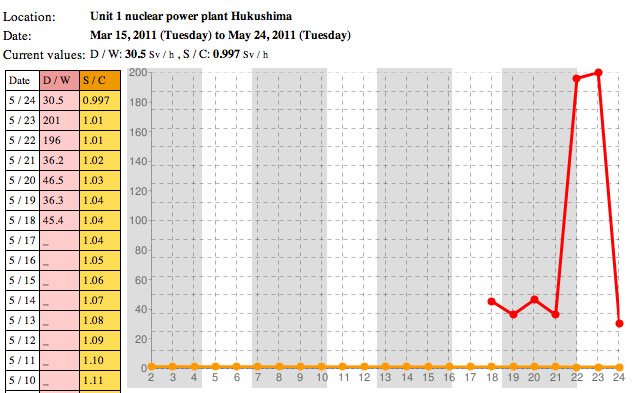
#justmyopinionby elainekirk 5/24/2011 10:03:33 AM  New data now showing that the 201 Sv has dropped back down, and now they say it was the drywell, not the suppression chamber. If I'm reading it right... webcache.googleusercontent.comby bojack54 5/24/2011 10:09:01 AM
- Same thing, different URL: atmc.jpby bojack54 5/24/2011 10:11:01 AM
- @bojack54 Pretty bizarre peak reading I dare say. Wonder what is up wit' dat'.by Rob in SF 5/24/2011 10:15:52 AM
- It certainly looks as if something happened. TBS camera a nice blue tonight rather than pink.by hudebnik 5/24/2011 10:18:30 AM
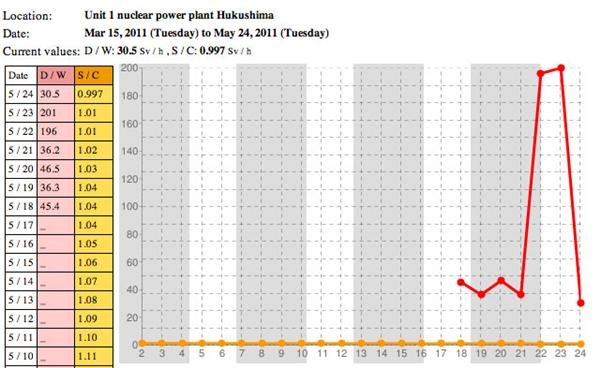
It's bizarre...
gallery.me.comby Rob in SF via Gallery.me 5/24/2011 10:20:40 AM- Corium burp?by Rob in SF 5/24/2011 10:23:17 AM
- fart more likeby hudebnik 5/24/2011 10:23:39 AM
- ANyone know what the rad level in Sv would be in a working reactor?by hudebnik 5/24/2011 10:24:14 AM
- @angie how long are you here for? anymore mods around to let lost souls out of mod ? I am having to venture out into the ash cloud shortly though we have bright sunshine and high winds so no ash evident mmm maybe a slight hazeby elainekirk 5/24/2011 10:30:15 AM
- @elainekirk Yeap I am around for another 3 or 4 hrs at least! Hubby's first night shift so I wont sleep very well lol So this will be on for a while.........by Angie 5/24/2011 10:30:54 AM
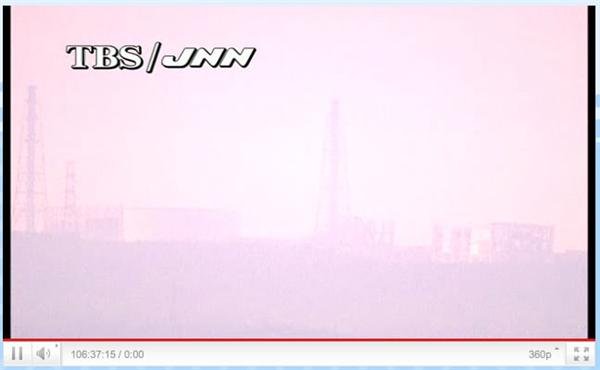
@hudebnik Dude, your Live Webcam FLASH page is freaking me out!
fukushimafaq.wikispaces.com
fukushimafaq.wikispaces.comby Rob in SF via Fukushimafaq.wikispaces 5/24/2011 10:32:13 AM- @all - these are Tepco's latest figures for #1, and they show a 9-fold increase in radiation in the suppression chamber (right hand columns) www.tepco.co.jp Can anyone please translate an entry like 9.99E-01 Sv into a straightforward figure?by hudebnik 5/24/2011 10:33:17 AM
- @rob, they freaked me out a while ago!by hudebnik 5/24/2011 10:33:31 AM
- We missed the initial flash which was brighter and white.by hudebnik 5/24/2011 10:34:01 AM
- Tippycam is probably a day/night camera using an IR cut filter. Various links below:by jt 5/24/2011 10:34:02 AM
- Tippycam is probably a day/night camera using an IR cut filter. Various links below:
www.electronics123.com
IR cut filters are great for day time images, because the sunlight does not cause a pink hue in the image. However they do not work at night because it blocks out light from an IR light illuminator. The same it true in reverse, without a IR cut filter the night time images turn out very good but the daytime images have a pink discoloration. This cut switch allows the IR filter to be turned on and off. The IR Cut Switch filters out intensive light to create more beautiful and natural image color in either day or night.
dpfwiw.com
dpfwiw.com
Infrared (IR) basics for digital photographers
www.davidkennardphotography.com
More on the Fuji IS-Pro and infrared photography
www.moretonalarms.com
DAY/NIGHT CAMERAS
When selecting cameras for surveillance applications there is a third choice available. In addition to standard monochrome and colour there are ‘Day-Night’ cameras.
Day-Night cameras provide a colour picture when there is sufficient light to do so, normally during daylight hours. When light levels fall, the picture reverts to black and white, to take advantage of the inherently better sensitivity performance of monochrome cameras.
Monochrome cameras typically require approximately 1/10 of the amount of light to make a useable picture, compared with a good quality colour camera.
The switching from colour to monochrome at dusk, or from mono to colour at dawn can either be automatic, using the camera itself as a light level meter or it can be controlled via an external photocell or a contact from suitable telemetry equipment.
In order for colour cameras to reproduce colours accurately they are normally equipped with an infrared cut filter. This prevents infrared light getting onto the CCD imaging device.
Natural daylight is a mixture of both visible and infrared light. If a colour camera is exposed to infrared light, the image will be lighter than if it was producing it from the available visible light. Hence colours would appear whitened; red objects would appear pink. Grass, being reflective to infrared light, would appear a pale shade of green.
Not all Day/Night cameras are the same; there are three distinct types.
One does not have an infrared cut filter fitted. Digital or other signal processing is used to compensate and make colours look correct when in day mode. This type of camera has good sensitivity at night and can be used with infrared lighting.
A second choice of Day/Night camera comes fitted with an infrared filter. This gives good colour rendition in daylight, however the camera is not as sensitive as a monochrome camera. The camera is not as sensitive to infrared and cannot be used with infrared illumination. If lighting is required, which is likely given the cameras reduced sensitivity; only visible lighting can be used.
Clearly, it would be appropriate if the infrared filter was in the optical path during daylight to give good colour rendition. It would also be best if there was no filter in place at night so that the camera is as sensitive as a normal monochrome camera, therefore it would be sensitive to infrared light, enabling overt or semi-covert surveillance.
Finally, there are Day-Night cameras, for instance the VCP501 Zoom camera from Videcon, which physically move an infrared cut filter in and out of the optical path to give true colour rendition in daylight, and low light and infrared sensitivity at night.
Because of there different wavelengths, infrared and visible light focuses at different points behind the lens. It is often a problem achieving a sharp image in both day and night modes. When using a standard auto-iris lens on a Day-Night camera, always perform the back focussing at the lowest light levels when depth of field is at a minimum.
The Concept Pro VCP501 is equipped with an auto-focus lens and will automatically give as sharp an image as is possible with which ever type of light is being used, visible or infrared.
www.axis.com
Day & Night network cameras
A day and night, color network camera delivers color images during the day. As light diminishes below a certain level, the camera can automatically switch to night mode to make use of near infrared (IR) light to deliver high-quality, black and white images.
Near-infrared light, which spans from 700 nanometers (nm) up to about 1000 nm, is beyond what the human eye can see, but most camera sensors can detect it and make use of it. During the day, a day and night camera uses an IR-cut filter. IR light is filtered out so that it does not distort the colors of images as the human eye sees them. When the camera is in night (black and white) mode, the IR-cut filter is removed, allowing the camera’s light sensitivity to reach down to 0.001 lux or lower.
www.astro-imaging.de
UV/IR cut filter
Atmospheric Dispersion
An UV/IR-cut filter helps removing the effects of atmospheric refraction / atmospheric dispersion in CCD-imaging. The direction of light as it passes through the atmosphere is changed because of refraction, the direction of refraction is that a sky object apparently moves towards the zenith. The amount of this apparent movement is wavelength dependent, the shorter the wavelength of light the greater the resulting movement so every object actually appears as a little spectrum with the blue end towards the zenith. This effect is called atmospheric dispersion.
CCD RGB Filter Matrix
If we image a sky object with a color CCD cam we usually record Red Green and Blue channels. The color CCD features a filter matrix with R, G and B filters for each pixel to record R;G and B for each final pixel separately (in fact the ICX098BQ CCD of a ToUcam pro has a Bayer filter matrix but we can live with the simple RGB model here...). The R filter lets only red light pass, the G filter green light and the B blue light. Unfortunately the RGB filters let also infrared light pass. Near infrared light and blue light reside on "opposite sides" of the visible light spectrum so they will be moved quite noticiable from each other by atmospheric dispersion. The B sensor of the CCD will record blue light and the shifted near infrared light resulting in an unsharp muddy blue channel or ghost images in the blue channel at worst. The same applies to the green channel with a smaller shift between near IR and green.
Solution
The solution for this problem is an IR-cut filter to block (near) infrared light. The standard lens of a ToUcam has an IR-cut filterfoil on the backlens. If we use the cam in primefocus of a scope we have to use a separate filter like the UV/IR-cut filter from Baader:
www.accuteoptical.com
Optical Filters>IR Blocking Filter(IR cut coating,reflective type)
www.webcamstore.com
The AXIS 232D+ Network Dome Camera is a day/night camera designed for outdoor surveillance and remote monitoring applications. The 232D+ provides 24 hour, high quality Motion JPEG and MPEG-4 video, with pan/tilt/zoom control over IP networks. It features an 18x optical zoom, autofocus lens and a removable IR-cut filter.by jt 5/24/2011 10:34:44 AM - @jt - could well be, norla night pic now.by hudebnik 5/24/2011 10:34:46 AM
- normal!by hudebnik 5/24/2011 10:34:51 AM
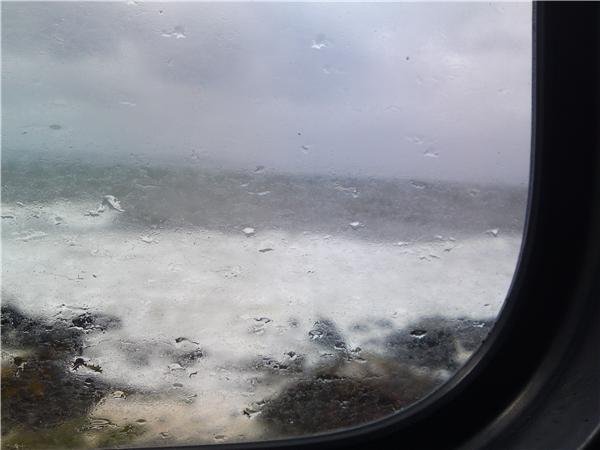
@angie great ty -we now have torrential rain I can see this trip being scarier than yesterdays
by elainekirk 5/24/2011 10:39:50 AM ah yes, fukushima back on top of the news in germany ! congratulations !by Edano 5/24/2011 10:40:26 AM
- @elainekirk Oh dear you be careful!!!by Angie 5/24/2011 10:41:14 AM
- Hi @edanoby hudebnik 5/24/2011 10:42:17 AM
- @hudebnik :)by Edano 5/24/2011 10:42:42 AM



Japan Earthquake | Page 1357
- Who's Blogging
-
 hudebnik
 alblee
 UKVal
UKVal Jonathan Keebler
 Oliver (ScribbleLive)
 kaykodh
 Markfm
- Angie
 Mid Valley
 Matt (ScribbleLive)
 George Gibb
- elainekirk
 PKelley
 lillymunster
 dean
dean bo
bo Edano
Edano Deb
Deb- Pedro Jesus
 IanGoddard