Japan Earthquake | Page 1995
 Disaster management at its worst: over the past three years that's all we've seen from the corporations that run this place. We're seeing that these elaborate, detailed (?), slick, glossy "plans" with letter perfect corporate graphics are worth probably less that the paper they're printed on, given the cost of oil based inks these days.by RadioGuy 7/22/2011 3:17:33 PM
- @lillymunster Remember: In US terms, this area is the Red State area.by RadioGuy 7/22/2011 3:18:30 PM
 @RadioGuy Katrina, BP Gulf, Fukushima. Los Alamos & Ft. Calhoun sort of fit the same flavor of managment, ignore it and bury the data and hope people will go back to watching TV.by lillymunster 7/22/2011 3:18:51 PM
- That was actually general. I had just alrerady clicked lilly and forgot.by RadioGuy 7/22/2011 3:18:52 PM
- @RadioGuy What area?by lillymunster 7/22/2011 3:19:09 PM
- @lillymunster NE Japan. Rural, farming, small shops that contract single jobs long-term from corporate industry located elsewhere...by RadioGuy 7/22/2011 3:20:01 PM
 @lillymunster , the sheer volume IS the problem. I imagine that the Institute in Tokyo may have less than a handful of these counters, which you may be able to take perhaps 400 samples at a time. Each sample needs counting for 10 minutes or more. Then technicians must work the flood of data. They are just not set up for the avalanche (would be the same mess overhere).by Peter Melzer 7/22/2011 3:20:55 PM
- Here, at least, those areas tend to run conservative and
slow to change.by RadioGuy 7/22/2011 3:21:08 PM - @RadioGuy ah, yes and a couple of big industries plop a few factories (or power plants) in the mix for some cheap labor.by lillymunster 7/22/2011 3:21:09 PM
- yepby RadioGuy 7/22/2011 3:21:42 PM
- Oh and fishing. Let's not forget fishing.by RadioGuy 7/22/2011 3:22:51 PM
- @RadioGuy @lillymunster, think of the overloaded bridge in Minneapolis, the gas pipeline near SF with nicks and rusted shut-off valves, the failing relais in the D.C. Metro. Each incident cost plenty lives. Everywhere you look, the country banks on luck. Why should the nuke industry be different.by Peter Melzer 7/22/2011 3:39:52 PM
- I am about to figure out why the operator shut the emergency cooling of Unit 1 off after the quake. RADIATION EMBRITTLEMENT and other wear and tear dictate the rate of temp. a RPV can be cooled down, that is how fast you can cool it without cracking. This rate is re-assessed on a regular basis. The older the RPV, the slower the rate. Unit 1's RPV cooled down too fast. Thus the operator switched the isolation condenser off. In other words, AGE prevented a timely shutdown. You tell me that could not happen with other reactors of this age, ;)by Peter Melzer 7/22/2011 3:48:06 PM
 @Peter Melzer Neat conclusion. Thanks.by es 7/22/2011 3:50:26 PM
 is it possible to exchange an rpv ?by Edano 7/22/2011 3:58:50 PM
- @Edano I thought about that too. I guess it is too radioactive owing to neutron capture and activation. Perhaps if you wait a long time. We should ask Dean.by Peter Melzer 7/22/2011 4:07:38 PM
- if it fits thru the opening, is another question. but i think it was entered there during construction.by Edano 7/22/2011 4:09:33 PM
 @Peter Melzer I thought Soft Shutdown would be the limiting procedural reason for decreasing the rate of temp change. I don't know, but I would think embrittlement fears would be less restrictive than the soft shutdown.by RBeaner 7/22/2011 4:15:07 PM
- @Edano In this case it may have been the RPV embrittlement but who's to say where all the other potentially fatal weaknesses are in such aged equipment? Surely it's not financially viable to renovate everything. Might as well build a brand new one, eh?by es 7/22/2011 4:15:56 PM
- Mongolia is not the only place vying for your nuclear waste these days: "Tennessee Awaits Tons Of German Nuclear Waste" www.npr.orgby Peter Melzer 7/22/2011 4:19:22 PM
- @es at the moment the nuke companies pretend that their nukes are built for eternity. they get prolongations every few years, and not few nukes are around 50 years of age. if there is a risk of material failure in extreme situations, it should be recognized. then they have to be decommissioned or run at lower output.by Edano 7/22/2011 4:19:53 PM
- or maybe it is like the planes: they run til they fa(i)ll.by Edano 7/22/2011 4:21:01 PM
- @Edano TEPCO feasability stusy on RPV replacement www.google.com and a Nuke Eng discussion on it www.neimagazine.comby RBeaner 7/22/2011 4:22:19 PM
- @RBeaner : wow ! i think there is exactly the crane in the picture that they use now !by Edano 7/22/2011 4:24:25 PM
- @Edano I agree. I'm not sure 'extreme' conditions are even required for such dramatic failure. Like you say with planes, old things can and do just fail.by es 7/22/2011 4:24:44 PM
- @RBeaner , I am not sure whether the reactors at Units 1-4 were equipped for soft-shutdown. The possibility was not mentioned in the papers I read so far.by Peter Melzer 7/22/2011 4:25:06 PM
- @es : i once calculated that >33% of all constructed airplanes end in a crash. of course this is not discussed in public.by Edano 7/22/2011 4:27:37 PM
- @Edano Of course not. And we usually have a choice whether to risk boarding a plane :(by es 7/22/2011 4:32:23 PM
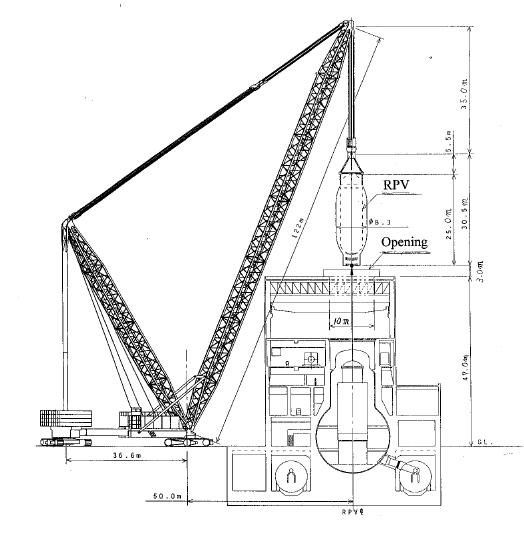 by Edano 7/22/2011 4:36:35 PM
 We do not read about all airplane crashes, but we do read about all large airplane crashes. Boeing makes 32 737's a month, so you are telling me that 10 crash each month?by Ralph Unger 7/22/2011 4:38:31 PM
- @Edano So there is/was an opening in the roof?by es 7/22/2011 4:39:35 PM
- @Ralph Unger , I guess edano was counting small airplane crashes in. Think Alaska!by Peter Melzer 7/22/2011 4:39:40 PM
- 120 737's crashing each year? even small plane crashes make the news and that is because they are relatively rare, 33% crashing? I need a steel umbrella!by Ralph Unger 7/22/2011 4:40:51 PM
- @es , now there will be plenty opportunity to test lifting rumpled rpvs out, ;)by Peter Melzer 7/22/2011 4:41:02 PM
- @Peter Melzer Ooh, what fun!by es 7/22/2011 4:41:30 PM
- by Ralph Unger 7/22/2011 4:41:33 PM
- @es , I would not be surprised, if tepco proposed to put new ones in. After all, we have got to catch up with the profit making.by Peter Melzer 7/22/2011 4:43:42 PM
 @ peter I found a paper the other day dean saw and only six could be shut down by any other method than soft shut down they modified six but others are soft due to thickness of something that was why they stopped cooling in oneby elainekirk 7/22/2011 4:44:44 PM
- Should not there be a standard of posting that requires some documentation or others will challenge it??by Ralph Unger 7/22/2011 4:48:34 PM
- @Peter Melzer Yes, I share such fears, and not just for the Japanese either. I imagine the industry will get increasingly desperate to survive.by es 7/22/2011 4:49:17 PM
 Judge Allows Closure of Vermont Yankee Nuclear Plant
Earlier this week, a federal judge denied a request for an injunction from owners of the Vermont Yankee nuclear power plant to keep the facility online past its deadline to close down when its 40-year contract license expires next year. Although the Vermont Senate voted to deny the company a new operating license last year, the federal Nuclear Regulatory Commission opted to extend the plant’s license for 20 more years, in the days following the Fukushima nuclear crisis.
The heart of the dispute is whether a state has a right to close down a federally permitted facility. An appeal is expected from the Vermont Yankee owners, who are a subsidiary of Entergy Corporation, the second largest nuclear power plant operator in the United States.
The Vermont Yankee plant is one of the oldest in the country and has had a series of radioactive tritium leaks.
Vermont’s attempt to closure the facility marks the first time a state has moved to shut down a reactor in more than 20 years.
The case could affect nuclear policy across the United States as dozens of other aging nuclear plants seek renewed operating licenses in upcoming years.
More: www.democracynow.orgby joniver 7/22/2011 5:30:21 PM- 1999, 12 years ago, tepco investigated the feasibility to replace the rpv in a 800 MW BWR plant, obviously a Mark 1 type .... coincidence ? www.google.comby Edano 7/22/2011 5:41:35 PM
- @Edano that is all they ever do , mutter 'sorry' or 'we are considering'by elainekirk 7/22/2011 5:45:09 PM
 @all I would repectfully submit that @Bobby1 has done a reasonable statistical analysis of Morbidity and Mortality rates, @Bobby1 has then presented a conclusion based on the statistics. Is that conclusion right or wrong? Well that remains to be seen, but @Bobby1 has submitted supporting data....by smoss 7/22/2011 5:52:35 PM
- @elainekirk : was the rpv in #1 damaged before ?by Edano 7/22/2011 5:54:32 PM
Japan Earthquake | Page 1995
- Who's Blogging
-
 hudebnik
 alblee
 UKVal
UKVal Jonathan Keebler
 Oliver (ScribbleLive)
 kaykodh
 Markfm
 Angie
Angie Mid Valley
 Matt (ScribbleLive)
 George Gibb
- elainekirk
 PKelley
- lillymunster
 dean
dean bo
bo- Edano
 Deb
Deb- Pedro Jesus
 IanGoddard