Japan Earthquake | Page 2037
 @Edano the articles the IAEA posted were from World Nuclear Assoc., they seem to have a delusional view of reality.by lillymunster 7/28/2011 10:30:35 PM
 How many assemblies are in Daiichi common sfp?
3.3.6.3. Fukushima Daiichi
The AFR(RS) facility, completed October 1997, has been added to the Fukushima Daiichi
reactor site to overcome a short-fall in on-site storage capacity.
The facility comprises of a 29 m x 11 m pool with a storage capacity of around
12001 HM equivalent to about 6 800 fuel assemblies.
www-pub.iaea.orgby elainekirk 7/28/2011 10:31:14 PM- Playing baseball in the fallout ex-skf.blogspot.comby lillymunster 7/28/2011 10:33:32 PM
 @Elaine So true. It's going to be interesting to see where they end up disposing the waste.by LM 7/28/2011 10:35:27 PM
 @lillymunster
in the Tōkai-mura incident (September 30, 1999), we even have the names of the dead:
- Hisashi Ōuchi, 35, 16 - 20 Sievert, died Dezember 21, 1999
- Masato Shinohara, 40, 6 - 10 Sievert, died April 27, 2000
how can they even dare to lie about that ?by Edano 7/28/2011 10:36:44 PM- @Edano because nuke industry wellbeing trumps human wellbeingby elainekirk 7/28/2011 10:39:06 PM
- 1,500 tons of radioactive sludge cannot be buried
Nearly 50,000 tons of sludge at wastewater treatment facilities has been found to contain radioactive cesium as the result of the accident at the Fukushima Daiichi nuclear power plant. Over 1,500 tons is so contaminated that it cannot be buried for disposal.
Water treatment facilities in eastern and northeastern Japan have been discovering sludge containing cesium.
The health ministry says there is 49,250 tons of such sludge in 14 prefectures in eastern and northeastern Japan.
A total of 1,557 tons in 5 prefectures, including Fukushima and Miyagi, was found to contain 8,000 or more becquerels per kilogram. This sludge is too radioactive to be buried for disposal.
The most contaminated sludge, with 89,697 becquerels per kilogram, was discovered at a water treatment facility in Koriyama City, Fukushima.
The ministry says 76 percent of the roughly 50,000 tons of radioactive sludge is being stored at water treatment plants and they have no ways to dispose of most of it.
It says more than 54,000 tons of additional sludge has not been checked for radioactive materials.
The ministry plans to study how to dispose of the radioactive sludge.
Friday, July 29, 2011 04:35 +0900 (JST)
www3.nhk.or.jpby Edano 7/28/2011 10:48:19 PM - the more interesting question is: how do they prevent the radiation from entering the fresh water systems ???by Edano 7/28/2011 10:49:01 PM
- and how did it enter the facilities ?by Edano 7/28/2011 10:50:09 PM
- @Edano I dont see how they can and they have left it far too long to do anything effective befare autumn #s winds and rain arriveby elainekirk 7/28/2011 10:50:43 PM
- does anyone check the fresh water radiation ?by Edano 7/28/2011 10:51:28 PM
- Oh it is all clear I read that in a iaea doc earlier !?!?!?by elainekirk 7/28/2011 10:52:16 PM
 @Edano How long do you think will take to see a real increase of persons going to hospitals because radioactive relate problems?? Are we looking for months, year or years here? They are eating , drinking, walking,sleeping and breathing Radiation at the moment. How far can it go ???by Majj 7/28/2011 11:03:24 PM
- Take the sludge, make bricks out of it. Build a new TEPCO executive headquarters on site at the plant? That is lots of material to deal with. What are these cities doing with it while it is decided what to do? Treatment facility workers should have dosimeters now also.by lillymunster 7/28/2011 11:03:26 PM
- @Majj : every day people go to doctors who diagnostize cancer. you will only see a statistical rise in detections. these statistics will be made not before the next year and they can be falsified, hidden or downplayed. you may see an increase in death births and an increase of children leukemia.
by Edano 7/28/2011 11:07:29 PM  @Majj How do you know that there is not a real increase in hospital admissions already? Or a real increase in deaths, for that matter?by Bobby1 7/28/2011 11:07:50 PM
- Is this correct ??? A shocking discovery at Fukushima was that zirconium (used as a "transparent" - allowing passage of neutrons - protective cladding around the fuel rods) when superheated can become a catalyst for an esoteric type of nuclear fission. At extreme temperatures, zirconium ignites even the tiniest quantities of airborne nuclear isotopes, releasing "blue lightning". This means that zirconium catalysis could also be occurring underground, triggering mini-fission events. This sort of nuclear reaction is terra incognita, a yet unexplored frontier of physics, the joker in the deck.
Much of the danger comes from simpler processes. Extremely hot magma, consisting of nuclear residues mixed with soil minerals, will boil any sea water seeping underground, creating pressurized steam.Think of oatmeal cooking in a pot and how bubbles create blow holes. The same is happening inside the landfill.
The steam-created tubes harden when they cool, leaving lines of structural weakness. Eventually, these air pockets will collapse, and the massive weight of the water-filled reactors, piles of spent rods and their supporting structures will drop into deep sinkholes.
If the magma tubes become filled with sea water, the landfill will resemble a gigantic sponge, prone to liquefaction and collapse under earthquake motion. Even the resonance vibrations from large machines could trigger the sudden opening of new sinkholes..... www.rense.comby Majj 7/28/2011 11:07:53 PM - @Edano Thanks . Resuming it will be slowly and easy to cover up :-((((by Majj 7/28/2011 11:09:59 PM
- @Majj : yes.by Edano 7/28/2011 11:10:16 PM
- @Bobby1 I imagine there are many . For months I read of kids bleeding theyer noses....by Majj 7/28/2011 11:11:32 PM
- @Majj : we have an interesting effect in south germany : far more boys than girls are born, because the female fetus dies easier of radiation. this is probably a chernobyl effect. south germany was hit hard by the rad cloud.
www.mnn.comby Edano 7/28/2011 11:13:46 PM - @Majj We don't know about increased hospitalizations because it hasn't been reported. We wouldn't know about 24,900 excess deaths in the US either, because it hasn't been reported either except by me. And this is publicly available disease and mortality data.by Bobby1 7/28/2011 11:16:19 PM
- @Majj : the kids were not near enough to the reactor cores to develop a radiation induced nose bleed.by Edano 7/28/2011 11:17:26 PM
- @Edano What, you have to stick your nose in corium to get a nose bleed?by Bobby1 7/28/2011 11:24:32 PM
- @Bobby1 yes it is a symptom of the acute radiation sickness (>500 mSv/hr).by Edano 7/28/2011 11:25:41 PM
- @Edano There have been thousands of tweets and message board posts reporting nose bleeds and other symptoms. Read the Yablokov book, nosebleeds are one of the first signs of internal radiation exposure.by Bobby1 7/28/2011 11:27:04 PM
- @Bobby1 yes, acute, >500 mSv/hrby Edano 7/28/2011 11:27:42 PM
- then you lose your hair.by Edano 7/28/2011 11:28:47 PM
- @Edano It is a result of internal radiation. Hot particles, like in Tokyo and Seattle.by Bobby1 7/28/2011 11:30:27 PM
- @Bobby1 we do know from Chernobyl that immediate effects are not common and it is the long term we need to be aware of.by elainekirk 7/28/2011 11:40:10 PM
- Health Effects of Radiation www.epa.govby Edano 7/28/2011 11:44:07 PM
- @elainekirk The long term is much more important, but immediate (in 4 months can still be considered immediate) effects are not rare.by Bobby1 7/28/2011 11:47:56 PM
 Good morning all. First cup of coffee. You know, we may have radiation here, but we also have most of the world's supply of Blue Mountain coffee.by bo 7/28/2011 11:49:16 PM
- @bo yes please boby elainekirk 7/28/2011 11:49:43 PM
- @bo This is the way to start day. By the bright side :-)by Majj 7/28/2011 11:50:36 PM
- a really nice site on health effects: www.furryelephant.comby Edano 7/28/2011 11:51:38 PM
- @Majj it is though it is my night time almost 1a.m.by elainekirk 7/28/2011 11:59:10 PM
- @elainekirk Better drink hot milk now :-)by Majj 7/29/2011 12:01:41 AM
- Gov't eyes selling shares in NTT, JT in reconstruction efforts
TOKYO, July 29, Kyodo
The government is considering selling part of its shareholdings in Nippon Telegraph and Telephone Corp., and Japan Tobacco Inc. to help finance reconstruction efforts in the wake of the March 11 earthquake and tsunami, government sources said Thursday.
The plan surfaced amid bickering between the government and the Democratic Party of Japan over how to secure funds to be specified under the basic policy guidelines for reconstruction, which the government hopes to finalize on Friday.
The government of Prime Minister Naoto Kan is hoping to use the sale of the NTT and JT shares to cut the size of provisional tax increases proposed by an advisory panel in its draft guidelines.
english.kyodonews.jpby Edano 7/29/2011 12:01:50 AM - @Edano tepco has yearnings for the telephone shares it would be blummin ironic if goj sold them to bail tepco out and tepco bought them to bolster its monopoly of Japan.Incby elainekirk 7/29/2011 12:11:23 AM
- @Majj the other shares tepco wanted were dairy but maybe after contaminating the herds they have put that one on the back burner ...can I drink hot milk with a shot of bo's coffee in it :)by elainekirk 7/29/2011 12:13:17 AM
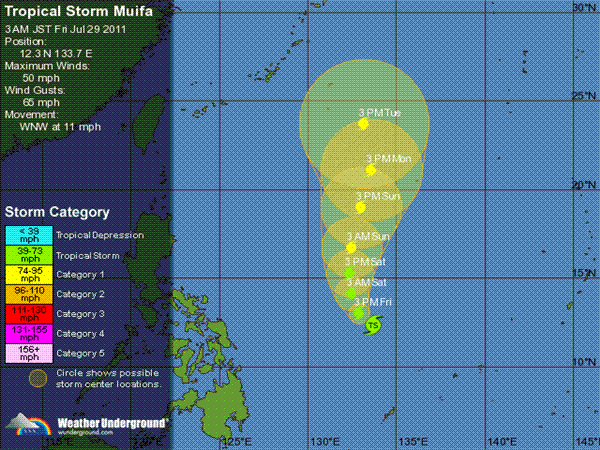
Could be another typhoon coming our way in Japan next week
by bo 7/29/2011 12:36:14 AM- @bo OH NOby elainekirk 7/29/2011 12:39:14 AM
- And this one never gets old. From The Onion the week of the disaster:
Nuclear Energy Advocates Insist U.S. Reactors Completely Safe Unless Something Bad Happens
MARCH 17, 2011
WASHINGTON—Responding to the ongoing nuclear crisis in Japan, officials from the Nuclear Regulatory Commission sought Thursday to reassure nervous Americans that U.S. reactors were 100 percent safe and posed absolutely no threat to the public health as long as no unforeseeable system failure or sudden accident were to occur. "With the advanced safeguards we have in place, the nuclear facilities in this country could never, ever become a danger like those in Japan, unless our generators malfunctioned in an unexpected yet catastrophic manner, causing the fuel rods to melt down," said NRC chairman Gregory Jaczko, insisting that nuclear power remained a clean, harmless energy source that could only lead to disaster if events were to unfold in the exact same way they did in Japan, or in a number of other terrifying and totally plausible scenarios that have taken place since the 1950s. "When you consider all of our backup cooling processes, containment vessels, and contingency plans, you realize that, barring the fact that all of those safety measures could be wiped away in an instant by a natural disaster or electrical error, our reactors are indestructible." Jaczko added that U.S. nuclear power plants were also completely guarded against any and all terrorist attacks, except those no one could have predicted.
www.theonion.comby bo 7/29/2011 12:41:24 AM - The Japan section of this is very interesting not least the fact that in 1999 it was assumed plants reaching the end of their lifespan would shut down the IAEA had a major shift in the intervening few yrs didnt they ~~
IAEA Factors determining the long term
back end nuclear fuel cycle strategy
and future nuclear systems
www-pub.iaea.orgby elainekirk 7/29/2011 12:42:05 AM
Japan Earthquake | Page 2037
- Who's Blogging
-
 hudebnik
 alblee
 UKVal
UKVal Jonathan Keebler
 Oliver (ScribbleLive)
 kaykodh
 Markfm
 Angie
Angie Mid Valley
 Matt (ScribbleLive)
 George Gibb
- elainekirk
 PKelley
- lillymunster
 dean
dean- bo
- Edano
 Deb
Deb Pedro Jesus
 IanGoddard