Japan Earthquake | Page 2036
 Panel's power-shortage estimate at odds with industry ministry's warning [28 July, 2011]: www.asahi.com
"A panel directed by a distrustful Prime Minister Naoto Kan calculated expected power shortages next summer that run counter to the industry ministry's warnings of blackouts if all nuclear reactors are shut down.
The National Policy Unit estimates that power supply will fall short of demand by a maximum 16.56 gigawatts, or 9.2 percent, during peak usage next summer if all 54 reactors in Japan are shut down in May next year."by es 7/28/2011 7:44:25 PM back for a bitby lillymunster 7/28/2011 7:50:14 PM
 @lillymunster wrong link this link www.tepco.co.jpby elainekirk 7/28/2011 7:55:54 PM
- Peter are you lurking?by lillymunster 7/28/2011 8:20:58 PM
- anybody heard of Paks npp ? www-pub.iaea.orgby elainekirk 7/28/2011 8:24:41 PM

Despite assurances by Japanese authorities that radiation levels pose no immediate risk, worried parents living around Fukushima are trying their children to see volunteer doctors at open clinics.
by Majj 7/28/2011 8:25:32 PM- Interesting bits from the MOX article. Talks about how the MOX can cause things to get worse fast. Something I found related to many other aspects of MOX study where the technical issues create a worse scenario. "If significant numbers of fuel failures occur early in the accident, fission products will be released and changes in fuel geometry may interfere with the flow of coolant through the core, ‘Increasing the risk that fuel heat-up will continue until the irreversible core melting and quantitative fission product release occur.’ "by lillymunster 7/28/2011 8:25:52 PM
 @lillymunster, I just returned.
by Peter Melzer 7/28/2011 8:27:23 PM- @elainekirk never heard of it but found a wiki on it. en.wikipedia.orgby lillymunster 7/28/2011 8:29:20 PM
- @lillymunster tyby elainekirk 7/28/2011 8:29:38 PM
- @Peter Melzer the second link in your article on embrittlement isn't working. Can you post the address for the link?by lillymunster 7/28/2011 8:29:44 PM
- Elaine, Paks had an accident a few years back. Too much reliance on Areva was blamed for the events that lead up to it.by lillymunster 7/28/2011 8:32:55 PM
- I grabbed all the Scribd documents from the MOX article Ariadne posted. If anyone wants a copy let me know and I can put them somewhere for download.by lillymunster 7/28/2011 8:41:02 PM
- @lillymunster the doc I posted lists a number of accident risks whilst saying it got a 20yr extension and permission for more reactors onsite e.g it is next to the danube and vulnerable to flooding , also problem with extended power loss ...by elainekirk 7/28/2011 8:47:30 PM
- @elainekirk I saved it in my IAEA file. IT really sounds like Fukushima 2.0 :-(by lillymunster 7/28/2011 8:48:58 PM
- This doesn't make sense. Says a fuel assembly was stuck in one of the Hamaoka reactors for 17 years. The article also says it was in the spent fuel pool.... Anyone have a clue? www.myfoxdc.comby lillymunster 7/28/2011 8:54:09 PM
 @lillymunster
Chubu Electric unable to remove damaged nuclear fuel rod for 17 years
SHIZUOKA, July 28, Kyodo
Chubu Electric Power Co. revealed Thursday it has been unable to remove a spent fuel rod that was damaged in an accident 17 years ago from its Hamaoka nuclear power plant in Shizuoka Prefecture.
While spent nuclear fuel is normally sent to the reprocessing plant in Rokkasho, Aomori Prefecture or elsewhere, the damaged rod remains inside the fuel pool of the plant's now decommissioned No. 1 reactor, in a special container, it said.
The company said it had asked domestic research organizations and foreign nuclear fuel firms to take it but to no avail, and is still pondering how to get the rod outside in the absence of clear government rules on how to dispose of damaged fuel that requires more delicate handling.
english.kyodonews.jpby Edano 7/28/2011 9:03:57 PM- @Edano that makes much more sense.by lillymunster 7/28/2011 9:05:18 PM
- @lillymunster should be quite cool by now ;)by Edano 7/28/2011 9:07:58 PM
- @Edano I would think they could cut around the assembly rack with a torch and pull it out with the small part of the rack still on it. If they put it in a cask alone rather than with other assemblies it should fit. Casks usually hold multiple assemblies. They would just have to make something to hold it.
Or they could hit it with a hammer. :-)by lillymunster 7/28/2011 9:10:16 PM - if it is in a special container, i don't really understand why they cannot remove it.by Edano 7/28/2011 9:10:18 PM
- @lilly, adams.search is a strange link. they asked me for a login this time. The chrome stalled. I'll figure something else out.by Peter Melzer 7/28/2011 9:12:12 PM
- i think it is a translation error. it is not in a special container. they wanted to say usually they are shipped in a special container, i guess.by Edano 7/28/2011 9:13:17 PM
- this is a useful IAEA doc it has all Japans nuke laws, agenciies, international agreements, etc etc webcache.googleusercontent.comby elainekirk 7/28/2011 9:14:46 PM
- @Peter Melzer I have the article ready to go minus the link. Let me know when you determine what you wish to do with that part.by lillymunster 7/28/2011 9:15:58 PM
- what are EAF and UCF ??? www-pub.iaea.orgby elainekirk 7/28/2011 9:22:01 PM
- @lillymunster , I uploaded the doc to my google docs as a share. Here is the link: bit.ly . Please redirect the link. Perhaps it's best to keep another copy somewhere else. It's of extreme historical value, :)by Peter Melzer 7/28/2011 9:26:26 PM
- if you start at page 322 it gives you info on each unit at fuku annual data for each year from 1982 - 2003 www-pub.iaea.orgby elainekirk 7/28/2011 9:33:49 PM
- @Peter Melzer we can use the google docs one for the article. I will download a copy to my archive file. I have been messing with various ideas for an online archive for group/public use.by lillymunster 7/28/2011 9:35:28 PM
- @Peter Melzer Done and live.by lillymunster 7/28/2011 9:38:09 PM
- @lillymunster , that is what I meant. Perhaps one day you may wish to link to a copy in the simplyinfo tree. For the worst case, I always try to provide sufficient info in the text that readers could find the docs by own search.by Peter Melzer 7/28/2011 9:38:41 PM
- @lillymunster , great :) :)by Peter Melzer 7/28/2011 9:39:24 PM
- How to say *uck the public feed em BS for long enough and they will believe you
1) Inevitability of Nuclear Events. First and most elementally, nuclear accidents happen. This is not a
trivial observation. Even as we strive for impeccable management of nuclear facilities, we can never
have confidence that we will succeed absolutely. Nor can we expect the public to believe that we
have. We must concede that human beings make mistakes, individually and collectively.
This in itself is not debilitating. Our problem lies in how this reality is construed. Right now, most
people continue to assume that nuclear power carries the low probability of a highly lethal event.
While Fukushima may offer strong evidence to the contrary, few in the public have perceived it thus.
The future of nuclear energy will rest on fragile foundations as long as the perception of heavy risk
to human well-being remains. Our aim must be to explain to the public that even worst-case nuclear
events are not only extremely low in probability but also increasingly small in consequence as
nuclear technology continues to advance. This is true and must be presented believably.
www-pub.iaea.orgby elainekirk 7/28/2011 9:52:47 PM - this is a blatant lie
If Fukushima were to produce a radiation fatality, it would be
the first ever to occur in the nuclear power history of Japan, America, or France – nations that
account for half the world’s power reactors. Indeed, apart from Chernobyl, WNA is not aware of a
single radiation fatality that has occurred in the entire history of nuclear power, spanning over
14,000 reactor-years of nuclear electricity generation in some 30 nations worldwide. This
impressive truth remains colossally unappreciated by the public and the medi
www-pub.iaea.orgby elainekirk 7/28/2011 10:00:00 PM - @elainekirk LOL OMG.by lillymunster 7/28/2011 10:01:13 PM

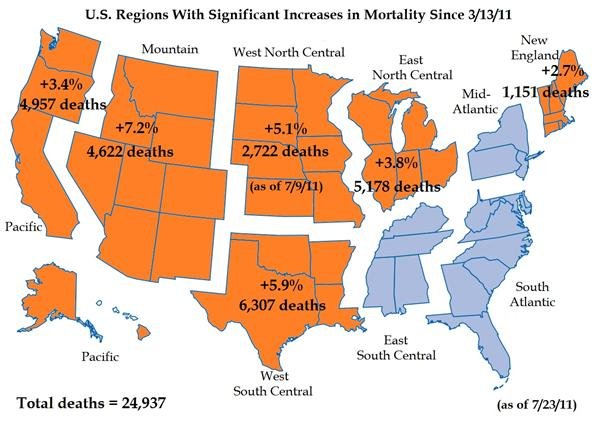
US excess deaths since Fukushima i51.tinypic.com
by Bobby1 via I51.tinypic 7/28/2011 10:01:41 PM- And now Germany is in the firing line! blimey these people act like total pricks behind closed doors
Weak Support Where Nuclear is an Ideological Issue. A fifth reality underscored by Fukushima is
the bizarre weakness of support for nuclear power in a few technologically advanced European
countries. As Europe’s leading economic power, Germany is particularly remarkable. Acting in the
name of environmentalism, Germans will now begin to burn more lignite, coal, and gas, while
reverting when necessary to importing their nuclear power. Inasmuch as Mrs. Merkel leads a party
that strongly believes in Germany’s need for nuclear energy, one feels compelled to ask: What is the
purpose of politics if one discards all principle and logic simply to retain the trappings of powerby elainekirk 7/28/2011 10:05:26 PM - @elainekirk : it is strange: look at the german version of de.wikipedia.org , there are lots of deaths of radiation. if you look at the corresponding english site: en.wikipedia.org , they follow the iaea lies !!!by Edano 7/28/2011 10:08:58 PM
- @Edano sickeningby elainekirk 7/28/2011 10:11:21 PM
- in other words feed children the myth of nuclear safety by controlling what they are told about it
Building real public awareness will require focused educational projects in countries where energy
ministries and nuclear enterprises are prepared to commit resources to strengthen the foundations
on which nuclear power operates. Such projects could prove supremely cost-effective, especially by
employing the multiplier effect of educating educators. Each project would begin with a careful look
at what students are learning, not learning and mis-learning about nuclear power. For any such
project, WNA can provide reliable resource material, but others must adapt and apply it in diverse
social, cultural and educational settingsby elainekirk 7/28/2011 10:14:08 PM  Hi all! Yikes..........1,500 tons of radioactive sludge cannot be buried
Nearly 50,000 tons of sludge at wastewater treatment facilities has been found to contain radioactive cesium as the result of the accident at the Fukushima Daiichi nuclear power plant. Over 1,500 tons is so contaminated that it cannot be buried for disposal.
Water treatment facilities in eastern and northeastern Japan have been discovering sludge containing cesium.
The health ministry says there is 49,250 tons of such sludge in 14 prefectures in eastern and northeastern Japan.
A total of 1,557 tons in 5 prefectures, including Fukushima and Miyagi, was found to contain 8,000 or more becquerels per kilogram. This sludge is too radioactive to be buried for disposal. www3.nhk.or.jpby LM 7/28/2011 10:18:05 PM- @LM and it can only get worseby elainekirk 7/28/2011 10:19:52 PM
- - Los Alamos, New Mexico, Vereinigte Staaten
30. Dezember 1958 – Ein Kritikalitätsunfall ereignete sich bei der Extraktionsarbeit mit einer plutoniumhaltigen Lösung im Los Alamos Scientific Laboratory in New Mexico. Der Operator starb an akuter Strahlenkrankheit. (INES: 4) 1 death
- Der SL-1-Reaktor bei seiner Entfernung von der National Reactor Testing StationIdaho Falls, Idaho, Vereinigte Staaten
3. Januar 1961 – In der National Reactor Testing Station Idaho erlitt der experimentelle SL-1-Reaktor einen kritischen Vorfall mit einer Dampfexplosion und schwerer Freisetzung radioaktiven Materials, bei dem die drei Mitglieder der Bedienungsmannschaft getötet wurden. (INES: 4) 3 deaths
- Charlestown, Rhode Island, Vereinigte Staaten
24. Juli 1964 – In einer Fabrik für nukleare Brennelemente in Charlestown starb ein Mann an einer tödlichen Strahlendosis, als eine flüssige Uranlösung, mit der er hantierte, kritisch wurde. (INES: 4) 1 death
- Leningrad, Sowjetunion
6. Februar 1974 – Aufgrund siedenden Wassers ereignete sich ein Bruch des Wärmetauschers im Block 1 des Leningrader KKW. Drei Menschen starben. Hochradioaktives Wasser aus dem Primärkreislauf zusammen mit radioaktivem Filterschlamm wurde in die Umwelt freigesetzt. 3 deaths
- Buenos Aires, Argentinien
1983 – Durch das Vernachlässigen von Sicherheitsregelungen starb ein Operator während einer Modifikation des Reaktorkerns. Er befand sich nur wenige Meter entfernt und erhielt mit ca. 20 Gy eine tödliche Strahlendosis (INES: 4). 1 death
- Wladiwostok, Sowjetunion
10. August 1985 – In der Chazhma-Bucht nahe Wladiwostok ereignete sich ein ernster Unfall beim Brennelementwechsel des atomgetriebenen U-Bootes K-431.[11] Beim Wiederaufsetzen des Reaktordeckels kam es durch unsachgemäße Handhabung zu einer spontanen Kettenreaktion. Das Kühlwasser verdampfte schlagartig und der Reaktorkern wurde von der Explosion auf die Pier geschleudert. 29 Menschen erhielten hohe Strahlendosen, weitere 10 Menschen starben an einer tödlichen Neutronendosis (INES: 5) 10 deaths
- Gore, Oklahoma, Vereinigte Staaten
6. Januar 1986 – In der Wiederaufarbeitungsanlage Kerr-McGee in Gore, Oklahoma zerbrach ein Zylinder mit nuklearem Material nach unzulässiger Erhitzung. Ein Arbeiter starb, 100 mussten ins Krankenhaus eingeliefert werden. (INES: 2–4) 1 death
- Tōkai-mura, Japan
30. September 1999 – In einer Brennelemente-Fabrik in Tōkai-mura, Japan befüllten Arbeiter einen Vorbereitungstank mit 16,6 kg Urangemisch (statt den vorgeschriebenen 2,3 kg). Daraufhin setzte eine unkontrollierte Kettenreaktion ein und Strahlung trat aus. Die Zahl der Menschen, die erhöhte Strahlendosen erhielten, wird mit 35 bis 63 angegeben. Drei Arbeiter wurden einer besonders hohen Radioaktivität von bis zu 17 Sievert ausgesetzt. Ca. 300.000 Anwohner wurden aufgefordert, ihre Häuser nicht zu verlassen. Dieser Unfall wird von offizieller Seite mit INES 4,[13][14] von einigen Wissenschaftlern aber mit INES 5 bewertet.[15] Der Arbeiter Hisashi Ōuchi, der einer Strahlendosis von mutmaßlich 16 bis 20 Sievert ausgesetzt war, verstarb am 21. Dezember 1999 im Alter von 35 Jahren an Leberversagen. Am 27. April 2000 verstarb mit Masato Shinohara (40) ein weiterer Arbeiter nach langer Krankheit. Er war Strahlung von vermutlich 6 bis 10 Sievert ausgesetzt. 2 deaths
... and more ....by Edano 7/28/2011 10:23:10 PM - @Edano there was a link the other day to deaths in Japan it is most stupid to say none and the same article states there were only 16 deaths after chernobyl
www-pub.iaea.orgby elainekirk 7/28/2011 10:26:57 PM - the iaea is a criminal group of liars with a dwarf moron at the top.by Edano 7/28/2011 10:28:59 PM
Japan Earthquake | Page 2036
- Who's Blogging
-
 hudebnik
 alblee
 UKVal
UKVal Jonathan Keebler
 Oliver (ScribbleLive)
 kaykodh
 Markfm
 Angie
Angie Mid Valley
 Matt (ScribbleLive)
 George Gibb
- elainekirk
 PKelley
- lillymunster
 dean
dean bo
bo- Edano
 Deb
Deb Pedro Jesus
 IanGoddard