Japan Earthquake | Page 2398
 @Edano - no drywell spray until they got AC power and that wold be if it would even work thenby lillymunster 9/24/2011 1:15:20 AM
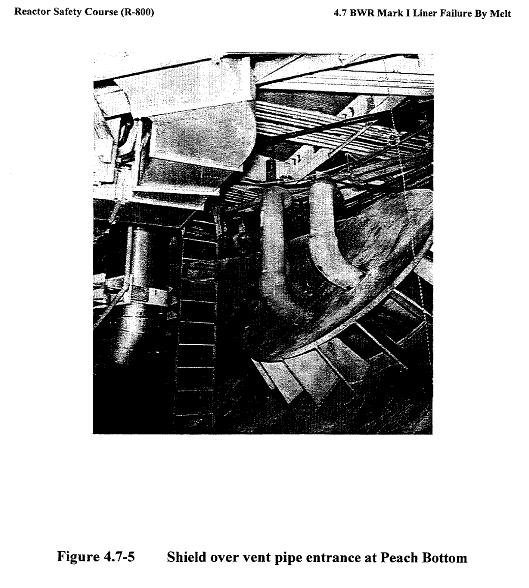
the entrance to the torus
by Edano 9/24/2011 1:15:37 AM @lillymunster eh I didnt see thatby elainekirk 9/24/2011 1:15:57 AM
- it wasn't closed. been posting all the time.by Edano 9/24/2011 1:16:29 AM
- That was very weird I had to restart it too,by lillymunster 9/24/2011 1:19:15 AM
- with a dry drywell there's a good chance for containment failure.by Edano 9/24/2011 1:21:27 AM
- @Edano looking at the vent pipe entrance. Active corium that is splattering and bubbling could easily go in that. It also says that the spot right below the vent is a collection spot for corium and the sand pocket. So many things right there making it prone to failure. IIRC they didn't get AC back until after all the explosions?by lillymunster 9/24/2011 1:22:48 AM
- So could the area where the steel shell is embedded in concrete have the steel melt out and provide a small path for corium to flow down or would that be too thin (2-3inches)?by lillymunster 9/24/2011 1:25:15 AM
- @lillymunster in #2 they established seawater injection by hoses before the explosion. the explosion could have happened when corium dripped into the water in the pedestal and blew the hole in the torus (theory). (?) see diagram further down)by Edano 9/24/2011 1:26:20 AM
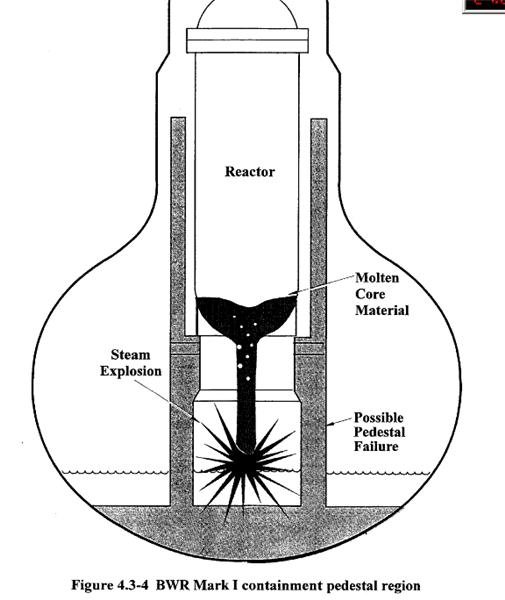 by Edano 9/24/2011 1:27:55 AM
- @Edano I don't know if they could get water into the drywell without power? Firehose connection would have run inside the RPV? So unless the water followed the melted fuel water couldn't get out of the RPV or pedestal?by lillymunster 9/24/2011 1:28:28 AM
- @lillymunster yes, corium would flow into the small steel liner path.by Edano 9/24/2011 1:29:38 AM
- @lillymunster i think the control rod seals were broken in the rpv bottom head, so water could have flown to the pedestal.by Edano 9/24/2011 1:30:37 AM
- twet that may be useful RT @tsukiyominoasa: Pilgrim #Nuclear power plant Cape Cod MA 's reactor is the same type&design as the #Fukushima I GE Mark I which has inherent safety problemsby elainekirk 9/24/2011 1:33:34 AM
- @Edano I don't think water could get past the pedestal. I think we have a water injection schematic somewhere that TePCO put out explaining how they hooked into the water system. If water was on top of the corium and it collected around that edge the water may not have mattered if it wasn't in there first or wasn't enough to not boil off. that document mentions that the transition at the edge of the drywell can rupture
Thus, the shell is subject
to temperature-induced creep rupture at the
locations where it would be heated by
adjoining debrisby lillymunster 9/24/2011 1:33:42 AM - a three
dimensional, finite element, structural analysis
of the Mark I shell in localized contact with
debris, the results of which are documented in
Part V of Reference 3. The debris, which is of
composition (oxidic) and depth (20 cm [8 in.])
corresponding to Scenario I, was assumed to be
covered with water. Containment pressure was
represented as remaining constant at 0.2 MPa
(29 psia). Creep rupture was predicted to fail
the shell at 1533 K (2300 'F), which is about
240 K (430 'F) lower than the carbon steel
melting temperature. This temperature of 1533
K (2300 'F) was then adopted by the Mark I
failure study for use as the best-estimate failure
temperature for the drywell shell.by lillymunster 9/24/2011 1:35:30 AM - well, the doc says it is an important emergency measure to flood the drywell in a meltdown scenario. maybe they found a way to do that at least in #2.by Edano 9/24/2011 1:37:02 AM
- @Edano we should be able to find something if we go dig back in records. Water location and timing seem to be the make or break factors.
Out for a bit.by lillymunster 9/24/2011 1:39:55 AM - TV journalists discuss coverage of Japan disaster
TV journalists from Japan, South Korea, and China have discussed how television covered the earthquake and tsunami that hit Japan on March 11th.
Six TV journalists from the 3 countries had a 3-hour discussion at a symposium in the Japanese city of Sapporo on Friday. About 150 people were in the audience.
An NHK news presenter said he still wonders whether TV broadcasters could have saved more lives during the disaster. He said broadcasters need to keep making programs about the survivors and should consider how best to use the Internet when reporting disasters.
A news presenter from Japanese commercial broadcaster TBS said some reporters on the ground weren't sure whether they should carry on reporting or start helping to rescue people.
A TV producer from South Korea said South Korean coverage of the disaster was dramatic and emotional whereas Japanese coverage was very calm.
Saturday, September 24, 2011 09:09 +0900 (JST)
www3.nhk.or.jpby Edano 9/24/2011 1:41:05 AM - @Edano is that like on page 2 here or is that flooding it is unit 2 www.tepco.co.jpby elainekirk 9/24/2011 1:41:17 AM
- if you look at the 7th slide on here it shows the torus room www.tepco.co.jpby elainekirk 9/24/2011 1:46:07 AM
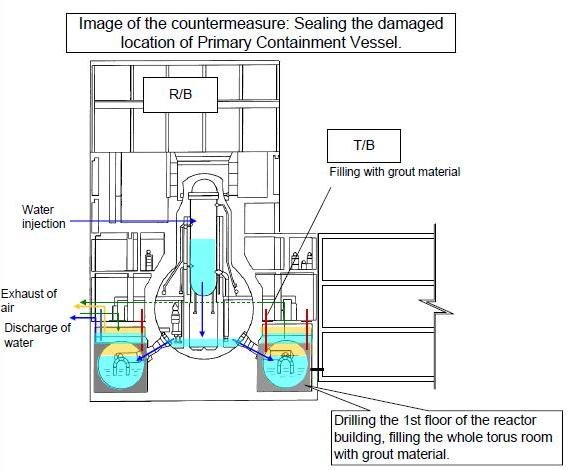
not sure, elaine, if this is planned or already been done at #2 before the explosion.
by Edano 9/24/2011 1:47:15 AM- @Edano I don't believe the grouting has been done but not certainby elainekirk 9/24/2011 1:55:46 AM
- no, the flooding of the containment floor i mean. before the explosion.by Edano 9/24/2011 1:56:53 AM
- @Edano no idea I'm afraid I must sleep will search more in nmorningby elainekirk 9/24/2011 2:00:37 AM
- @elainekirk nightynight.by Edano 9/24/2011 2:00:53 AM
 @Edano , the water level looks like the current situation, I suppose, since there are holes in the RPV, through which the water they inject into it can drain into the space below. I can't recall that tepco ever mentioned using the drywell sprayers. The question remains whether enough water was leaking from the rpv and collecting at the bottom of the drywell, before the fuel core melted through.by Peter 9/24/2011 2:04:07 AM
- @Peter yes, maybe elaine finds something in the docs.by Edano 9/24/2011 2:05:32 AM
- but it's not likely.by Edano 9/24/2011 2:06:01 AM
- @Edano grouting is part of the roadmap and not startedby lillymunster 9/24/2011 3:03:44 AM
- @Edano, there it is!! :)
Whence that ex-vessel stream explosion illustration?by Ian 9/24/2011 3:49:48 AM - @Ian there are all sorts of goodies in that document that lead back to your steam theoryby lillymunster 9/24/2011 3:52:49 AM
- Ah : pbadupws.nrc.gov :)by Ian 9/24/2011 3:53:37 AM
- I found a couple of things that may related to #3's explosions. The yellow containment cap bolts can stretch in the style used at Fuku when heated up. The silicon gasket can fail. So the yellow cap could both still be there and have been the point of exhaust of containmentby lillymunster 9/24/2011 3:54:29 AM
- @lillymunster, sounds great! posted today? I've been buried in house cleaning all day.by Ian 9/24/2011 3:54:40 AM
- Dean posted Monday, been reposting the link periodically so people could catch it. Been reading it off and on in between other things most of the week and taking notes off of it.by lillymunster 9/24/2011 3:55:24 AM
- The other thing was the refueling connection and the underside of the containment cap can concentrate hydrogen under the cap.by lillymunster 9/24/2011 3:56:06 AM
- There was also extensive talk of heating containment including doing so in a flash in certain situations.by lillymunster 9/24/2011 3:56:36 AM
- @lillymunster, so the cap could remain loosely attached and still allow a blast of steam out?by Ian 9/24/2011 4:01:43 AM
- @Ian stretch the bolts and lift up allowing a gap. Sort of like a pressure cooker relief valveby lillymunster 9/24/2011 4:04:13 AM
- @lillymunster, wow, a major detail! A visual analysis I want to do is if you line-up the center of the mushroom cloud, where its peak is highest, it lines up with the well cap, and not the fuel pool. Then, an obvious thing people overlook is just a volumetric consideration of where the heck do you think all this matter that composed the mushroom came from, and centered right over the reactor well?! Then when we ask what could be in the PCV that would produce such a hot cloud, the obvious answer is the tons seawater that was just injected and turned to blazing hot steam in a steam explosion. Imo, the more you think about it, the more this is the inevitable conclusion about what we see.by Ian 9/24/2011 4:16:53 AM
- What would happen if u pumped concrete direct into reactor therefore entombing it?by Tdm 9/24/2011 4:19:37 AM
- @Ian There are lots of details in that document that back up your idea. Direct containment heating, fuel can be made aerosol in the containment in various circumstances and can super heat or flash heat containment.by lillymunster 9/24/2011 4:21:31 AM
- @Tdm depends on where things were in the process in the reactor. Right now there probably isn't much in the metal reactor pressure vessel. Most people are pretty sure it melted out long ago and is either in the reactor basements, part way through the base mat concrete or already out of the buildings.by lillymunster 9/24/2011 4:22:44 AM
- @lillymunster, the NRC document I linked just below?by Ian 9/24/2011 4:26:57 AM
Japan Earthquake | Page 2398
- Who's Blogging
-
 hudebnik
 alblee
 UKVal
UKVal Oliver (ScribbleLive)
 Jonathan Keebler
 Matt (ScribbleLive)
 kaykodh
 PKelley
 Markfm
 dean
dean Angie
Angie- Edano
 Deb
Deb Mid Valley
- Pedro Jesus
 George Gibb
- elainekirk
- lillymunster
 bo
bo IanGoddard