Japan Earthquake | Page 2391
 @Vivre I didn't see your post. I went and scrolled back through to see what you were talking about. Now I see you posted a set of links on Kystym before Crypto did. Very sorry I missed them. I have been popping in and out of the scribble page all day in between chasing the sick dog around the house with a mop and finishing a project for work so I am highly distractable today. Sorry I missed it, I assure you it was unintentional and being a ditz on my part. :-)by lillymunster 9/22/2011 6:14:24 PM
- Added the missed links to the library. If anyone sees Ian today make sure he knows there are a bunch over there if he needs themby lillymunster 9/22/2011 6:18:17 PM
 Oh man nobody's heard this except the nuclear nuts. Much worse than fukushima, says 300 people died outright from the nuclear waste explosion, but ROUTINE dumping of waste has caused all sorts of problems, and this is the first documention I've seen of people actually getting sick or dying from cesium contamination, so anything people can dig up is appreicated before I pronounce fukushima levels of cesium contamination are probably NOT worth shutting down all of northern Japan in a panic over levels of radiation far below levels that cause radiation sickness.
"Inside the Zone" by Alexander Zaitchik. The most in-depth recent report on the history of the Mayak plant and its impact on local communities. (2007)
www.freezerbox.comby artnuke 9/22/2011 6:18:17 PM- here's the wikipedia on that plant. It is STILL reprocessing fuel, and it's still dumping waste to this day. Who knew??by artnuke 9/22/2011 6:19:42 PM
- oops link: en.wikipedia.orgby artnuke 9/22/2011 6:19:49 PM
 @lillymunster :-)
didn't mean to arise stress ontop of you really hard and much appreciate work
(I was simply hit to strong)by Vivre 9/22/2011 6:20:26 PM- @Vivre no worries, just wanted to make sure you knew it was oops on my part not intentional. :-)by lillymunster 9/22/2011 6:20:55 PM
 We Must Cooperate on Nuclear Safety www.nytimes.comby Panserbjorne9 9/22/2011 6:37:19 PM
- nice breakdown of fission elements and the dangers: hyperphysics.phy-astr.gsu.eduby Panserbjorne9 9/22/2011 6:38:33 PM
- what was the name of the site for medical journals that people can't get into, again? i forgot.by Panserbjorne9 9/22/2011 6:44:59 PM
- @Panserbjorne9 JSTORby lillymunster 9/22/2011 6:53:39 PM
 "An accelerated time line floated this week by Japanese authorities for stabilizing the crippled Fukushima Daiichi atomic energy facility is not reflected in an updated schedule issued on Tuesday, the Asahi Shimbun reported (see GSN, Sept. 21)." And in same article, O'Bama (you didn't know he was really Irish? He's got that gift of gab! :) )) hedges away from USA delegate's position at IAEA conference on safety. "Meanwhile, the Obama administration on Wednesday suggested it might in the future support binding international mandates aimed at preventing atomic accidents (see GSN, Sept. 19). The United States successfully helped advocate for the removal of legal mandates from atomic safety reforms proposed at the International Atomic Energy Agency, according to earlier reports." www.globalsecuritynewswire.orgby M.I.A. 9/22/2011 6:59:52 PM
- @lillymunster Thanks Nancy!by Panserbjorne9 9/22/2011 7:08:36 PM
- conclusions:
¹³⁷Cesium Exposure and Spirometry Measures in Ukrainian Children Affected by the Chernobyl Nuclear Incident
"These findings are unique and suggest significant airway obstruction and restriction
for children chronically exposed to low-dose radioactive contaminants"
docs.google.comby Panserbjorne9 9/22/2011 7:27:54 PM  @Panserbjorne9 thank you Panser that is really helpfulby elainekirk 9/22/2011 7:30:42 PM
- @Panserbjorne9 added a link to it in
the libraryby lillymunster 9/22/2011 7:34:15 PM - @lillymunster @elainekirk :)by Panserbjorne9 9/22/2011 7:44:14 PM
- @lillymunster
I now saw you grouped the articles under 'RADIATION EXPOSURE' which seams fairly enough to step into the Kyshtym Disaster on interest. (- so I stop my search now)
But I would like to leave two more findings about Mayak:
- closer dates about the plant and many topografic pictures
Weapons of Mass Destruction (WMD) www.globalsecurity.org
- details about the accident process
Data Analysis and Physicochemical Modeling of the Radiation Accident in the Southern Urals in 1957 www.fas.orgby Vivre 9/22/2011 7:48:04 PM - cesium in chernobyl - possible link to lung problems, bad but hardly supports Busby's cataclysmic numbers: "These findings are unique and suggest significant airway obstruction and restriction
for children chronically exposed to low-dose radioactive contaminants"
docs.google.com
by Panserbjorne9 12:27 PM
consequences to human health are much less than expected
most of the acute effects from the chernobyl incident have been compared with 131 iodine exposures, whereas 137 cs has been the radioisotope of greatest concern for persistent explosures in the affected communities. In many rural villages across the Ukraine and Balarus, people are routinely exposed to 137 cs through their diet of locally grown food that bioaccumulates 137 cs and use of drinking water from shallow, open wells... forest fires and agricultural activities also release radionucllides to the atmosphere as aerosals or attached to dust particles which are then widely transported.
these findings support the hypothesis that long-term exposure is associated with decrements in lung function during child development
thousnds of peasant children are living in and consuming locally grown foods where the soil is still profoudnly contaminated.. hundreds of them may grow up with lungs that are damaged from chronic exposure to the radioisotope. The long term prognosis of these children is poor. Some will probably develop significant respiratory problems as they age.by artnuke 9/22/2011 7:49:07 PM - @Vivre I think I am now much wiser tyby elainekirk 9/22/2011 7:52:11 PM
- @Vivre Myak sounds like the soviet counterpart to Hanford which had its own share of problems. US set up 2 bomb tracks, one for enriching uranium at Oak ridge, and one for brewing plutonium at Hanford. KCTS-9 had excellent documentary on Hanford which I put on DVD. They anticipated these might blow up so they built 3 reactors, far apart, not like fukushima where they are cheeck by jowl. Fortunately columbia river did not suffer same fate as russian downstream towns. It houses the decommissioned trojan reactor that was near Portland.by artnuke 9/22/2011 7:52:51 PM
- @artnuke i wasn't referencing Busby so i'm unclear on rationale of mentioning 'hardly supporting'.by Panserbjorne9 9/22/2011 7:55:32 PM
- @Vivre great info, Vivre.by Panserbjorne9 9/22/2011 7:55:52 PM
- @elainekirk - good to hear
.. 'cos wheren't you envited yesterday to go for a graduation? ;)by Vivre 9/22/2011 7:55:53 PM - Transcript: Speech of Japanese PM Noda at the U.N. Nuclear Safety Meeting www.panorientnews.comby Panserbjorne9 9/22/2011 7:57:03 PM
- 151-nation meeting endorses nuke safety plan www.sfgate.comby Panserbjorne9 9/22/2011 8:07:25 PM
- @artnuke I'm glad you and others have the closer knowledge of the constructions and chemical processes - I can only consider the valuation of these infos and hand them over.
Still I grab your comparison and the good hint about the columbia river.by Vivre 9/22/2011 8:08:42 PM  @Vivre :)by Edano 9/22/2011 8:16:08 PM
- @Vivre found and grabbed your new linksby lillymunster 9/22/2011 8:16:11 PM
- cool. just caught up on the venting rupture disk discussion. ty lilly, mia, peter, dean. very interesting insights. i would never have thought that such a simple thing like heating up water could turn out so complicated. it's madness.by Edano 9/22/2011 8:36:54 PM
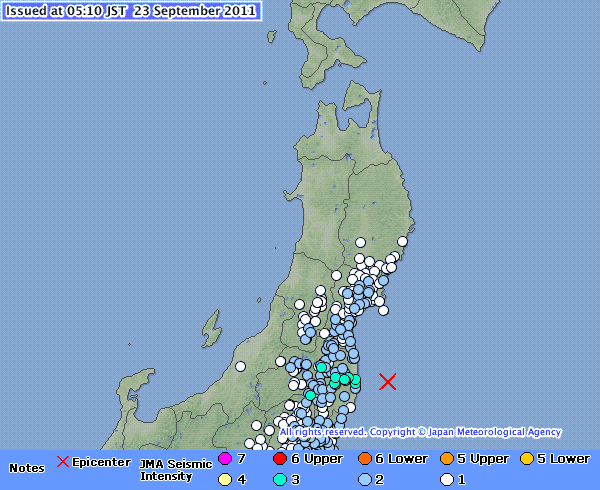
www.jma.go.jp a 5.0 next to the plants. 3 seismic intensity.
Thursday September 22 2011, 19:59:18 UTC 32 minutes ago near the east coast of Honshu, Japan 5.0 13.8by Edano via Jma.go.jp 9/22/2011 8:42:41 PM- Noda vows to raise nuke safety to highest level
Prime Minister Yoshihiko Noda has promised that Japan will raise the safety of its nuclear power plants to the highest level in the world.
Noda made the remark on Wednesday in a speech to a UN high-level meeting on nuclear safety in New York.
Noda began by expressing deep gratitude for the encouragement and support extended by many countries around the world for victims of the earthquake and tsunami that hit northeastern Japan in March.
On the nuclear accident at the Fukushima Daiichi plant, Noda said that the situation is steadily being put under control. He said recent estimates of radioactive releases from the damaged plant are about one 4-millionth of that recorded just after the accident.
He said efforts are underway to achieve cold shutdown of the reactors by the end of this year, instead of in January as originally planned.
The prime minister stressed that the government is determined to objectively identify the cause of the accident, and disclose its findings to the world.
Noda said Japan will raise the safety of its reactors to the world's highest level. He laid out plans to tighten regulations and establish a new nuclear safety agency in April next year.
Noda promised Japanese support for countries seeking ways to use nuclear power generation to secure energy and combat global warming.
Noda also said his government will work harder to develop and promote renewable energy and draw up a mid-term energy strategy by next summer.
Thursday, September 22, 2011 22:20 +0900 (JST)
www3.nhk.or.jpby Edano 9/22/2011 8:51:42 PM - this man has no character. mr blablabla.by Edano 9/22/2011 8:52:04 PM
- @Edano the issues with those vents to the torus are yet another design flaw they had to retrofit to make them work right. They are known to stick open or not open until way past their set opening pressure. This has been known since the 70's and nobody thought this important enough to do much. Sounds like their workaround may not have worked.by lillymunster 9/22/2011 8:54:01 PM
- @Edano so much for Noda changing anything. :-(by lillymunster 9/22/2011 8:55:16 PM
- @lillymunster the rupture disks have to be exchanged from time to time, all at the same time. who knows if this has been done properly ?by Edano 9/22/2011 8:55:50 PM
- @Edano the talked about corrosion causing incorrect behavior in the target rock valves on the torus pipes. I don't think I have seen anything in TEPCO's old documents talking about testing them.by lillymunster 9/22/2011 9:04:34 PM
The procedures for operation in severe accidents define the PCV vent conditions and the
PCV vent operation during severe accidents as follows: PCV vent from the S/C
(hereinafter referred to as ―wet vent‖) shall be given priority; and when the PCV pressure
reaches the maximum operating pressure before core damage, when the pressure is
expected to reach about twice as high as the maximum operating pressure after core
damage and if RHR is not expected to be recovered, wet vent shall be conducted if the
total coolant injection from the external water source is equal to or less than the
submergence level of the vent line in the S/C or PCV vent from the D/W (hereinafter
referred to as ―dry vent‖) shall be conducted if the vent line of the S/C is submerged. The
procedures for operation in severe accidents specify that the chief of emergency response
headquarters shall determine whether PCV vent operation should be conducted after core
damage
www.kantei.go.jp
sorry if I am repeating what is already knownby elainekirk 9/22/2011 9:09:04 PM- Noda expresses confidence over resolution of Fukushima nuclear crisis
By Takuya Karube
NEW YORK, Sept. 22, Kyodo
Japanese Prime Minister Yoshihiko Noda on Thursday expressed confidence that the ongoing nuclear crisis at the Fukushima Daiichi power plant will be brought under control in the not-too-distant future.
In a speech at the United Nations, Noda pledged that Japan will disclose all information related to the crisis, the worst since the Chernobyl disaster in 1986, and share with the international community the lessons Japan has learned about nuclear safety.
Noda explained that he visited the power plant, crippled by the March 11 earthquake and tsunami, earlier this month to get a closer look at its reactor buildings.
''This very fact demonstrates the steady progress in our efforts to bring the accident under stable control,'' he told the world body's high-level meeting on nuclear safety and security.
The prime minister informed U.N. Secretary General Ban Ki Moon and other world leaders of the latest Japanese estimates showing that the amount of radioactive substances being released from the reactors has fallen to around one-four millionth of the level at the early stage of the crisis.
Noda, who took office three weeks ago, said Japan will aim to bring the reactors into a state of cold shutdown by the end of this year, one month ahead of the initial target.
While admitting Japan's emergency response and preparedness for an enormous tsunami was insufficient, he said, ''Japan is determined to raise the safety of nuclear power generation to the highest level in the world,'' signaling that his government has no immediate plans to phase out the country's nuclear reactors.
Noda also said Japan stands ready to continue to export its technology and expertise to emerging economies seeking to introduce nuclear facilities and at the same time to step up its efforts to take the lead in expanding the use of renewable energy.
Noda, who is making his international debut as premier in New York, noted that Japan will present the specifics of its new energy policy over the medium and long terms around next summer.
He added that Japan will strengthen nuclear security with the rest of the world to prevent terrorist access.
In closing his remarks, Noda said he is confident that the nuclear crisis in Japan will be tackled and there will be a time when Fukushima will be remembered as ''the place where, through people's strong will and courage, a new era was opened for the future of humankind.''
==Kyodo english.kyodonews.jpby Edano 9/22/2011 9:17:30 PM - "a new era was opened for the future of humankind" ???by Edano 9/22/2011 9:18:22 PM
- ah, he means the german turn to abolish nukes. :)by Edano 9/22/2011 9:20:10 PM
- Full text of Noda's speech at U.N. meeting on nuclear safety
NEW YORK, Sept. 22, Kyodo
The following is a draft government translation of the full text of a speech that Japanese Prime Minister Yoshihiko Noda delivered Thursday at a high-level U.N. meeting on nuclear safety and security.
Mr. Secretary General of the United Nations,
Mr. President of the United Nations General Assembly,
Excellencies,
Ladies and gentlemen,
1. The accident at the Fukushima Daiichi Nuclear Power Station of the Tokyo Electric Power Co. has raised the profound issue of how humankind should deal with nuclear energy. I commend the insight of the secretary general for his leadership in convening this meeting, taking the opportunity of the U.N. General Assembly, for which representatives of states around the world assemble.
2. Since struck by a massive earthquake and tsunami, the people of Japan have been receiving very heart-warming encouragement and support from all over the world. On behalf of all the Japanese people, I should like to take this opportunity to express our sincere gratitude to you all.
3. Science and technology have aided the progress of the human race and brought prosperity to every corner of the world. For over half a century, since it made use of the most advanced high technology to take its first stride toward the civil use of nuclear energy in 1957, Japan has researched and applied the means to use nuclear power safely, and fostered and developed its nuclear industry so diligently that the whole nation suffered a serious blow from the recent accident.
4. For the last half a year, since the accident occurred, Japan has been struggling with all its strength by concerted efforts throughout the nation to bring the accident under stable control at the earliest possible time. As the person in overall charge of those efforts, I visited the site of the Fukushima Daiichi Nuclear Power Station of the Tokyo Electric Power Co. immediately upon taking office as prime minister this month, and observed the reactor buildings up close. This very fact demonstrates the steady progress in our efforts to bring the accident under stable control.
5. Through the dedicated efforts of the people involved, we are steadily moving closer to stable control of the accident. The most recent estimates indicate that the amount of radioactive material being discharged is now being held down to a level of one-four millionth of that at the early stage of the accident. We are now making every effort to achieve the state of cold shutdown of the reactors roughly within 2011, ahead of schedule. Improvements in the situation are being sustained by the dedicated efforts of over 2,000 workers who persevere steadfastly in their work even as they expose themselves to the dangers of radiation and heat stroke. We would be remiss to forget that fact.
6. The unimaginable destructive force of the enormous tsunami, which reached a height of 15 meters, has left traces that can still be found even now in the tsunami-stricken areas. At a minimum, there is little doubt that we had overestimated our preparations for tsunami. It is clear that electrical power supplies for emergency use and pumps should not have been situated in locations that could be submerged by tsunami. Our preparations for a severe accident that would result in damage to the reactor core were insufficient. Making a vent took more time than expected, causing loss of precious time. While a full-scale process to discover the cause of the accident will continue for some time, we have identified ''faults'' as well as ''lessons learned'' from them. Full-fledged inspections to be conducted based upon these on the safety of nuclear power stations both within Japan and abroad should be a most urgent task ahead of us.
7. Japan will disclose to the international community all the information related to this accident, in both a swift and accurate manner. We have already presented two reports to the IAEA on the course of events. The Investigation Committee on the Accident at the Fukushima Nuclear Power Station of Tokyo Electric Power Co. is conducting a comprehensive investigation of the accident from a neutral and objective standpoint and will release its final report next year. Japan will hold an international conference to be co-hosted by the IAEA next year, through which we will share with the international community the results of our comprehensive inspections and our charted courses of action towards the safe use of nuclear energy.
8. Japan will send out to the whole world the lessons learned through this accident. It has already made proposals to the international community, such as the strengthening of cooperation and coordination among regulatory authorities of nations, the reinforcement of the international assistance mechanism in the event of nuclear accidents, and a review of the IAEA Safety Standards. The international community has responded to this. The leaders of the Group of Eight in Deauville, and the ministers of a larger number of states in Paris, declared their determination to raise the safety of nuclear power to the highest level in the world, and today an Action Plan on Nuclear Safety was endorsed by the IAEA General Conference. These are all very welcome developments.
9. Japan is determined to raise the safety of nuclear power generation to the highest level in the world. In addition to the emergency measures already taken, we plan to establish ''The Nuclear Safety and Security Agency'' around April of next year, by separating off the Nuclear and Industrial Safety Agency from the Ministry of Economy, Trade and Industry, to accomplish the independence of nuclear regulation from promotion, for the purpose of centralizing the regulatory system and ensuring a thorough safety culture. We will also fundamentally reinforce nuclear safety regulations themselves.
10. Japan stands ready to respond to the interest of countries seeking to use nuclear power generation. For several years, emerging nations and many other countries around the world have earnestly explored ways of using nuclear energy amid the need for energy security and in response to global warming. Japan has been supporting their efforts, including their improvements of nuclear safety. Japan remains steadfast in responding positively to their interest in our undertakings.
11. In parallel, Japan will also take the lead to increase development and use of renewable energies. Japan will redouble efforts to increase development and use of renewable energies by mobilizing the advanced technologies in the possession of both the public and private sectors. Japan will also present practical strategies and plans around the summer of 2012 concerning the composition of energy sources over the medium and long terms.
12. Japan will also participate actively in efforts to ensure nuclear security. Preparedness for terrorist attacks on nuclear power facilities and exchanging security information among relevant authorities of countries should be important tasks. I will take part in the Nuclear Security Summit next year, and will join actively in international undertakings in this field. Japan will for its part reinforce its measures to protect its nuclear materials and facilities.
13. Energy is the ''lifeblood'' of the economy and is a foundation of daily human life. In a broader context, it impacts the peace and prosperity of the entire human race. It is the cornerstone of the well-being of not just our own generation but of future generations as well. We can ill afford to continue wavering over our next actions. We must mobilize science and technology to the maximum extent possible to decide urgently on our next steps, rationally grounded.
14. I am confident that the human race will be able to utilize its wisdom to overcome the challenge thrust before us by this nuclear accident. I am confident that, for Fukushima, the day will come when it is remembered as ''the place where, through people's strong will and courage, a new era was opened for the future of humankind.'' And indeed, I am confident that today's meeting will serve as a signpost for the next actions we should take together in order to raise the safety of nuclear power to the highest level. I should like to close my remarks by pledging that Japan, as the country in which this accident occurred, will dedicate itself to shouldering its responsibilities and taking action.
Thank you very much.
==Kyodo english.kyodonews.jpby Edano 9/22/2011 9:22:33 PM - TEPCO built new vent pipes extending from the S/C and D/W to the stacks from 1999 to
2001 as PCV vent facilities during severe accidents as shown in Figs. IV-2-13 and
IV-2-14. These facilities were installed to bypass the standby gas treatment system
(hereinafter referred to as SGTS) so that they can vent the PCV when the pressure is high.
The facilities are also provided with a rupture disk in order to prevent malfunction. www.kantei.go.jp
apologies if repeatby elainekirk 9/22/2011 9:28:01 PM - @Edano it galls me how these minority of men who are paid by us stand there saying how safe nuke is gong to be in the future , apart from a minority of countries the peoples wishes have not been asked forby elainekirk 9/22/2011 9:32:02 PM
- "Science and technology have aided the progress of the human race and brought prosperity to every corner of the world." i could slap him in the face. there are children dying during his pathetic and redundant show.by Edano 9/22/2011 9:36:11 PM

Japan Earthquake | Page 2391
- Who's Blogging
-
 hudebnik
 alblee
 UKVal
UKVal Oliver (ScribbleLive)
 Jonathan Keebler
 kaykodh
 PKelley
 Markfm
 Angie
Angie Deb
Deb Mid Valley
- Pedro Jesus
 Matt (ScribbleLive)
 George Gibb
- elainekirk
- lillymunster
 dean
dean bo
bo- Edano
 IanGoddard