Japan Earthquake | Page 2460
 @ Mona, there are some things about the Fuku accidents for which there are no scales to compare to since it involved 3 reactors and spent fuel pools. For this reason the international scale will have to be modified to accomodate such an accident as fukushima. In addition, Fuku is in the early stages of the accident and is still an "at risk" accident with conditions that could change suddenly for unforeseen problems, typhoons, earthquakes or other natural disasters. The radioactive inventory at fuku clearly is larger than chernobyl and is only being partially contained. The coverings being placed over the reactors will aide to some degree but they will introduce new challenges in dealing with the debri and inside the facilities. fukushima clearly has had more impact on the neighboring body of water off the coast and could clearly be something that continually grows to a worsening condition,,, along with the ground water tables. since fukushima is a much more populated area, the time dependence of affects from radioactive fallout could very well exceed that of chernobyl over time.
by dean 10/6/2011 4:05:33 PM @Mona I think the water contamination may in the end make it larger that Chernobyl. Fuku seems to just keep leaking.by lillymunster 10/6/2011 4:10:39 PM
 @Ian Lillymunster Ty. It’s good to have you people to talk to, who try to be ahead of things and to tell about things. Here is a really light in the dark. :
www.youtube.com
youtu.beby Mona 10/6/2011 4:33:24 PM- @Mona Very cool, indeedby M.I.A. 10/6/2011 4:38:45 PM
- Here's the ECRR's declaration against the ICRP standard model, many important points made (it's not just Busby, see the signatories) : www.euradcom.orgby Ian 10/6/2011 4:44:35 PM
 back for a bit.by Edano 10/6/2011 4:57:16 PM
- Here is the list of all the FOIA documents sorted by file number. The big central file should be done soon, going to try another upload method here in a bit.
houseoffoust.comby lillymunster 10/6/2011 4:58:00 PM - @all, don't forget the NRC public meeting on GE Mark 1 reactors is tomorrow morning at 10am ESTby lillymunster 10/6/2011 5:02:00 PM
- @lillymunster, where? I live a few miles from their HQ.by Ian 10/6/2011 5:02:44 PM
- @Ian this has the info on the meeting room location www.nrc.govby lillymunster 10/6/2011 5:05:31 PM
- @Mona i agree with you. there seems to be a huge psychological hurdle to admit that fuku is worse or even equal to chernobyl. i think the released radiation is still covered up in fukushima and it will take years to backtrace all the numbers. it is quite clear that fuku is a disaster of the same scale, and the two are outstanding events. we have complete meltdowns and containment failures probably in all three reactors (that's why they build the tents) and not to forget the spent fuel pools, the state of which is still unclear, and the immense ammount of radioactive waste. what is really different, is the response to the disaster. we will have to wait some years to get an unbiased valuation of the fuku event, but if you don't close your eyes, it is obvious that fuku will probably be worse than chernobyl.by Edano 10/6/2011 5:10:56 PM
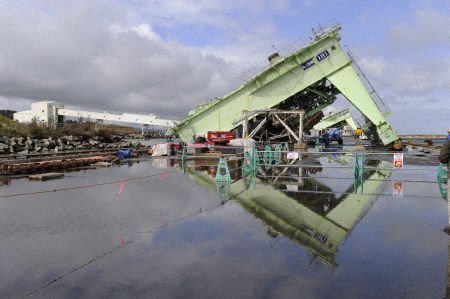
english.kyodonews.jp
Tsunami-hit Haramachi thermal power plant
Photo taken Oct. 6, 2011, shows a coal unloader damaged by the March 11 tsunami at the Haramachi thermal power plant, operated by Tohoku Electric Power Co., in Minamisoma, Fukushima Prefecture. (Kyodo) english.kyodonews.jpby Edano via English.kyodonews.jp 10/6/2011 5:18:21 PM- @all. Question, should I try live blogging the NRC meeting tomorrow? If I do I can create another "event" to run it on if we don't want it clogging the main scribble?by lillymunster 10/6/2011 5:34:48 PM
- backby dean 10/6/2011 5:44:04 PM
- @lilly.. what time is it.. I"m off now for 6 monthsby dean 10/6/2011 5:44:37 PM
- @Vivre, I'm in and out but at the library now, so I need to focus in the remaing 3 hrs it's open.by Ian 10/6/2011 5:49:23 PM
 @lillymunster I think it would be great just to have the live NRC blog on this board...by smoss 10/6/2011 5:49:43 PM
- One thing I'm finding in the literature is lots research showing serious cognitive damage to Chernobyl workers and those who where in the exolcusion zone after the accident. There's even a 'schizophrenia syndrome' among liquidators (this study is free online, check out the graphs!!) schizophreniabulletin.oxfordjournals.org .
One study reports "The biological age in the investigated persons exceeded its average populational value for 5 years (the integral biological and partial cardiopulmonary age) and for 11 years for the partial psychological age." www.ncbi.nlm.nih.govby Ian 10/6/2011 6:05:28 PM - Some blame increased psychological impairment on those living outside the Chernobyl exclusion zone on knowledge of radiation risks causing unwarraneted stress. But there is plenty of emerging evidence that low-dose radiation has negative mental effects, like in this animal study : "Taken together, these findings indicate that low-dose ionizing radiation rapidly activates the neuroimmune system potentially causing early onset fatigue-like symptoms in mice". www.sciencedirect.comby Ian 10/6/2011 6:22:33 PM
 crash course review theincidentaleconomist.com Not many reviews, this guy says good points are raised but it is one-sided towards predicting doom and unsustainability. 1st trillion took 300 years to build everything. Last trillion was created about a month ago. Of course if Fukushima takes down the Japanese economy or even a good sized chunk of it, that won't help either.by artnuke 10/6/2011 6:35:47 PM
- @lillymunster I never heard of Mayak until I saw it on this board. Yeesh what a horrible mess. Mayak was Russia's version of Hanford. As far as I knew growing up the Columba River has never been in danger of nuclear pollution, nor all the salmon that go up and down that river from birth to spawning (or so I thought). Of course that was back in the day we they taught us the PNW had limitless water and hydro energy, and the marvelous fish ladders would protect the fish and we had limitless low cost safe nuclear energy, and it doesn't quite look that way today when WA is starting to blow up some of the older dams. KCTS-9 had an excellent Hanford documentary about how they built not 1, not 2 but 3 reactors spaced far apart fully expecting them to blow up once, maybe twice. Is there a good reference on how the Russians went about setting up their nuclear program beside stealing IP from the USA?by artnuke 10/6/2011 6:35:49 PM
- @dean was out for a bit. The NRC meeting is 10am EST tomorrow (Friday) morning.by lillymunster 10/6/2011 6:37:43 PM
- @artnuke part of the problem at Mayak was the Russians were somewhat winging it and didn't fully understand what they were doing. For everything unknown or unknowingly risky at Hanford double it for Mayak. I have a pile of Mayak links, will try to find them when I get a breakby lillymunster 10/6/2011 6:40:29 PM
- @dean I have the individual PDF documents organized and up on the group website for the NRC FOIA. Still working on the central document version.
houseoffoust.comby lillymunster 10/6/2011 6:41:38 PM  At 9:58 am on October 6, we stopped the operation of Water Desalinations
No2 and No3 because we found stain of leaked water in the water joint at
the outlet piping of the Water Desalinations' waste RO supply pump. We
are going to repair those. The operation of water injection at reactor
unit 1-3 is continued and there is enough treat water in the buffer tank,
so this event does not affect the operation of injecting the water to
the reactors. www.tepco.co.jpby elainekirk 10/6/2011 6:43:23 PM- Another Fukushima worker has died www.telegraph.co.ukby lillymunster 10/6/2011 6:48:44 PM
 @lillymunster i still can't believe that the one that died from acute leukemia didn't make more of a news dent.by Panserbjorne9 10/6/2011 6:54:58 PM
- @Panserbjorne9 they tried really hard to brush him under the rug. This one nobody is giving a cause of death. I hope the authorities are maybe taking a more serious look since workers have consistently been dying.by lillymunster 10/6/2011 6:57:23 PM
- @elainekirk will get the live blogging thing together and do a post so we can tweet it.by lillymunster 10/6/2011 6:57:47 PM
- Japan Test Reactor Was Shaken Beyond Design Limit in March Quake - Bloomberg bloom.bg via @BloombergNewsby elainekirk 10/6/2011 6:58:50 PM
- @Ian very interesting findings.by Edano 10/6/2011 7:03:43 PM
- www3.nhk.or.jp A worker in his fifties who had been working for 46 days at Fukushima Daiichi, installing water treatment tanks, died on 6 October. He was taken to hospital on 5 October after feeling unwell during the morning assembly. According to Tepco, his radiation record being 2.02 mSv, it is difficult to think that radiation is the cause.by Edano 10/6/2011 7:09:00 PM
- @Edano the worker interviewed by German TV said their dosimeters will error out when they get to high radiation areas. I am starting to wonder if their dosimeters are working rightby lillymunster 10/6/2011 7:14:36 PM
- @lillymunster my link is wrong. trying to find the right one.by Edano 10/6/2011 7:15:14 PM
- @lillymunster i am very sure that the dosimeters are wrong / don't work. i am convinced that the real readings are not revealed.by Edano 10/6/2011 7:18:54 PM
- @Edano something has to give. Either these workers readings are wrong or there is something else at the plant causing a fatal health complication. This is beyond coincidenceby lillymunster 10/6/2011 7:21:40 PM
- @lillymunster wholeheartedly agreedby Panserbjorne9 10/6/2011 7:24:43 PM
- Obama Acknowledges Wall Street Protests as a Sign
abcnews.go.comby Panserbjorne9 10/6/2011 7:27:14 PM - i got a german confirmation for the worker's death: www.spreadnews.de
"Weiterer Fukushima-Arbeiter gestorben: TEPCO meldet den heutigen Tod eines Arbeiters Mitte 50, der in der Nähe der Tanks für kontaminiertes Wasser gearbeitet hatte. Gestern habe er über Unwohlsein geklagt, heute habe sich dann der Todesfall ereignet. Nach offiziellen Angaben, war er insgesamt nur einer Belastung von 2,02 Milisievert ausgesetzt, “daher hat sein Tod nichts mit der Strahlung zu tun” erklärte der Kraftwerksbetreiber.
Nach Angaben der Asahi Shimbun hat der Energiekonzern keine Untersuchungsergebnisse zur Todesursache oder medizinische Hintergründe über möglicherweise vorhandene Erkrankungen des Arbeiters veröffentlicht. Offiziell sind in den vergangenen sechs Monaten insgesamt drei Angestellte verstorben."
"Another worker died Fukushima: TEPCO reports the death of a worker today's mid-50s who had worked in the vicinity of the tanks for contaminated water. Yesterday he had complained of being unwell, then today had the death occurred. According to official figures, he was just a total load of 2.02 Milisievert exposed, "so his death has nothing to do with radiation," said the power plant operators.
According to the Asahi Shimbun, the energy company does not test results or medical background to the cause of death may be present on the worker's illness was made public. Officially in the past six months, a total of three people have died."by Edano edited by lillymunster 10/6/2011 7:29:29 PM - www.ibtimes.com
Japan nuclear plant worker dies
(AFP) – 8 hours ago
TOKYO — A worker at Japan's disaster-stricken Fukushima nuclear power plant died Thursday, its operator said, adding that the death was not necessarily related to radioactive leaks.
The male worker, in his 50s, was taken to hospital for treatment Wednesday after feeling ill during a regular morning assembly at the plant, some 200 kilometres (140 miles) north of Tokyo, according to Tokyo Electric Power Co. (TEPCO).
He died early morning Thursday at the hospital, TEPCO spokeswoman Chie Hosoda said, adding that the cause of his death was being investigated.
"He had been exposed to a small amount of radiation. It is difficult to assume that radiation was a cause of his death," she said.
The unidentified worker had worked for 46 days at the plant to install a tank which will be used for processing contaminated water from the crippled reactor units.
He worked three hours every day and had been exposed to a total of 2.02 millisieverts of radiation, the official said. An exposure of 100 millisieverts per year is considered the lowest level at which any increase in cancer risk is evident.
He was the third worker to die at the plant following the March 11 earthquake and tsunami.
A male worker, in his 60s, died of a heart attack in May and another, in his 40s, succumbed to acute leukemia in August. TEPCO said both cases were not attributable to radiation.
Two other male employees were also killed directly in the disaster.
The 9.0-magnitude quake and tsunami left 20,000 dead or missing on Japan's northeast coast and crippled cooling systems at the Fukushima plant, causing reactor meltdowns. www.google.comby Edano 10/6/2011 7:37:29 PM - Tokyo FD Chief speaks on their role at the disaster site www.taiwannews.com.twby lillymunster 10/6/2011 7:46:07 PM
- Thyroid gland irregularities found in young evacuees from Fukushima
NAGANO, Japan, Oct. 4, Kyodo
english.kyodonews.jpby Edano 10/6/2011 7:48:51 PM - Thyroid gland irregularities found in young evacuees from Fukushima
NAGANO (Kyodo) -- Hormonal and other irregularities were detected in the thyroid glands of 10 out of 130 children evacuated from Fukushima Prefecture, a Nagano Prefecture-based charity dedicated to aid for the victims of the 1986 Chernobyl nuclear accident said Tuesday.
The Japan Chernobyl Foundation and Shinshu University Hospital did blood and urine tests on youngsters aged up to 16 including babies under the age of one for about a month through the end of August in Chino, Nagano, when the children stayed there temporarily after evacuating from Fukushima.
As a result, one child was found to have a lower-than-normal thyroid hormone level and seven had thyroid stimulation hormone levels higher than the norm. The remaining two were diagnosed with slightly high blood concentrations of a protein called thyroglobulin, possibly caused by damage to their thyroid glands.
Three of the 10 children used to live within the 20-km no-go zone around the nuclear plant and one was from the so-called evacuation-prepared area in case of emergency in areas between 20 and 30 kilometers from the plant, while six others were from towns outside such zones.
"At present, we cannot say the children are ill but they require long-term observation," said Minoru Kamata, chief of the foundation. No clear link has been established between the children's condition and the radiation from the crippled Fukushima Daiichi nuclear power plant, according to the nonprofit organization.
Radioactive iodine tends to get lodged in children's thyroid glands more than those of adults, placing youngsters at greater risk of developing disorders and diseases including cancer.
(Mainichi Japan) October 4, 2011
mdn.mainichi.jpby Edano 10/6/2011 7:52:15 PM - @Edano hello how are you ? have you ordered pizza?by elainekirk 10/6/2011 7:55:26 PM
- @elainekirk yes, but i returned home for the night. :) tomorrow they want to do the coronar angiography.by Edano 10/6/2011 7:56:53 PM

Japan Earthquake | Page 2460
- Who's Blogging
-
 hudebnik
 alblee
 UKVal
UKVal Oliver (ScribbleLive)
 Jonathan Keebler
 kaykodh
 PKelley
 Markfm
 Angie
Angie Deb
Deb Mid Valley
- Pedro Jesus
 Matt (ScribbleLive)
 George Gibb
- elainekirk
- lillymunster
- dean
 bo
bo- Edano
 IanGoddard