Japan Earthquake | Page 2593
 wow - fukushima made the local news here - it was only the bit about the media being allowed in..by lillymunster 11/2/2011 11:56:43 AM
 Temperature, pressure unchanged in No.2 reactor
TEPCO says temperature and pressure in the No.2 reactor at the Fukushima Daiichi nuclear power plant is basically unchanged in a 24-hour period between Tuesday and Wednesday.
The company says the temperature at the bottom of the reactor was 76 degrees Celsius as of 5 AM on Wednesday. That was down 1.4 degrees from 24 hours earlier.
The reactor's pressure gauge registered 0.007 megapascals at 5 AM on Wednesday, down one part per thousand from the same time on Tuesday .
Wednesday, November 02, 2011 12:05 +0900 (JST)
www3.nhk.or.jpby Edano 11/2/2011 11:56:56 AM- Nuke watchdog says fresh meltdown unlikely
Japan's nuclear watchdog says it believes another meltdown at the Fukushima Daiichi nuclear power plant is unlikely, but will continue to monitor the situation closely.
The Nuclear and Industrial Safety Agency held a news conference on Wednesday, after radioactive xenon was detected in the containment vessel of the No.2 reactor. The presence of the substance indicates that nuclear fission may have briefly resumed.
The safety agency says it is unlikely that nuclear fuel has begun melting again, as the density of xenon is low and there has been no change in the reactor's temperatures.
The agency also says it will closely monitor if xenon continues to be detected after Tokyo Electric Power Company poured boric acid solution into the reactor to suppress nuclear fission.
It added that it cannot yet say how the latest development will affect the government's plan to achieve a cold shutdown of the disabled reactors by the end of the year.
Senior official Yoshinori Moriyama said it is difficult to determine the amount of nuclear fuel remaining in the containment vessel of the No.2 reactor. He said his agency will assess the situation and judge if it is still possible to stably lower temperatures in the reactor and containment vessel.
Wednesday, November 02, 2011 15:10 +0900 (JST)
www3.nhk.or.jpby Edano 11/2/2011 11:58:50 AM  good morning to allby dean 11/2/2011 11:59:47 AM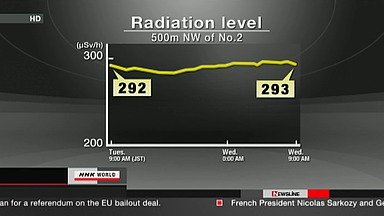
www3.nhk.or.jp
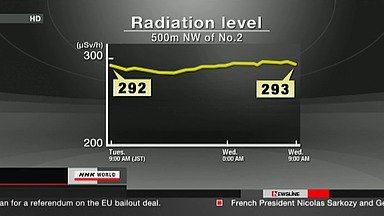
TEPCO: Radiation levels unchanged
TEPCO says the radiation reading taken on Wednesday near the No.2 reactor at the Fukushima Daiichi nuclear plant was basically unchanged from the day before.
The utility says the reading, taken at a monitoring post about 500 meters northwest of the reactor, stood at 293 microsieverts per hour at 9 AM, up only one microsievert from 24 hours earlier.
It says the radiation level near the compound's west gate, about one kilometer from the No.2 reactor, was also unchanged at 11.2 microsieverts per hour, and that no neutron radiation was detected.
Readings at 8 other monitoring posts on Wednesday were also the same as Tuesday.
Wednesday, November 02, 2011 11:41 +0900 (JST)
www3.nhk.or.jpby Edano via Www3.nhk.or.jp 11/2/2011 12:01:04 PM
www3.nhk.or.jp
SDP head criticizes Genkai reactor restart
Opposition Social Democratic Party leader Mizuho Fukushima is criticizing the government for allowing the restart of a nuclear reactor in western Japan.
The No.4 reactor at the Genkai plant in Saga Prefecture was shut down early last month in a procedural error. Kyushu Power Electric Company will restart the reactor later on Wednesday.
Fukushima told her party executive on Wednesday the government's Nuclear and Industrial Safety Agency and Nuclear Safety Commission can't be trusted. She called for open debate before restarting any nuclear reactors. She strongly opposed restarting the Genkai reactor saying there was no discussion about it in the Diet.
Fukushima noted the Kyushu utility has been criticized recently for trying to manipulate public opinion in favor of nuclear power. She said she can't believe the industry ministry and the agency have approved restarting the reactor.
Wednesday, November 02, 2011 16:39 +0900 (JST)
www3.nhk.or.jpby Edano via Www3.nhk.or.jp 11/2/2011 12:02:44 PM- Japan's Ukraine embassy to study Chernobyl
Japan will expand its embassy in Ukraine to collect information on the country's response to the 1986 Chernobyl nuclear accident.
The information will be utilized in dealing with the aftermath of the nuclear accident at the Fukushima Daiichi nuclear plant.
The embassy will have 6 more workers in addition to the current staff of about 40. New staff will include 2 nuclear specialists and 3 translators of Russian and Ukrainian.
The office building will be expanded and equipped with dosimeters and protective gear.
The embassy staff will interview Ukrainian and former Soviet officials, experts and residents about the effects of lingering radioactive contamination. Ways to manage restricted zones and decontamination methods will also be studied.
The Japanese government plans to appropriate about 2 million dollars for the expansion in the fiscal 2012 budget bill.
Wednesday, November 02, 2011 10:39 +0900 (JST)
www3.nhk.or.jpby Edano 11/2/2011 12:05:19 PM - heading for coffee.. will returnby dean 11/2/2011 12:07:58 PM
- Post-Fukushima nuclear energy demand up but slower, IAEA head says
NEW YORK, Nov. 1, Kyodo
Yukiya Amano, head of the International Atomic Energy Agency, said Tuesday demand for nuclear energy around the world is on the rise, although the nuclear crisis in Japan triggered by the March earthquake and tsunami has dented growth.
''Despite the accident, the IAEA's latest projection is that the number of operating nuclear reactors in the world will continue to increase steadily in the coming decades, although less rapidly than was anticipated before the accident,'' the agency's director general said in his report to the 66th U.N. General Assembly.
Most of the growth will occur in countries such as India and China that already have operating nuclear power plants, he said. english.kyodonews.jpby Edano 11/2/2011 12:08:16 PM - Reactivated Genkai nuclear reactor starts power generation
TOKYO, Nov. 2, Kyodo
A nuclear reactor at Kyushu Electric Power Co.'s Genkai power plant resumed power generation at around 3 p.m. Wednesday, after it was reactivated late Tuesday following a one-month hiatus, company officials said.
If all runs smoothly, the No. 4 reactor at the plant in the town of Genkai, Saga Prefecture, is expected to be back to normal operation Friday, despite opposition from some local residents.
It was the first time since the start of the nuclear crisis at the Fukushima Daiichi power plant in March that a utility reactivated a nuclear reactor that went offline due to a technical problem. english.kyodonews.jpby Edano 11/2/2011 12:09:21 PM - TEPCO finds sign of recent nuclear fission at Fukushima reactor
TOKYO, Nov. 2, Kyodo
Tokyo Electric Power Co. said Wednesday that it has detected signs of a recent nuclear fission in the No. 2 reactor at the crippled Fukushima Daiichi power plant, but ruled out the possibility that a major criticality accident had occurred.
The plant operator injected early Wednesday water containing boric acid to control a possible nuclear reaction at the reactor, where nuclear fuel is believed to have melted when the cooling system failed following the devastating March 11 earthquake and tsunami. The company said the reactor's temperature and pressure were stable.
As for the possibility of criticality, in which nuclear fuel sustains a fission chain reaction, the utility's spokesman said such a phenomenon may have happened ''temporarily or partially,'' but he does not think enough energy has been generated to raise the reactor's temperature and pressure. english.kyodonews.jpby Edano 11/2/2011 12:10:19 PM 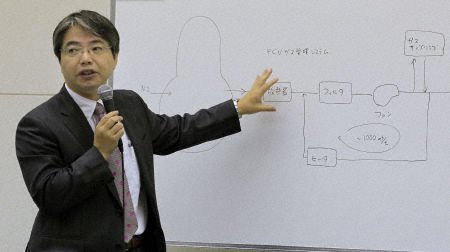
english.kyodonews.jp
TEPCO finds fresh nuclear fission sign at Fukushima reactor
Junichi Matsumoto, an official of Tokyo Electric Power Co., explains the utility's injection of boric acid into the No. 2 reactor of the Fukushima Daiichi nuclear power plant during a press conference at the company's head office in Tokyo on Nov. 2, 2011. The company known as TEPCO said there may be signs of fresh nuclear fission in the reactor and that it has injected boric acid to control a possible nuclear reaction. (Kyodo) english.kyodonews.jpby Edano via English.kyodonews.jp 11/2/2011 12:11:24 PM- done :)by Edano 11/2/2011 12:14:07 PM
- @Edano Did NHK make a slip? They said unsure how much fuel is in containment?by lillymunster 11/2/2011 12:15:56 PM
- @lillymunster i realized that sentence.....by Edano 11/2/2011 12:17:33 PM
- but sometimes they mix up pressure vessel and containment.by Edano 11/2/2011 12:18:11 PM
- They go on to talk about the reactor and containment, that seems to clarify they meant containmentby lillymunster 11/2/2011 12:18:21 PM
- back... coffee for every oneby dean 11/2/2011 12:37:22 PM
- @ Edano, lots of "possible", "may be", and I'd love to see the rationale on how much boric acid to inject.. it's not to "control the nuclear reaction" rather to STOPby dean 11/2/2011 12:40:37 PM
- @dean lots of vague and ambiguous statements .... only admit the obvious.by Edano 11/2/2011 12:42:05 PM
- yes agree, We have discussed nuclear instrumentation before but thought it would be good to look at the shutdown nuclear instrumentation to detect the persence of neutrons called the COUNT RATE SYSTEM. In a reactor Uranium-235 undergoes a small rate of natural spontaneous fission, so there are always some neutrons being produced even in a fully shutdown reactor. When the control rods are withdrawn and criticality is approached the number increases because the absorption of neutrons is being progressively reduced, until at criticality the chain reaction becomes self-sustaining. Note that while a neutron source is provided in the reactor, this is not essential to start the chain reaction, its main purpose is to give a shutdown neutron population which is detectable by instruments and so make the approach to critical more observable. The reactor will go critical at the same control rod position whether a source is loaded or not. During the shutdown the count rate monitoring system uses Fission chambers are used to detect neutrons. A fission chamber contains the fissile material and a gas capable of ionising. Under the action of neutrons, the fissile material emits particles that ionise the gas. The quantity of gas ionised expresses the quantity of neutrons received in the fission chamber. Only a part of the fissile material, known as the effective mass, participates in the emission of the particles that ionise the gas. In practice, precise knowledge of the effective mass is necessary for the determination of the absolute physical magnitudes, which are the neutron flux or the indices of spectra.
by dean 11/2/2011 12:48:08 PM - the neutron population multiplication follows the K multiplication factor (neutrons produced in one generation /neutrons produced in previous generation). The "Six-factor formula" is the neutron life-cycle balance equation, which includes six separate factors, the product of which is equal to the ratio of the number of neutrons in any generation to that of the previous one; this parameter is called the effective multiplication factor (k), a.k.a. Keff. k = LfρLthfηЄ, where Lf = "fast non-leakage factor"; ρ = "resonance escape probability"; Lth = "thermal non-leakage factor"; f = "thermal fuel utilization factor"; η = "reproduction factor"; Є = "fast-fission factor".
k = (Neutrons produced in one generation)/(Neutrons produced in the previous generation) When the reactor is critical, k = 1. When the reactor is subcritical, k < 1. When the reactor is supercritical, k > 1by dean 11/2/2011 12:52:37 PM - @dean in a normal fuel rod, the decay products are supposed to stay inside the rod (the cladding). how can it be that you always find low xenon concentrations even in normal operating reactors, eg on fuel exchanges ?by Edano 11/2/2011 12:54:03 PM
- fission chambers are essential to ensure the neutron population says sub critical at shutdown conditions and is used during startup to detect slight increases as the control rods are withdrawn and to tell when criticality is reached.. ie: the count rate signal will show slight increase trend once critical .. with no control rod movementby dean 11/2/2011 12:54:43 PM
- @Edano primarily the fact you stated,, the fission products remaining with in the cladding material... if any leakage as in a pin hole defect of the cladding the fission products will escapeby dean 11/2/2011 12:57:42 PM
- I'm not sure we've seen normal STACK emissions for fission products but fission gases are given off and filtered then counted prior to going up the stack... and in the water systems that cool the reactorby dean 11/2/2011 12:59:06 PM
- @dean a "leaking rod" is "normal", inevitable ?by Edano 11/2/2011 12:59:55 PM
- leaking pellets are not by design, we have seen that many reactors have them and detect the fission products that leak out and actually operate with them unless they raise the activity level in the system or activity out the stack. Leakers as I call them, can also make the refueling process difficult because the activity level in the reactor water needs to be cleaned up to acceptable levels prior to pulling the top head off the reactor for accessby dean 11/2/2011 1:05:07 PM
- most leakers happen at normal operating temps and pressures and then seal off when temp and pressure is reduced so they are hard to find if the fuel element is sent to the SFP to try and find which element is leakingby dean 11/2/2011 1:06:04 PM
- @dean would you say every fuel load has a leaker or is it not so often ?by Edano 11/2/2011 1:06:52 PM
- I am not certain on how commercial plants find the leaky fuel elements, would be a nice research.by dean 11/2/2011 1:07:10 PM
- @ Edano with the quality control, testing etc of the pellets I would say it is low and the exception .... I'm sure several fuel loads would run before a leaker is discoveredby dean 11/2/2011 1:09:11 PM
- @dean i ask because of the kikk study and the fact that they found radiation spikes around the npps while refuelling.by Edano 11/2/2011 1:10:53 PM
- if the leaking continues in the SFP I belive they have encapsulation proceduresby dean 11/2/2011 1:11:15 PM
- @ Edano.. this would be an excellent search ,,, a number of questions are raised around the whole issue of leakers..by dean 11/2/2011 1:12:21 PM
- like.. what is shutdown criteria at NPP's, what are the procedures in SFP for handling leakers.. remembering that if a leaker is discovered it could be releasing high level activity and in the SFP's being out of confinement how do their procedures deal with it... etc.by dean 11/2/2011 1:13:37 PM
- i can imagine it might be quite difficult to identify a leaker.by Edano 11/2/2011 1:14:47 PM
- www-pub.iaea.org failure in water reactors:
Causes and mitigationby dean 11/2/2011 1:15:16 PM - On the other hand, complementary information are gained due to inspection methods to
assess failures during outage:
• in-mast or in-cell qualitative sipping test,
• quantitative sipping test in some countries,
• individual inspection of failed rod, after extraction,
• ultrasonic testing and Eddy Current testing if rods are individually reachable.by dean 11/2/2011 1:18:16 PM - @ Edano.. the first bullet is what I've seen.. they put the fuel element in the transfer mast which confines the element and then they "sipp" water out and run the water sample past a counter..by dean 11/2/2011 1:19:06 PM
 maybe the government man could step in and help with the sipping he enjoyed yesterdays from 5&6by elainekirk 11/2/2011 1:20:25 PM
- Utilities that want to go to a higher burnup limit on the fuel do it at increasing the risk of fuel pellet failures..by dean 11/2/2011 1:21:54 PM
- lol ).. elaine.. ha ha...yes.. "I will sip to show fuel ok,,,, GULP OOOPS!!!!by dean 11/2/2011 1:22:35 PM
- @elaine.. it wil be ok.. those FIRE WALKERS liveby dean 11/2/2011 1:23:23 PM
- @dean lolby elainekirk 11/2/2011 1:26:13 PM


Japan Earthquake | Page 2593
- Who's Blogging
-
 hudebnik
 alblee
 UKVal
UKVal Oliver (ScribbleLive)
 Jonathan Keebler
 Matt (ScribbleLive)
 kaykodh
 PKelley
 Markfm
- dean
 Angie
Angie- Edano
 Deb
Deb Mid Valley
 Pedro Jesus
 George Gibb
- elainekirk
- lillymunster
 bo
bo IanGoddard