Japan Earthquake | Page 2631
 Can you even try to imagine reading this article and being in that 70,000 group. They should pack up and move.by MaryW 11/10/2011 4:29:48 AM
 @MaryW there are so many people in distressed and compromised situations with inadequate information to make crucial life decisions. My heart goes out to them, especially those with small children.by bo 11/10/2011 4:40:28 AM
- @artnuke TMI delayed evacuation, according to tapes I've heard in a documentary, because they didn't want to inflict the stress of it, but mostly 'cuz they didn't know where rad plume would go. Were afraid they'd move people into a plume. Those are good rationales, but not valid reasons, imo.by M.I.A. 11/10/2011 6:27:58 AM
 g'morningby elainekirk 11/10/2011 7:50:08 AM
 TEPCO: hydrogen from reactor caused blast
The operator of the Fukushima Daiichi nuclear plant says the explosion of the facility's Number 4 reactor on March 15th was caused by a backflow of hydrogen from an adjacent building.
The Tokyo Electric Power Company, or TEPCO, announced the finding on Thursday.
The blast was initially thought to have been caused by hydrogen created when spent fuel stored in a pool at the reactor building was damaged by the devastating March 11th quake.
TEPCO workers who entered the building on Tuesday to determine the cause found that the 5th floor was more severely damaged than the 4th, where a pool of spent fuel is located, and that the fuel was intact.
The workers also confirmed that an air conditioning duct on the floor was severely damaged.
TEPCO says the hydrogen likely flowed into the reactor through the duct connected to the plant's Number 3 reactor when workers released pressurized air from it to prevent a hydrogen blast.
The firm says the explosion very likely occurred after the density of hydrogen in the duct increased.
A hydrogen blast took place at the Number 3 building a day before the explosion at the Number 4 building.
Thursday, November 10, 2011 17:24 +0900 (JST)
www3.nhk.or.jpby Edano 11/10/2011 9:14:59 AM- TEPCO to monitor xenon at Fukushima plant
Tokyo Electric Power Company or TEPCO says that it will install devices to detect radioactive xenon and determine any occurrence of nuclear criticality.
Radioactive xenon was detected in gases from the containment vessel of No. 2 reactor at the Fukushima Daiichi nuclear plant on November 1st and 2nd.
TEPCO said that xenon was produced through spontaneous fission, not from sustained fission.
But initially the utility could not determine whether it was sustained fission or not.
The utility also plans to create a system to measure temperature changes of nuclear reactors as an indicator of nuclear fission.
Thursday, November 10, 2011 11:25 +0900 (JST)
www3.nhk.or.jpby Edano 11/10/2011 9:16:12 AM - @Edano well they were going to compensate victims and the victims are still waiting. What tepco say they will do is no indication of hen they will do itby elainekirk 11/10/2011 9:17:55 AM
www.tepco.co.jp
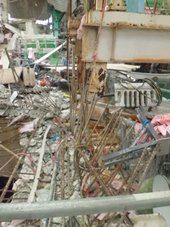
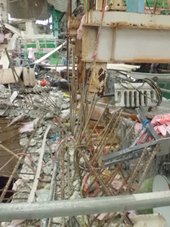
Survey result of damages to air-conditioning ducts etc. in the
Reactor Building, Unit 4, Fukushima Daiichi Nuclear Power Station full doc www.tepco.co.jp
The originals of the photo's on the doc can be found here www.tepco.co.jpby elainekirk via Tepco.co.jp 11/10/2011 9:38:04 AM- the first 3 sheets are Nov 9th data then the rest are the 1st and 2nd Nov
www.tepco.co.jp
The results of sampling surveys gas management system
in primary containment vessel
(Unit 2, Fukushima Daiichi Nuclear Power Station)by elainekirk 11/10/2011 9:42:20 AM - IEA: Denuclearization to increase energy prices
The International Energy Agency has warned that the cost of energy will grow if a global trend toward scrapping nuclear power spreads following Japan's nuclear accident.
The IEA, an advisory body of major oil-consuming countries, released its annual World Energy Outlook on Wednesday, exploring the world's energy prospects by 2035.
The agency examined the impact of the accident at the Fukushima Daiichi plant, speculating that it will halt construction of new reactors in developed countries and halve construction in developing nations.
The report says that the demand for natural gas and coal will drastically grow causing high prices, while renewable energy such as wind power will increase.
It says the result is that energy importing countries, including Japan, will face a total increase in energy costs of 90 billion dollars in 2035.
The report adds that emerging economies must meet their energy needs and warns that carbon dioxide emissions will rise by 6 percent, seriously affecting the fight against global warming.
Thursday, November 10, 2011 08:16 +0900 (JST)
www3.nhk.or.jpby Edano 11/10/2011 12:11:01 PM - the iae is even a bigger bunch of liars than the iaea.by Edano 11/10/2011 12:12:07 PM
- didn't they state yesterday that nuke power will grow by 70% ?
Global nuclear power output to rise over 70% by 2035: IEA
LONDON, Nov. 9, Kyodo english.kyodonews.jpby Edano 11/10/2011 12:12:43 PM - we urgently need an IREA - international renewable energy agency - to face the lies of the pollution agencies.by Edano 11/10/2011 12:16:06 PM
- Idaho lab:Plutonium leaked from damaged container
A nuclear facility in the US State of Idaho says damage to a decades-old steel container led to the leakage of plutonium that caused its workers to be exposed to radiation.
The Idaho National Laboratory says 7 workers, not the initially announced 6, were exposed to low-level radiation while handling stored plutonium fuel on Tuesday.
3 workers are undergoing additional checks after lung examinations pointed to possible internal exposure.
The research lab says workers found powder leaking from a small opening in the stainless steel case of plutonium when they opened an aluminum box that housed the case.
The lab says the fuel had been stored there for 30 years.
Lab officials believe the damage to the case led the plutonium to oxidize and turn into powder form.
The facility is looking into how the steel container was damaged.
But it says it has confirmed that no radiation leaked outside the facility, and that the incident poses no risk to the environment.
Thursday, November 10, 2011 13:04 +0900 (JST)
www3.nhk.or.jpby Edano 11/10/2011 12:17:20 PM 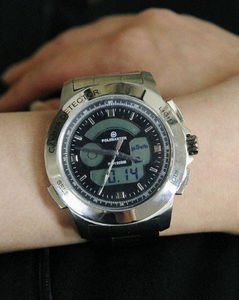
english.kyodonews.jp
Dosimeter for pregnant women in Fukushima
Photo shows the type of dosimeter that the Minamisoma city government in Fukushima Prefecture began lending on Nov. 9, 2011, for free to pregnant women concerned at exposure to radiation following the devastating explosions in March at the nearby Fukushima Daiichi Nuclear Power Station. (Kyodo) english.kyodonews.jpby Edano via English.kyodonews.jp 11/10/2011 12:21:42 PM- @Edano that is a practical piece of equipmentby elainekirk 11/10/2011 12:32:01 PM
- @elainekirk looks nice.by Edano 11/10/2011 12:32:39 PM
- @Edano your idea of a renewables agency is soundby elainekirk 11/10/2011 12:33:34 PM
- @elainekirk i think it is necessary to promote renewables, but iaea and iea get their big money from the global pollution giants.by Edano 11/10/2011 12:37:13 PM
- @Edano yeah but they get a fair whack from governments tooby elainekirk 11/10/2011 12:40:16 PM
 Morning (afternoon-evening)
The IAEA was started to foster use of nuclear power, an international renewables would be a great idea. It could help developed countries set a strategy and developing countries skip over old technology straight to renewables.by lillymunster 11/10/2011 1:14:43 PM- The plutonium accident, if this stuff is that dangerous to handle what happens if all these EPR reactors start running 100% mox. Now we have an entire system of even harder to handle fuel.by lillymunster 11/10/2011 1:18:00 PM
- TEPCO admits they procrastinated on tsunami threat after being told in 2002 to upgrade ajw.asahi.comby lillymunster 11/10/2011 2:36:04 PM
- @lillymunster mmm weekend again dump the news when everybody is shutting down for the weekend so by monday it will be old newsby elainekirk 11/10/2011 2:39:20 PM
- TEPCO still has a Yakuza problem www.japansubculture.comby lillymunster 11/10/2011 2:39:52 PM
- The Asahi story was buried pretty deep in the English websiteby lillymunster 11/10/2011 2:40:21 PM
- @lillymunster yeah how to make bad news 'old news'by elainekirk 11/10/2011 2:50:34 PM
- @elainekirk yep. Asahi is usually on TEPCO's case. I don't remember seeing that article at all on the JP site.by lillymunster 11/10/2011 2:56:13 PM
 human body has about 5000 bq
Contribution to natural radioactivity
Potassium-40 is the largest source of natural radioactivity in animals and humans. An adult human body contains about 160 grams of potassium, hence about 0.000117 x 160 = 0.0187 grams of 40K; whose decay produces about 5,000 disintegrations per second (becquerels) continuously throughout the life of the body.[1][2]
Seems that 4 sv worth of potassium 40 would kill you just as much as that cesium pipe if it came out a reactor
en.wikipedia.orgby artnuke 11/10/2011 3:02:31 PM- There may be some misunderstanding of Potassium 40. This from Oak Ridge National Lab may shed some light.
Dose from Potassium-40
The dose to a typical member of the population is approximately 15-20 mrem/year due to the K-40 in the body and 10 mrem/year due to the gamma rays emitted by K-40 in the environment (primarily the soil).
The human body maintains relatively tight homeostatic control over potassium levels. This means that the consumption of foods containing large amounts of potassium will not increase the body’s potassium content. As such, eating foods like bananas does not increase your annual radiation dose. If someone ingested potassium that had been enriched in K-40, that would be another story.
www.orau.orgby lillymunster 11/10/2011 3:04:38 PM - Here is the pdf report on unit 4 explosion. No word on how much radiation in each spot. Evidence is that all the air vents are blown up, which points to hydrogen coming in front vents according to unit 3 leakage theory, vs hydrogen coming from overheated spent fuel pool.
Now why in the blazes do they wait until now to release decent floor plans???
www.tepco.co.jpby artnuke 11/10/2011 3:07:54 PM - Cesium has a biological half-life of a few weeks, it is also expelled from the body eventually like potassium. I'm pretty sure nobody has died from radiation poisining from banana overdose, now the interestring question has anybody actually documented people who are sick or dead from cesium. The Mayak disaster seems to be the best case I've seen so far, but it's pretty shady as to what poisined how many of whom. Seattle Weekly "nuclear option" says scientists need to glassify tanks at Hanford much like the ones at Mayak, worse case is they could blow up the same way. Good thing I live across the mountains from there.by artnuke 11/10/2011 3:15:57 PM
- @lillymunster , 30 millirem per year, that is 0.03 rem per year, from K-40 compared to 17.5 rem per year at 0.20 microSv/h that is the levels recorded around Dai-ichi.by Peter 11/10/2011 3:30:48 PM
- .... bananas have got little to do with the problem, :)by Peter 11/10/2011 3:32:30 PM
- Seattle Weekly on Washington's Nuclear Wonderland
www.seattleweekly.com
radioactive animals eating radioactive plants, and making sure it doesn't blow up like Mayak did. Recall irony that officials are looking at Mayak because data on what radiation did to people is still classified for hanfordby artnuke 11/10/2011 3:48:02 PM - the conclusion to the radioactive wolves program was that populations were no bigger or smaller compared to control areas, but the absence of people seemed to work to their benefit otherwise.by artnuke 11/10/2011 3:48:03 PM
- The problem is that any amount of radiation is probably a bad thing to some degree. But at the levels we are seeing, it's going to be enough to cause concern over the entire island since it's already concentrating in spots around Tokyo, and I'll be if you looked hard enough you'd find hotspots all over the US west coast and hawaii. The OTHER problem is that the only way to completely get away from it is to abandon Japan, Hawaii, California, Oregon and Washington. Unless we're willing to tell Japan to throw in the towell and put a big radioactive wasteland sign like Moret and Busby, please don't visit us sign, they're going to learn how to live with it and decontaminate the best they can and figure out for themselves how much radiation is safe when.by artnuke 11/10/2011 3:56:19 PM
 Btw, this assay was posted yesterday www.aeon.jp as a i-131 findings, but someone who reads Japanese told me the number in the i-131 column is "the detection limit" and that the test results were zero.by Ian 11/10/2011 4:37:58 PM
- @Ian I mentioned that yesterday. Right hand side numbers are their detection threshold. Left side is a number or if there is text = none detectedby lillymunster 11/10/2011 4:39:44 PM
- The video released yesterday, 'journalist gets inside Fukushima plant says reactor no.4 spent fuel pool is completely exposed, sure go the ball rolling on publishing some old news on reactor 4.by MaryW 11/10/2011 4:45:38 PM
- @lillymunster, it sure looks like a test result. But wasn't there a confirmed rice i131 case? There's this report : fukushima-diary.comby Ian 11/10/2011 5:03:24 PM
- @Ian Fukushima rice found with cesium in October harvest by CRMS testing facilityby lillymunster 11/10/2011 5:50:37 PM
- Japanese food retailer promises radiation-free food. November 09.2011 In the months since the beginning of the Fukushima nuclear crisis, Japanese consumers have rightly been worried about radiation levels of food they are buying and eating. www.greenpeace.orgby MaryW 11/10/2011 6:15:20 PM
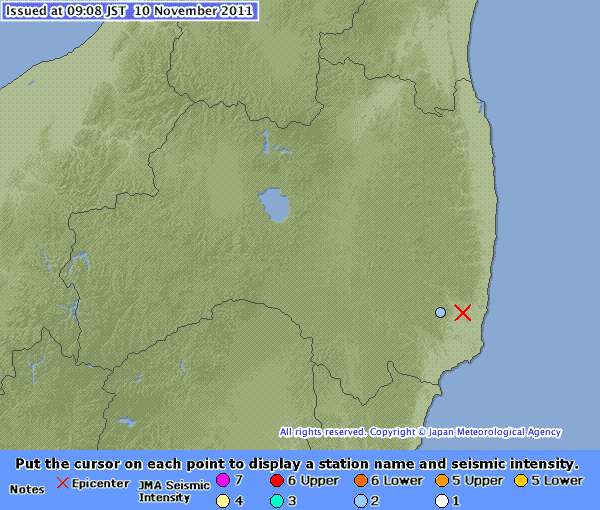 by Edano via Jma.go.jp 11/10/2011 6:28:02 PM
- @Edano
is that on the plant?by elainekirk 11/10/2011 6:33:49 PM


Japan Earthquake | Page 2631
- Who's Blogging
-
 hudebnik
 alblee
 UKVal
UKVal Oliver (ScribbleLive)
 Jonathan Keebler
 Matt (ScribbleLive)
 kaykodh
 PKelley
 Markfm
 dean
dean Angie
Angie- Edano
 Deb
Deb Mid Valley
- Pedro Jesus
 George Gibb
- elainekirk
- lillymunster
- bo
 IanGoddard