Japan Earthquake | Page 2633
 I think they make two really good points beyond the technical theories explained (those are good too). 1. Nuclear scientists need to be involved and TEPCO needs to be removed from the picture. 2. They have to start trying to located the cores.
There have got to be nuclear scientists who would jump at the chance to attempt some tries and this by various means.by lillymunster 11/10/2011 10:01:17 PM- @Edano was wondering if the cooling at one matches what would be expected as decay heat dropping off for the same time period. But there may be too many variables to use that.by lillymunster 11/10/2011 10:02:12 PM

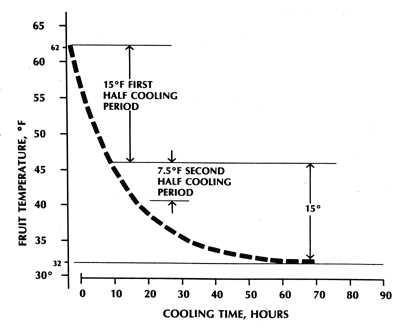
postharvest.tfrec.wsu.edu decay heat curve
by Edano via Postharvest.tfrec.wsu.edu 11/10/2011 10:02:18 PM- Heh, 1's is opposite. :-)by lillymunster 11/10/2011 10:02:44 PM
- the heat curve is ideal, it would look like this if the amount of water would be the same every day.by Edano 11/10/2011 10:04:13 PM
 by Ian 11/10/2011 10:05:31 PM
- Have to run again for a bit. Looking at 9 months out. There are multiple situations.
1. Evacuees and their situation
2. Food, water and air safety issues
3. Hot spots
4. Policies or lack of
5. Unintended consequences - radioactive cars, animals abandoned in the zone etc.
6. Status of the plant itself
7. Regional and worldwide contamination
What else should be included?by lillymunster 11/10/2011 10:05:41 PM - what i mean is, #1 seems to be much easier to cool than 2 and 3. this could be caused by the absence of fuel. and the temperatures of the vessel are very homogenous, there is no difference between upper and lower parts, and that since april. so i vote for no fuel anymore at home.by Edano 11/10/2011 10:08:00 PM
- it is an interesting point that low levels of xenon support the china syndrome theory. normally you would expect a constant level of xenon produced by spontaneous fission. but i have no idea how high such a constant level should be.by Edano 11/10/2011 10:14:39 PM
- if there is still fuel in the reactors, fission products must be detected. if there are no such products anymore ("n.d."), there likely is no fuel anymore.by Edano 11/10/2011 10:16:12 PM
- this is what the article wants to say, basically. :)by Edano 11/10/2011 10:17:38 PM
 @Edano you explain it wellby elainekirk 11/10/2011 10:22:13 PM
- @elainekirk i have problems explaining things in english :) i am better in spanish.by Edano 11/10/2011 10:22:54 PM
- "Heating of the core(s) would be the result of fast fission. Because cores emitting fission products cannot be sub-critical, the low detection levels of these gases is instead likely because the cores are underground."
this passage of the article is wrong for the term "(sub-)critical", but the overall idea is correct, as i pointed out.by Edano 11/10/2011 10:26:20 PM - Crypto thanks good ideas to add.by lillymunster 11/10/2011 10:31:59 PM
- interesting question: was the #3 explosion ex vessel caused by the first concrete-corium reaction ? the lightbulb pressure before the explosion was definitely above design and dropped afterwards.by Edano 11/10/2011 10:45:21 PM
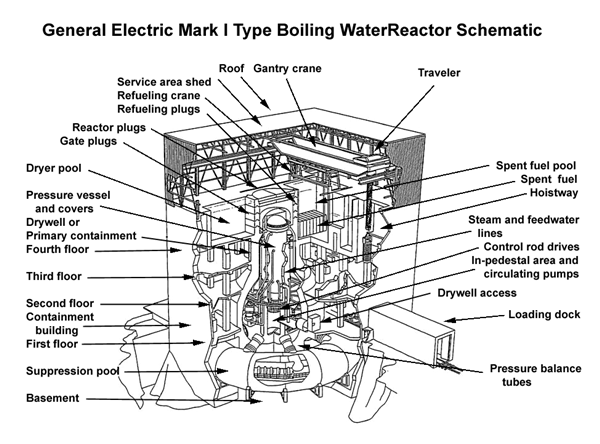 by Edano via Economic-undertow 11/10/2011 10:49:42 PM
- the article has some crucial conclusions:
- as soon as the corium reaches neutron reflecting layers (granite), there is a possibility of a fast chain reaction, which would destroy all 6 daiichi reactors, and the fallout would spread around the entire land of japan (depending on the prevailing winds).
- it is much too early to think about returning of the evacuees.
- there have been no efforts made to localize the corium, and therefore there are no plans for containing it.
- the term "cold shutdown" is not used in a scientific way, but in a PR way, and therefore BS. no matter in what conditions are the reactors, as long as we don't know anything about the corium, there can be no useful roadmap to contain the disaster.
- the feared "second explosion" was anticipated in chernobyl by constructing an underground concrete shell. for some reasons, this is not possible at fukushima. it has to be added, that the concrete shell in chernobyl was not needed because not reached by the corium.by Edano 11/10/2011 11:24:02 PM - @Edano I thought I undertood but I didnt realise just how badby elainekirk 11/10/2011 11:28:58 PM
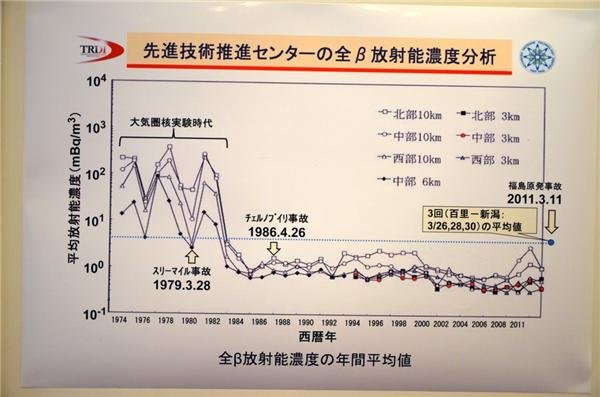
twitpic.com
now the nukies are bullying people with this !by elainekirk via Twitpic 11/10/2011 11:32:34 PM- @elainekirk yes, there are some very concerning details. and tepco is playing blind in ignoring these complications. they just look at their data and say everything is fine.by Edano 11/10/2011 11:32:35 PM
- @elainekirk without knowing what is exactly meant, this paper shows that fuku is worse than chernobyl in some respect.by Edano 11/10/2011 11:36:32 PM

www.mod.go.jp
@elainekirk the graphic stems from here: www.mod.go.jpby Edano via Mod.go.jp 11/10/2011 11:41:33 PM- @Edano have you read the comments under the twitpicby elainekirk 11/10/2011 11:57:57 PM
- @Edano but yes it does show it is worse :)by elainekirk 11/10/2011 11:58:27 PM
- @elainekirk i suppose it is a radiation measuring in japan, so for the japanese of course fuku is worse than chernobyl.by Edano 11/11/2011 12:02:45 AM
- but they are saying this is better than the rad tepco spewed in the 70's and therefore the public should shut up and get on with lifeby elainekirk 11/11/2011 12:08:30 AM
- @elainekirk i think the 70's were the bomb tests in the pacific. :) rather than tepco :)by Edano 11/11/2011 12:10:29 AM
- @Edano yes it is so wrong that the people are being bullied into submission like thisby elainekirk 11/11/2011 12:15:50 AM
- I wish I knew where those readings we taken I will ask rockhopperby elainekirk 11/11/2011 12:16:56 AM
- @lillymunster
“The site of the station covers about 3.5 million square meters (865 acres) and the plants are built on solid bedrock.” www.tepco.co.jp
contradictions ? what is below the plants ? soil ? bedrock ? sponge ?by Edano 11/11/2011 12:17:12 AM - ‘Fourier2020 says:
November 9, 2011 at 12:31 am
Per Tepco’s website:
“The site of the station covers about 3.5 million square meters (865 acres) and the plants are built on solid bedrock.”’
The plants are built on light fill over a thick formation of intercalated lenses of sandy material within mudstones, which are lightly consolidated clays.
Tepco’s use of the term “solid bedrock” is disingenuous in my personal opinion but I have checked out some maps and other documentation.
??? what is correct ?by Edano 11/11/2011 12:19:24 AM - and what is below the clay ? when does solid rock begin ?by Edano 11/11/2011 12:21:05 AM
- The mudstone IIRC is the correct definition. TEPCO started telling the public how it was on bedrock as part of their "everything is fine" campaign.by lillymunster 11/11/2011 12:25:11 AM
- What is the chart down the page further? In Japanese, no clue what it shows.by lillymunster 11/11/2011 12:26:44 AM
 @lillymunster Suggestions to add: 8. Radiation monitoring systems and activities
9. Health findings, hospital and doctor reports
10. Research published in academic journals
11. Decontamination technologiesby Cryptococcus edited by lillymunster 11/11/2011 12:40:45 AM @Edano On page 77 is a diagram on the soils in Fukushima Pref. As much as I can get out of it, it basically consists of peat, clay, gravel and sand (not in that order). Geomorphological Surfaces in the Koriyama Basin Fukushima Pref. ir.library.tohoku.ac.jpby MaryW 11/11/2011 12:45:03 AM
- If I understand correctly, seismic nuclear power plant engineering distinguishes only between rock and soil. Reactors must be built on rock, whatever the composition may be, and other structures can be built on soil. I suppose this led to the confusion. The Daiichi reactor buildings are built on a sedimentary rock called mudstone.by Peter 11/11/2011 12:50:27 AM
- @Peter Tonstein ?by Edano 11/11/2011 12:58:37 AM
- "Misitu says:
November 9, 2011 at 5:57 pm
I am not sure about the plant having been built on “bedrock”, that is, relatively solid dense foundation material, metamorphic or igneous rock or metamorphosed shales and sandstones such as schists and gneisses. Rather it seems that the foundation material is a very thick layer of intercalated mudstones and sandy mudstones (compacted clays and silts) and above is what the Japanese Geol Survey map shows as “Holocene Reclaimed Land” (Holocene = post Ice Age), in this case some sort of screed of light landfill covering the cut made when the hill was excavated to give a nice level platform just some 10m above sea level (reason: cost savings on cooling water pumping)."by Edano 11/11/2011 1:02:42 AM - 'The Sendai Airport's elevation is 2 meters above sea level, partly 7 meters (inland) above sea level'. '...massive tsunami reported to be up to 15 meters (50 feet) high'. The Aviation Herald avherald.comby MaryW 11/11/2011 1:10:54 AM
- Found a wiki on mudstone: en.wikipedia.orgby Peter 11/11/2011 1:13:45 AM
- "Someone failed to note that emergency generators in a basement at sea level might pose an issue"by MaryW 11/11/2011 1:16:19 AM
- Collie in the coal mine, Fukushima dogs www.pbs.orgby lillymunster 11/11/2011 1:39:20 AM
- @All In the article below from the avherald.com, click on the link at the bottom of this article, ed.easa.europa.eu Its a pdf, Adobe. The European Aviation Safety Agency have released information Bulletin 2011-04 for all aircraft stating....Issued on March22.2011 'The Japanese authorities have declared an INES rating of 5 for one of the reactors...' This bulletin also includes numerous link.by MaryW 11/11/2011 1:39:52 AM

Japan Earthquake | Page 2633
- Who's Blogging
-
 hudebnik
 alblee
 UKVal
UKVal Oliver (ScribbleLive)
 Jonathan Keebler
 Matt (ScribbleLive)
 kaykodh
 PKelley
 Markfm
 dean
dean Angie
Angie- Edano
 Deb
Deb Mid Valley
- Pedro Jesus
 George Gibb
- elainekirk
- lillymunster
 bo
bo IanGoddard