Japan Earthquake | Page 2722
 @lillymunster @Edano Too many inconsistencies. Loss in translation? Disinformation? Or is TEPCO, like Lilly said, preparing the public for some real bad news and, in this case, what could be worse than what we have already figured out?by Pedro Jesus 11/30/2011 1:00:40 PM
 @Pedro Jesus we need a more detailed explanation from an expert. the news articles are not exact enough.by Edano 11/30/2011 1:02:18 PM
 @Pedro Jesus I would put translation issue low on the list. Both Kyodo and NHK have pretty good translators and both came from their English editions. Disinformation is always a possibility but who and why?by lillymunster 11/30/2011 1:04:16 PM
- There is an updated countermeasures report for Daini today, none for Daiichi. No other new types of reports. Seawater analysis and plant parameters.by lillymunster 11/30/2011 1:08:31 PM
- Nothing on the JP sideby lillymunster 11/30/2011 1:12:42 PM
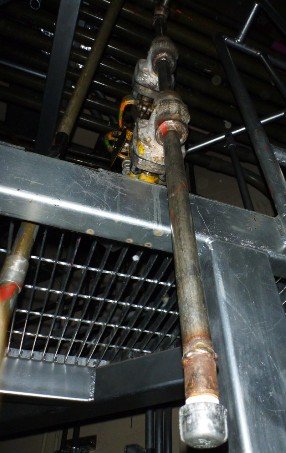
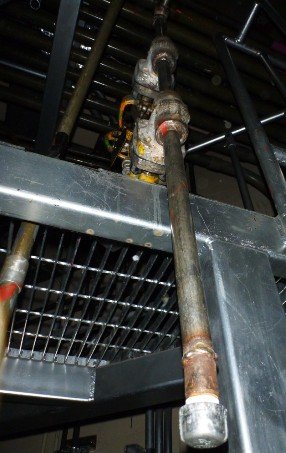
New nitrogen injection www.tepco.co.jp
www.tepco.co.jp
www.tepco.co.jpby lillymunster via Tepco.co.jp 11/30/2011 1:24:51 PM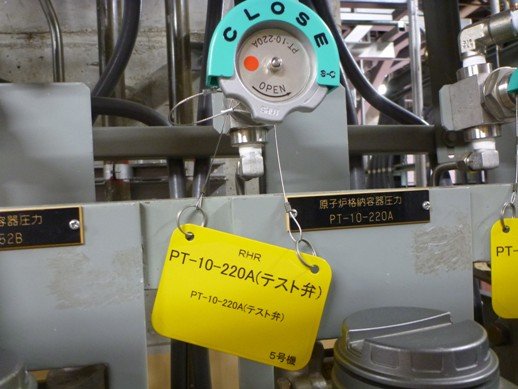
New nitrogen injection www.tepco.co.jp
www.tepco.co.jp
www.tepco.co.jpby lillymunster via Tepco.co.jp 11/30/2011 1:24:51 PM- ENG trans of Yomiuri article on the melted fuel/containment erosion:
TEPCO 30, No. 1-3 for the Fukushima Daiichi Nuclear Power Station of the accident, based on data such as reactor temperature and water, announced the results of core analysis of the situation.
In Unit 1, the worst case, all molten fuel (100%) that penetrate the pressure vessel, containment and fall to the floor, and there is probably a deposition. 57% of the fuel in Unit 2, Unit 3 in the fall may be 63%.
Rigorous analysis of Unit 1 was immediately after the accident in March, about 14 hours suspended injection to the reactor, and for longer than six to seven hours of Unit 2 and 3. The molten fuel is reached at temperatures close to 3000 temporary rather than just a hole in the bottom of a steel pressure vessel, containment concrete floor (1.4 to 2.6 m thick) are also up to 65 cm seems to have eroded. The heat generated from nuclear fuel-fired state were empty, reached twice the amount of heat needed to melt all the equipment inside the pressure vessel, such as fuel and control rods.
( 49 minutes on November 30, 2011 at 20:00 Yomiuri Shimbun)
www.yomiuri.co.jpby lillymunster 11/30/2011 1:35:16 PM  The diagram on the melt-through is misleading. I first thought the rpv had defecated. These reactors do not possess core catchers, and the concrete under the pedestal is several (7?) meters thick. However, it is much thinner near the torus. Perhaps, tepco discovered evidence that the corium reached that location. Tepco regularly draws samples from wells on the plant premises. Perhaps they already detected signature radionuclides in the water that indicate worse to come. At least, they admit now that significant amounts of molten fuel escaped the rpvs.by Peter 11/30/2011 1:42:28 PM
- The U.S. Nuclear Regulatory Commission should expedite a rule requiring plant owners to better prepare for a loss of electrical power, the chairman of an independent advisory panel said.
The NRC staff’s Oct. 3 proposal to establish the rule within 4 1/4 years is “is just way too long for an important action of this type,” Said Abdel-Khalik, chairman of the Advisory Committee on Reactor Safeguards, said today during a meeting at the NRC’s Rockville, Maryland, headquarters.
www.bloomberg.comby M.I.A. 11/30/2011 1:42:44 PM - @Peter i think you are right. the status at #1 is worse than now admitted.by Edano 11/30/2011 1:46:49 PM
- European Union Wants Post-Soviet Members Nuclear Reactors Permanently Offline
oilprice.comby lillymunster 11/30/2011 1:47:18 PM - The "weak spot" of containment is near the Torus. The steel torus vent systems are simply holes in containment. The concrete as it curves up towards these holes has a sand pocket making the lip where the torus vent holes join up with the floor of containment thinner. What is unknown about the fuku units is if the torus vent holes sit directly on the floor line of containment or a few feet above. I saw both when researching this issue. If the torus holes sit up higher you are still only talking 1m of lateral concrete to burn through.
Corium in the Torus area of the building would explain some of the higher than expected radiation levels in buildings or to the environment.by lillymunster 11/30/2011 1:51:22 PM - From FNN translation:
TEPCO on the status of the fuel in nuclear reactors in Fukushima 1, No. 1 in the fall to the molten fuel containment from the pressure vessel, and published estimates of up to 65cm eroded concrete on the bottom.
In the estimation results published by TEPCO, the No. 1, fell to the containment from the pressure vessel is a significant amount of fuel in Unit 3 and Unit 2, which says that it has fallen into the containment portion of the fuel.
In Unit 1, dropped a chunk of fuel, although it is estimated that up to 65cm to erode the bottom of the concrete containment vessel, to penetrate the containment vessel had not been reached.
Video in the link
www.fnn-news.comby lillymunster 11/30/2011 2:04:40 PM - 47 news translation:
TEPCO 30, fuel melting accident at Unit No. 1 nuclear power plant in Fukushima 1-3, the outer containment leakage from the reactor pressure vessel was originally decomposed by heat at the bottom of the concrete containment vessel, announced the results of 65 cm and the maximum erosion damage in the most intense Unit 1. The steel containment vessel had not been reached.
In the analysis, an earthquake on March 11, fuel will melt cooling effect is lost after the tsunami hit, 100% in Unit 1, Unit 2 and 3 in the pressure vessel from an original position about 60% Assuming you fall to the bottom.
Unit 1 at the pressure vessel is damaged, fall into a considerable amount of fuel containment. Eroded the concrete fell into the bottom of the fuel.
www.47news.jpby lillymunster 11/30/2011 2:10:00 PM 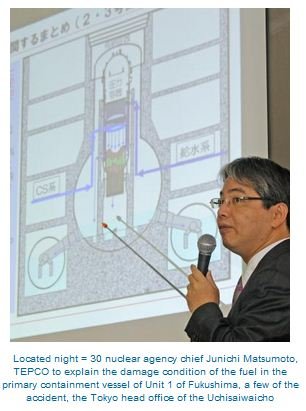
TEPCO press conf photo. Notice torus vent location in illustration
by lillymunster 11/30/2011 2:11:05 PM- @lillymunster again, a different illustration. here we have steps in the containment bottom. and where is the steel lining ? on the inside or the outside of the concrete ?by Edano 11/30/2011 2:14:03 PM
- Radioactive pollack from Hokkaido shows up in S. Korean food market sankei.jp.msn.comby lillymunster 11/30/2011 2:19:07 PM
- @Edano there is a darker line representing the steel liner on the inside and embedded into the concrete floor. The dips in the containment floor, this is the first I have seen this anywhere. Photos of inside unit 5 show a flat floor in the pedestal with the machinery for the control rods in the middle.by lillymunster 11/30/2011 2:20:09 PM
- Japan nuke accident plan still inadequate www.bloomberg.comby lillymunster 11/30/2011 2:37:55 PM
 Japan: Fukushima Dai-ichi Meltdown Deeper Than Previously Thought
www.huffingtonpost.comby Panserbjorne9 11/30/2011 2:59:17 PM- Farmer who unknowingly shipped radioactive rice says prefecture's testing not enough
mdn.mainichi.jpby Panserbjorne9 11/30/2011 3:02:55 PM  It seems that Tepco is admitting full melt-through at Unit 1, the graphic shows that : www.youtube.com/watch?v=on1veYU5npM#t=0m38s The google-translation of that video title is: Almost no fuel in the pressure vessel of Unit 1 nuclear power plantby Ian 11/30/2011 3:17:57 PM
- Here's the video link again: www.youtube.comby Ian 11/30/2011 3:18:37 PM
- Reactor #1 translation by Mochizuki @ Fukushima Diary: "They (TEPCO) assume the melted fuel is sinking to about 65cm depth of the concrete on the bottom of the containment vessel. Please note that there is only 37 cm left to the body of the container vessel." NHK:Over half of fuel has melted out of containment vessel says TEPCO's assumed worst scenario. --- Happening Now: US media only mentions about melt-through at reactor No. 1, not melt-outs at No 2 and 3. WSJ source: "...(reactor #1) such intensity that it eroded through 2 meters of the 2.6 meter concrete base". enenews.comby MaryW 11/30/2011 3:24:43 PM
- All of these TEPCO reports don't state how they assumed this and the assumption seems to be straight down melt through. The BWR disaster manual Dean found that I took notes on states the high probability of at least some lateral movement, damage to the pedestal etc. www.simplyinfo.orgby lillymunster 11/30/2011 3:28:34 PM
- So if there is 37 cm of concrete left is the lower side of the corium that has contact with the concrete still hot enough to continue burning concrete and at what rate?by lillymunster 11/30/2011 3:30:27 PM
- @lillymunster And I believe that is only an assumption. There could be less than the 37 cm left.by MaryW 11/30/2011 3:31:21 PM
- In the Wall Street Journal article (which Fukushima-Diary is using for source) only .6 meter of concrete base left. I am not a whiz when it comes to metric measurements, but Looks more like 1/4 left.by MaryW 11/30/2011 3:36:02 PM
- My guesstimate is another 3 months and a total melt-through scenario.by MaryW 11/30/2011 3:38:01 PM
- @MaryW IF that is the case the next question is how fast the corium might move when it hits soil. Is the ground saturated enough to make a steam explosion or the reflection theory where it could create a criticality?by lillymunster 11/30/2011 3:45:13 PM
- @lillymunster I remember Dean had some data on concrete melt through. He might be able to answer that based upon those official simulations. But according to them, melt through concrete would happen very quickly, like in a few weeks from the accident. According to those simulations, or for what I understood of them, core won't melt through concrete for so long because it gets colder and colder down to the point where temperature is not enough to corrode any more concrete. Ask Dean when he shows up.by Pedro Jesus 11/30/2011 3:45:32 PM
- NRC email notice about concrete degredation
The U.S. Nuclear Regulatory Commission (NRC) is issuing this information notice (IN) to inform
addressees of the occurrence of alkali-silica reaction (ASR)-induced concrete degradation of a
seismic Category 1 structure at Seabrook Station. The NRC expects that recipients will review
the information for applicability to their facilities and consider actions, as appropriate, to avoid
similar problems. However, suggestions contained in this IN are not NRC requirements;
therefore, no specific action or written response is required.by lillymunster 11/30/2011 3:47:34 PM - @Pedro Jesus hopefully Dean remembers or can point us to the documents with the calculationsby lillymunster 11/30/2011 3:48:14 PM
- Does anyone know how many feet above sea-level are the reactors?by MaryW 11/30/2011 3:49:52 PM
- @MaryW the basements, ground or?by lillymunster 11/30/2011 3:51:17 PM
- geography of land or ground...by MaryW 11/30/2011 3:53:02 PM
- @MaryW lookingby lillymunster 11/30/2011 3:54:32 PM
- I THINK "OP of 0" = sea level. Tried to find a confirmation online and can't. The reactor blueprints show the grade (land) level near the reactor buildings to be OP 10000 (millimeters) or about 32 feet plus 9 inches above sea level.by lillymunster 11/30/2011 4:01:00 PM
- I was just thinking, complete melt-through may end up in the Pacific Ocean pretty quick :)by MaryW 11/30/2011 4:02:58 PM
- Someone posted a few weeks back on the Windscale fire/accident in Great Britain, Oct 1957. Here is a personal visual examination by plant operator, Tom Hughes, into the reactor, "fuel glowing bright cherry red". His interview at... en.wikipedia.orgby MaryW 11/30/2011 4:09:12 PM
- @MaryW they have claimed a portion of the water issues at the plant is groundwater being so high.by lillymunster 11/30/2011 4:19:48 PM
- '..."all reactor cores are ex-vessel" due to time without cooling' VIDEO of briefing June 15.2011, NRC enenews.comby MaryW 11/30/2011 4:42:02 PM
- RSOE EDIS Alert Map: Environment Pollution in Taiwan on Wednesday, 30 November 2011. Event Description:...amounts of radioactivity outside the nuclear waste storage space on Orchid Island...cobalt-60...cesium-137... I wonder if yesterday's 6 mag earthquake in the Philippines had anything to do with this 'leak'? hisz.rsoe.huby MaryW 11/30/2011 5:02:40 PM
- I am trying to piece something together on these melt through stories from today. I don't know if we have enough data to really do anything with TEPCO's claim. Maybe it is just PR as in either disinformation or foreshadowing an upcoming admission.
Are there any China Syndrome studies beyond theoretical? IIRC there has never been such an accident or small scale simulation of one?by lillymunster 11/30/2011 5:04:24 PM
Japan Earthquake | Page 2722
- Who's Blogging
-
 hudebnik
 alblee
 UKVal
UKVal Oliver (ScribbleLive)
 Jonathan Keebler
 kaykodh
 PKelley
 Markfm
 Angie
Angie Deb
Deb Mid Valley
- Pedro Jesus
 Matt (ScribbleLive)
 George Gibb
 elainekirk
- lillymunster
 dean
dean bo
bo- Edano
 IanGoddard