Japan Earthquake | Page 2753
 Kansai Electric reactor shut down at Mihama
The operator of the Mihama nuclear power plant in western Japan says it has shut down one of 3 reactors because of an ongoing leak of radioactive water within the reactor.
Kansai Electric Power Company says work began on Wednesday night to manually shut down the number-2 reactor at Mihama in Fukui Prefecture. It was completed as of 4 AM on Thursday.
The utility says radioactive water has been leaking from a valve in the pressure vessel into the collection tank since early November. It says there is a risk that the water will exceed the processing capacity of the tank.
The company says all the leaked water has been collected into the tank within the reactor, and that the leakage has caused no damage to the environment.
The reactor was scheduled to be shut down on December 18th for a regular checkup.
The suspension means that 46 of the country's 54 reactors, or 85 percent of them, are currently out of operation.
Thursday, December 08, 2011 05:02 +0900 (JST)
www3.nhk.or.jpby Edano 12/8/2011 10:21:08 AM- UPDATE1: TEPCO mulling release of low-level radioactive water in sea
TOKYO, Dec. 8, Kyodo
Tokyo Electric Power Co. said Thursday it is considering releasing into the Pacific Ocean low-level radioactive water now stored in tanks at the premises of its crippled Fukushima Daiichi nuclear power plant as storage capacity may run short by next March.
The plant operator known as TEPCO said the water would be released only after it clears the country's legal concentration limit of radioactive substances, including cesium and strontium, but a fisheries group immediately expressed strong concerns.
The National Federation of Fisheries Cooperative Associations filed a protest against the plan with TEPCO, saying it cannot accept such an action that could affect the fishing industry by lowering fish consumption.
Nobutaka Tsutsui, senior vice minister for agriculture, forestry and fisheries, said at a press conference he cannot approve of the plan.
He said he has already asked Tadahiro Matsushita, senior vice minister for economy, trade and industry which oversees the nuclear industry, to reconsider the TEPCO plan and will work on relevant parties to prevent TEPCO from implementing the plan.
The plant has been plagued with highly radioactive water accumulating inside reactor turbine buildings as a result of the continuing injection of water to cool the stricken Nos. 1 to 3 reactors.
The water is currently recycled as a coolant after reducing its radioactive level through a water processing facility, installed after the plant was hit by the March 11 earthquake and tsunami.
But as about 200 to 500 tons of groundwater a day flows into the reactor turbine buildings, the amount of water that is processed has exceeded that needed for injection into the reactors, according to TEPCO spokesman Junichi Matsumoto.
He said the capacity of tanks installed at the plant's premises is expected to total 15.5 tons but there is a possibility the capacity would fall short possibly by early March.
''We cannot keep on increasing the number of tanks in the next year or two. So we're considering the possibility of releasing water into the sea,'' Matsumoto told a press conference.
The water processing facility reduces the amount of radioactive cesium, but does not remove radioactive strontium, which tends to accumulate in bones and is feared to cause bone cancer and leukemia.
TEPCO has not only accidentally released highly radioactive water into the sea after the nuclear crisis, but also intentionally dumped low level radioactive water as an emergency measure in April, drawing concerns from neighboring countries.
In another accidental case, TEPCO said Tuesday that around 150 liters of processed water has flowed into the sea. The water is estimated to contain strontium, it said.
==Kyodo english.kyodonews.jpby Edano 12/8/2011 10:22:58 AM - 300 campaigners file suit to suspend nuclear plant operation in Ehime
MATSUYAMA, Japan, Dec. 8, Kyodo
About 300 campaigners filed a lawsuit Friday in Ehime Prefecture demanding Shikoku Electric Power Co. suspend the operation of its nuclear power plant in the town of Ikata in the prefecture.
The plaintiffs from Ehime and 15 other prefectures argue that the plant site is vulnerable to landslides and at risk of being hit by a devastating earthquake due to its proximity to a major fault line.
They said the power plant should not operate unless the government takes steps to ensure its complete safety because the disaster at the Fukushima Daiichi nuclear power plant showed that government safety standards there were flawed.
At present, the Nos. 1 and 3 reactors at the Ikata plant are undergoing regular checkups and the No. 2 unit is due for a similar test in January. Shikoku wants to restart the No. 3 reactor at an early date.
''Local citizens are anxious (about the Ikata plant),'' said Nobuo Komoda, leader of the legal counsel representing the plaintiffs. ''Nobody can predict when an earthquake strikes so we want the operation of the plant suspended in advance.''
Shikoku Electric said in a written statement that sufficient safety measures are in place at the Ikata plant so there is no need to suspend operations there.
==Kyodo english.kyodonews.jpby Edano 12/8/2011 10:24:19 AM - Lower house panel seeks cut in budget for prototype nuclear reactor
TOKYO, Dec. 8, Kyodo
The House of Representatives' audit panel called on the government Thursday to reduce spending on development of the country's prototype fast-breeder reactor Monju and of its nuclear fuel cycle program.
The Audit and Oversight of Administration Committee unanimously passed the nonbinding resolution, which also urges the government to file a progress report to the committee within six months on government actions in response, such as when compiling the fiscal 2012 budget and revising nuclear power policies.
The lower house panel passed the resolution in response to a package of proposals, worked out in November by lawmakers, for a thorough review in the government's energy policies.
Committee chairman Yoshitaka Shindo, who is a member of the main opposition party, the Liberal Democratic Party, will send the resolution to Cabinet ministers, lawmakers said.
Chief Cabinet Secretary Osamu Fujimura, speaking at the day's committee session, said the government will respect the resolution and act properly.
Committee members said the panel will adopt another resolution and press the government to cut spending if the government's action is insufficient.
The Monju fast-breeder reactor, located in Tsuruga, Fukui Prefecture and operated by the state-run Japan Atomic Energy Agency, has been expected to play a key role in establishing Japan's nuclear fuel cycle. It was intended to use spent fuel from nuclear reactors and produce more nuclear fuel than it consumed. But the Monju reactor has long been plagued with a series of troubles.
The panel's resolution said the government should look into the Monju project's validity and reduce spending on it.
The resolution, referring to the state budget for all nuclear programs, called for shifting the focus to improving safety and reviewing the country's nuclear development policy.
It also called for the government to reduce costs in supercomputer development and to make new rules on the selection of supercomputer users, while urging a sharp spending cut on housing for public servants.
On Nov. 16 and 17, a subcommittee of the lower house audit panel screened the government's various projects.
==Kyodo english.kyodonews.jpby Edano 12/8/2011 10:24:58 AM - Kansai Electric shuts nuclear reactor on malfunction
TSURUGA, Japan, Dec. 8, Kyodo
Kansai Electric Power Co. said Thursday it has shut down the No. 2 nuclear reactor at its power plant in Mihama, Fukui Prefecture due to technical trouble.
The shutdown may further tighten the power supply of the company, which is expected to face shortages this winter, as only two reactors -- the No. 2 unit at the Oi plant and the No. 3 unit at the Takahama plant -- are in operation among 11 reactors in the prefecture run by the utility.
The Oi unit and the Takahama unit are scheduled to go offline, respectively, on Dec. 16 and in February for periodic checkups, according to the utility.
At the Mihama plant's No. 2 reactor, a malfunction of a pressure valve had caused leakage of cooling water. The utility started shutting the reactor manually Wednesday as the amount of leaked water was about to exceed the processing capacity of the plant's wastewater treatment system.
The No. 2 reactor will undergo a regular checkup on Dec. 18 as scheduled.
==Kyodo english.kyodonews.jpby Edano 12/8/2011 10:26:18 AM - Fukushima governor apologizes over cesium-tainted rice
FUKUSHIMA, Japan, Dec. 8, Kyodo
Fukushima Gov. Yuhei Sato apologized to consumers on Thursday over the excessive levels of radioactive cesium found in rice harvested in three cities in the nuclear crisis-hit prefecture, less than two months after he declared this year's crop safe for shipment.
Sato admitted at the prefecture's emergency response headquarters meeting that earlier inspections had been imperfect, saying, ''I reflect on the fact that we should have asked extensively for expert opinions on how to monitor (the contamination levels) in areas with high airborne radiation.''
The governor said he hopes to work with the central government, universities and other parties concerned to investigate the cause of the contamination.
Meanwhile, Mayor Keiichi Miho of Nihonmatsu, where cesium-tainted rice was detected a day earlier, expressed his anger at a news conference and said, ''All this time we have been urging the central and prefectural governments to conduct blanket screening of the rice.''
Miho said he will call on manufacturers to develop equipment that can conduct radiation checks speedily, as he believes contaminated rice may have slipped through tests conducted so far.
The prefecture, which hosts the radiation-leaking Fukushima Daiichi nuclear plant, declared in mid-October that newly harvested rice there is safe for shipment after tests showed all samples cleared the government-set allowable limit for radioactive cesium, with 80 percent of the samples found to be completely free of contamination.
But by November, excessive levels of contamination were found in the cities of Fukushima and Date, prompting Sato to ban shipments from those areas, followed by detection of cesium in Nihonmatsu on Wednesday.
==Kyodo english.kyodonews.jpby Edano 12/8/2011 10:27:08 AM - Chugoku Electric to set up quake-proof building at Shimane plant
MATSUE, Japan, Dec. 8, Kyodo
Chugoku Electric Power Co. said Thursday it will set up a quake-proof emergency response building at the Shimane nuclear power plant in the western Japan city of Matsue, Shimane Prefecture, in light of the Fukushima nuclear accident.
The Shimane plant already has an emergency response room in an existing building to be used in a crisis, but the utility decided that a new building exclusively designed for use in the event of earthquake and nuclear accidents is necessary after seeing such a building has been effectively used as the headquarters for containing the ongoing crisis at the crippled Fukushima Daiichi nuclear power plant.
The three-story building will be set up on ground higher than 15 meters from sea level to avoid damage from tsunami and will be equipped with air conditioning to reduce radioactive materials and its own power-supply system, according to Chugoku Electric.
The utility plans to begin constructing the building in fiscal 2013 and start its operation by March 2015.
==Kyodo english.kyodonews.jpby Edano 12/8/2011 10:28:02 AM  Morning, have a pile of news to post. Will be back in a few mins.by lillymunster 12/8/2011 12:30:04 PM
- Cesium-laced baby formula sparks concern, but risk low www.japantimes.co.jp
More information on the Woods Hole Ocean study post Fuku www.redorbit.com
TEPCO and 4 more power cos sign on to buy LNG from Austrailia mdn.mainichi.jp
Yoko Ono visits Fuku mdn.mainichi.jp
Turkey still wants JP nuke plants mdn.mainichi.jp
Checking up on elderly in disaster area www.bellinghamherald.comby lillymunster 12/8/2011 12:59:21 PM - TEPCO exec non-committal on liability ajw.asahi.com
Compensation plan criticized for lack of rationale
mdn.mainichi.jp
Govt panel split on ending nukes
mdn.mainichi.jp
TEPCO stock tanks on nationalization announcement
www.bloomberg.comby lillymunster 12/8/2011 1:08:50 PM - So will TEPCO's nationalization mean the govt. will have a hand in running things or will it be business as usual?by lillymunster 12/8/2011 1:09:13 PM
 Eastern Japanese are starting to have bruise on their bodies: This kind of posts will be “unconfirmed” forever.
A Japanese citizen talked about his own symptoms on a Japanese forum.
In his case ,a bruise appeared on his stomach and it does not hurt even if he touches it.
This is only one of the many cases posted on the internet.
I expect someone who got through Chernobyl or has radioactive medical knowledge to see this picture. fukushima-diary.comby Majj 12/8/2011 1:48:41 PM- Torus in 1 and 3 may likely also be broken. With steam coming up out of basements and unit 3's steam shows it used to have, he is probably right IMHO ex-skf.blogspot.comby lillymunster 12/8/2011 1:55:11 PM
- Radiation dosimeters givent to school children results in. The machine translation is a bit hard to read but it looks like many are beyond the "goal" readings.
Cumulative dose: first published measurements of elementary Koriyama
Updated 38 minutes at 20:00, 8 December 2011: December 08, 3:22 minutes
Koriyama City, Fukushima Prefecture, 08, published the first measurement of the cumulative radiation dose of about one month to the city for all school children. Average of 33 days from October 05 is 0.12 mSv, 1.33 mSv was equivalent to a year. Annual radiation exposure in the school's efforts to target the Ministry of Education is 1 mSv. The maximum value of 0.45 mSv in terms of one year and 4.98 mSv. [Minoru Ota, Kenji Kimura]
Measured is 55,510,002 people and special needs schools students in primary and secondary schools in the city. Measurement period was measured for 24 hours until 33 days from November 06 October 05 dosimeters were distributed compact city equation badge. Minus 0.06 mSv in a period of significant amounts of natural radiation exposure from measured values of the cumulative dose.
The distribution of measurement results are 56.66 million people from 0.10 to 0.19 mSv = 1 (61.31%) less than 8363 people = ▽ 0.1 mSv (32.73%) ▽ 0.20 ~ 0 .29 mSv = 1459 people (5.71 percent) ▽ 0.30 ~ 0.39 = 59 mSv (0.23 percent) ▽ 0.40 ~ 0.45 mSv = 4 (0 .02%). Less than 0.2 mSv was 94 percent. Dose measurements are continued.
According to Koriyama, request consideration of measurement results from the City of nuclear emergency response advisor Toshiaki Ohkubo, president of the Radiation Effects Research Foundation. "Everyone, no health effects level" and that were evaluated. Children. Personal data of 08 students, their parents were notified.
The city Board of Education School Management Division "measured data, comparing with the table we record an individual's life, you want leverage to reduce radiation exposure," he said.
◇
Ministry of Education, April 19, and 1 to 20 millisievert per year to estimate the radiation dose of Fukushima Prefecture in schools, outdoor activities if more than 3.8 micro-Sieverts per hour limit was calculated back from Set the reference value of the interim limit. Then, since progress in soil decontamination and removal process, on August 26 was abolished as a criterion of 3.8 micro sievert. From May, the dose received by students from the school as "less than 1 millisievert per year rule" and has set a goal. Monitoring of school gardens in Fukushima 1715, an average of 0.1 micro sievert per hour in October, just a dose of the school was expected to be 0.2 mSv per year.
The results of Koriyama, ministry officials, "including the dose of the whole life time outside tend to stay in high school. 努Metai dose reduction measures to expand the scope of such children through decontamination," he said that. [Minoru Ota, Kenji Kimura]
mainichi.jpby lillymunster 12/8/2011 2:02:03 PM - Fisherman slam plan to release TEPCO water www.japantimes.co.jpby lillymunster 12/8/2011 2:07:48 PM
 by Ian 12/8/2011 2:19:10 PM
- by Ian 12/8/2011 2:21:10 PM
- @all. Simply Info is starting to show up in some of the web category google news feeds. :-)by lillymunster 12/8/2011 2:27:22 PM
- @Ian any idea where we can get the full documentary. That looks really good!by lillymunster 12/8/2011 2:32:32 PM
- @lillymunster, I don't know. I posted that question to the short teaser version at ChrisNolandTV.by Ian 12/8/2011 3:26:35 PM
- @Ian I hope we can get an answer. Looks good. I wish more media would talk to the evacuees. They seem to be able to give the true story about what is going on you can't get otherwise.by lillymunster 12/8/2011 3:27:37 PM
- Honeywell Ion product used to remove cesium from water at Fuku www.prnewswire.comby lillymunster 12/8/2011 4:15:04 PM
- This says the honeywell product removes cesium & stronium. So why was the treated leaking water still full of stronium? www.uop.comby lillymunster 12/8/2011 4:16:43 PM
- “Radioactive substances come from the ground, from the river bottom” says hotel manager near Fukushima no-go zone — Local Official: “The gov’t is a liar” . “It’s invisible substances,” said Sumiko Goto, a manager of a hotel filled with engineers, officials and construction workers who’ve been there for months cleaning up the wreckage that inundated everything within a kilometer of the shoreline. “It’s in the air, in the river, on the walls,” she said. “People are very anxious about the situation. Radioactive substances come from the ground, from the river bottom.” [...] enenews.comby Majj 12/8/2011 4:18:40 PM
- Greenpeace article with details of their investigation in Fukushima City www.greenpeace.orgby lillymunster 12/8/2011 4:50:37 PM
 In my opinion, my question from yesterday was answered today when TEPCO's shares/stock plummeted with the news of Japan government plans to place TEPCO under its control. 'TEPCO has been the government's puppet' to take blame for Fukushima's catastrophe. And now Japan government can buy TEPCO at less than market value. Looking back, TEPCO's President Masataka Shimizu wanted his staff to walk out/ evacuate the Fukushima facility on March 15th. And Kan rejected TEPCO's request. www.abc.net.au www.japantimes.co.jpby MaryW 12/8/2011 5:40:17 PM
- @MaryW If the debt owed for compensation and the plant is far more than TEPCO's assets the govt doesn't gain anything. TEPCO execs may have found a way to subside some liability as Japan now pretty much owns TEPCOby lillymunster 12/8/2011 5:58:07 PM
- CERN to announce Higgs boson research results
Physicists at the European Organization for Nuclear Research, or CERN, is set to announce the results of their search for the theoretically predicted particle known as the Higgs boson.
Two CERN scientist groups, one involving many Japanese researchers, plan to make the announcement at a news conference in Switzerland on December 13th.
The groups used a circular accelerator 27 kilometers in circumference to have protons collide into each other at nearly the speed of light to observe a variety of resulting particles.
In experiments conducted through October, the scientists are believed to have found a particle whose mass is comparable to that of the Higgs boson.
Standard physics theory says the universe are full of Higgs bosons, and that collisions between them and elementary particles gave form to mass.
The Higgs boson is the only particle whose presence has yet to be proven in modern physics.
The news conference is scheduled to begin at 2 PM next Tuesday, Central European Time, and be shown live on the Internet.
Thursday, December 08, 2011 20:11 +0900 (JST)
www3.nhk.or.jpby Edano 12/8/2011 6:22:18 PM - ooops they found it ???by Edano 12/8/2011 6:22:33 PM
- @lillymunster: The government of Japan will not be blamed for the worst nuclear disaster in earth's history. Thus the nuclear industry remains safe, to continue in the eyes of the world. In regards to compensation, it became the Japanese taxpayer's money when Japan's government approved the over $60 billion plan to 'bail out' TEPCO. Japan's Government Approves Tepco compensation scheme. May 13.2011 www.bbc.co.ukby MaryW 12/8/2011 6:23:30 PM
- There will forever by theories and speculations on the March 11 2011 Japan Earthquake and Fukushima.by MaryW 12/8/2011 6:30:45 PM
- @MaryW True, in people's minds it is TEPCO's fault with blame focused on them. In the US there was an industry push to blame the disaster on Japanese safety and design. Never mind unit 1 was 100% designed and built by GE as Japan's first commercial reactor and had a decreasing hand in the build & design of all the other units. But via the media they partially succeeded in getting the public in the US to ignore the blaring problem that the exact same technology exists here and our safety is just as bad.by lillymunster 12/8/2011 6:36:35 PM
- be back later, watching shooting at Virginia techby MaryW 12/8/2011 6:41:43 PM
- @MaryW ??by lillymunster 12/8/2011 6:42:44 PM
- OMG mary you were not kidding!
RT @CollegiateTimes: Police officer is dead in Coliseum Lot near McComas Hall.by lillymunster 12/8/2011 6:43:30 PM - Breaking: suspect being apprehended on steps of performing arts building on College Aveby lillymunster 12/8/2011 6:44:04 PM
- by lillymunster 12/8/2011 6:45:04 PM
- UPDATE: #VATech Reports say a suspect has been apprehended in Virginia Tech shooting. wj.la
Students are reporting shots near Torgersen Hallby lillymunster 12/8/2011 6:47:10 PM - TEPCO considering 10% rise in electricity bills: sources
TOKYO, Dec. 9, Kyodo
Tokyo Electric Power Co. is considering temporarily raising electricity charges by 10 percent from the fall of 2012 and seeking the restart from the spring of 2013 of nuclear reactors in Niigata Prefecture suspended for checkups, sources close to the matter said Thursday.
The plans are intended to restore the utility's finances, which may remain distressed even if the company receives public funds, given increasing fuel costs caused by boosting thermal power generation in the wake of the nuclear crisis at its Fukushima Daiichi power plant.
But it is not certain whether permission would be granted either to raise electricity charges given harsh public sentiment toward the company known as TEPCO, or to restart reactors in the face of strong public concern over the safety of nuclear power plants.
Hiking electricity charges, for what is currently expected to be a three-year period, would require the permission of the economy, trade and industry minister.
TEPCO plans to eventually end the electricity bill hikes, depending on how far it can trim costs by restarting reactors at its Kashiwazaki-Kariwa plant in Niigata.
Only two of the 17 nuclear reactors owned by TEPCO are currently operating. And even those two, at the Kashiwazaki-Kariwa plant, will be suspended for regular checkups by March next year, a move that will cast a darker shadow over TEPCO's business conditions.
Thus TEPCO wants to seek to restart all seven reactors at the Kashiwazaki-Kariwa plant during the period from the spring of 2013 to the spring of 2014, the sources said.
So far, the government has decided to provide to TEPCO a total of 891 billion yen in financial assistance from the state-backed Nuclear Damage Liability Facilitation Fund. But that money is only to be used to pay compensation for the damage caused by the Fukushima Daiichi plant disaster, while the utility is believed to need massive additional funds to scrap crippled nuclear reactors there.
TEPCO and the state-backed fund are separately considering strengthening TEPCO's financial standing by 3 trillion yen over the next four business years through an injection of public funds and additional bank lending.
But the utility could still face fund shortages unless the operational finances of its electric business improve.
As part of efforts to win public understanding of electricity bill hikes, an idea TEPCO presented in September but retracted later, TEPCO and the Nuclear Damage Liability Facilitation Fund plan to review current electricity charges after a third-party panel suggested TEPCO may have been passing on unnecessarily high business costs to consumers for years.
Under the country's so-called ''full-cost'' electricity pricing system, utilities are basically allowed to pass on personnel, fuel, facility repair and various other costs plus a certain margin to consumers.
But the panel found that TEPCO's estimate of electricity business costs exceeded actual spending by some 600 billion yen over the last 10 years.
==Kyodo english.kyodonews.jpby Edano 12/8/2011 6:49:30 PM - UDPATE1: Fukushima governor apologizes over cesium-tainted rice
FUKUSHIMA, Japan, Dec. 8, Kyodo
Fukushima Gov. Yuhei Sato apologized to consumers on Thursday over the excessive levels of radioactive cesium found in rice harvested in three cities in the nuclear crisis-hit prefecture, less than two months after he declared this year's crop safe for shipment.
Sato admitted at the prefecture's emergency response headquarters meeting that earlier inspections had been imperfect, saying, ''I reflect on the fact that we should have asked extensively for expert opinions on how to monitor (the contamination levels) in areas with high airborne radiation.''
The governor said he hopes to work with the central government, universities and other parties to investigate the means of the contamination. The prefectural government has been measuring radiation levels in agricultural products, soil and water at all farming households in Fukushima.
Later in the day, the government banned shipments of rice harvested in an area of Nihonmatsu in Fukushima Prefecture, following the detection of excessive levels of radioactive cesium in samples taken at a farm in the city.
The Fukushima prefectural government said Wednesday the cesium in the rice samples taken at the Nihonmatsu farm measured 780 becquerels per kilogram, against the provisional 500-becquerel limit. None of the rice from the farm has been shipped to markets.
The central government had banned shipments of rice produced in two other cities in Fukushima after similar contamination was reported. The latest ban affects 248 rice farming households in Nihonmatsu.
Nihonmatsu Mayor Keiichi Miho expressed his anger at a news conference Thursday, saying, ''All this time we have been urging the central and prefectural governments to conduct blanket screening of the rice.''
Miho said he will call on manufacturers to develop equipment that can conduct radiation checks speedily, as he believes contaminated rice may have slipped through tests conducted so far.
The prefecture, which hosts the radiation-leaking Fukushima Daiichi nuclear plant, declared in mid-October that newly harvested rice there is safe for shipment after tests showed all samples cleared the government-set allowable limit for radioactive cesium, with 80 percent of the samples found to be completely free of contamination.
But by November, excessive levels of contamination were found in the cities of Fukushima and Date, followed by detection of cesium in Nihonmatsu on Wednesday.
On Thursday, the prefectural government said it also found excessive levels of radioactive cesium in rice harvested at two additional farms in Date.
==Kyodo english.kyodonews.jpby Edano 12/8/2011 6:50:44 PM 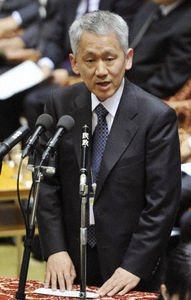
english.kyodonews.jp
Nobel laureate Tanaka in Fukushima probe panel
Nobel chemistry laureate Koichi Tanaka speaks in the Diet in Tokyo on Dec. 8, 2011, after assuming a post as a member of a panel probing the causes of the disaster at the Fukushima Daiichi Nuclear Power Station. (Kyodo) english.kyodonews.jpby Edano via English.kyodonews.jp 12/8/2011 6:52:11 PM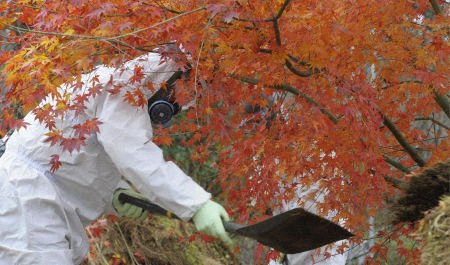
english.kyodonews.jp
SDF member decontaminates Fukushima
A member of Japan's Self-Defense Forces removes soil near the Tomioka town hall in Fukushima Prefecture on Dec. 8, 2011. SDF members have been mobilized to help decontaminate areas tainted with radioactive substances emitted by the Fukushima Daiichi Nuclear Power Station. (Kyodo) english.kyodonews.jpby Edano via English.kyodonews.jp 12/8/2011 6:53:35 PM- a hi tek shovel.by Edano 12/8/2011 6:54:33 PM
- @Edano I wonder what the SDF people doing the work think about it.by lillymunster 12/8/2011 6:55:09 PM
- @lillymunster soldiers are not supposed to think.by Edano 12/8/2011 6:55:41 PM


Japan Earthquake | Page 2753
- Who's Blogging
-
 hudebnik
 alblee
 UKVal
UKVal Oliver (ScribbleLive)
 Jonathan Keebler
 kaykodh
 PKelley
 Markfm
 Angie
Angie Deb
Deb Mid Valley
- Pedro Jesus
 Matt (ScribbleLive)
 George Gibb
 elainekirk
- lillymunster
 dean
dean bo
bo- Edano
 IanGoddard