Japan Earthquake | Page 2768
 Fukushima releases radiation checkup results
Japan's Fukushima Prefecture says a survey shows that radiation exposure levels among residents near the damaged nuclear plant are low, with little health impact.
The prefecture has been checking the health of its nearly 2-million residents, focusing on estimates of their external radiation exposure during the 4 months since the accident at the Fukushima Daiichi nuclear plant.
On Tuesday, the prefecture released the results for 1,727 people in Namie Town, Iitate Village and a district in Kawamata Town. The municipalities are 10 to 50 kilometers from the plant.
Fukushima says 1,675, or 97 percent, of the people are thought to have been exposed to less than 5 millisieverts of radiation. 1,084 people are thought to have been exposed to less than one millisievert -- the government's safety limit for one year.
Nine people are thought to have been exposed to 10 millisieverts or more. Five of them are nuclear plant workers, among whom the highest level was 37 millisieverts. Of other 4, one who repeatedly visited an evacuation zone was exposed to 14 millisieverts.
Fukushima Medical University Vice President Shunichi Yamashita says the results show that exposure levels of most people were lower than a standard that would require evacuation, with extremely low health impact.
Tuesday, December 13, 2011 17:19 +0900 (JST)
www3.nhk.or.jpby Edano 12/13/2011 12:21:24 PM- "extremely low health impact" .... means what ?by Edano 12/13/2011 12:24:03 PM
 @Edano Nice one µ!by Pedro Jesus 12/13/2011 12:24:45 PM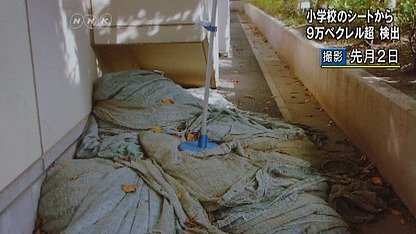
www3.nhk.or.jp
Radioactive cesium detected in Tokyo grade school
An extremely high reading of radioactive cesium has been detected on a groundsheet at an elementary school in Tokyo.
Officials of Suginami Ward detected 90,600 becquerels per kilogram of radioactive cesium on the sheet. It was used to protect the school lawn against frost from March 18th to April 6th, soon after the Fukushima nuclear accident. The school is located about 230 kilometers from the nuclear plant.
The sheet's radioactivity level is over 11 times the government's 8,000 becquerels-per-kilogram limit for disposal by burying underground.
The city is considering incinerating the sheet with other garbage.
The school stored the sheet next to a gymnasium until early November. Ward officials who measured radioactivity near the area where the sheet was kept detected 3.95 microsieverts per hour at about one centimeter above the ground.
A mother whose son and daughter attend the school said she is worried that contamination from the nuclear plant is reaching Tokyo, despite the capital's distance from Fukushima. She says she wants a thorough inspection of the school building, including windows and gutters.
Tuesday, December 13, 2011 19:59 +0900 (JST)
www3.nhk.or.jpby Edano via Www3.nhk.or.jp 12/13/2011 12:25:26 PM- @Pedro Jesus de.selfhtml.org :)by Edano 12/13/2011 12:25:54 PM
- µSv = & micro;Sv without spaceby Edano 12/13/2011 12:26:25 PM
- the last article is interesting. from the sheet, you can extrapolate the tokyo contamination. seems higher than reported.by Edano 12/13/2011 12:31:15 PM
www3.nhk.or.jp
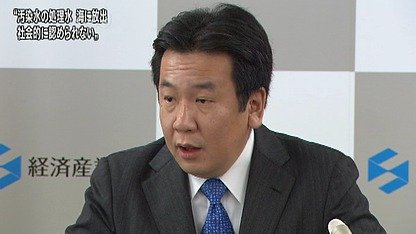
Edano spurns releasing radioactive water into sea
Industry Minister Yukio Edano has rejected an idea being considered by the operator of the crippled Fukushima nuclear plant to discharge low-level radioactive water into the sea.
Edano spoke to reporters on Tuesday, as Tokyo Electric Power Company considers the plan. TEPCO wants to reduce the level of radioactivity of the decontaminated water to below the level at which government standards allow it to be released into the sea.
The idea has drawn protests from fishing cooperatives across the nation.
Edano said that since March 11th, the fishing industry has been plagued by various issues, including falling sales due to unfounded rumors of radiation.
He said going ahead with the discharge of tainted water without the understanding of the industry is unacceptable.
Edano added that TEPCO should properly think about how to win the industry's understanding and make proper efforts to this end.
Tuesday, December 13, 2011 15:34 +0900 (JST)
www3.nhk.or.jpby Edano via Www3.nhk.or.jp 12/13/2011 12:33:25 PM- @Edano They tend to present optimistic (under)estimates as opposed to safe estimates, given the context, which is, in my opinion, counter productive and misleading.by Pedro Jesus 12/13/2011 12:34:28 PM
- @Pedro Jesus that sheet is quite a neutral witness, isn't it ?by Edano 12/13/2011 12:36:26 PM
- Google uploads street views of quake-hit towns
US search giant Google has uploaded street views of disaster-hit Japanese towns onto the Internet.
The company says it wants to show the world the scale of damage caused by the March quake and tsunami.
Google began taking pictures of 82 cities and towns in 6 northeastern prefectures, including Fukushima, from July.
It started sharing the images through its website on Tuesday. They include photos taken before the calamity.
Google says it hopes the photographic records will help research and rebuilding efforts, and also serve as a reminder of the catastrophe for future generations.
Tuesday, December 13, 2011 14:28 +0900 (JST)
www3.nhk.or.jpby Edano 12/13/2011 12:37:53 PM - Areva to post huge loss
French nuclear energy giant Areva says it will post a huge loss in 2011. It blamed business set-backs following the accident at Japan's Fukushima Daiichi nuclear power plant.
Areva announced on Monday that it projects a full-year operating loss of up to 1.6 billion euros, or 2.1 billion dollars.
The French firm is one of the world's leading multinational conglomerates in nuclear energy. Its business activities include the development of nuclear reactors and reprocessing of spent fuel.
Areva says its nuclear-energy business has been hurt by anti-nuclear movements around the world triggered by the Fukushima accident.
It also says the construction of its latest power station, the European Pressurized Reactor, has been delayed in Finland, incurring unforeseen expenses.
French media reported that Areva will cut its workforce. Areva asked the French bourse to suspend its stock listing as it was worried about a plunge in the price. But the firm has not made an official announcement about downsizing.
Tuesday, December 13, 2011 06:24 +0900 (JST)
www3.nhk.or.jpby Edano 12/13/2011 12:39:15 PM - UPDATE1: Fukushima gov't estimates radiation exposure of up to 19 millisieverts
FUKUSHIMA, Japan, Dec. 13, Kyodo
Residents near the crisis-hit Fukushima Daiichi nuclear power plant may have been exposed to up to 19 millisieverts of radiation in the four months after the plant was crippled by the March 11 earthquake and tsunami, the Fukushima prefectural government said Tuesday.
The local government released its estimates of residents' radiation exposure in 12 municipalities near the power plant -- Namie, Kawamata, Iitate, Futaba, Okuma, Minamisoma, Tamura, Tomioka, Naraha, Hirono, Katsurao and Kawauchi. The plant is located in the towns of Futaba and Okuma.
Residents who evacuated from high-risk areas in the village of Iitate in late June may have been exposed to the highest amount of 19 millisieverts, it said.
Shunichi Yamashita, vice president of the prefectural government-run Fukushima Medical University, told a news conference that the level is low compared with the 1986 Chernobyl nuclear disaster in the then Soviet republic of Ukraine. ''I think there is no problem,'' Yamashita said.
The prefectural government, which has conducted health checks on all of its roughly 2 million residents, said it based its estimates of radiation exposure on the timing and place of evacuation.
It used a radiation calculation system, developed by the state-run National Institute of Radiological Sciences in the city of Chiba east of Tokyo, to estimate residents' radiation exposure.
The estimates show residents in a no-go zone covering areas within a 20-kilometer radius of the crippled plant who evacuated in the early stages of the crisis were exposed to 0.18-2.3 millisieverts of radiation during the period.
But exposure levels for residents outside the no-go zone, who were advised to evacuate later, were high at 0.84-19 millisieverts.
Delayed evacuation may have led to the high level of radiation exposure, experts said.
Separate from the estimate, the prefectural government released the results of priority checks on around 29,000 residents in the towns of Namie and Kawamata as well as the village of Iitate.
The local government analyzed radiation exposure for 1,727 of the residents who filed records of their movements during the four months. One resident, who worked at the Fukushima Daiichi plant in containing the crisis, was found to have been exposed to up to 37.4 millisieverts of radiation.
The dosages for other residents stood at between over 10 and less than 15 millisieverts for eight people, over 5 and less than 10 millisieverts for 43, over 1 and less than 5 millisieverts for 591, and less than 1 millisievert for 1,084.
==Kyodo english.kyodonews.jpby Edano 12/13/2011 12:42:19 PM - Residents might have been exposed to up to 19 millisieverts of radiation
FUKUSHIMA, Japan, Dec. 13, Kyodo
Residents near the crisis-hit Fukushima Daiichi nuclear power plant might have been exposed to up to 19 millisieverts of radiation during the four months after the powerful March 11 earthquake and tsunami crippled the plant, the Fukushima prefectural government said Tuesday.
The local government released its estimate of radiation for residents in 12 municipalities near the power plant -- Namie, Kawamata, Iitate, Futaba, Okuma, Minamisoma, Tamura, Tomioka, Naraha, Hirono, Katsurao and Kawauchi. The plant is located in the towns of Futaba and Okuma.
Residents who evacuated from high-risk areas in the village of Iitate in late June might have been exposed to the biggest amount of 19 millisieverts, it said.
The prefectural government, which has conducted health checks on all of its roughly 2 million residents, said it based its estimated dosages of radiation from the plant on the timing and places of evacuation.
According to the estimate, residents in a no-go zone in areas within a 20-kilometer radius from the crippled plant who evacuated in the early stages of the crisis were exposed to 0.8-2.3 millisieverts of radiation during the period.
Meanwhile, those in contamination hotspots outside the no-go zone, where the government had failed to promptly urge residents to evacuate, might have been exposed to 0.84-19 millisieverts of radiation.
The local government has already conducted health checks on about 29,000 residents in the towns of Namie and Kawamata and the village of Iitate, which were designated as evacuation zones.
Of these residents, 1,730 filed records of their movements during the four months.
One of them has been found to have been exposed to up to about 37 millisieverts of radiation. But the resident had worked at the Fukushima Daiichi power plant to contain the crisis.
The average dosage is estimated at just above 1 millisievert, the maximum limit of radiation exposure per year in normal times. The dosages do not include exposure to natural radiation.
==Kyodo english.kyodonews.jpby Edano 12/13/2011 12:43:53 PM - Gov't to forgo test run of Monju reactor in fiscal 2012
TOKYO, Dec. 13, Kyodo
The Japanese government will not earmark funding for a test run of the country's prototype fast-breeder reactor Monju in the budget for fiscal 2012, starting next April, following a Diet panel's call to cut spending on the reactor and its nuclear fuel cycle program, Japan's science minister said Tuesday.
Masaharu Nakagawa, Minister of Education, Culture, Sports, Science and Technology, told a press conference that the government ''will exclude (spending on the Monju test run) after various views'' were expressed in parliament on the project earlier this month.
The science ministry has sought 21.5 billion yen for the Monju project in the fiscal 2012 budget, including 2.2 billion yen necessary for the practice run. The government has already decided not to run the reactor on a trial basis in the current fiscal year through March next year.
The Monju fast-breeder reactor, located in Tsuruga, Fukui Prefecture, and operated by the state-run Japan Atomic Energy Agency, has been expected to play a key role in establishing Japan's nuclear fuel cycle.
It was intended to use spent fuel from nuclear reactors and produce more nuclear fuel than it consumed. But the Monju reactor has been plagued by a series of mishaps, casting doubt on the project's viability.
On Dec. 8, the House of Representatives' audit panel passed a nonbinding resolution to slash spending for the Monju project in response to a package of proposals worked out in November by lawmakers for a thorough review in the government's energy policies.
Following the Fukushima nuclear crisis triggered by the March 11 earthquake and tsunami, the government plans to craft new energy policies next summer, which will also cover the future of the Monju project.
Nakagawa said if the government decides to continue the reactor's development next summer it will ''flexibly'' secure spending for a test run in a supplementary budget.
==Kyodo english.kyodonews.jpby Edano 12/13/2011 12:44:33 PM - Fishermen's OK needed to dump nuclear plant water into sea: Edano
TOKYO, Dec. 13, Kyodo
Japanese industry minister Yukio Edano on Tuesday called into question the Fukushima Daiichi nuclear power plant operator's plan to release low-level radioactive water into the Pacific Ocean, saying doing so without consent from fishermen should not be allowed.
''It should not be socially allowed that (the operator) goes ahead (with the plan) before gaining agreement from people involved in the fishery industry,'' Edano said at a press conference.
Tokyo Electric Power Co. said earlier this month it is considering releasing into the Pacific Ocean low-level radioactive water now stored in tanks at the premises of its crippled Fukushima Daiichi nuclear power plant, as storage capacity may run short by next March.
The utility known as TEPCO said the water would be released only after it clears the country's legal concentration limit for radioactive substances, including strontium, but domestic fisheries cooperatives fiercely oppose the plan.
Edano's remark effectively makes it necessary for TEPCO to gain consent from the fishery industry for its release of the power plant's treated water into the sea.
==Kyodo english.kyodonews.jpby Edano 12/13/2011 12:46:20 PM - only the fishery industry shall be asked ?by Edano 12/13/2011 12:47:26 PM
- Anti-nuclear power conference aims to draw 10,000 participants
TOKYO, Dec. 13, Kyodo
Six Japan-based nongovernmental organizations, including Peace Boat, said Tuesday they hope to attract 10,000 people for an international conference on Jan. 14 and 15 in Yokohama aimed at realizing a nuclear power-free world.
Experts and politicians from overseas, including Germany and Jordan, will attend the Global Conference for a Nuclear Power Free World to be held in the wake of the disaster at the Fukushima Daiichi power plant, while a European Parliament member, Rebecca Harms, will give a speech, they said.
The organizers are also planning to invite more than 100 people from Fukushima Prefecture, including children and their parents, to share their experience of the aftermath of the nuclear disaster.
==Kyodo english.kyodonews.jpby Edano 12/13/2011 12:48:00 PM - Panel sees nuclear power generation costs higher than 2004 estimate
TOKYO, Dec. 13, Kyodo
A government panel on Tuesday said in a draft report that nuclear power generation costs 8.9 yen per kilowatt hour when including expenses associated with nuclear accidents, higher than a 2004 projection of 5 to 6 yen per kwh.
The new estimate, calculated by considering the result of a nuclear accident at the Fukushima Daiichi power plant, showed that nuclear power is still one of the cheapest energy sources. But the report noted that 8.9 yen is the ''minimum'' cost of nuclear power as the total damage costs of a severe nuclear accident are yet unclear.
According to the draft report, the cost of electricity from coal-powered thermal plants is estimated at 9.5 yen per kwh and from liquefied natural gas-powered thermal plants 10.7 yen per kwh, reflecting higher fuel prices. In the 2004 projection, the cost of electricity from coal-fed plants was pegged at 5 to 7 yen per kwh, and from LNG-fired plants 6 to 7 yen per kwh.
As for renewable energy sources, costs of wind power generation on land are estimated at between 9.9 and 17.3 yen per kwh, and of solar power at 33.4 yen to 38.3 yen per kwh, compared with earlier projected costs of 11 to 26 yen per kwh and 37 to 46 yen per kwh, respectively.
In 2030, thermal power generation costs are expected to further increase, while the cost of wind and solar power generation are projected to drop to as low as 8.8 and 9.9 yen per kwh, respectively, amid expected market expansion. The cost of nuclear power generation is estimated to stay at 8.9 yen per kwh.
The calculation is part of the process of reviewing the country's energy policy following the Fukushima Daiichi plant disaster, the worst nuclear accident since the 1986 Chernobyl disaster. The March catastrophe has made the Japanese people increasingly cautious about relying heavily on nuclear power.
Under the national energy plan endorsed in June 2010, the country's reliance on nuclear energy was projected to increase to 53 percent of total power supply by 2030, from about 30 percent before the Fukushima accident.
Based on the report to be issued by the panel later this month, the government is expected to come up with the best combination of power sources for the country, or what is known as the ''energy best mix.''
The latest estimate is different from the 2004 figures because it has counted in what the panel calls social expenses, in addition to capital, fuel and operation and maintenance costs.
Social expenses are included in costs for nuclear power generation in the form of accident risk costs, and for thermal power generation in the form of costs to deal with carbon dioxide emissions.
Nuclear accident risk costs are estimated at 0.5 yen per kwh, according to the draft report, which noted that expense could increase further depending on the value of damage caused by a severe nuclear accident.
So far the panel estimates damage costs to be at least 5.8 trillion yen, drawing on the Fukushima accident, which erupted in the wake of the March 11 megaquake and tsunami. But that figures does not include, for example, expenses related to cleaning radiation-contaminated land around the plant.
==Kyodo english.kyodonews.jpby Edano 12/13/2011 12:48:55 PM - now that is interesting. the real costs of nuke power is about to equal the other energy sources !by Edano 12/13/2011 12:52:20 PM
- this is an excellent reason to stop investing a single cent in nukes furthermorre.by Edano 12/13/2011 12:54:33 PM
 @Edano does that cost include all the extra govt oversight required?by lillymunster 12/13/2011 12:54:34 PM
- @lillymunster i think it is still a conservative approach, a minimum.by Edano 12/13/2011 12:56:08 PM
- @Edano I'd say it will exceed, and that is if there is no other serious nuclear accident in the foreseen future. If we are so unfortunate that another such accident occur in the coming few decades the costs for nuclear energy will certainly top, by a fair margin, the cost/efficiency charts.by Pedro Jesus 12/13/2011 12:56:19 PM
- Google missed a big opportunity. They took street view images of the disaster areas. They could have taken radiation readings all along the way.by lillymunster 12/13/2011 12:58:01 PM
- "Jewish 'terrorists' attack Israeli base on the West Bank" edition.cnn.com
Luckily they didn't target a nuclear base.by Pedro Jesus 12/13/2011 12:58:50 PM - UPDATE1: Fishermen's OK needed to dump nuclear plant water into sea: Edano
TOKYO, Dec. 13, Kyodo
Japanese industry minister Yukio Edano on Tuesday called into question the plan of the operator of the Fukushima Daiichi nuclear power plant to release low-level radioactive water into the Pacific Ocean, saying doing so without the consent of fishermen should not be allowed.
''It should not be socially acceptable that (the operator) goes ahead (with the plan) before gaining agreement from people involved in the fishery industry,'' Edano said at a press conference.
Tokyo Electric Power Co. said earlier this month it is considering releasing low-level radioactive water into the Pacific Ocean that is currently stored in tanks at its crippled Fukushima Daiichi nuclear complex, as storage capacity may run short by next March.
The utility known as TEPCO said the water would be released only after it clears the country's legal concentration limit for radioactive substances, but domestic fisheries cooperatives fiercely oppose the plan.
Edano's remark effectively means that TEPCO will have to secure consent from the fishery industry for the release of the power plant's treated water into the sea.
The nuclear safety agency, which is under the wing of Edano's ministry, meanwhile, strongly warned TEPCO over repeated radioactive water leakages that have occurred recently at the crippled plant located on the Pacific coast.
The water leaked after passing through a water treatment facility and may have contained radioactive strontium because the facility is not capable of removing the substance, according to the Nuclear and Industrial Safety Agency.
In one of the cases, TEPCO said that around 150 liters of water had flowed into the ocean. The other cases detected on Sunday and Monday did not result in leakage to the external environment.
''We have attached weight to the fact that some water flowed into the sea and there was repeated leakage,'' agency spokesman Yoshinori Moriyama said.
==Kyodo english.kyodonews.jpby Edano 12/13/2011 12:59:29 PM - The made Yamashita a VP of the medical uni? Blargh.
Fukushima Medical University Vice President Shunichi Yamashitaby lillymunster 12/13/2011 1:01:43 PM - "Japan to pick Lockheed’s F-35 as new stealth fighter" www.washingtonpost.comby Pedro Jesus 12/13/2011 1:01:46 PM
- "the facility is not capable of removing the substance" [strontium]. another question of ours is answered !by Edano 12/13/2011 1:02:06 PM
- @Edano The manufacturer cited as providing the material for the filters, IIRC Honeywell. Their product sheet claims it removes cesium and stronium but it didn't cite how much or a percentage removed.
Happy also said that water is full of cobalt and IIRC manganese?by lillymunster 12/13/2011 1:04:39 PM - @Edano Bingo!by Pedro Jesus 12/13/2011 1:04:48 PM
- sometimes you find valuable infos in the mass of words. :)by Edano 12/13/2011 1:06:06 PM
- @Edano The RBTL factor.by Pedro Jesus 12/13/2011 1:07:34 PM
- @Pedro Jesus ah i googled it :)by Edano 12/13/2011 1:09:01 PM
- i am sure nisa did not want to admit that. oops.by Edano 12/13/2011 1:10:59 PM
- @Edano It can have a double meaning in this context. ;)by Pedro Jesus 12/13/2011 1:11:06 PM
- Seeing lots of little slips lately. An environment ministry official admitted people don't trust govt. rad readings. NISA published a document that people in the diet saw that said the RPV at one of the reactors cracked in the quake. Still waiting for that to make their website. People are leaking bits of truth out.by lillymunster 12/13/2011 1:14:01 PM
- the revelation that nuke power is not substantially cheaper than others, is a real gem. i would like to post it all over the world.by Edano 12/13/2011 1:17:50 PM
- @Edano In some ways, you've already been doing it. This is a place, as good as any, to present the facts, demystify the myth and expose the brutal truth.by Pedro Jesus 12/13/2011 1:50:56 PM
- Added Ian's new video to the site. If you have a twitter account please give it a tweet. www.simplyinfo.orgby lillymunster 12/13/2011 2:26:28 PM
 @lillymunster, thanks! :) As per your suggestion, I was able to add Japanese captions!by Ian 12/13/2011 2:29:33 PM
- AREVA to suspend extensions at 4 French nuclear sites – Halt work at Idaho… goo.glby lillymunster 12/13/2011 2:30:43 PM
- @Ian that always helps.by lillymunster 12/13/2011 2:30:55 PM
- Areva to monitor health of Niger uranium mine workers www.guardian.co.ukby lillymunster 12/13/2011 2:36:19 PM


Japan Earthquake | Page 2768
- Who's Blogging
-
 hudebnik
 alblee
 UKVal
UKVal Oliver (ScribbleLive)
 Jonathan Keebler
 Matt (ScribbleLive)
 kaykodh
 PKelley
 Markfm
 dean
dean Angie
Angie- Edano
 Deb
Deb Mid Valley
 Pedro Jesus
 George Gibb
 elainekirk
- lillymunster
 bo
bo IanGoddard