Japan Earthquake | Page 2968

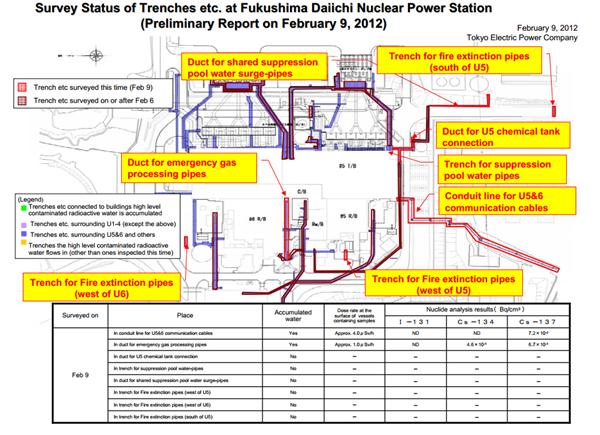
Today www.tepco.co.jp
by elainekirk 2/9/2012 3:55:18 PM- by elainekirk 2/9/2012 3:55:48 PM
 @elainekirk don't specifically remember but sounds about typical for TEPCO.by lillymunster 2/9/2012 3:56:06 PM
Nuclide Analysis Results of Radioactive Materials in the Air at the Upper Part of
the Reactor Building of Unit 1, Fukushima Daiichi <1/2 www.tepco.co.jpby elainekirk 2/9/2012 3:56:25 PM- by elainekirk 2/9/2012 3:57:28 PM
- I got 68.6 as an average by taking the 6 readings after 23:00 to 5am on the 9th. So I am not sure where they get the 67.9?by lillymunster 2/9/2012 4:01:57 PM
- @elainekirk WTH - how do they get 2 different readings for the same sensor on the same time???by lillymunster 2/9/2012 4:03:53 PM
 greetings to allby dean 2/9/2012 4:04:58 PM
- @lilly.. I saw that note you left last night and looked at the #2 data.. the statements under each section were somewhat strange seeming to qualify the databy dean 2/9/2012 4:05:59 PM
- From February 2, water injection to Unit 2 reactor was increased and the temperature tendency was monitored as the
tendency of temperature rise at the bottom of PCV was observed, but the temperature have been high value (around
70.0℃). As a result of the sampling for the Gas Control System of the Unit 2 on February 6 to make sure there is no
re-criticality state, we confirmed that the concentration of Xe-135 was below the detectible limit at the system’s inlet,
meaning that it falls below the re-criticality criteria of 1 Bq/cm
3
. In order not to raise the possibility of re-criticality state due
to the high density of water in the reactor by injecting cold water rapidly, we injected boric acid into the reactor from 0:19
am to 3:20 am on February 7, in advance of increasing water injection amount, as a safety countermeasures against
the re-criticality, and changed the amount of the core spray system injection water from 3.7m
3
/h to 6.7m
3
/h at 4:24 am
(the amount of the feed water system injection is 6.8m
3
/h). Currently, the temperature is approx. 66.8℃ (2/9 11:00) and
we continuously monitor the tendency At 9:47 am February 9, as the amount of water injection decrease, we adjusted the volume from the feed water system
increased from approx. 6.4 m3/h to approx. 6.8 m3/h(the amount of the continuing injection from reactor core spray
system is approx. 6.8 m3/h.
・ From 10:21 am to 12:35 pm on February 9, for the reliability improvement of nitrogen inclusion, we are working for
installing additional flow meter to the nitrogen inclusion line of the Primary Containment Vessel (PCV), and stopped the
inclusion temporarily. There is no significant change at the parameter. www.tepco.co.jpby elainekirk 2/9/2012 4:08:24 PM - @dean So they are actually finding xenon but they are being vague about what it means?by lillymunster 2/9/2012 4:12:41 PM
- can you post that in here for a min... or I can go back and get it then we can look what they sayby dean 2/9/2012 4:20:55 PM
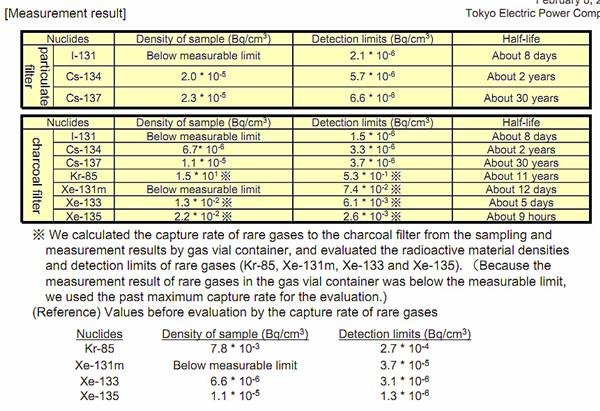 by elainekirk 2/9/2012 4:21:50 PM
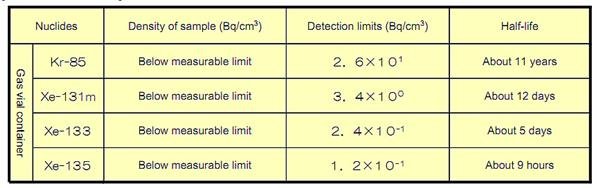 by elainekirk 2/9/2012 4:22:06 PM
- these are results I posted yesterday and I thought that the lower post clearly shows xe presentby elainekirk 2/9/2012 4:23:07 PM
- @elaine and lilly, trying to understand exactly how they collect the sample and then analyse it.. they have the qualifier statement (because the measurement result of rare gases in the gas vial container was below the measurable limit, we used the past maximum capture rate for the evaluation)..by dean 2/9/2012 4:26:02 PM
- so on the table for the charcoal filter are they saying that those values were the past highest they have seen? I'm kind of confused on that.. HELP!!!by dean 2/9/2012 4:28:00 PM
- @dean sorry it is way out of my comprehension scopeby elainekirk 2/9/2012 4:31:12 PM
- @elaine.. where I worked the radiochemist shows up with a small about 2 quart steel cylindrical container that has been evacuated to create a vacumn and with a fitting. He connects the fitting to a nozzle which had a specially designed fitting and is in the middle of the air flow through the ducting (in fukushimas case the air flow from handling units). he then opens a valve and sucks a sample of air into cylinder and then shuts the valves and takes it to the measurement facility, they hook up the container and then release the air and it passes through a particulate filter and then a charcoal filter, then those filters are counted to see what isotopes are present.by dean 2/9/2012 4:37:19 PM
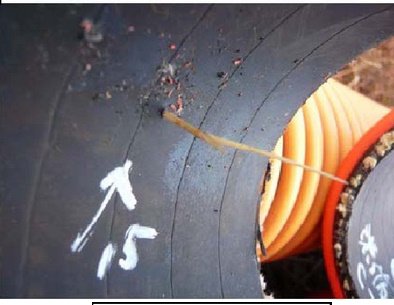
OMG the grass is eating into the pressure hoses Japanese only at the moment www.scribd.com
by elainekirk 2/9/2012 4:38:16 PM- @dean ah now I am getting better understanding thankyby elainekirk 2/9/2012 4:39:08 PM
- the day of the triffids just got real!!!by elainekirk 2/9/2012 4:39:47 PM
- can't get it to translate to englishby dean 2/9/2012 4:41:23 PM
- @elaine after a week or so those tubing materials will be so entangled with grasses and weeds they probably will clog and then be hard to pry apart.. geeeeeeeeeezhby dean 2/9/2012 4:43:54 PM
- @dean where is lilly she can ussually master it and edanoby elainekirk 2/9/2012 4:43:55 PM
- @dean bit of translation here if you scroll enformable.comby elainekirk 2/9/2012 4:44:50 PM
- @dean MIA mentioned earlier that the gas system at Fuku would normally have pressure behind it to move air through the system. If there is not that fan system pushing air it isn't pushing gas out of containment. That xenon is heavy and they may not get an accurate reading?by lillymunster 2/9/2012 4:45:38 PM
- @elainekirk will do a translate on the scribd here in a sec. The grass has been a known problem for a while. It is some sort of really rigid weed that was growing up and poking through the pipe plastic sheeting. There was some thought that while the plant was alive it filled the hole and as the plant died in winter it shriveled creating a leak.by lillymunster 2/9/2012 4:47:19 PM
- @elaine this is a brief explanation of the SPING real time monitor when I worked at the plant... SPTNCr-3
As shown in Table 1, the SPING component of the monitoring system includes four channels for
the measurement of the concentrations of radioact&ity, one each for particulate beta activity and
gaseous I-131 along with a lod- and a mid-range channel for noble gasses. It also includes four other
channels for the detection of “background” activity, some of which is subtracted from the active
measurement channels. Each of the channel’s detectors and its purposes are shown in Table 1. The
ranges of the monitoring detectors are also shown. As also indicated in Table I, three channels are
devoted to the measurement of flow rates and one to the measurement of absolute pressure in the
sample linesby dean 2/9/2012 4:49:47 PM - @lilly.. the whole sampling process and counting the samples is complex.. the main thing is for what ever flow rates they have in the system they will take a representative sample and see what's there. The air sampling must also go hand in hand with the effluent sampling to see what's in the water. if the system they hooked up (as I suspect) is the low velocity do as best you can one, it's probably not doing as good as the designed in plant HVAC system which passes 1000's of cubic feet per minuteby dean 2/9/2012 4:54:56 PM
- kind of like putting a garden hose in the SUPERDOME and pull air through it and suggest that's a good sample of the total gases in the domeby dean 2/9/2012 4:56:20 PM
- @dean thank youby elainekirk 2/9/2012 4:56:47 PM
- yw@elaineby dean 2/9/2012 4:56:59 PM
- What I sense is they have low volume feed water systems and low volume air handling systems as opp
osed to plant design valuesby dean 2/9/2012 4:57:51 PM - but at least it's giving some relative information and they act on it by increasing boric acid, water etc to hopefully counter the reactivity potential in the building and within what's left of the coreby dean 2/9/2012 4:59:04 PM
\by dean 2/9/2012 4:59:38 PM- Translation of the hose document www.simplyinfo.orgby lillymunster 2/9/2012 5:02:11 PM
- The sampling as I understand it is more like a "GRAB" sample ie: grab a sample every now and then and check up on things... I like the real time monitors the best to allow time to head off transientsby dean 2/9/2012 5:02:44 PM
- @lillymunster speedy work!!by elainekirk 2/9/2012 5:06:04 PM
- I hope they don't resort to using AGENT ORANGE to spray the Imperata cylindrica plants...by dean 2/9/2012 5:06:32 PM
- Cogongrass or "imperata cylindrica"
is monoecious (male and female reproductive organs on the same individual) and the flowers are complete (having a pair of female stamens and a pair of male stigma present in each flower), but the species is an obligate out-crosser.by dean 2/9/2012 5:09:38 PM - MacDonald (2004) indicates that cogongrass is now considered to be one of the ten most troublesome weeds in the world. Considerable effort is being made to manage and contain this species in Florida, but carelessness and unchecked growth in areas where it now occurs allow continued spread into non-infested areas.
Despite increased vigilance in the southeastern U.S. in regard to cogongrass, varieties of the species such as "Japanese Blood Grass" (I. cylindrica var. koenigii) are still being cultivated and sold as ornamentals in other parts of the country.by dean 2/9/2012 5:12:29 PM - I would probably want to sterilize the soil around that whole area to control the weed growth which, left unchecked could raise havocby dean 2/9/2012 5:13:16 PM
- fukushima-diary.com 2 is being heated but reactor 5 is steadily being heated as well.
From the plant parameter data of Tepco, the temperature of reactor 5 has gone up by 6.6℃ since 2/1/2012 12:00.by dean 2/9/2012 5:16:27 PM - I would think more permanent pipe materials would solve many of these issues?by lillymunster 2/9/2012 5:21:26 PM
Japan Earthquake | Page 2968
- Who's Blogging
-
 hudebnik
 alblee
 UKVal
UKVal Oliver (ScribbleLive)
 Jonathan Keebler
 kaykodh
 PKelley
 Markfm
 Angie
Angie Deb
Deb Mid Valley
 Pedro Jesus
 Matt (ScribbleLive)
 George Gibb
- elainekirk
- lillymunster
- dean
 bo
bo Edano
Edano IanGoddard