Japan Earthquake | Page 16
 Its like tring to make a copy on a copy machine from a faded page. Each time you copy it it gets harder to read. Thats what the DNA in cells are trying to do...make damaged copies.by Sinthia Domina 3/26/2011 9:21:56 AM
 @Jojo The figure I have heard more than once is that 100 mSv in one year will increase the risk of cancer (fatal or non-fatal) by 1%. www.hps.orgby borrrden 3/26/2011 9:22:02 AM
 BREAKING NEWS: TEPCO corrects announcement of high radiation at No. 1 unit of troubled nuke plant kyodo newsby NHK Listener 3/26/2011 9:22:39 AM
 @NHK Listener - Fucking LOOOLLLLLLL. Did they correct it to say "super-Gozirra-high radiation?"by Hank Scorpio 3/26/2011 9:23:20 AM
 I'm assuming all of you saw the article posted earlier quoting the "expert" who said they won't attempt to track the health implications of this tragedy because it's too complex given the mobility of the evacuees. Interestingly, the Japanese Government is only on the hook for the first billion in liability claims. It behooves both TEPCO and the GOJ to discourage both reporting and results.by Bev 3/26/2011 9:23:34 AM
- For that area that is receiving 103 uSv/hour. that works out to 2.472 mSv/day, and let's assume 10 days for 24 mSv. For girls < 15 the chance of getting fatal cancer is 14%/Sv, boys < 15 it's 7.2%. So for 24 mSv, according to the EPA this would be 1 in 297 young girls contracting fatal cancer from this radiation, and 1 out of 578 boys. And it just increases linearly every day. And that is just from air, not counting soil or ingestion of food/water.by Jojo 3/26/2011 9:24:11 AM
- yes I read that...its not a good enough test site since the subjects will be dispersed.by Sinthia Domina 3/26/2011 9:25:01 AM
- @Jojo Once again, you can't assume those levels for that many days, and you can't even assume that soil and plant based measurements are what is being received by the human body.by borrrden 3/26/2011 9:25:18 AM
- @Hank Scorpio I would bet they are going to clarify the 10000 number that is being used.by NHK Listener 3/26/2011 9:25:19 AM
- I wonder how snow figures into radiation contamination.by Sinthia Domina 3/26/2011 9:25:53 AM
- @NHK - This was a breaking news piece earlier today, not in relation to the water story yesterday (where the 10K number came from). They're correcting a bulletin issued about 1.5 hours ago which said work stopped at #1 due to high radiation.by Hank Scorpio 3/26/2011 9:26:39 AM
- @borrrden That's correct, 1% per 100 mSv for getting cancer, and .5% for dying of it. Per Sievert it would be 10% to get cancer, 5% to die from it. But that's everyone. For adult males it's 4%, adult females it's 6.2%, young boys it's 7.2%, young girls it's 14%.by Jojo 3/26/2011 9:26:43 AM
- @Sinthia Domina From what I've read, precipitation will knock radioactive dust particles out of the sky and down onto whatever is below (be it someone's head, water supply, soil, etc).by borrrden 3/26/2011 9:26:53 AM
- eah...I am just imagining all this radioactive snow on the ground.by Sinthia Domina 3/26/2011 9:27:35 AM
- @borrrden They are measuring 103 uSv/ hour, it doesn't matter where it comes from.by Jojo 3/26/2011 9:27:35 AM
- @Jojo Do you have any sources that suggest that this is a linear curve?by borrrden 3/26/2011 9:27:47 AM
- @Jojo Didn't we agree before that the explanation of that figure was in question? Why aren't the atmosphere measurements reflecting that same number if that is true?by borrrden 3/26/2011 9:28:24 AM
- Hard to tell when Japan's nuclear crisis would end: Edano english.kyodonews.jpby Sinthia Domina 3/26/2011 9:28:49 AM
- @borrrden It's the linear no-threshold, it's all over the EPA docs. It states that % chance to die is linear and there is no bottom threshold. Meaning even .0000001 Sv will increase your % chance of cancer.by Jojo 3/26/2011 9:28:49 AM
- @borrrden It doesn't matter, 103 uSv/hour is irrelevant where it comes from. They already take into account the Sv/hour depending on the element and how it's ingested/inhaled/stepped on. The Sv is a standard dose across all isotopes/methods of contact with the body.by Jojo 3/26/2011 9:30:41 AM
- @Jojo so you are saying that if they calculate that number from a soil measurement, it is automatically that number in the entire world? No, I know you aren't, but do you see the point? Let's assume that the number means that is the amount it is emitting. That means you will have to rub your face in that part of the soil to receive that much.by borrrden 3/26/2011 9:32:14 AM
- @borrrden In the EPA doc they have different coefficients for soil, air, water, food, etc. You plug in the Bq and you get the % fatality rate. They are standardizing everything to Sv.by Jojo 3/26/2011 9:32:27 AM
- @borrrden Well, sure they make assumptions that you don't rub your face in the soil, you walk on it. But if they calculate a certain Bq/kg of soil, you plug in the coefficient for that isotope and then get % /fatality PER SECOND you are in contact with that soil. So you factor in the time you are in contact and you get a fatality %.by Jojo 3/26/2011 9:34:03 AM
- @Jojo Ah ha! That is more useful, by the way what page is this stuff on? The document is about 200 pages long -_-;.by borrrden 3/26/2011 9:34:58 AM
- @borrrden It's quite a complex process. They have to figure the different rays for each isotope, how far they travel, absorption rates in different organs, cancer % for each, etc.by Jojo 3/26/2011 9:35:10 AM
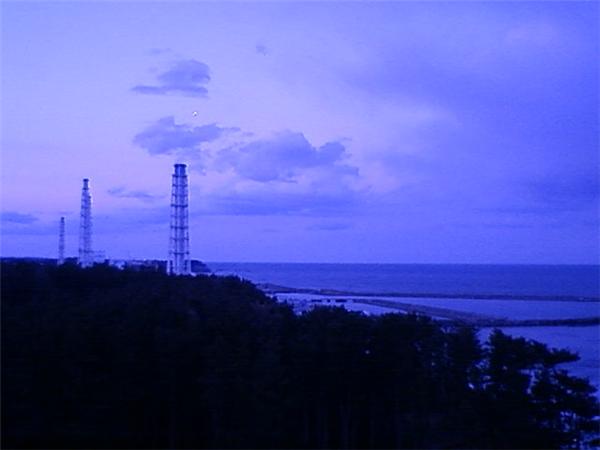
1800hrs pointscope01.jp
by NHK Listener via Pointscope01.jp 3/26/2011 9:36:03 AM- @Jojo I certainly won't argue that it is complex. That's exactly why I'm hesitant to make the calculations you are making.by borrrden 3/26/2011 9:36:12 AM
- Japan's nuclear crisis is mainly public panic, not radiation risk: Australian expert news.xinhuanet.com they are partnered with Reutersby Sinthia Domina 3/26/2011 9:38:02 AM
- @borrrden Inhalation starts on on p.38. p.100 is where you have coefficients for tap water and food. p.124 is where is has coefficients for submersion (air), ground plane (fallout), and soil. For some you need to calculate both Cesium 137 and Barium 137. Like I said, you plug in the Bq and you get a % fatality for each isotope.by Jojo 3/26/2011 9:38:25 AM
- From that doc you can calculate (according to the EPA) what the % fatality rates I have been posting here. I have just looked up the coefficients, plugged in the measurements, and then extrapolated the time.by Jojo 3/26/2011 9:40:32 AM
- What a crock of spinach! (that last link)by Sinthia Domina 3/26/2011 9:40:54 AM
- ok..goin back to bed. thanks and nite/mornin all.by Sinthia Domina 3/26/2011 9:42:20 AM
- Nite.by Jojo 3/26/2011 9:42:31 AM
 good morningby elainekirk 3/26/2011 9:44:37 AM
- Here's the link to the EPA document again www.epa.gov . From this you can calculate the % chance of getting cancer as well as fatal cancer for every type of exposure.by Jojo 3/26/2011 9:44:46 AM
- on the 25, 65 usv at 30 kms from fukushima (point n° 32) www.mext.go.jp This is 569 msv by year ...by futureisnow edited by elainekirk 3/26/2011 9:46:50 AM
- @futureisnow That assumes it stays at that level for an entire year, which is unlikely.by borrrden 3/26/2011 9:47:41 AM
- @futureisnow That's right. And if that radiation remained constant, according to the EPA, that would be 1 in 12 females < 15 getting fatal cancer, and 1 in 24 boys < 15 getting fatal cancer, sometime in their life from this cancer. Which is why they should evacuate these areas; even if the radiation subsides, how long do people have to sit in it?by Jojo 3/26/2011 9:49:31 AM
- @borrrden For iodine especially. But for cesium, even at 5 mSv per year they will have an increased % of cancer.by Jojo 3/26/2011 9:50:38 AM
- by NHK Listener 3/26/2011 9:50:57 AM
- @you So after 1 year, if this radiation remained constant, 8% of girls < 15 would get a fatal cancer in their lifetime from this radiation. After 2 years, it would be 16%. 3 years, 24%. etc.by Jojo 3/26/2011 9:52:13 AM
- @borrrden it depend on the radioactiv elements. snow and rain put them on the soil, if it's iodin, it's "ok", the half life is 8 days. if it's cesium, half life is 30 years. So I would evacuate places that show high uSv for several days first, and make appropriate detailed mesureby futureisnow 3/26/2011 9:54:02 AM
- @all , hello . For the evacuation, may be Government should consider evacuate places one by one, according to the results of radioactivity : If you look the map, there are places at 30 kms which are 68 uSV/hour, and some at 20 kms which are near "normal" ( 20 x the ordinary 0.16) Problem with an evacuation zone is that it become a no man'sland quickly . But letting people with 68 uSv/hour stay , without giving them a hand to relocate elsewhere, it's criminal, for me...by futureisnow 3/26/2011 9:54:19 AM
- And like I said, they have multiple readings outside of 30km that read > 100 uSv/hour. At 100 uSv/ hour, that would be 876 mSv/year. After 1 year 1 in 8 young girls (12%) would contract a fatal cancer from this radiation; after 2 years 24%, 3 years 36%, etc.by Jojo 3/26/2011 9:56:15 AM
- @futureisnow Absolutely. There are small infants here, pregnant mothers. They need to be evacuated.by Jojo 3/26/2011 9:56:48 AM

Japan Earthquake | Page 16
- Who's Blogging
-
 hudebnik
 alblee
 UKVal
UKVal Oliver (ScribbleLive)
 Jonathan Keebler
 kaykodh
 PKelley
 Markfm
 Angie
Angie Deb
Deb Mid Valley
- Pedro Jesus
 Matt (ScribbleLive)
 George Gibb
- elainekirk
 lillymunster
 dean
dean bo
bo Edano
Edano IanGoddard