Japan Earthquake | Page 617
 Thanks, @Ralph, Daini came out OK because that plant had the benefit of being younger than Daiichi, and so was able to incorporate some early lessons from its elder sibling, methinks.by alblee 4/10/2011 10:51:10 AM
 @alblee from France actually; I've been lurking from the beginning! I hardly ever post since I know naught in nuclear and most of my links would be in French! anyway, Japan is no longer of interest here in the media...
[Oui, glad to have you on board. Please feel free to interact. As you must already know, there is that other board for less newsy/techy chatter. Enjoy! - Alblee]by nestor edited by alblee 4/10/2011 10:52:46 AM- I think it was due to a 10 m wave and not a 30 m wave that took out the genies and the fuel supplies. It seems to me that the generators being underwater slowed them down, but the lack of fuel stopped them from ever getting the cooling back up.
[Ah, yes. Indeed. And is it also because some of the cooling infrastructure have been housed inside watertight buildings vis-a-vis Daiichi? - Alblee]by Ralph Unger edited by alblee 4/10/2011 10:54:52 AM - The tsunami washed away the fuel tanks.by Ralph Unger 4/10/2011 10:55:36 AM
- Flush the generators with oil and they will work again, even if seawater has engulfed them, no fuel or oil? Game over.by Ralph Unger 4/10/2011 10:58:09 AM
- My riding mower has been under 3 ft of water for 2 days, it works fine even 3 years later. But I did flush it out and clean it.by Ralph Unger 4/10/2011 11:00:44 AM
 @Ralph Unger, That depends if the intakes got under water the engines would vapor lock, causing bend or broken engine parts effectively rendering the engines unfixable.by WolfDK 4/10/2011 11:01:03 AM
- Do diesels do that? I know such things could happen with modern gas engines, but a diesel?by Ralph Unger 4/10/2011 11:02:22 AM
- I assume the generators were running at the time the tsunami hit (post quake)
[And these would be, umm, diesel turned? - Alblee]by WolfDK edited by alblee 4/10/2011 11:02:24 AM - They were on batteries I heard, but who knows?
[And these would have flatlined by nightfall after the quake hit around noon (?) - Alblee]by Ralph Unger edited by alblee 4/10/2011 11:04:21 AM - @Ralph Unger, Yes indeed, water cannot be compressed so if it draw in water there is nowhere for the pistons to go.by WolfDK 4/10/2011 11:05:24 AM
- But the lack of oxygen would shut them down before that happened.by Ralph Unger 4/10/2011 11:06:07 AM
- No more combustion...by Ralph Unger 4/10/2011 11:06:35 AM
- 8 hours max on batteries, the tsunami hit in less then 1 hour.by Ralph Unger 4/10/2011 11:09:03 AM
 I used to be on the boats and deisel engines can take a hell of a lot , even when my bilge pump failed the engine kept going.by elainekirk 4/10/2011 11:09:46 AM
- No spark plugs and only valve timing, those things rock!.by Ralph Unger 4/10/2011 11:10:34 AM
 Good morning, @elainekirk. I think I will be standing down in a bit.by Alblee 4/10/2011 11:10:59 AM
- @Ralph Unger, all engines have a flywheel diesels have big ones, think of a 100kg+ flywheel spinning at a couple of 1000's rpm and try to stop that in less than a stroke, inertia is huge hereby WolfDK 4/10/2011 11:11:21 AM
- @alblee I will go grab a coffee then :)by elainekirk 4/10/2011 11:11:29 AM
- Thanks, @Elaine.by Alblee 4/10/2011 11:12:02 AM
- Would a bit of water stop a round flywheel?by Ralph Unger 4/10/2011 11:12:18 AM
- I see your point Wolf, but I still think it was the lack of fuel , not he damage to the generators that led to the crisis.by Ralph Unger 4/10/2011 11:13:22 AM
- @Ralph Unger, water in the cylinders would, ingested via the engines air intakeby WolfDK 4/10/2011 11:13:28 AM
- Correction to prev post -> @Ralph Unger, That depends if the intakes got under water the engines would vapor lock, causing bend or broken engine parts effectively rendering the engines unfixable. <- should be HYDRO LOCK not VAPOR LOCKby WolfDK 4/10/2011 11:15:26 AM
- Pushing water is about 1000 times harder then pushing air. but as air is gone, combustion is no longer pushing much of anything.by Ralph Unger 4/10/2011 11:17:20 AM
- Are all diesel engines in sunken boats junk?by Ralph Unger 4/10/2011 11:18:16 AM
- If you look at before and after pics there were two large storage tanks washed away from the front *if* these were the diesel and they were connected by feed pipes to the engines then it would explain the engines failing after an hour but that is pure supposition without knowing if they were the deisel tanksby elainekirk 4/10/2011 11:19:36 AM
- I dunno, but that is what TEPCO said.by Ralph Unger 4/10/2011 11:20:25 AM
- @Ralph Unger, if running while being submerged, yes indeedby WolfDK 4/10/2011 11:20:28 AM
- Where does the O2 come from to run submerged?by Ralph Unger 4/10/2011 11:21:18 AM
- I seem to recall that the recent NISA emergency-response regulatory changes now prescribe backup power supply and pumpware to be housed in watertight rooms (or buildings), and that these directives are to be for implementation or retrofit across the board at all facilities (?)by Alblee 4/10/2011 11:22:18 AM
- A fire truck (pumper) on a hill nearby?
[Perhaps, or a more elegant solution, heh heh... - Alblee]by Ralph Unger edited by alblee 4/10/2011 11:23:06 AM - www.world-nuclear.org Scroll down to the HTR-10 and HTR-PM those designs rock!!by Ralph Unger 4/10/2011 11:27:32 AM
- There are some reading for the 10th 6:00a.m. here www.jaif.or.jpby elainekirk 4/10/2011 11:27:43 AM
 Work to dispose of highly radioactive water at the crippled Fukushima Daiichi nuclear power plant is not proceeding smoothly as more time is needed for preparations.
Heavily contaminated water in turbine buildings and a concrete tunnel is hampering work to restore cooling functions in the troubled reactors. The total amount of water in question is estimated at more than 50,000 tons.
www3.nhk.or.jpby Rob in SF 4/10/2011 11:27:44 AM- HTR-10 "n 2004, the small HTR-10 reactor was subject to an extreme test of its safety when the helium circulator was deliberately shut off without the reactor being shut down. The temperature increased steadily, but the physics of the fuel meant that the reaction progressively diminished and eventually died away over three hours."by Ralph Unger 4/10/2011 11:28:57 AM
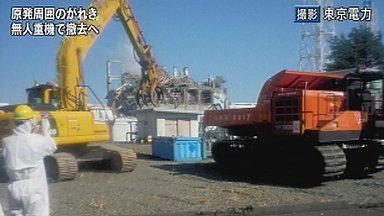
www3.nhk.or.jp Tokyo Electric Power Company has bugun using unmanned heavy equipment to remove radioactive rubble at the tsunami-hit Fukushima Daiichi nuclear plant.
The utility started using remote-controlled power shovels and bulldozers to remove the rubble on Sunday afternoon.
Operators are using cameras attached to the equipment as well as 6 fixed cameras at the site to carry out the work from hundreds of meters away.
A lead-covered mobile operating room will be used to remove debris from places that cannot be reached by radio waves.
TEPCO says the rubble will be put into containers and stored at the plant under strict supervision, as it may be contaminated with high levels of radiation. www3.nhk.or.jpby Rob in SF via Www3.nhk.or.jp 4/10/2011 11:29:27 AM- 11 years of testing, these thing are ready to go.by Ralph Unger 4/10/2011 11:31:55 AM
- Anyone who thinks that we will not have nuclear power in the the future, is an optimist? But I think it can be done in a safe manner, the disposal of old fuel still remains a big problem.by Ralph Unger 4/10/2011 11:35:48 AM
- @Ralph Unger, this is what happens when a diesel ingest water -> en.wikipedia.org Air is not necessary engine is spun by the inertia of its flywheel, think of this: when you turn off your cars ignition the engine takes a few more turns, it does not just stop dead.by WolfDK 4/10/2011 11:36:40 AM
- The Thursday quake, centered off Miyagi Prefecture, measured magnitude 7.1. This is a powerful earthquake in its own right, the kind that rarely occurs. But it is an aftershock of the March 11 temblor, which measured magnitude 9.0.
Experts say we should brace for aftershocks of magnitude 7 or so for at least half a year after that mega-quake.
A period of tension and anxiety will continue for a while.
www.asahi.comby Rob in SF 4/10/2011 11:37:52 AM - OMG Wolf, the evidence is that it was a lack of fuel , not a destruction of the generators that led to the problems at Fukushima. They were on battery power not gennies when the tsunami hit.After inje.cting seawater, all bets were off. it destroyed all mechanical parts of the plant, including the generatorsby Ralph Unger 4/10/2011 11:42:21 AM
- Radioactive cesium above the legal limit for consumption was detected Saturday in young sand lance caught off Fukushima Prefecture, as the prefecture took samples amid a voluntary ban on fishing there in the wake of the ongoing nuclear crisis.
One of the four sample fish had a level of cesium of 570 becquerels per kilogram on Thursday about 1 kilometer off the city of Iwaki, and the other three measured 480 to 500 becquerels. The limit is 500 becquerels under the Food Sanitation Law. english.kyodonews.jpby Rob in SF 4/10/2011 11:42:39 AM - I gotta mention this. Soil cesium limit set for rice / Some farmers won't be allowed to plant this season, possibly longer.The Fukushima prefectural government announced Wednesday that rice paddies in Iitatemura have shown as much as 15,031 becquerels per kilogram of radioactive cesium. Part of Iitatemura is within 20 kilometers to 30 kilometers of the plant, where residents have been instructed to stay indoors....The maximum level was based on studies that have shown brown rice absorbs one-tenth of the radioactive cesium in soil. Since the provisional guideline for radiation in rice is 500 becquerels per kilogram under the Food Sanitation Law, the government decided on a limit of 5,000 becquerels per kilogram."http://www.yomiuri.co.jp/dy/national/T110409003461.htm
www.mext.go.jp
You have to scroll down a bit to find levels higher then 500 Bq/m3 (not Bq/kg,) I wonder why they use different measurements for everything? )
【3-14】(About40kmNorth/West) 2011/4/8 10:07 I-131=27,000 Cs-137=24,000 3.8 n(Bq/m3)
【83】(About20kmNorth/West) 2011/4/8 12:10 I-131=210,000 Cs-137=270,000 μSv/h=53.5
Even the highest reading I can find is 270,000 Cs137 Bq/m3 which is about 157 Bq/kg.by Ralph Unger 4/10/2011 11:45:39 AM - China expands food bans The Chinese government announced on Saturday that it was adding 6 prefectures to the current 5 to make a total of 11, including Tokyo, from which it will not accept food imports.
It said the additional measure was taken because radioactive substances from the nuclear plant are contaminating agricultural products. www3.nhk.or.jpby Rob in SF 4/10/2011 11:46:08 AM
Japan Earthquake | Page 617
- Who's Blogging
-
 hudebnik
- alblee
 UKVal
UKVal Jonathan Keebler
 Oliver (ScribbleLive)
 kaykodh
 Markfm
 Angie
Angie Mid Valley
 Matt (ScribbleLive)
 George Gibb
- elainekirk
 PKelley
 lillymunster
 dean
dean bo
bo Edano
Edano Deb
Deb- Pedro Jesus
 IanGoddard