Japan Earthquake | Page 700
 From NISA _ They are discussing temperatures not previously revealed and they are being asked why this hadn't been revealed. They spoke of #3 "No. 3: the lower flange 4 cylinder / 12 144 degrees (normal temperature) 3 / 4 165 degree seal 14 / 4 12 170 degrees / 250 degrees the other 14 I'm not nervous change. Cause under investigationby ColorMeRed 4/14/2011 9:42:48 AM
 I was born at night, but it was not last night.by Ralph Unger 4/14/2011 9:43:01 AM
 @Ralph Unger fukushimafaq.wikispaces.comby NHK Listener 4/14/2011 9:46:00 AM
- I said this last night, why does the the drone show nothing? It is hardened for radioactivity, but my lame-o home built RC airplane could have cone as close. And gotten better pictures?by Ralph Unger 4/14/2011 9:49:20 AM
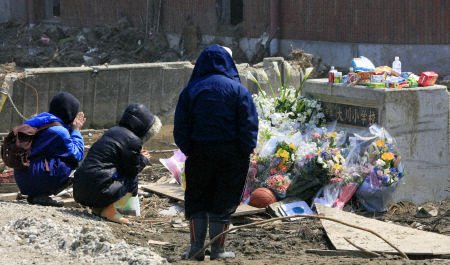
english.kyodonews.jp Children lost in tsunami
People offer flowers in front of an entrance of Okawa elementary school, where 70 percent of its 108 students were killed or went missing in the March 11 tsunami, in Ishinomaki, Miyagi Prefecture, on April 13, 2011. A father, who lost his sixth-grade daughter, blamed the school for failing to evacuate its students promptly. (Kyodo)by NHK Listener via English.kyodonews.jp 4/14/2011 9:49:34 AM- TEPCO press conference is about to begin: www.ustwrap.infoby ColorMeRed 4/14/2011 9:54:04 AM
- Or do you think that a lame-o home built airplane would suffer from the radioactivity from that distance? My way or the highway! My BS detectors are going off the charts.by Ralph Unger 4/14/2011 9:54:57 AM

@Ralph Unger I'm not sure if this is the T-Hawk or the Helipse footage. I suspect Helipse due to the flight characteristics, any opinion? (Wow, I have 6000+ hits on this upload!)
by Rob in SF 4/14/2011 9:55:09 AM- Summary of Press Conference by the Chief Cabinet Secretary Edano (April 13th, 2011) www.facebook.com!/notes/prime-ministers-office-of-japan/summary-of-press-conference-by-the-chief-cabinet-secretary-edano-april-13th-2011/139206959484841by NHK Listener 4/14/2011 9:55:10 AM
- @Rob in SF That is the thawk footageby NHK Listener 4/14/2011 9:56:13 AM
- Rob , that is T-hawk, which is like ny home video I guess. It does not come close to the danger zone.by Ralph Unger 4/14/2011 9:56:29 AM
- @Rob in SF www.tepco.co.jpby NHK Listener 4/14/2011 9:56:35 AM
- Per NISA : no2 pressure vessel would be damaged, there could be holes. make a plan based on thisby ColorMeRed 4/14/2011 9:57:39 AM
- I have mentioned how RF can be interfered by ionizing radiation. I must be wrong because no remote vehicles go close the the plants.:-) DOH!by Ralph Unger 4/14/2011 9:59:59 AM
- Not even the hardened T-hawk went very close , lol.by Ralph Unger 4/14/2011 10:01:31 AM
- Police in protective gear scoured a 6-mile (10-kilometer) radius around the Fukushima Dai-ichi for the first time Thursday as part of their search for thousands of victims still missing after the March 11 earthquake and tsunami.
"We need to work very carefully so as not to rip our radiation suits with the debris, metal and chunks of concrete scattered everywhere in the zone," a police officer who gave only his surname, Sato, said in a telephone interview.
Read more: www.foxnews.comby NHK Listener 4/14/2011 10:01:50 AM  @Ralph Unger They are using a lot of remote controlled vehicles to clear rubble on site.by borrrden 4/14/2011 10:02:54 AM
- Yep. and at a very short distance from the controllers. I think they are getting 750 uSv while doing that.by Ralph Unger 4/14/2011 10:04:55 AM
- by Ralph Unger 4/14/2011 10:06:34 AM
- Toshiba Corp. has proposed to rival Hitachi, Ltd. that the two companies join hands in decommissioning the crippled reactors at the Fukushima No. 1 nuclear power plant in Fukushima Prefecture, The Yomiuri Shimbun learned Wednesday.
Specifically, the work of cooling the interior of the overheated reactors and removing debris would be done in the next six months, while the following five years would be spent on removing fuel rods from the reactor and spent fuel rods from a storage pool. In the final five years, the buildings housing the reactors and other equipment would be dismantled, along with the reactors themselves, while the contaminated ground would undergo soil improvement and the whole lot would be left vacant.
Meanwhile, Hitachi has formed a 30-member team of experts, jointly with six other firms, including GE and leading U.S. industrial plant manufacturer Bechtel Corp.
The plan proposed by the Hitachi team includes the work of taking nuclear fuel out of the reactor, the decontamination of equipment and of buildings housing reactors and other machinery, the dismantling of the buildings and the disposal of waste following the dismantling. Under this plan, the entire task would take about 30 years.
The Hitachi plan is based on their experience of analogous work in the aftermath of the Three Mile Island nuclear plant accident in the United States and the Chernobyl nuclear plant accident in Ukraine, then a Soviet republic. www.yomiuri.co.jpby Rob in SF 4/14/2011 10:11:12 AM - Notice that the buildings that people are in are to the right of the reactors. They do not even publish levels from there.by Ralph Unger 4/14/2011 10:11:55 AM
- The wind has been to what direction? To the East? That has helped to save many of the Japanese?by Ralph Unger 4/14/2011 10:13:25 AM
- Yep, but those in the plant.by Ralph Unger 4/14/2011 10:14:20 AM
- @Rob in SF Areva is going to put a bid in as wellby NHK Listener 4/14/2011 10:14:24 AM
- TOKYO -- Japan's Nuclear Safety Agency was set Thursday to view safety measures at nuclear plants across the country, as a report revealed that more than 100 designated evacuation centers were destroyed by the March 11 tsunami triggered by a magnitude-9.0 earthquake.
Following the tremor, countless residents sought refuge in evacuation sites designated safe by local government authorities, but were swept to their deaths, Kyodo News reported.
To date, no figures on the number of people who perished at the sites have been tallied.
Read more: www.foxnews.comby NHK Listener 4/14/2011 10:14:32 AM - Maybe not so lucky.by Ralph Unger 4/14/2011 10:14:42 AM
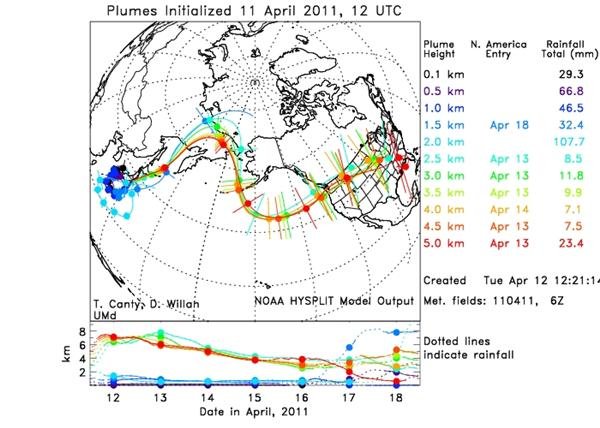
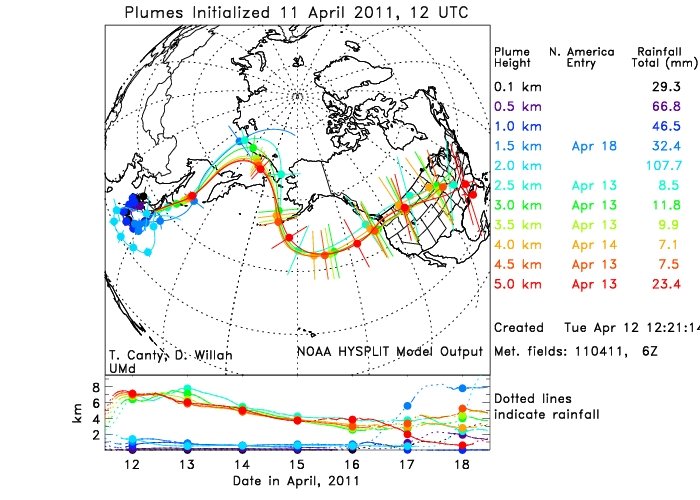
@Ralph Unger Yes. Pretty consistently. www.atmos.umd.edu
by Rob in SF via Atmos.umd.edu 4/14/2011 10:15:06 AM- Sent to Fairwinds. I watched the CNN interview. Dumping a few tonnes of radioactive water into the ocean is OK, it will be diluted. What about ocean currents? There is no magic force that disperses the radioactive water across the whole Pacific as the CNN interviewer implied. Temperature and salinity maps clearly show that water does not mix uniformly in the Pacific or any other ocean. My house is on fire, but it is OK because it will raise the temperature of houses in my city by only .000001 percent, so my house will not be damaged?by Ralph Unger 4/14/2011 10:16:48 AM
- @Ralph Unger Lotsa' good ocean modeling here: sirocco.omp.obs-mip.frby Rob in SF 4/14/2011 10:18:43 AM
- Ooops, here's the Fukushima modeling page... sirocco.omp.obs-mip.frby Rob in SF 4/14/2011 10:19:43 AM
- No one knows, as thye clearly state. But we all know that dumping garbage in the ocean has no effect at all. en.wikipedia.orgby Ralph Unger 4/14/2011 10:20:36 AM
- Let's add some Cs-137 to that mix!by Ralph Unger 4/14/2011 10:22:05 AM
- One crisis after another harried TEPCO's response www.yomiuri.co.jp
TEPCO's venting of radioactive steam from a reactor at the crippled Fukushima No. 1 nuclear plant came too late, but even after the utility acted, a series of hydrogen explosions at the plant's reactor buildings quickly turned the situation into a nightmare the government's Nuclear and Industrial Safety Agency had never anticipated. www.yomiuri.co.jpby Rob in SF 4/14/2011 10:27:47 AM - My point is that the ocean is not a homogeneous mix. The are concentrations of all sorts of things.by Ralph Unger 4/14/2011 10:28:39 AM
- And that is not even counting the biological food web kind of concentrations.by Ralph Unger 4/14/2011 10:29:36 AM
- IIRC the Fukushima mess would be as bad as Chernobyl if the sea was countedby Ralph Unger 4/14/2011 10:31:20 AM

CONCRETE PUMPS HEAD TO JAPAN
by Sin 4/14/2011 10:32:53 AM- Radiation effects on electronics en.wikipedia.orgby NHK Listener 4/14/2011 10:34:29 AM
- Tepco said it is planning to move the spent fuel rods out of the storage pools at reactors 1 through 4 so they can be moved to a safer location, although details on when and how haven't been decided yet.
Some of the options Tepco is considering include pulling the rods out with a crane or building a special structure nearby to pull them out.
But these tasks will be tough because the site is so radioactive and cluttered with debris from last month's hydrogen explosions. search.japantimes.co.jpby Rob in SF 4/14/2011 10:37:52 AM  @Rob in SF - There's ANOTHER article that's talking about #4 as if the reactor had fuel in it. WTF? Until this point, the nuclear safety agency had been saying the No. 4 reactor was relatively stable. TEPCO had repeatedly said the No. 4 reactor had been stopped and as long as there was water in the spent fuel storage pool, things would be fine Were they in the middle of refueling when this happened?by Hank Scorpio 4/14/2011 10:40:35 AM
- I mocked John for suggesting #4 had fuel in the RPV the other day. I still think he's less than reliable based upon other posts, but damn, wtf?by Hank Scorpio 4/14/2011 10:41:21 AM
- @Hank Scorpio elain and I have been trying to figure that out.. if you look back a bitby NHK Listener 4/14/2011 10:42:11 AM
- @NHK Listener - Sorry, missed it. I've been on and off the computer.by Hank Scorpio 4/14/2011 10:42:36 AM
- @Hank Scorpio about 2 hrs back you will see my post has 2 links in itby NHK Listener 4/14/2011 10:44:01 AM
- On the evening of June 15, 1896, the northeast coast of Hondo, the main island of Japan, was struck by a great earthquake wave (tsunami), which was more destructive of life and property than any earthquake convulsion of this century in that empire. The whole coastline of the San-Riku, the three provinces of Rikuzen, Rikuchu, and Rikuoku, from the island of Kinkwazan, 38° 20' north, northward for 175 miles, was laid waste by a great wave moving from the east and south, that varied in recorded height from 10 to 50 feet. A few survivors, who saw it advancing in the darkness, report its height as 80 to 100 feet.by Sinthia Domina 4/14/2011 10:44:10 AM

Japan Earthquake | Page 700
- Who's Blogging
-
 hudebnik
 alblee
 UKVal
UKVal Oliver (ScribbleLive)
 Jonathan Keebler
 kaykodh
 PKelley
 Markfm
 Angie
Angie Deb
Deb Mid Valley
- Pedro Jesus
 Matt (ScribbleLive)
 George Gibb
 elainekirk
 lillymunster
 dean
dean bo
bo Edano
Edano IanGoddard