Japan Earthquake | Page 786
 That has to be explained first.by Hank Scorpio 4/21/2011 12:50:38 AM
 Activities for Effective Aging Management
and Safe Long-Term Operation
Implemented at Fukushima Dai-ichi
Nuclear Power Plant nisaplm.jpby elainekirk 4/21/2011 12:51:00 AM- Here's the source of those numbers. english.kyodonews.jpby Hank Scorpio 4/21/2011 12:51:56 AM
 "To be honest, I was startled to see the figures. The results make it really hard for me to ask repair workers to go inside and do their jobs," said Haruki Madarame, chairman of the Nuclear Safety Commission of Japan, during a press conference the same day.
"It will take hours for workers who are not familiar with nuclear reactors to do a simple task, increasing the risk for them to be exposed to radiation," said University of Tokyo professor
"We are yet to know the detailed conditions of their working environment. However, both the No. 1 and No. 2 reactors are too hot and humid for repair crews to stay more than 30 minutes and 15 to 20 minutes, respectively, if they are to engage in operations that require exercise equivalent to going up and down stairs. As for the No. 3 reactor, they will be able to work for about an hour," Nose said.
"A lot of manpower will be needed to bring the crisis under control. There is a limit to remote operations using robots. Whether the restoration work proceeds smoothly in accordance with the timetable depends on if they can remove the source of pollution quickly and reduce the radiation leakage," Shibata said.
mdn.mainichi.jpby Rob in SF 4/21/2011 12:55:55 AM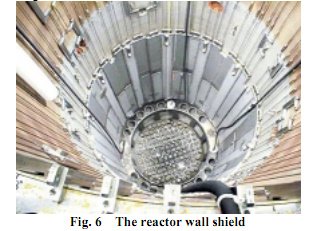
lh6.googleusercontent.com
Radiation Control in the Core Shroud Replacement Project of
Fukushima-Daiichi NPS Unit #2
tinyurl.comby elainekirk via Lh6.googleusercontent 4/21/2011 12:56:36 AM @Nancy, the counts are low. Counting error equals the sqare root of count. The larger the count, the smaller the error. I wonder what that error may be for these samples.by Peter Melzer 4/21/2011 12:57:12 AM
- www.tepco.co.jp - Those are the revised numbers for the water in #1's turbine building. There's more iodine than cesium in that sample, but not twice as much. Is WikiPedia's article on fission yields incorrect?by Hank Scorpio 4/21/2011 1:00:38 AM
 by e123 4/21/2011 1:02:37 AM
 @Hank Scorpio It's wikipedia.by Sin 4/21/2011 1:03:11 AM
- @Sin - True, but the technical stuff like that is usually reliable. It's opinionated things that are usually what's incorrect. The only conclusion I can reach is that TEPCO is half right. I think it's rain deposition. I think rain captures iodine more readily than cesium. However, I think it's deposition from recent radiation, not from the first days of the accident. That's the only conclusion I can reach.by Hank Scorpio 4/21/2011 1:05:39 AM
lh4.googleusercontent.com
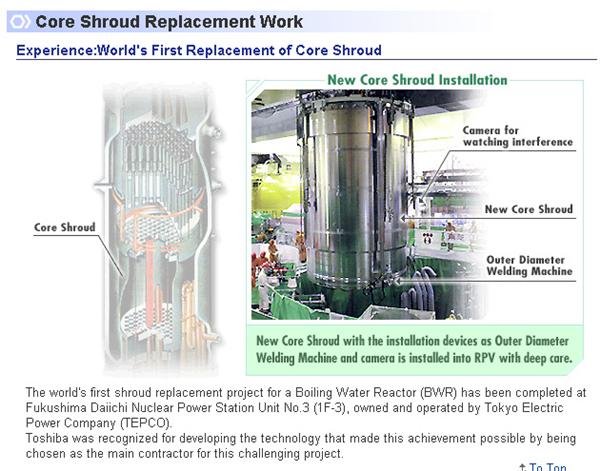
#3 core replacement the first in the world so complete experiment 1997/98
www.toshiba.co.jp
And #4 shroud was being replaced at the time of the 'accidentby elainekirk via Lh4.googleusercontent 4/21/2011 1:07:24 AM- Thursday April 21 2011, 00:39:04 UTC 27 minutes ago off the east coast of Honshu, Japan 5.8 Depth 15.0by Edano 4/21/2011 1:10:52 AM
 @elainekirk Aha! the shroud in number 4. That's the first I've seen for the reason of the extended outage.by Jim Carver 4/21/2011 1:11:18 AM
- Vollbild
Type: Earthquake
31 minutes ago
Magnitude: 5.8
DateTime: Thursday April 21 2011, 00:39:04 UTC
Region: off the east coast of Honshu, Japan
Depth: 15 kmby Edano 4/21/2011 1:11:22 AM - Well reactor#1 is full of steam, which has to be leaking from the reactor vessel....at least 2 of them have reactor containment breach, so no surprise to me that the I131 is there in those numbers. Fresh radioactive particle release on an hourly basis, not to mention what evaporates in the steam from the SFPs.by Sin 4/21/2011 1:11:33 AM
- WHY EVEN PUBLISH THIS? Fukushima accident likely caused by blackouts
A Japanese nuclear safety official says the crisis at the Fukushima Daiichi nuclear power plant was likely caused by electricity blackouts as a result of tsunami and not by shock of the earthquake. National Nuclear Safety Commissioner Osamu Oyamada made the remark at a news conference on Wednesday in the city of Fukushima after inspecting the plant. Referring to accounts of the accident by the plant manager and workers, Oyamada said the reactors were apparently shut down without any hitch. He said the reactors and their buildings did not likely incur serious damage caused by the quake itself and that they were intact immediately after it. But he said there are no gauge readings or other data available to prove this assumption.
Thursday, April 21, 2011 00:34 +0900 (JST) www3.nhk.or.jpby Sin 4/21/2011 1:11:38 AM  Tokyo Electric admits fuel could be melting at Fukushima nuke plant
TOKYO, April 21, Kyodo
An official at Tokyo Electric Power Co., the operator of the crippled Fukushima Daiichi nuclear power plant, admitted Wednesday that fuel of the plant's No. 1 reactor could be melting. REALLY? english.kyodonews.jpby gabe 4/21/2011 1:13:29 AM- @Jim Carver, but then it occurred to me that perhaps the reporter at kyodonews did not bother with such details. I wish the TEPCO people would realize that the only way the can win the public is accurate, complete and timely information.by Peter Melzer 4/21/2011 1:17:03 AM
- Govt suspends shipment of Fukushima sand lances
The government has instructed Fukushima Prefecture to suspend shipments of a small fish caught off its coasts found to have radioactive contamination, and to warn people not to eat them. The restrictions announced on Wednesday are being applied to marine products for the first time, amid ongoing troubles at the Fukushima Daiichi nuclear power plant.
The instruction follows a health ministry report that the fish called sand lance caught on Monday near Iwaki city, south of the plant, was found to contain 14,400 becquerels per kilogram of radioactive cesium. That's 29 times the safe limit.
Ministry testing also found 3,900 becquerels, or twice the limit, of radioactive iodine in the fish.
Excessive amounts of radioactive cesium were detected in sand lances caught in the same area on April the 7th and 13th.
The government says the fish are not on the market, as fishery cooperatives in Fukushima are not operating.
Wednesday, April 20, 2011 14:18 +0900 (JST) www3.nhk.or.jpby Sin edited by elainekirk 4/21/2011 1:18:32 AM - These news reports @sin is putting up need filing in their entirity because the press clampdown could mean they will disappear , the media are no longer allowed to cause fear (in other words they want to fool the people that eerything is under control)by elainekirk 4/21/2011 1:20:59 AM
- @Sin , now that I call one HEALTHY DOSE. I wonder whether the little fishies glow in the dark. Point is the cesium will stay and concentrate up in the food chain. The iodine will disappear.by Peter Melzer 4/21/2011 1:22:05 AM
- @sin do you think the media are publishing to cock a snook at the new orders , it is good to see real news getting outby elainekirk 4/21/2011 1:23:20 AM
 @Hank Scorpio The barium-140 numbers in the water of #2 and #3 imply strontium-89 in about the same amount. There would have been more barium to begin with, but it decays faster.by Bobby1 4/21/2011 1:27:02 AM
 @Peter Melzer TEPCO is working the confusion angle with all they got. They measure volume in tons, leaving the press to completely muck up what KIND of tons. If there's a second number it will be in cubic meters. Still no gallons or liters people can relate to with fluids. If its radiation, just try to keep track of all the different units mixed, possibly appropriately, who can tell without a conversion table. If you can't beat 'em with the facts, baffle 'em with bull pucky.by radioguy 4/21/2011 1:33:19 AM
 @all For those who might be interested in new EPA numbers, especially for CA....Los Angeles milk collected 4/13 and posted today has 4 pCi/l of I-131, drinking water posted on 4/10 is .39 pCi/l I-131. Oakland was added today and tested with 2.5 pCi/l Cs-134 and 3.7 pCi/l of I-131. The LA iodine levels went up from 2.9 pCi/l to 4. Definitely something to watch all over. www.epa.govby LM 4/21/2011 1:36:11 AM
 Does anyone have a link to the explosion of 4? I tried a video google search and some youtube searching but keep getting 3 or a tv clip with no explosion video.by Nancy 4/21/2011 1:38:56 AM
- by Sin 4/21/2011 1:40:25 AM
- Sand lance constitute a major prey for at least some populations of over 100 species
of consumer, including 40 species of birds, 12 species of marine mammals, 45 species
of fishes, and some invertebrates. Variation in the availability of sand lance (and
other forage fishes) can have major effects on the breeding success and survival of
their predators.by Sin 4/21/2011 1:41:49 AM - NEWS ADVISORY: Kan announces areas 20-km from Fukushima plant as no-entry zone
english.kyodonews.jpby estacion 4/21/2011 1:42:12 AM  @Nancy Todays Fire Near Fukushima Daiichi Reactor No 4 12.04.11 www.youtube.comby Majjham Zazen 4/21/2011 1:42:37 AM
- @Nancy Operator of Japan's leaking nuclear plant releases footage of the ruined interior of reactor No. 4 at the Fukushima Daiichi nuclear complex. www.telegraph.co.ukby Majjham Zazen 4/21/2011 1:46:36 AM
- Decontamination of water by photolytic oxidation/reduction utilizing near blackbody radiation
United States Patent 6200466
A reactor system for decontamination of water by photolytic oxidation utilizing near blackbody radiation, the system comprising (1) a reaction chamber defining an internal space with an inlet and an outlet; and (2) a broadband radiator for generating radiant energy with wavelengths between about 150 nm and about 3 μm, the broadband radiator disposed within the reaction chamber, such that a sufficient dosage of broadband radiation irradiates the contaminants and/or the oxidant within the internal space of the reaction chamber thereby causing photolytic oxidation of the contaminants by direct action of the radiation on the contaminants to break chemical bonds by sustaining a free radical chain reaction of oxidizing components, thus breaking down the contaminants by way of atomic abstraction of the components of the contaminants. In preferred embodiments, at least a portion of the radiant energy is generated in a pulsed mode, such as between about 1 and about 500 pulses per second. In preferred embodiments, the broadband radiator generates radiant energy at a rate of between about 1 kW and about 10 MW., and the resultant dosage rate of broadband radiation is between 1 joule/cm2 and about 5000 joules/cm2. In preferred embodiments, the radiant energy is produced by at least one gas filled flashlamp having a gas plasma temperature of between about 9,500° K and about 20,000° K.by Rob in SF 4/21/2011 1:51:21 AM - General Decontamination Procedure (When water is available)
Those concerned about possible exposure to radiation from the the Tokyo Electric Power Fukushima Dai-ichi nuclear accident should follow the steps below.
Even in the case of contamination, you can remove a great deal of radioactive materials with the following methods.
1. Remove your shoes and clothes and place them in a plastic bag.
2. Wipe yourself down with cloth or a wet tissue (afterwards place the cloth or wipe in the plastic bag and throw the bag and contents away).
Follow the procedure below if shower is available
1. Wash your hair with shampoo.
2. Wash your face. (with soap or body wash)
3. Wash your body. Including the inside of your ears and under your fingernails (with soap or body wash)
4. Wash the clothes in the laundry or if you are still concerned, dispose of the clothes.
National Institute of Radiological Sciences
original here: www.nirs.go.jpby Rob in SF 4/21/2011 1:54:43 AM - @radioguy, I bet they measure in metric tons and it is standard to measure water usage in cubic meters. Another thought, is Japan on 220V, 50 Hz? Anyone knows?by Peter Melzer 4/21/2011 1:56:11 AM
- 20110415002-3 is the april 15 6:00 file. You can also get all the major parameter data by looking at the tables in the ceramic damage reports, the ones that are now up around 104by Markfm 4/21/2011 2:11:33 AM
- NEWS ADVISORY: Gov't reduces evacuation zone around Fukushima No.2 nuclear plant: Edano (11:10 21 April) english.kyodonews.jp
Tada, The magician does his trick to calm the sheep asleepby estacion 4/21/2011 2:23:30 AM - @Peter Melzer They use metric tons, but say tons. The British use tonnes which are almost metric tons but not quite. Americans round a kilo to two pounds and call it even. I can't help think of the BP reporting, mixing gallons and barrels and cubic feet and tons (American ... or BP and all, were they British?) Obfuscation.by radioguy 4/21/2011 2:26:34 AM
- @Peter melzer even worse.. Half of Japan is on 50 Hz, the other half is on 60 Hz.. That's the reason for the rolling blackouts..by sims 4/21/2011 2:30:33 AM
- by e123 4/21/2011 2:32:45 AM
- @Peter Melzer oops... I posted this on the other blog:
Japan 100 V 50/60 Hz*
*Eastern Japan 50 Hz (Tokyo, Kawasaki, Sapporo, Yokohoma, and Sendai);
Western Japan 60 Hz (Osaka, Kyoto, Nagoya, Hiroshima)by radioguy 4/21/2011 2:32:51 AM - found this vid of the 14th when they had fire at reactor 4by e123 4/21/2011 2:33:13 AM
- that day the wind was strong and blowing 20 miles an hour out to sea i think.by e123 4/21/2011 2:33:46 AM
- 6.0 off eastern coast of Honshu, Japan. earthquake.usgs.govby LM 4/21/2011 2:39:55 AM
- Ty @radio guy and @sims. Flabbergasting, to say the least!by Peter Melzer 4/21/2011 2:47:40 AM
- "Overall radiation at fukushima NPP is 2.2×10^11bq."Say them, just now, in Live TEPCO Conf at iwakamiyasumi.comby estacion 4/21/2011 2:55:17 AM


Japan Earthquake | Page 786
- Who's Blogging
-
 hudebnik
 alblee
 UKVal
UKVal Oliver (ScribbleLive)
 Jonathan Keebler
 kaykodh
 PKelley
 Markfm
 Angie
Angie Deb
Deb Mid Valley
- Pedro Jesus
 Matt (ScribbleLive)
 George Gibb
- elainekirk
 lillymunster
 dean
dean bo
bo Edano
Edano IanGoddard