Japan Earthquake | Page 947

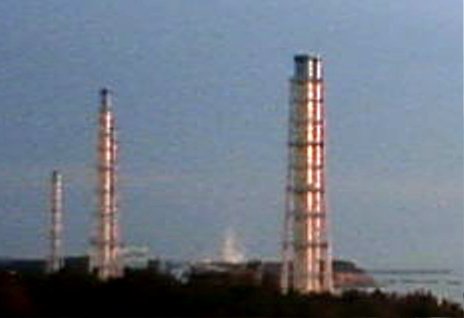
i56.tinypic.com
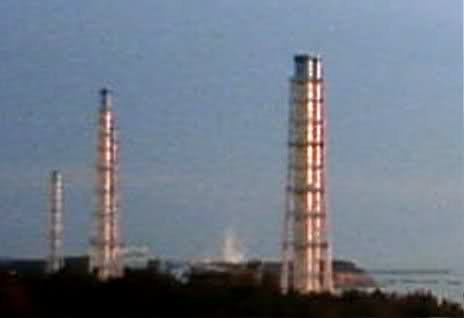
@WolfDK I blew it up and white balanced it. Little else to see, but it looks like it's coming right up the center of R4, and no wind, so rising straight up. I think that's about as good a bead as we can get on where the SFP/flooded building/whatever is boiling.by radioguy via I56.tinypic 5/2/2011 8:56:08 PM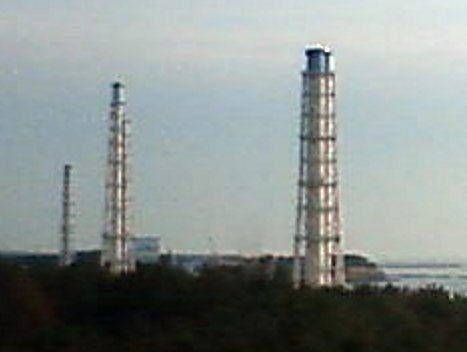
i54.tinypic.com
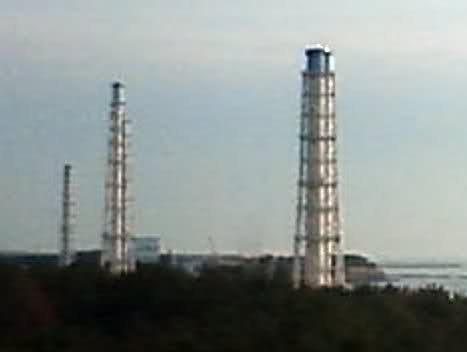
Here's the new one... later so warmer and less steam, but black smoke at the front, in a different spot than the steam.by radioguy via I54.tinypic 5/2/2011 9:12:15 PM- The smoke looks like it could as easily come from R3 half-hidden behind R4.by radioguy 5/2/2011 9:14:37 PM

jim:
Japan
What can the US learn from Fukushima?
An expert tells the Senate that US reactors are more vulnerable than Japan's Daiichi plant.
Japan protests
Japanese civic group members hold placards to protest against Tokyo Electric Power Company (TEPCO) over the nuclear leakage at the comnpany's Fukushima nuclear power plant, following the 9.0-magnitude earthquake and tsunami outside the TEPCO headquarters in Tokyo on March 30, 2011. (Yoshikazu Tsuno/AFP/Getty Images)
BOSTON — It may seem easy to prevent a nuclear accident like the one in Fukushima, Japan: avoid building reactors near a fault, or on a coastline vulnerable to tsunamis.
But it’s not quite that simple.
In fact, neither the jolt of tectonic plates grinding together nor the massive wave were directly responsible for the calamity. True, the 9.0-magnitude quake was larger than the reactor was designed to handle. Yet none of the six reactors at the station crumbled under the assault. Instead, the emergency systems kicked in, shutting down the three reactors that were operating at the time of the disaster (the other three were off for maintenance).
It was something far more mundane that triggered the accident: A blackout.
Nuclear facilities generate enormous amounts of heat even when they’re shut off. So it is essential that cooling systems continue operating. If not, the heat will eventually boil off the cooling water, melting the fuel into one very hot, uncontrollable mass. Because the reactors were down, because the electric grid was destroyed, and the diesel generators were washed away by the tsunami, there was no power left to run the cooling systems.
So a power cut is the culprit. Ever have one of those in your neighborhood?
If you think your local nuclear power plant is prepared to handle such a mundane event, you may want to heed the warnings of Dr. David Lochbaum, who directs the nuclear safety project at the Union of Concerned Scientists, a watchdog that is neither for nor against nuclear power.
“As at Fukushima, U.S. reactors are designed to cool the reactor core during a station blackout of only a fairly short duration,” Lochbaum told the Senate Energy and Natural Resources Committee (emphasis added). “It is assumed that either the connection to an energized electrical grid or the repair of an emergency diesel generator will occur before the batteries are depleted.”
In the United States, 104 reactors produce 20 percent of the nation’s energy. Only 11 of those, Lochbaum said, “are designed to cope with a station blackout lasting eight hours, as were the reactors in Japan.”
The other 93? They can only hang on for four hours.
Consider an accidental power cut — like, perhaps the one caused by solar flares in 1989 leaving 2 million Quebecois without power for nine hours. Or imagine that someone who didn’t care much for the United States knocked out the electric grid, and then interfered with emergency workers, for example by deploying a dirty bomb. Then add a failure (or knockout) of backup diesel generators. Most American reactors would have only four hours before the cooling systems run out of juice and the fuel starts heating up, triggering a crisis.
But that’s not all. Lochbaum also stated that the U.S. is vulnerable to a spent fuel pool disaster, similar to the one underway at Fukushima.
At issue here is the fuel rods that have already been used in the reactor. These remain dangerously radioactive for many centuries after they are no longer useful to produce electricity. The U.S. lacks a safe place to bury these. Yucca Mountain, Nevada was selected for that purpose in the 1980s, but political and safety concerns have prevented construction. As a result, they’ve been building up at nuke facilities, adjacent to the reactors.
Lochbaum told the Senators that at many U.S. reactors, there is “far more irradiated fuel in the spent fuel pool” than in the reactor itself. This material is cooled “by fewer and less reliable systems” than in the reactor, and is “housed in far less robust structures than surround the reactor core.” This means that any radiation release from a pool will be less-well contained than a release from the reactor core.
“It also means that spent fuel pools are more vulnerable to terrorist attack than is the reactor itself,” Lochbaum concluded. “More irradiated fuel that is less well protected and less well defended is an undue hazard.”
As a near-term alternative, Lochbaum suggested that after an initial cooling period, the fuel should be stored in dry casks. This is currently the practice in Germany, where regulators decided three decades ago that fuel pools were too dangerous in the event of a war.
In response to these lessons from Fukushima, this week Rep. Edward J. Markey (D-MA) introduced legislation requiring nuclear plants to increase their battery capacity to 72 hours, and to have 14 days worth of diesel fuel on-site. The legislation would also halt new reactor licenses or license extensions until regulators enact new safety standards based on the lessons learned at Fukushima.
The Nuclear Energy Institute, an industry association, suggested that Rep. Markey's legislation was redundant with existing regulation. Markey’s “call for a moratorium ignores the Nuclear Regulatory Commission's 90-day safety review and processes already in place in the licensing processes to review new information that may arise during new plant construction,” said Marvin Fertel, NEI president and chief executive officer, in a statement.
"The NRC chairman testified before a Senate committee today that U.S. nuclear plants are safe and secure, and it is 'very unlikely' that the combination of events in Japan earlier this month would occur in the United States. Nonetheless, the NRC is an independent regulator of the nuclear energy industry and therefore can require additional action by the industry as part of its licensing processes. Similarly, Congress has direct oversight of the NRC and has an established process to vet these issues before hastening to legislate changes to the licensing process,” Fertel said. www.globalpost.comby Jim Carver 5/2/2011 9:14:58 PM- No, I think it's from R4, because if you look you can see the smoke in the other shot as well, and the lighting pulls it out more.by radioguy 5/2/2011 9:16:09 PM
- @Jim Carver Great. Like whoever early on said "I just decided after GoogleEarthing in on Daiichi so much, to zoom in on my own local nuclear power plant. What a dump!"by radioguy 5/2/2011 9:17:28 PM
- "In the United States, 104 reactors produce 20 percent of the nation’s energy. Only 11 of those, Lochbaum said, “are designed to cope with a station blackout lasting eight hours, as were the reactors in Japan.”
The other 93? They can only hang on for four hours."
Really???by radioguy 5/2/2011 9:18:32 PM  @radioguy I lost the teppycam url again! Please could you give me the link?by marie rich 5/2/2011 9:18:42 PM
- by radioguy 5/2/2011 9:19:01 PM
- Ty, sir.by marie rich 5/2/2011 9:19:17 PM
- @radioguy That article crystallized my thoughts precisly.by Jim Carver 5/2/2011 9:20:19 PM
- @Jim Carver Excellent article. I'm going in to the station to link up the blog page, and I'll add that one. But first, off to bail out of my last Wells Fargo account and get it into my credit union. It's a good feeling. :)by radioguy 5/2/2011 9:23:45 PM
Japan’s NHK TV is reporting the “Japanese government is about to begin releasing data projecting the spread of radiation from the Fukushima Daiichi nuclear plant that it initially withheld for fear of causing panic.”
by Jim Carver 5/2/2011 9:40:40 PM- I just hate insincere appologies...by marie rich 5/2/2011 9:44:23 PM
May 01 (NHK) — Prime Minister Naoto Kan says the government and Tokyo Electric Power Company failed to fully address safety issues that had come to light before the March 11 disaster.
by Jim Carver 5/2/2011 9:50:18 PM- Fukushima radiation levels rise to highest levels yet
By William Whitlow
2 May 2011
As the twenty-fifth anniversary of Chernobyl passes, Fukushima looks set to overtake it as the world’s worst nuclear disaster. Two weeks ago Fukushima was raised from a level 5 disaster to a level 7 like Chernobyl. But nearly two months after the crisis began, Fukushima is still emitting radioactivity, while Chernobyl’s emissions had been contained at this stage.
Robots sent into the Number 1 reactor building have recorded the highest reading of radioactivity so far found at the Fukushima Dai-ichi plant since the emergency began almost two months ago. Two robots found 1,120 millisieverts of radiation an hour was being emitted from the stricken reactor. This level of radiation is more than enough to cause immediate radiation sickness if a human being were exposed to it. The Tokyo Electrical Power Company (Tepco) which runs the Fukushima facility has begun to use robots because it has become impossible to send workers into the plant for long enough to take accurate readings.
Read More: www.wsws.orgby Jim Carver 5/2/2011 10:10:24 PM  @Jim Carver : hmmm the headline is wrong.by Edano 5/2/2011 10:13:06 PM
 I contacted Markley's office and asked them for the text or legislation number of that new law mentioned in Jim's article from Globalpost.com. His web site has some good information but nothing about the proposed law that would extend back up power times and review licenses. He also has a contact form on his web site if you want to email his office. Page on his site related to the power plant issues. markey.house.govby Nancy 5/2/2011 10:13:22 PM
- @Nancy mucho tanksby Jim Carver 5/2/2011 10:14:56 PM
- @Jim Carver So if they still have sky high radiation levels in #1 what will they do in order to send people in later this week? Release radiation into the air? Cook a couple of workers? I think this may be the issue of the week.by Nancy 5/2/2011 10:15:31 PM
 @edano is it though? if that is in #1 and escaping to the atmosphere what do you get when you add all the other sources? it is even in #6 isn't it? the air above that plant , which isn't being measured, must be ....by elainekirk 5/2/2011 10:16:10 PM
- @Jim Carver It sounds quite a bit like what people were mentioning on here they wanted to push for. If it is, makes taking action on it easier with legislation already in the works. Markley may have a hard sell in the house so public pressure will matter in trying to get it through.by Nancy 5/2/2011 10:17:38 PM
- @Nancy Probably is..they tell us what to print I guess. Only fly in their ointment is we don't print what they want us to...and yeah their open air filtration system is a joke. My eight year old doesn't buy it either.by Jim Carver 5/2/2011 10:19:14 PM
- @Nancy Maybe he might be up for an interview..by Jim Carver 5/2/2011 10:20:22 PM
- @Edano That article is long. I just posted an excerpt.by Jim Carver 5/2/2011 10:21:53 PM
- Fukushima Daiichi - Fukushima Daini 1985-1994 just compare those figures for ave individual dose!!!
www.jnes.go.jp
that is crazyby elainekirk 5/2/2011 10:24:01 PM - I have my first guest coming on pretty soon.by Jim Carver 5/2/2011 10:26:07 PM
- @link Jimby elainekirk 5/2/2011 10:26:51 PM
- I mean in a couple of days. We still have to get set up.by Jim Carver 5/2/2011 10:28:33 PM
- @Nancy : i have a technical question on a photo.
by Edano 5/2/2011 10:29:38 PM - @Edano i'm around for a few. What do you need?by Nancy 5/2/2011 10:31:40 PM
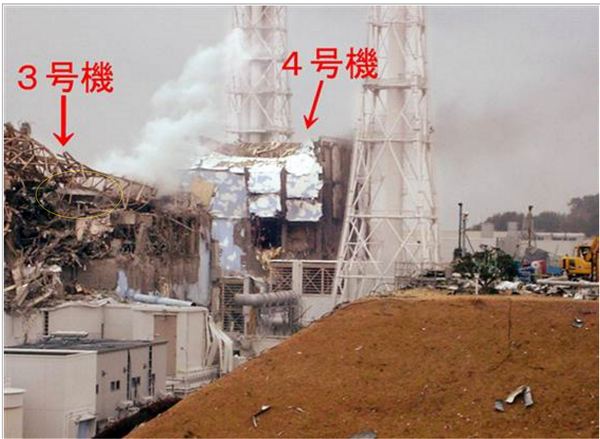
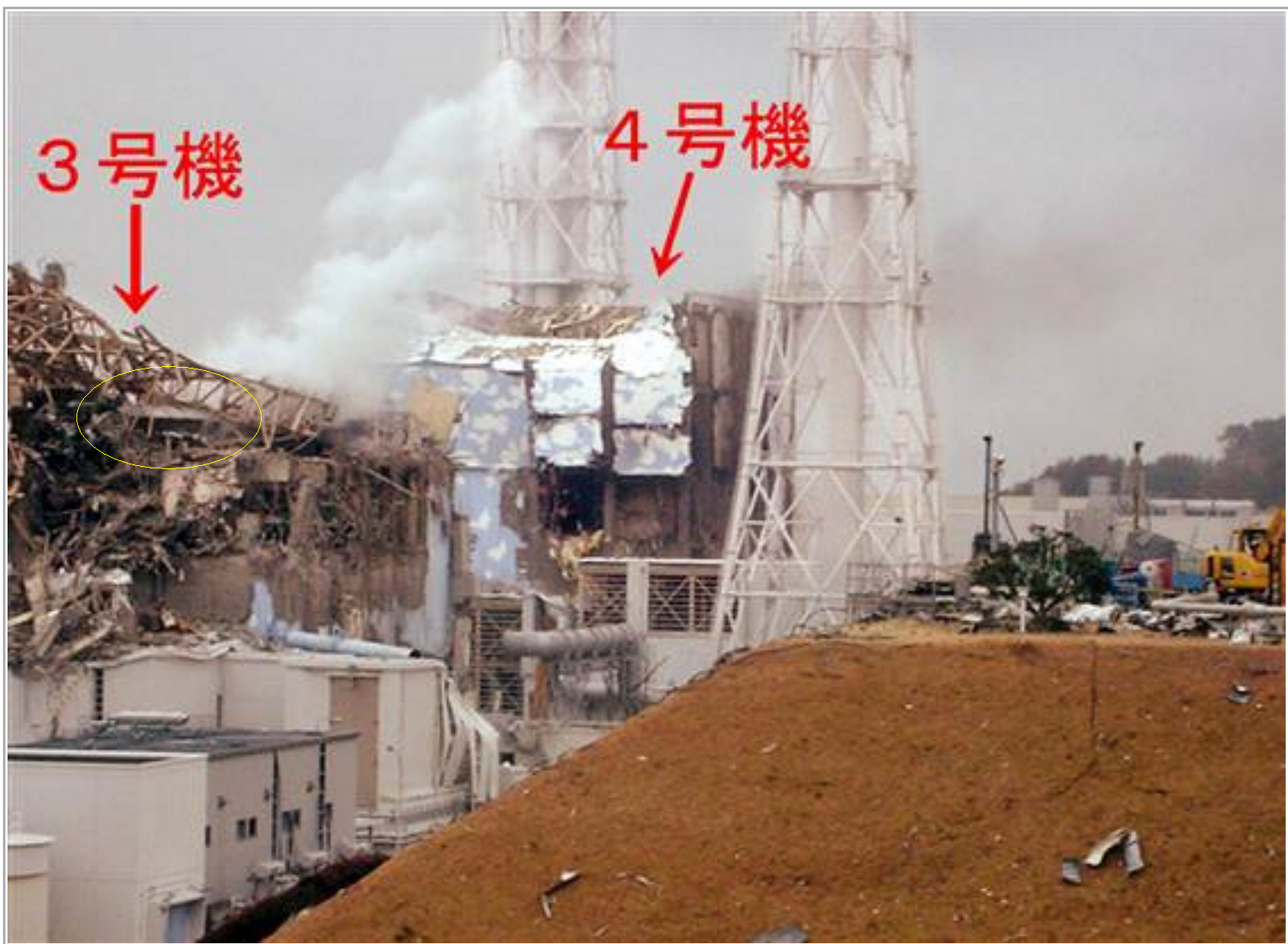
@Nancy : please, what is the round structure under the left arrow (i made a circle) ? it doesn't let me sleep. s7.directupload.net
by Edano via S7.directupload.net 5/2/2011 10:33:29 PM- @Jim Carver The rough idea of the air scrubber if it is what I assume it to be is using a larger version of the military haz-mat units. Being the major source of the air pollution is inside the building it might be able to lower levels in the air a bit. The real problem is this chicken vs. egg issue. Have to send someone into the highly radioactive environment to hook it up in order to then hopefully have lower air levels. Same goes for the air cooling unit. Have to get people inside to hook it up.by Nancy 5/2/2011 10:36:11 PM
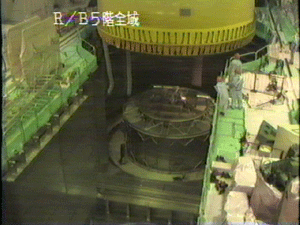
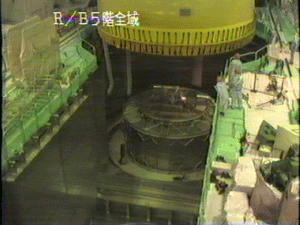
@Nancy : doesn't it look like this part ? www.houseoffoust.com
by Edano via Houseoffoust 5/2/2011 10:37:08 PM- @Edano the white part is smoke. the black part is either the refueling floor deck or the top of the reactor well. I am leaning more towards it being deck because the overhead shots show a bit of deck still intact past the reactor well going towards where the deck is blow out on that north east corner.by Nancy 5/2/2011 10:38:03 PM
- @Nancy They might be able to do at least some of it robotically, and yes anything will help, but what about all the residue on all the walls, floors and ceilings...not to mention the debris? That debris is hot as hell.by Jim Carver 5/2/2011 10:39:54 PM
- @Edano I don't think it is that or at least not from that angle. the angle in that second picture shows this pit. We can see this pit but with the big metal plate put in place that goes at the end of the pit to close off the reactor well. That pit is further to the left in the first image and appears to be intact on overhead shots. Now that you mention it I really should grab a couple of overhead shots and trace a line of where that refueling floor still exists! I will see if I can get a couple overhead angles grabbed and done up with that side view in mind.by Nancy 5/2/2011 10:41:00 PM
 hi to every one....by dean 5/2/2011 10:42:25 PM
- mourning!by Jim Carver 5/2/2011 10:43:00 PM
- @dean Hiby elainekirk 5/2/2011 10:44:36 PM
- @Nancy i suspect it is the top of the reactor well, which would mean the yellow cap is gone. on the first picture, i don't mean the black structure, i mean the greyish metal looking "plate".by Edano 5/2/2011 10:45:04 PM
- hi elaine... hope all is well on the home frontby dean 5/2/2011 10:45:07 PM
- @Jim Carver When I first heard of this I thought we had radiation stats for containment on #1. Then when I checked back here all we have is sky high stats then nothing and some high readings in other areas. I would think having 1 sievert or higher readings in the web well would make things in the dry well pretty damn radioactive. My understanding is they would have to get into containment at some point to install the air scrubber. There was also mention they were fiddling with the water and air because of worries of a hydrogen explosion. I don't know enough to know if opening up containment would potentially cause an explosion or that much air would toss the balance past the mix need to blow up.by Nancy 5/2/2011 10:46:09 PM
- @Edano I will see what I can dig up on other views. May help sort it out.by Nancy 5/2/2011 10:46:55 PM
- Hi dean!by Nancy 5/2/2011 10:47:02 PM
Japan Earthquake | Page 947
- Who's Blogging
-
 hudebnik
 alblee
 UKVal
UKVal Jonathan Keebler
 Oliver (ScribbleLive)
 kaykodh
 Markfm
 Angie
Angie Mid Valley
 Matt (ScribbleLive)
 George Gibb
- elainekirk
 PKelley
 lillymunster
 dean
dean bo
bo Edano
Edano Deb
Deb Pedro Jesus
 IanGoddard