Japan Earthquake | Page 1194
 ok thanksby Veenie 5/15/2011 6:00:50 PM
 by elainekirk 5/15/2011 6:01:46 PM
- So, it's fog ?by Veenie 5/15/2011 6:01:54 PM
 @Veenie I hope so - it behaved like cloud or fog.by UKVal 5/15/2011 6:02:37 PM
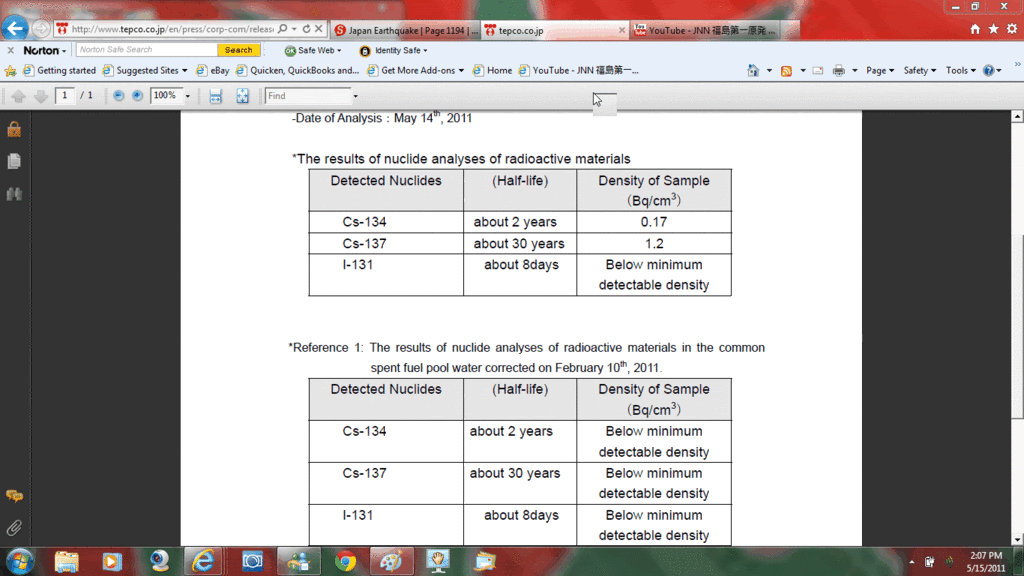
 Thanks to Bo for the online.wsj story. Has anybody seen the new TEPCO analysis of unit 4 that the story mentions in the last two paragraphs?by bo34 5/15/2011 6:05:50 PM
 @bo34 I am not seeing a TEPCO document in their press releases. www.tepco.co.jpby Nancy 5/15/2011 6:12:55 PM
- 'Moving on to the latest developments in Japan's ongoing nuclear crisis highly radioactive substances were detected in parts of Tokyo. Japan's Asahi Shimbun reports about 3,200 and nearly 2-thousand becquerels of radioactive cesium per kilogram were found in the soil of Tokyo districts of Koto and Chiyoda, respectively, from testing conducted between April 10th and the 20th. This amount is higher than what was found in the prefectures near the Fukushima plant and experts warn that other areas may be subject to radiation contamination as clusters of clouds containing radioactive material remain in the atmosphere. Meanwhile, the plant's main operator, TEPCO, says that over 3-thousand tons of contaminated water has been found in the basement of the No. 1 reactor, causing a delay in Japan's latest approach to cool down the reactors'. hisz.rsoe.huby UKVal 5/15/2011 6:14:43 PM
 a small timeline given by tepco:
Rapid meltdown in No.1 reactor
Tokyo Electric Power Company, the operator of the Fukushima Daiichi nuclear power plant, says most of the fuel rods in the No.1 reactor had dropped to the bottom of the pressure vessel within 16 hours of the earthquake on March 11th.
The utility revealed its study on the subject on Sunday.
TEPCO said it analyzed the data and calculated a timeline for the developments in the No. 1 reactor on the assumption that the reactor lost its cooling system as soon as it was hit by the tsunami.
The firm said that within about 3 hours after the reactor automatically shut down, the cooling water had evaporated to a level at the top of the rods.
In the next hour and a half, parts of the fuel rods are believed to have begun melting.
The temperature of the fuel rods is believed to have reached 2,800 degrees Celsius at this stage, and the meltdown advanced rapidly.
Almost of all the fuel rods melted and dropped to the bottom of the pressure vessel by 6:50 am on March 12th.
TEPCO said the temperature dropped after water was poured into the reactor starting at 5:50 am on the same day.
The firm says the melted rods created small holes on the bottom of the vessel, but that no major problems are developing there. It believes that the amount of radioactive substances that could spread from the reactor will be limited.
Sunday, May 15, 2011 23:29 +0900 (JST)
www3.nhk.or.jpby Edano 5/15/2011 6:33:30 PM- kyodo going cinical ?
Japan says its nuclear crisis action appropriate in draft IAEA report
TOKYO, May 15, Kyodo
The Japanese government says in a draft report to be presented to the U.N. nuclear watchdog that it took appropriate action immediately after the crisis emerged at the Fukushima nuclear power plants following the March 11 earthquake, describing generally in a favorable light the responses of itself and plant operator Tokyo Electric Power Co., a gist of the report showed Sunday.
english.kyodonews.jpby Edano 5/15/2011 6:38:26 PM - @Edano. So nice to hear - no major problems, limited spread. They think we are stupid.by Scilla 5/15/2011 6:39:15 PM
 Pets of evacuees 'trapped' in cars www.yomiuri.co.jpby Panserbjorne9 5/15/2011 6:46:53 PM
 TIPPYcam starts resolving into fog.by radioguy 5/15/2011 7:03:31 PM
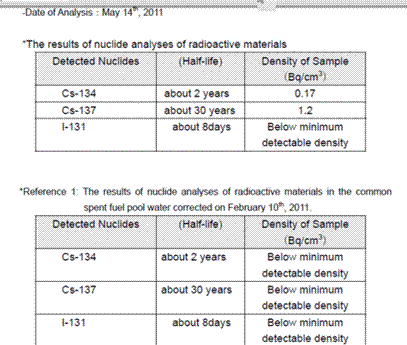 by marie rich via I1207.photobucket 5/15/2011 7:10:52 PM
- @marie have they given any temps for common pool?by elainekirk 5/15/2011 7:17:52 PM
- Not that I know of
haven't they been testing or recording on a regular basis at all this is ridiculous why aren't our governments shouting from the tree tops???by marie rich edited by elainekirk 5/15/2011 7:18:28 PM - Common pool temps are listed in the daily nisa reportsby Markfm 5/15/2011 7:36:35 PM
- @mark thanks have you noticed any changes?by elainekirk 5/15/2011 7:38:32 PM
- Pretty calm, around 25cby Markfm 5/15/2011 7:39:56 PM
- @mark @marie does the comparisson with a feb reading mean it is the first time they have tested since the quake?by elainekirk 5/15/2011 7:46:49 PM
- UPDATE ON BOTTOM
TEPCO Stating the Obvious After 2 Month: Reactor 1 Meltdown Occurred Within 16 Hours of March 11 Earthquake
"Almost of all the fuel rods melted and dropped to the bottom of the pressure vessel by 6:50 am on March 12th." (NHK WORLD news)
NHK WORLD, whose outlandish report that there was a 300 millisievert/hr debris on a nearby mountainside is still uncorrected, says that TEPCO has disclosed the Reactor 1 meltdown occurred within 16 hours of the March 11 earthquake:
Tokyo Electric Power Company, the operator of the Fukushima Daiichi nuclear power plant, says most of the fuel rods in the No.1 reactor had dropped to the bottom of the pressure vessel within 16 hours of the earthquake on March 11th.
The utility revealed its study on the subject on Sunday.
TEPCO said it analyzed the data and calculated a timeline for the developments in the No. 1 reactor on the assumption that the reactor lost its cooling system as soon as it was hit by the tsunami.
The firm said that within about 3 hours after the reactor automatically shut down, the cooling water had evaporated to a level at the top of the rods.
In the next hour and a half, parts of the fuel rods are believed to have begun melting.
The temperature of the fuel rods is believed to have reached 2,800 degrees Celsius at this stage, and the meltdown advanced rapidly.
Almost of all the fuel rods melted and dropped to the bottom of the pressure vessel by 6:50 am on March 12th.
TEPCO said the temperature dropped after water was poured into the reactor starting at 5:50 am on the same day.
The firm says the melted rods created small holes on the bottom of the vessel, but that no major problems are developing there. It believes that the amount of radioactive substances that could spread from the reactor will be limited.
Sunday, May 15, 2011 23:29 +0900 (JST)
For people who can read the Wikipedia entry on "Corium", it's abundantly clear what happens once the water is no longer cooling the fuel rods:
During the Three Mile Island accident, slow partial meltdown of the reactor core occurred. About 19,000 kg of material melted and relocated during about 2 minutes, about 224 minutes after the reactor scram.
In the case of Chernobyl:
The first phase lasted only several seconds, with temperatures locally exceeding 2600 °C, when a zirconium-uranium-oxide melt formed from no more than 30% of the core.by Veenie 5/15/2011 7:52:40 PM - NHK WORLD, whose outlandish report that there was a 300 millisievert/hr debris on a nearby mountainside is still uncorrected, says that TEPCO has disclosed the Reactor 1 meltdown occurred within 16 hours of the March 11 earthquake' ... I wonder if this is a mistranslation for 'slope near the reactor' - i.e. fuel pellet ejection?by UKVal 5/15/2011 7:57:35 PM
- Sunday May 15 2011, 18:37:10 UTC 52 minutes ago Bougainville region, Papua New Guinea 6.5 43.2 and tsunami warning for hawaii and solomon island.by Edano 5/15/2011 7:58:02 PM
- @UKVal You're good, i deliberatly tried to shift the focus off that by saying update on bottom ))........THAT has me boggled as wellby Veenie 5/15/2011 7:59:28 PM
 Anyone notice the shutdown delay Hamaoka had..saltwater in the RPV www.japantoday.comby RBeaner 5/15/2011 8:12:01 PM
 Morning everyone...........by Angie 5/15/2011 8:12:33 PM
- @angie g'morning :) @rbeaner yes I saw that I havent seen any update yetby elainekirk 5/15/2011 8:14:53 PM
- @Edano That's your 2 hours to insert rods and shutdownby RBeaner 5/15/2011 8:15:11 PM
- @RBeaner WTH? 400 tons of water and saltwater in the RPV.by Nancy 5/15/2011 8:15:33 PM
- @elainekirk There all shutdown, it was a delay, But salt water shouldn't be thereby RBeaner 5/15/2011 8:15:51 PM
- There shouldnt be saltwater in there unless there was a problem and they needed to put it there right?? sorry only just woke up.........by Angie 5/15/2011 8:17:07 PM
- it has happened before en.wikipedia.orgby elainekirk edited by Angie 5/15/2011 8:18:23 PM
 How the !? does saltwater cross between the primary and secondary cooling loop and enter the reactor ? its un-possible, what are the chances of both failing in a way to allow pri and sec coolant water to mix ?by WolfDK 5/15/2011 8:22:30 PM
- @RBeaner : uuh, again, unbelievable.by Edano 5/15/2011 8:27:32 PM
- @WolfDK : this means, in the other direction, radiation leaking ! do they think we are stupid ?by Edano 5/15/2011 8:28:26 PM
- @elainekirk First time they tested the common pool that they'll admit to?by marie rich 5/15/2011 8:32:02 PM
- Must be some kind of mixup, like saltwater entered the reactor buildingby WolfDK 5/15/2011 8:32:47 PM
- "the salt was successfully removed by technicians using vacuum cleaners" en.wikipedia.org duct tape is used in us nukes as well !by Edano 5/15/2011 8:35:56 PM
- @you : sorry, in scottish nukes !by Edano 5/15/2011 8:36:31 PM
- @Marie did no government agency charged who may be impotent generallly not think to use the power they have to demand data that would be needed to assess risk to citizens think to ask tepco for the data ??by elainekirk 5/15/2011 8:36:46 PM
- @Edano, "the salt was successfully removed by technicians using vacuum cleaners" <- kinda rules out the reactor vessel ;)by WolfDK 5/15/2011 8:36:54 PM
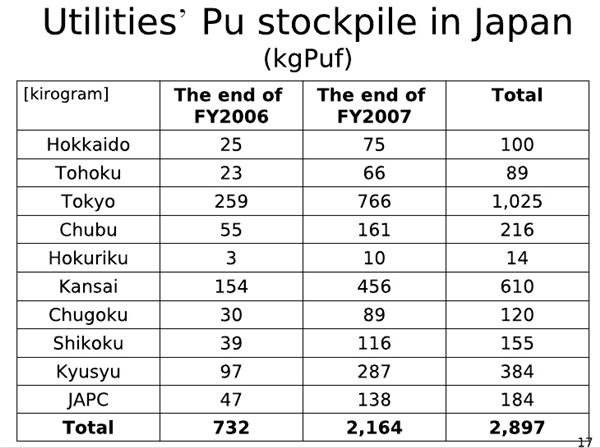
- Since Japan’s reprocessing plant does not have the capacity to reprocess spent fuel at the samerate at which it is discharged from Japan’s power reactors, of central dry-storage capacity for fivethousand tons8 of spent fuel is being built in Mutsu near the Rokkasho reprocessing plant. In1993, five hundred tons of interim dry-cask storage capacity was authorized to be built at theFukushima I reactor site. In both cases, however, commitments were received by the localauthorities that the spent fuel would be reprocessed in a second reprocessing plant if and whenone is built. in the expectation that the fuel would be shipped to the second reprocessing.9 Giventhe delay in building the second reprocessing plant, which was originally scheduled to operationin 2010, however, and delays in full-scale operation of Rokkasho, it is likely that interim storagecapacity will be required.by elainekirk 5/15/2011 8:37:05 PM
- Wow, Tepco really got after that disaster clean up today!by Nancy 5/15/2011 8:38:24 PM
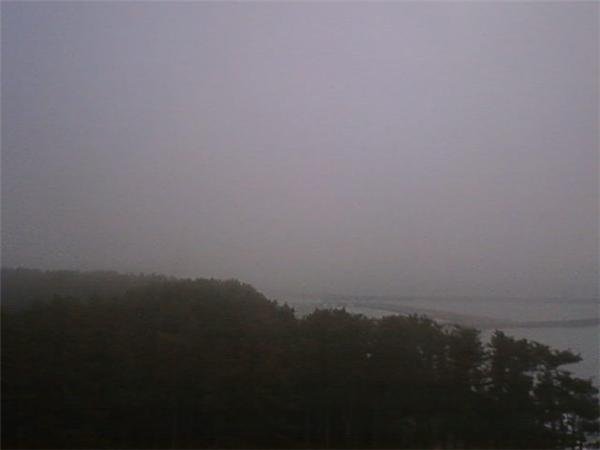 by Nancy via Pointscope01.jp 5/15/2011 8:38:30 PM
- 18yrs is a hell of a long 'temporary'!!by elainekirk 5/15/2011 8:38:32 PM
- @WolfDK : but it seems that saltwater can ruin a reactor forever.by Edano 5/15/2011 8:38:49 PM

Japan Earthquake | Page 1194
- Who's Blogging
-
 hudebnik
 alblee
 UKVal
UKVal Jonathan Keebler
 Oliver (ScribbleLive)
 kaykodh
 Markfm
- Angie
 Mid Valley
 Matt (ScribbleLive)
 George Gibb
- elainekirk
 PKelley
 lillymunster
 dean
dean bo
bo Edano
Edano Deb
Deb- Pedro Jesus
 IanGoddard