Japan Earthquake | Page 1280
 ty nancy will lookby dean 5/21/2011 1:59:11 AM
 @Reed EURAD model takes ages to load...by skibboy 5/21/2011 1:59:19 AM
 @dean Wasn't it amazing that the WSPEEDI maps were so accurate in the distribution of fallout levels given the restrictions of information about source terms ?by Reed 5/21/2011 1:59:38 AM
- @skibboy The ZAMG site has today's calculated map.by Reed 5/21/2011 2:02:03 AM
- @Nancy.. looks great.. your remarkableby dean 5/21/2011 2:03:25 AM
- @Reed didnt even have a look today, and calculations....??by skibboy 5/21/2011 2:03:46 AM
- yep @Reedby dean 5/21/2011 2:03:48 AM
- when we had emergency excercises the first information that the dispersion experts wanted to know .. WHAT'S THE SOURCE TERM.. in the early days plants didn't even think about that.. but now.. all the plants know what their source terms are...by dean 5/21/2011 2:05:04 AM
- @skibboy Yes...same as ever.by Reed 5/21/2011 2:06:03 AM
- nite all, talk again!by skibboy 5/21/2011 2:07:31 AM
- @dean Do you think that the Japanese WSPEEDI calculations had the actual numbers to work with, but never released that numeric to the public ? That could account for the accuracy of the modeling.by Reed 5/21/2011 2:08:43 AM
- @Reed, I think things were so chaotic around that area through all that, instrumenation lost, systems broke down communication channels lost.. I'm amazed they put anything out at all. I remember seeing a dispersion map near the start of the accident and people on the USA coast were all worried like crazy from the initial dispersion path,,, I had a friend up in Alaska who said.. nah it won't come here.. then it sure did... global dispersion paths are very hard to model I'd sayby dean 5/21/2011 2:14:30 AM
- @dean Very true that they're difficult to model, but super computing and all, they seem to do a very good job predicting the quantities.by Reed 5/21/2011 2:18:21 AM
 Do we know about this This TEPCO document with the title "Start of regular inspection Fukushima Daiichi Nuclear Power Station Unit 4" dated Nov. 30, 2010, details the work to be accomplished at reactor #4 until Sep. 24, 2011? www.google.comby Peter Melzer 5/21/2011 2:19:07 AM
- good data in and good data out...it's too bad they can't launch something as a tracer to follow the plume and then feed real time data back to adjust the model..by dean 5/21/2011 2:19:30 AM
- interesting find Peter, they talk alot about stress (residual and corrosion)by dean 5/21/2011 2:25:06 AM
 SYOA mode ON
Saturday, May 21, 2011
Crisis center kept in dark on SPEEDI dataKyodo
The crisis management center was not informed about SPEEDI data predicting how radioactive substances would spread from the damaged Fukushima No.1 power plant, Chief Cabinet Secretary Yukio Edano said Friday.
Edano said the prime minister's office received a fax containing computer projections of how radioactive materials probably dispersed in the early hours of March 12 — a day after the earthquake and tsunami triggered the nuclear crisis -but that this data was not passed on to Prime Minister Naoto Kan nor himself.
This would indicate that when Kan inspected the stricken plant by air that morning, he was unaware of the estimates, which were made using the Nuclear Safety Technology Center's system for prediction of environmental emergency dose information, or SPEEDI.
Edano said the data could have been meaningful in issuing evacuation orders to residents near the plant during the nuclear emergency.
The government eventually directed people within 20 km of the plant to evacuate and those within 20 to 30 km to stay indoors or voluntarily leave on March 11 through 12. But the SPEEDI projections were only being sent to the United Nations. It was disclosed to the Japanese public much later.
"We will thoroughly check the circumstances regarding why the data was not reported, and also want this to be reviewed by an independent panel probing the nuclear accident," Edano said.
No-go zone too small?
A decision by the Nuclear Safety Commission to leave the size of "emergency planning zones" in its disaster guidelines unchanged in 2006 resulted in a much smaller initial evacuation than Fukushima Prefecture needed in March, minutes of the discussion show.
The NSC's guidelines call for any danger zone set up around a nuclear disaster to have a roughly 8- to 10-km radius, much smaller than the 20- to 30-km radius now in place at Fukushima. This casts doubt on whether the NSC fully grasped the dangers nuclear disasters pose to their surroundings.
After the Fukushima No. 1 power plant was stricken by the quake and tsunami on March 11, the government formally designated an area with a 20-km radius around it as a no-go zone and told most residents within 30 km of the plant to evacuate.
Many municipalities across the country have based their emergency planning on the commission's guidelines. Now they are raising questions and calling for a review as the Fukushima crisis drags on.
"The subject of reviewing the scope of the zone hasn't been a topic for a long time," an official at the NSC's secretariat said.
Noting that it should have been reconsidered earlier, the official said the commission plans to review it in the future.
The NSC's panel discussed the matter in 2006 — after the International Atomic Energy Agency urged that a roughly 5- to 30-km radius be used as the criteria for setting up an emergency planning zone that requires preparations be made in advance.
During its five sessions, however, the NSC's secretariat said the emergency planning zone referred to in the Japanese guidelines had a "sufficient leeway," noting that the IAEA also allows each country to use its own discretion, according to the minutes.
The panel didn't suggest the scope of the zone be reconsidered, concluding that "pains should not have to be taken to include additional measures" in the guidelines, the minutes show.
The guidelines say that even in extremely severe disasters, "no protective measures are needed outside (the emergency planning zone), such as staying indoors or evacuation."
For the Fukushima crisis, the government initially told people within 20 km of the plant to evacuate and those between 20 and 30 km to stay indoors or voluntarily leave. The U.S. was more cautious and urged citizens within 80 km of the plant to leave. Japan has since expanded the area beyond the 20-km zone.by estacion 5/21/2011 2:26:36 AM @Peter Melzer Elaine grabbed a copy of that earlier. This looks like it might have more detail though? Anyone understand what they are referring to with the Gadolinia fuel?by Nancy 5/21/2011 2:27:19 AM
- Crisis center kept in dark on SPEEDI data
search.japantimes.co.jpby estacion 5/21/2011 2:28:44 AM - @estacion TY, I saw that one. Doesn't this seem like a "plausible deniability" senario to cover the leader to you ?
"But that this data was not passed on to Prime Minister Naoto Kan nor himself."
Sure, whoever had that information simply forgot ?!by Reed 5/21/2011 2:32:46 AM - @Reed: SYOA mode ON= Save Your Own Ass. :))by estacion 5/21/2011 2:35:28 AM
- @estacion :)by Reed 5/21/2011 2:37:59 AM
- nite all.. time to get rest..by dean 5/21/2011 2:43:19 AM
 Night Dean sleep well!by Angie 5/21/2011 2:43:40 AM
- nite dean!by estacion 5/21/2011 2:43:56 AM
- @dean G'nightby Reed 5/21/2011 2:44:23 AM
- nite dean!by Nancy 5/21/2011 2:45:07 AM
- @Nancy, I can hardly make sense of it either. One item that struck me is that they speak of fuel assembly REPLACEMENT, not removal. I was wondering whether much of this work was supposed to be carried out with fuel loaded, since the SFP was already overcrowded.
by Peter Melzer 5/21/2011 2:56:06 AM - @Nancy, I found what gadolinium is supposed to do to the rods here: www.iaea.orgby Peter Melzer 5/21/2011 3:00:59 AM
- @Peter Melzer The translation on that is really wonky. The dry cask mentions are vague if they mean offload some fuel into casks and put in the cask building or store the casks in 4.by Nancy 5/21/2011 3:01:04 AM
- @Nancy, question remains what of this plan was actually carried out at the time of the quake.by Peter Melzer 5/21/2011 3:02:51 AM
- @Nancy, I did not translate it intentionally. I opened it in google docs from the link and thought some non-native speaker who knows the lingo typed it up in English. I may be wrong.by Peter Melzer 5/21/2011 3:05:39 AM
- @Peter Melzer It has some of the same odd language in the shorter version I saw elsewhere. Thus my guess it was translated.by Nancy 5/21/2011 3:08:41 AM
- hmm since they needed to dry cask some fuel and the pool was full it raises some questions. I don't know if anyone had found any detail about where they were in the process of all the work.by Nancy 5/21/2011 3:10:59 AM
- 20 terabecquerels of radioactive materials flowed out to sea
TOKYO, May 21, Kyodo
english.kyodonews.jp
Anyone with full access to Kyodo News?by estacion 5/21/2011 3:37:16 AM - @estacion I don't. I know there are problems because they are running out of water storage. I hope this isn't another water dump into the sea...by Nancy 5/21/2011 3:48:17 AM
- @Nancy - I keep replaying that one press conference in my head "We dump it now and study it later"by Luriking 5/21/2011 3:54:20 AM
- Posted by deb in the other board:
It's 12:45 there now, Issued at 12:43 JST 21 May 2011
Occurred at (JST) Latitude
(degree) Longitude
(degree) Depth Magnitude Region Name
12:40 JST 21 May 2011 37.1N 141.2E 50 km 4.1 Fukushima-ken Okiby estacion 5/21/2011 3:59:39 AM 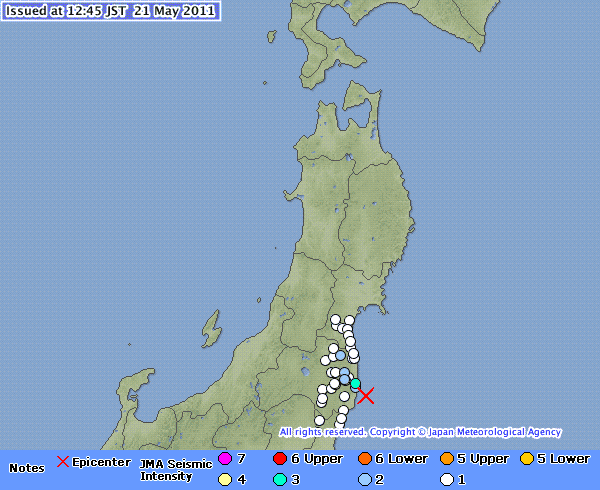 by estacion via Jma.go.jp 5/21/2011 4:00:33 AM
- Ty, Angie.
By the way @Nancy:
@Nancy:
May be you have missed this...
@estacion and @Nancy: The TEPCO plan was for the water supply and drainage system at Daiichi NPP and the Japanese for deep well indicates it is a well that "goes down to the water table."
by dh
by estacion at 5/20/2011 1:44:27 PM3:44 PM yesterdayby estacion 5/21/2011 4:10:02 AM - The air is getting better, but the sea is suffering big time. www.nisa.meti.go.jpby Ralph Unger 5/21/2011 6:10:54 AM
- Oops old link.by Ralph Unger 5/21/2011 6:12:37 AM
- I see a link to "Deans table" above, Dean did not write that table, could you pls link the source?by Ralph Unger 5/21/2011 6:15:27 AM
- hi all...by dean 5/21/2011 6:19:39 AM
- Ralph that table is part of the write up I did and will be on the web linkby dean 5/21/2011 6:20:08 AM

Japan Earthquake | Page 1280
- Who's Blogging
-
 hudebnik
 alblee
 UKVal
UKVal Oliver (ScribbleLive)
 Jonathan Keebler
 kaykodh
 PKelley
 Markfm
- Angie
 Deb
Deb Mid Valley
- Pedro Jesus
 Matt (ScribbleLive)
 George Gibb
 elainekirk
 lillymunster
 dean
dean bo
bo Edano
Edano IanGoddard