Japan Earthquake | Page 1513
 @lillymunster Could be another reason, but unirradiated fuel rods are commonly put into SPF to sort of 'season' the prior to insertion...by M.I.A. 6/5/2011 11:17:27 PM
 @nancy yup those water docs are great and @edano finding the english version was pure goldby elainekirk 6/5/2011 11:17:34 PM
 @M.I.A. I thought only the MOX rods had to be stored in water prior to use?by lillymunster 6/5/2011 11:19:14 PM
- @lillymunster They don't need to be stored (reg. ones) in water, just open air in the fuel handling building. But when they want to refuel, they put them in the SPF to sort of build up some radiation prior to using them for the refuel.by M.I.A. 6/5/2011 11:21:55 PM
- @M.I.A. #4 was going to be out of service for a long time (months, maybe a year) would they have stored them that long before use?by lillymunster 6/5/2011 11:22:46 PM
- @lillymunster IDK,maybe the steel shroud refit was more of an emergency than they let on. If so, they might have been ready to refuel (they replace 1/3rd at a time) and had to stop for shroud. Then they couldn't take out those rods because they were hot by then.by M.I.A. 6/5/2011 11:25:16 PM
- the refits were all scheduled starting in '98 it doesn't explain #4 having so many in comparison to the other units
There was much upset on twitter a couple of weeks back over fuel storage in #4 some off you may remember me going on about extra storage in there I think now the translate misled and it was 'extra stored' I never found the report but heard meti gave retro permission so will see what I can find on meti siteby elainekirk 6/5/2011 11:26:25 PM - @elainekirk Well....couriouser...by M.I.A. 6/5/2011 11:27:39 PM
 @elainekirk , but we do not know whether these ways of communication between buildings existed before the explosions.by Peter Melzer 6/5/2011 11:27:39 PM
- It seems really strange they would have rods stored. Need to find out the time frame used to "prep" them. Makes me wonder if some of that mystery mox was stored at 4.
see below though I doubbt we will narrow it down to mox but..by lillymunster edited by elainekirk 6/5/2011 11:27:39 PM  I read somewhere that there was a problem with the shroud replacement.. sorry I don't have details & I can't remember where I read it..by UKVal 6/5/2011 11:28:47 PM
- @peter that is why I am hunting the pic I just keep finding gems in my archives that I bring out for a second airing but I will get thereby elainekirk 6/5/2011 11:32:16 PM
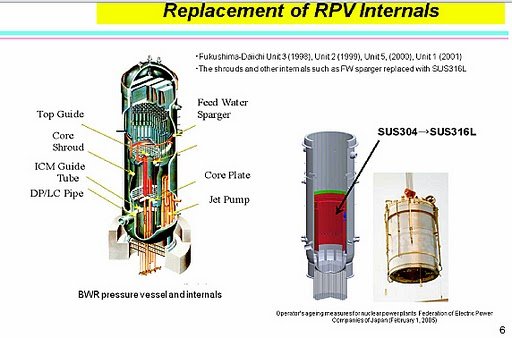
Oh look a name for the shrouds in the refit units if anyone is into shrouds
by elainekirk via Lh6.googleusercontent 6/5/2011 11:34:06 PM- don't know if this has been posted before. It's an interview with the fromer superintendant of the plant spectrum.ieee.org Futami: The scale of the Fukushima Dai-1 accident was far beyond my imagination. When I was superintendent, I could not have imagined that all electricity including battery power for units 1 through 4 would be completely lost at the same time, and would not be restored for more than 9 days. (On 20 March, a temporary power line was connected to the power center of unit 2 for the first time after the accident. On 22 March, lighting for unit 3's main control room was restored.)
At first, I thought that the diesel generator for each reactor automatically started, so I was sure that they could bring the plant to a cold shut down, although there would be many difficulties. When I watched TV reports of the huge tsunami attacking the coast of the Tohoku area, I thought that major equipment like the condensate water pumps and the residual heat removal sea water pumps, which are on the ground lower than 10 meters above the sea level, must be damaged. That sent a chill down my spine. However I could not imagine that both the diesel generators and the power centers in the turbine buildings were completely covered with seawater by a tsunami that was over 14 meters high.
IEEE Spectrum: Were there safety upgrades while you were head of Fukushima Dai-1?
Futami: In the 1990s, countermeasures against severe accident were taken reflecting NRC and Japanese authorities’ regulations. They included the installation of recirculation pump trips (RIP) and alternate rod-injection systems (ARI) for an event known as anticipated transient without scram (ATWS), installation of automatic depressurization systems (ADS) for the reactor pressure vessels, installation of alternate water injection lines to the reactors and primary containment vessels, and installation of primary containment vessel vents.by UKVal 6/5/2011 11:36:12 PM - from same interview: IEEE Spectrum: Did you experience any serious problems with any of the reactors while you were head of the nuclear plant?
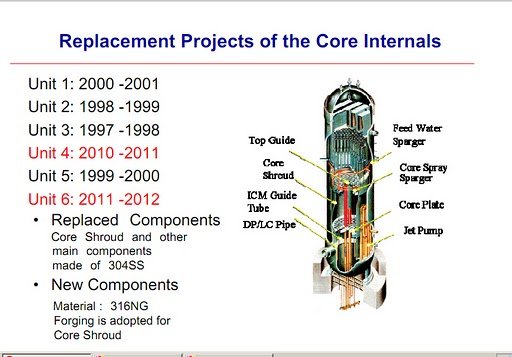
Futami: I did not experience serious operational problems. Instead of that, I was fighting against stress corrosion cracking of internal components in the reactor pressure vessels. Those components are highly radioactive and are inside the reactor pressure vessels. However it was necessary to work inside the reactor pressure vessels in order to replace a component called a shroud, although we used remote and automatic equipment as much as possible. I led the shroud replacement program of unit 1, 2, 3 and 5 and completed the world’s first shroud replacement in 1998.
Stress corrosion cracking is an aging problem. Some Fukushima Dai-1 reactors exceeded 30 years while I was a superintendent. I put my best effort into replace aging equipment based on preventive maintenance philosophy.
IEEE Spectrum: Can you explain what a shroud is?
Futami: The shroud is a large component inside the reactor pressure vessel. It's a very large cylindrical form made of stainless steel. In the space between the shroud and the reactor pressure vessel's outer walls, the water flows down from the top to the bottom of the reactor vessel. Then in the reactor core, which is inside the shroud, the water flows from the bottom to the top.
We found many stress corrosion cracks on the shroud’s welding lines, so we decided to replace the shrouds. We had to stop the plant about a year, and it cost about 8 billion Yen.by UKVal 6/5/2011 11:38:04 PM - @lillymunster are you still hereby fitter 6/5/2011 11:39:22 PM
- From UKVal's article 'installation of alternate water injection lines to the reactors" So the last ditch sea water injection lines were likely an upgrade. If they had not had the seawater lines they would have been screwed.by lillymunster 6/5/2011 11:40:50 PM
- @ukval good find @nancy yup screwedby elainekirk 6/5/2011 11:41:52 PM
- Makes me wonder if US BWR plants have fire hose lines?by lillymunster 6/5/2011 11:42:21 PM
- @lillymunster The partial set of drawings I have does have very detailed fire lines.by fitter 6/5/2011 11:43:41 PM
- @lillymunster but something that I was surprised to see on these drawins was the amount of Floor/Roof drains and drainage vent stacks (not the hardend vents)by fitter 6/5/2011 11:45:30 PM
- @fitter were they hooked to secondary systems? I remember the sludge tank in #4 had a small air intake pipe but didn't specify where it exhausted at. It was identified as a place where hydrogen could build up plus the sludge was from the SPF IIRC.by lillymunster 6/5/2011 11:47:54 PM
- Anyone thinking still that they have single beds -
It said the government has sent the revised figures to the International Atomic Energy Agency and that the Vienna-based U.N. group has endorsed its findings.
According to the ministry, 106 kg of the 206 kg of "missing" plutonium was later found to have been mixed with high-level radioactive liquid waste and was either stored inside the Tokai facility or stored after it was solidified into glass.
The ministry said 29 kg of the missing plutonium was made up of short-life isotopes and degraded during storage.
The report says another 12 kg of the plutonium was probably stuck in fuel tubes that were disposed of separately from nuclear waste liquid, leaving the amount of plutonium still unaccounted for at 59 kg.
search.japantimes.co.jpby elainekirk 6/5/2011 11:47:58 PM - @elainekirk ::Headdesk::by lillymunster 6/5/2011 11:49:16 PM
lh3.googleusercontent.com
Yes #4 was planned outage for shroud replacementby elainekirk via Lh3.googleusercontent 6/5/2011 11:50:53 PM GE whistleblower Jack Shannon claims that the US plants have the same problem with cracks in the shrouds that Japanese had and fixed: www.youtube.comby Bobby1 6/5/2011 11:53:23 PM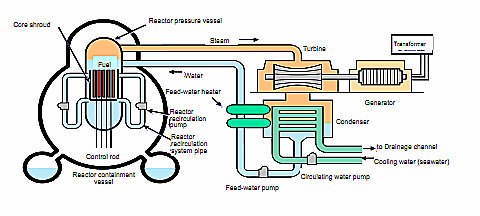
lh4.googleusercontent.com
the seawater cooling system that was added it shows the seawater after circulating going to a drainage channelby elainekirk via Lh4.googleusercontent 6/5/2011 11:54:32 PM Morning everyone!!by Angie 6/5/2011 11:55:45 PM
- @Bobby1 do you have any idea of Shannon is still alive or talking to the media? I would love to get his take on this mess and ask him a few questions about BWR design.by lillymunster 6/5/2011 11:56:25 PM
- Here is a letter laying out the work planned for unit 4: www.google.comby Peter Melzer 6/5/2011 11:58:30 PM
- @lillymunster Good idea. I don't know if he is still around or not, he is very knowledgeable.by Bobby1 6/5/2011 11:58:54 PM
- morning @angieby elainekirk 6/6/2011 12:01:01 AM
 Hi you all. Looks like you're having fun in tech land.by carabnr 6/6/2011 12:08:32 AM
 Re: Woods Hole research team -
In an interview last night with ScienceInsider, expedition lead investigator Buesseler explained that in addition to the well-known isotopes iodine-131 and cesium-137, the cruise will measure the spread and bioaccumulation of rarer isotopes such as plutonium, strontium, and tritium, about which little is known. The extensive data set he expects to gather could take up to a year to analyze.
It's hard to say, Buesseler says, what impact on the marine environment this overflow would have, but his crew will be there at the right time to measure a baseline. The expected overflow of cooling water from the plant, atomic energy researchers report today, could be as serious as the meltdown itself due to the estimated 720,000 terabecquerels of radiation in it.
news.sciencemag.orgby Rob in SF 6/6/2011 12:09:38 AM- @@lillymunster Floor plan R4 from From The Madrat Markups - 福島第一原子力発電所
fukushimafaq.wikispaces.com
(rotated back 180 degrees)by jt 6/6/2011 12:11:57 AM  @jt : you should better not offer her that ;)by Edano 6/6/2011 12:14:07 AM
- @nancy or elieine what corner and elevt is nancy looking for..by fitter 6/6/2011 12:14:54 AM
- @Edano But I think it is the one she mentioned, though not at high resolution.by jt 6/6/2011 12:15:15 AM
- @jt : just wait, she will explain you, why this is completely wrong ...... ;)by Edano 6/6/2011 12:16:26 AM
- @Edano thpppppt :-Pby lillymunster 6/6/2011 12:16:59 AM
- @lillymunster I have the US drawings out what elev and build corner were you looking atby fitter 6/6/2011 12:17:47 AM
- @Edano Why what is completely wrong?by jt 6/6/2011 12:17:51 AM
- @jt actually what I am looking for is a snippet in a TEPCO press release from the last month. It showed the elevation in some detail of that corner. They were explaining about standing water and destroyed stairs. But it is the same corner of the building.by lillymunster 6/6/2011 12:18:07 AM
- @lillymunster, the queen of floorplans .... !by Edano 6/6/2011 12:19:02 AM
- @lillymunster There are stairs in SE and NW corners. One says locked gate?by jt 6/6/2011 12:19:17 AM


Japan Earthquake | Page 1513
- Who's Blogging
-
 hudebnik
 alblee
 UKVal
UKVal Jonathan Keebler
 Oliver (ScribbleLive)
 kaykodh
 Markfm
- Angie
 Mid Valley
 Matt (ScribbleLive)
 George Gibb
- elainekirk
 PKelley
- lillymunster
 dean
dean bo
bo Edano
Edano Deb
Deb- Pedro Jesus
 IanGoddard